
Inactive· since May 16, 2026
- 4
- days it ran
- 2
- relaunches
Ad copy
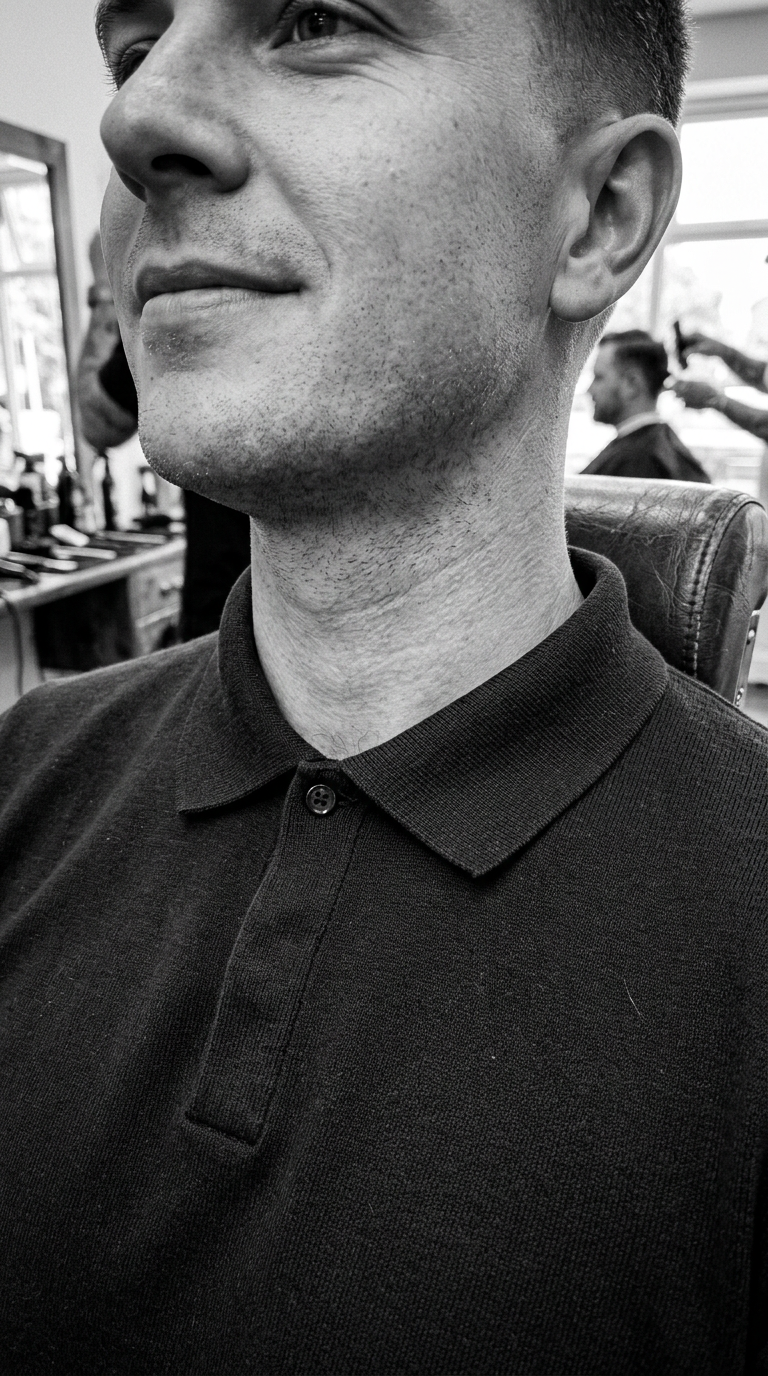
I've been cutting Mike's hair every two weeks for eleven years. That's roughly 286 haircuts. 286 times he's sat in my chair, looked at himself in my mirror, and I've stood behind him with my hands near his head reading his body the way barbers read bodies — from the neck up, from behind, with the specific intimacy of a person who touches your head and sees your face when you think nobody is watching. Barbers see things. We don't talk about it because there's a code — the chair is confidential. What happens in the mirror stays in the mirror. But I've been seeing something in Mike's mirror for four years that I almost said something about a hundred times and didn't. Mike's neck got thicker. That's where it starts for men — not the gut. The gut comes later and everyone sees it. But the neck comes first and only the barber sees it. The collar tightens. The line where the hair meets the skin changes angle because there's more skin. The jaw softens — not the bone, the tissue around it. The face rounds. I watched all of it from behind the chair. At 37, Mike's neck was lean. I could see his jaw from behind — the sharp line where the mandible meets the neck. My clippers followed that line. Clean. Defined. The line of a man whose body is doing what it's supposed to do. At 38, the line softened. Not dramatically — the way changes happen when you see someone every two weeks. You adjust the clippers half a degree. You blend differently because the contour has shifted. You don't say anything because one degree isn't a conversation. It's a millimeter. But 286 haircuts of millimeters is a different man. At 39, the collar conversation started. Mike always wore the same shirt to haircuts — a fitted polo, collar buttoned. At 39 the top button was open. I noticed because the button had been closed for six years and now it was open and the neck above it was the reason. At 40, the polo changed. Crew neck t-shirt. No collar at all. The collar was eliminated from the equation because the equation had changed. His neck had expanded past the collar's willingness to contain it. A barber understands this shift: when a man stops wearing collars, his neck has crossed a line. I cut hair. I don't comment on bodies. But I see them. Every two weeks. From the most honest angle — behind and above, in a mirror they're forced to look at, in a chair they can't leave for twenty minutes. My chair is the only place in Mike's life where he has to face his reflection without being able to angle away. The barber's mirror is the mirror nobody escapes. At 41, I noticed the mirror-avoidance. Mike used to watch me cut. Most clients do — they track the clippers, watch the shape, check the sideburns. Mike stopped watching. His eyes went down. To his phone. To the cape covering his body. Anywhere but the mirror. He'd look up when I asked "how's that look?" — a quick glance, a "looks good" that wasn't about the hair, and eyes back down. He was avoiding his own face in my mirror. The face I'd been watching change for four years. The face that used to have a jawline and now had a slope. The face that used to look back at its owner with casual recognition and now got a quick glance and a look-away. I didn't say anything for four years. 104 haircuts of silence. But I saw things from the chair that nobody else sees. Because nobody else stands behind Mike every two weeks and watches his body through a mirror while holding sharp objects near his head. The trust of a barber chair creates an honesty no other relationship has. He can lie to his doctor for thirty minutes once a year. He can't lie to my mirror for twenty minutes every two weeks. Here's what the mirror showed me: Year one of the change: the neck. Thicker. The line moving. Year two: the face. Rounder. The jaw gone. The skin under the chin filling in. Year three: the posture. He used to sit up in my chair — straight, chest out, the way men sit when they're comfortable being seen. Now he slumped. Shoulders forward. Chin down. The posture of a man making himself smaller in a chair where he can't hide. Year four: the eyes. Flat. The light behind them — the casual confidence that used to look at me through the mirror while we talked about nothing — was gone. Replaced by something resigned. The eyes of a man who's accepted a face he didn't choose. I cut Mike's hair through all of it. Same cut. Same clipper settings. Same fifteen minutes of conversation about sports and weather and kids. The haircut didn't change. The head underneath did. And I adjusted — the way barbers adjust. A little more length here to soften. A different fade to balance. Working around the changes the way you work around anything you can't fix but can manage. He tried everything. I knew because the haircut is where men confess. "Started a new gym program." Three months later: "Quit the gym. Wasn't working." "Trying this diet. No carbs." Two months later, ordering off his phone during the cut: a burger and fries. The diet was over. "My doctor says metabolism." Said with the flatness of a man who's received a verdict he doesn't believe but can't argue with. Every confession came from the chair. Between the buzzing of the clippers and the brushing of the cape. The chair is where Mike was honest because the chair doesn't judge. The mirror judges. The chair holds. At 42, he said something that stayed with me. I was finishing the back, brush on the neck, last look in the mirror. "Sometimes I don't know who that is," he said. Looking at his reflection. Not to me specifically — to the room. To the mirror. The way men say things in barber chairs that they'd never say standing up. Sometimes I don't know who that is. A man looking at his own face and not recognizing it. From the only chair where the mirror is mandatory. I found the article that night. Not because of Mike specifically — because of all of them. Because Mike isn't the only man whose neck I've watched thicken and whose eyes I've watched go flat. There are five Mikes in my chair every week. Men whose bodies change under my hands over years of haircuts. Men who confess diets and gyms and doctors who say "metabolism" while the mirror shows me something nobody else is tracking: the slow, consistent, measurable progression of a body that's holding. The article was about the nervous system. About survival mode. About cortisol. About bodies that hold weight because the wiring is running emergency. About how no gym and no diet overrides a body in emergency. About Liven. Micro-Cycle Method. Five minutes a day. For the wiring. I printed it. Folded it. Put it in my station drawer. Next haircut. Mike sat down. Cape on. I started the fade. "You still doing the gym thing?" I asked. Casual. Between clips. "Nah. Gave up. Nothing works." "I read something." He looked up. The mirror. His face. My face behind his. The specific framing of a barber and a client that exists nowhere else. "About weight?" "About why nothing works. It's not a diet thing. It's a body thing. A nervous system thing." I handed him the folded paper. He read it in my chair. While I cut. The multitasking of a barber appointment — the only place a man will read a health article without feeling like he's reading a health article, because he's "just sitting in the chair." He took the quiz on his phone before I finished the sideburns. Yes to everything. "Nobody's asked me these questions," he said. "Not my doctor. Not the trainer. Nobody." He downloaded Liven in my chair. Cape still on. Hair half-cut. "You're not done with the cut," I said. "I know. Finish. I'll start this tonight." Here's what I watched from behind the chair. Haircut #1 after starting: two weeks in. Nothing visible. Same neck. Same face. But he looked at the mirror differently. Not the quick-glance-and-away. A slightly longer look. The beginning of curiosity instead of avoidance. Haircut #2: four weeks. Something in the jaw. I can't explain it to someone who doesn't see faces from behind every two weeks. But the tissue under the jaw was slightly — less. Not dramatically. The way a barber sees it. A millimeter of change that nobody else would clock. I clocked it. Haircut #3: six weeks. He sat up straighter in the chair. Not all the way — but the slump was less. The shoulders came back a degree. The chin came up. From behind, the posture was shifting from making-himself-smaller to occupying-the-chair. "Looking different," I said. The barber's phrase. The maximum commentary the code allows. "Feeling different," he said. The client's response. The maximum honesty the chair permits. Haircut #4: eight weeks. The jawline. I saw it. From behind, with the clippers, I saw the line return. Not all the way — but the angle was sharper. The mandible was emerging from the tissue that had been covering it. The line my clippers used to follow at 37 was becoming visible again at 43. I adjusted the fade. Not because he asked — because the contour had changed and the haircut needed to follow the face, and the face was coming back, and the haircut should show it instead of hiding it. "Tighter on the sides today," I said. "Why?" "Your jaw's back. Let people see it." He looked in the mirror. Really looked. For the first time in two years he studied his own face in my mirror. Not the quick glance. The study. The inventory. Except this time the inventory was finding things instead of cataloging losses. "There I am," he said. To the mirror. To me. To the man in the chair who'd been disappearing for four years and was starting to reappear from the jawline down. It's been five months. He's down about 28 pounds. The neck is leaner. The jaw is back — not all the way, but the line is clean enough that my clippers follow it instead of guessing where it should be. The polo is back. Collar buttoned. The button that had been open for three years because the neck wouldn't allow it — closed. He sits up in my chair. Watches me cut. Tracks the clippers in the mirror the way he used to. His eyes have something behind them again. Not flat. Not resigned. Present. The eyes of a man who recognizes the face looking back. He told me last haircut — cape on, clippers buzzing, the intimacy of the chair: "You're the one who saw it." "Saw what?" "What was happening. Before I did. Before my wife did. Before the doctor. You saw my face change every two weeks for four years and you didn't say anything until you had something to say." He was right. I saw it. 104 haircuts of watching and adjusting and filing and waiting. Because the barber chair is a place of trust. And trust means knowing when to speak and when to cut. I'm a barber. I see 40 men a week. I see their necks and their jaws and their eyes in a mirror they can't escape. I see the slow changes that nobody else tracks because nobody else stands behind them every two weeks measuring the millimeters. If you're a barber reading this — you have Mikes in your chair. Men whose lines are softening. Whose eyes are going flat. Whose mirrors are becoming something they avoid instead of something they use. Print the article. Fold it. Put it in your drawer. Wait for the right haircut. Then hand it over between the fade and the sideburns. And if you're a man whose barber has been adjusting your cut around a face that's changing — your barber sees it. He won't say it. But he sees it. And the mirror shows what nobody else will tell you. Liven has a quiz. A few minutes. Doesn't cost anything. Take it in the chair. Cape on. Hair half-cut. That's where men do things they wouldn't do anywhere else. Link is below. 💙
THIS IS what you need to do
LEARN MORELike this ad? Make it yours.
Crush rebuilds this exact creative around your product — your brand, your colors, your offer — in about a minute.