

Sarah Bramwell
Active· since May 30, 2026
- 115
- days running
- 0
- relaunches
Ad copy
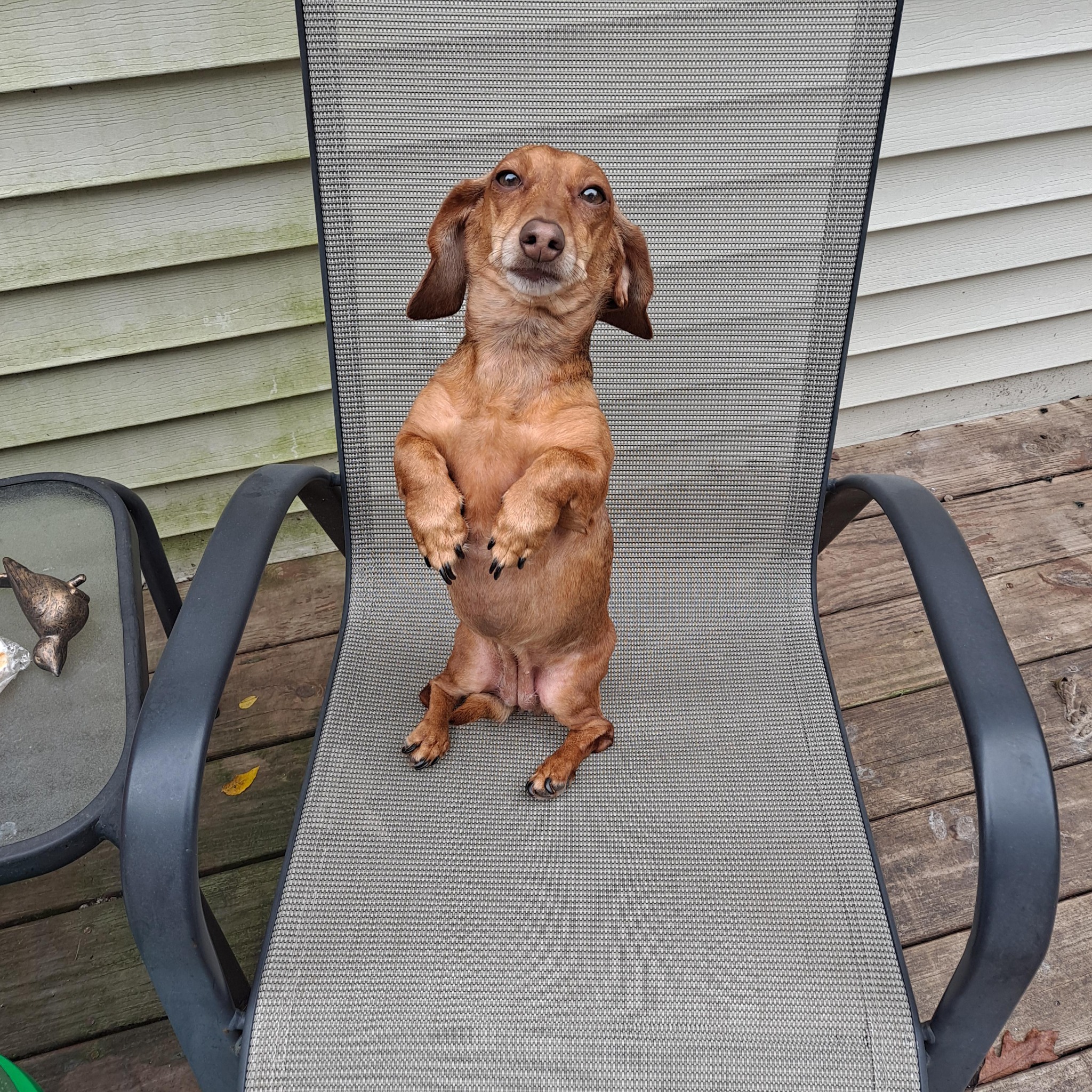
My husband had 4 dachshunds. All jumped off everything their whole life. Couch, bed, the back of the truck. Lived to 17 without any back problems. I had 5 dachshunds. Half the jumping. Last 3 went down before 8 because of their backs. For 12 years I thought I was unlucky. My new vet proved me wrong. My first 2 dachshunds were in the 80s. They jumped off everything, lived long, died old, never had a back problem in their lives. I thought that was just how it went. Then came Charlie. Got him in 1994. Sweet red boy, smart, slept on my pillow. His back went at 6 and a half. We did the surgery, but he never walked the same, and we lost him at 7. Murphy was next, 2 years later. Black and tan, stubborn, the love of my life. His back went at 5. We didn't catch it fast enough. He was gone in a month. Daisy was my last before Penny. I got her after I swore I was done, told myself I'd be more careful. No couch, no bed, no stairs. Ramps everywhere. Her back went at 7. 3 dogs in a row. I'd done everything every vet, every breeder, every dachshund forum told me to do. My husband's 4 dogs jumped off the back of a truck their whole lives. He kept saying it wasn't luck. I kept telling him to stop. I swore I was done with this breed after Daisy. But funny enough this promise only lasted about 8 months. My friend Linda's dachshund had puppies, my husband drove me to see them "just to look," and I came home with a small red girl who would not stop biting my shoelaces. We named her Penny. What happened next changed how I think about her back forever. Penny was due to be spayed. My regular vet didn't want to do it in her office — dachshunds are higher risk under anesthesia because of the chest shape and the airway, and she sent us to a small-breed surgical practice 2 hours away. She wrote the name on a sticky note. The clinic wasn't a regular vet's office. Dachshunds and corgis in the waiting room. Half the back wall was rehab equipment — underwater treadmills, balance pads, a whole physical therapy setup I'd never seen at a vet before. Most of what they did was back work for breeds shaped like Penny. The vet came out before they started. Routine — confirming the spay, going over Penny's history. She got to the part of the intake form where they ask about previous pets, and she stopped. She looked up. "3 dachshunds, all under 8? That's not luck. That's a pattern. Did anyone ever explain to you what's actually happening inside their backs?" I said no. "Come back at 3. I think you need to hear this." She pulled up a study from UC Davis on her laptop. Every dachshund, every single one, carries a gene called FGF4. It's the same gene that gives them their short legs and their long body. The reason the breed exists. The reason we love them. It does one other thing nobody mentions in the breeder packet. It kills off the cells inside their back that keep the cushions full of water. "Between every bone in your dog's spine, there's a little cushion that takes the hit every time he jumps off the couch. Think of a water balloon wrapped in a rubber ring. The water balloon absorbs the jump. The rubber ring holds it in place." "In every dachshund, the cells that keep that water balloon full start dying off before age 2. By age 2 they're almost gone. The balloon starts drying out. The rubber ring starts cracking under weight it wasn't built to take alone. And the dying tissue swells up, turns the bone around it hard, and presses on the nerves. All 3 of those things happen at the same time." "And it's happening to every dachshund in America right now. Including Penny, in the back recovering from her spay, who looks fine." 13% down to under half a percent. By age 2. Penny was 2. I asked her how she knew all this and my regular vet didn't. "Regular vets are trained for what comes through the door. The damage inside a dachshund's back doesn't come through the door — it doesn't hurt the dog until something breaks, and it doesn't show up on any normal exam. The research on it lives in the universities and in clinics like this one, not in the vet's office on your corner." Her practice sees over 100 dachshunds a month and reads the studies because that's their whole job. A regular vet sees one dachshund a week and fixes whatever's wrong that day. Not a vet failure. Just how it's set up. Then I asked the obvious question. If this is happening to every dachshund in America, what kept my husband's 4 alive to 17? "The gene was the same in his dogs. Their bodies were the same. Their ending wasn't. Something he was giving them every day was helping the cushion from the outside, while the inside was drying up. Find out what was different. That's where your answer is." I drove home with Penny half asleep in the back seat and called my mother-in-law. My father-in-law Pete had been gone almost 10 years. The dogs were all gone too. I asked her what Pete fed those 4 dachshunds. "Honey, Pete fed those dogs Purina, same bag every month. But that man couldn't cook a thing, or cut up anything, without the dogs getting a piece of it." I asked her to walk me through what Pete actually gave them. Sunday was bone broth — he'd simmer the chicken bones all afternoon and pour it over their rice. Most weeknights, turmeric chicken. Pete's mother was from a part of India where everything got cooked in turmeric, and Pete cooked the same way his whole life. The dogs ate off the same pot. In the fall he'd fry up lion's mane mushrooms he found behind the property and split them with the dogs. And he was a butcher's son. Whatever cartilage came off the birds and rabbits he cut up, the dogs got raw. 4 things. An old man who couldn't cook without sharing. 4 dogs that jumped off pickup trucks and lived to 17. I had no idea why any of it would matter. But the vet had told me to find what was different in their daily food, and this was the only difference I had. I called the clinic the next morning and booked a follow-up. 2 weeks out — the soonest she had. I brought the list, put it on her desk, and asked her straight. Could any of these be why my husband's dogs never went down? She read it twice. Then she looked up like I'd handed her something she sees once a year. "Whoever fed these dogs," she said, "was accidentally doing the one thing that actually works. Let me show you why." She picked up a pen and went down my list. Bone broth. The water inside the cushion is held in place by something called hyaluronic acid — the exact thing the dead cells used to make. Bone broth is one of the few foods that has it in a form the body can actually use. It refills the water balloon from the outside, every day, the way the inside used to do on its own. Raw cartilage. The rubber ring around the cushion is built from a type of collagen called undenatured Type II. The "undenatured" part matters. It has to survive the stomach in one piece, and raw is what does that. Cooked or powdered collagen breaks down before it gets anywhere near the back. Turmeric. The dying tissue inside the cushion gives off the swelling that turns the bone hard and presses on the nerves. Turmeric brings that swelling down — but it doesn't absorb on its own. It needs fat and black pepper in the same meal. Which is exactly how every Indian kitchen on earth cooks turmeric, and exactly how Pete's mother cooked it. Lion's mane. The nerves running through that whole area need their own protection from the swelling and the hardening. Lion's mane is one of the only things in nature that gives them that. She put the pen down. "4 problems and 4 fixes. The cushion is breaking down in all 4 of those ways at the same time, so doing one of them and not the others doesn't get you very far. Hit all 4 and the cushion has what it needs to be healthy." She let that sit for a second. "Skip them and you're playing a lottery with your dog's back. Some dachshunds get lucky and walk fine. But the ones that go down weren't getting these 4 things that prevent it. You don't get to know in advance whether your dog is the lucky one or not. Most owners find out the day a back finally goes. By then, years of damage are already done." For 12 years I thought I was unlucky. I wasn't. The answer existed. It just never reached me until now. 3 of my dogs paid for it. I drove home with Penny asleep in the back seat and one thing in my head. I needed those 4 ingredients. I'd never heard of any of them in my life until that afternoon, and now they were the difference between me playing the lottery with Penny's back or fully protecting it. I didn't know how. I just knew I had to figure it out, and I had to figure it out before the silent damage got any worse. I sat at the kitchen table that night and didn't know where to start. Later that week a woman in the dachshund Facebook group messaged me. She'd seen me posting about Penny over the last few months and said her rehab vet had told her about something called Nevo. Her dog had been on it for almost a year. She wasn't selling. She said she wasn't even sure I'd want to know but it felt wrong not to send it after what I'd written. I clicked the link she sent me. I held the label up against my notes from the vet. Every single ingredient the vet had drawn boxes around on my legal pad was there. In the form she said it had to be in. At the dose she said it had to be at. Listed individually, by milligram. Not a "blend." Not a "complex." Just the four things, named, measured, on the label. I ordered a bottle that night and the morning it came I drove it to the rehab clinic and asked the vet to look at it. She read the panel without saying anything for almost a minute. Then she looked up. "Where did you find this?" I told her. "This is what I've been hoping someone would build for this breed. Forms and doses are right." I asked her if it would work. She said "It puts back into the disc exactly what the dead cells used to put there." I started Penny on Nevo that afternoon. I give her 2 chews a day, she eats them like a treat. I want you to hear what the rehab vet said to me on my way out of the clinic that day. "The gene does not take a day off. Every week is a week of damage you cannot get back. If I were sitting where you are sitting — with a dachshund at home — I would not wait." What's running is the gene inside your dog's spine. Right now. It is his biology. The 2 or 5 or 9 years of silent damage your dog has already lived through are behind. You can only support what's left. I wish someone had written this for me when Charlie was 4. I don't want another woman to lose a dachshund the way I lost my 3. I attached the link to the Nevo chews below. https://nevochews.com/products/nevo-ivdd-spine-defense-chews Penny is asleep next to me right now. I know what I'm doing for her back. And I wish someone had told me sooner. P.S. Nevo tends to run out, because they only produce it in small batches, and every run has to be lab-tested for active compound concentration before it ships. When a batch sells out, the next one takes 7 to 10 weeks to come back around. They've been upfront about that on the site.
Like this ad? Make it yours.
Crush rebuilds this exact creative around your product — your brand, your colors, your offer — in about a minute.