Karma Items
 Facebook ad: “What if the fog isn't aging, it's a blocked channel?”
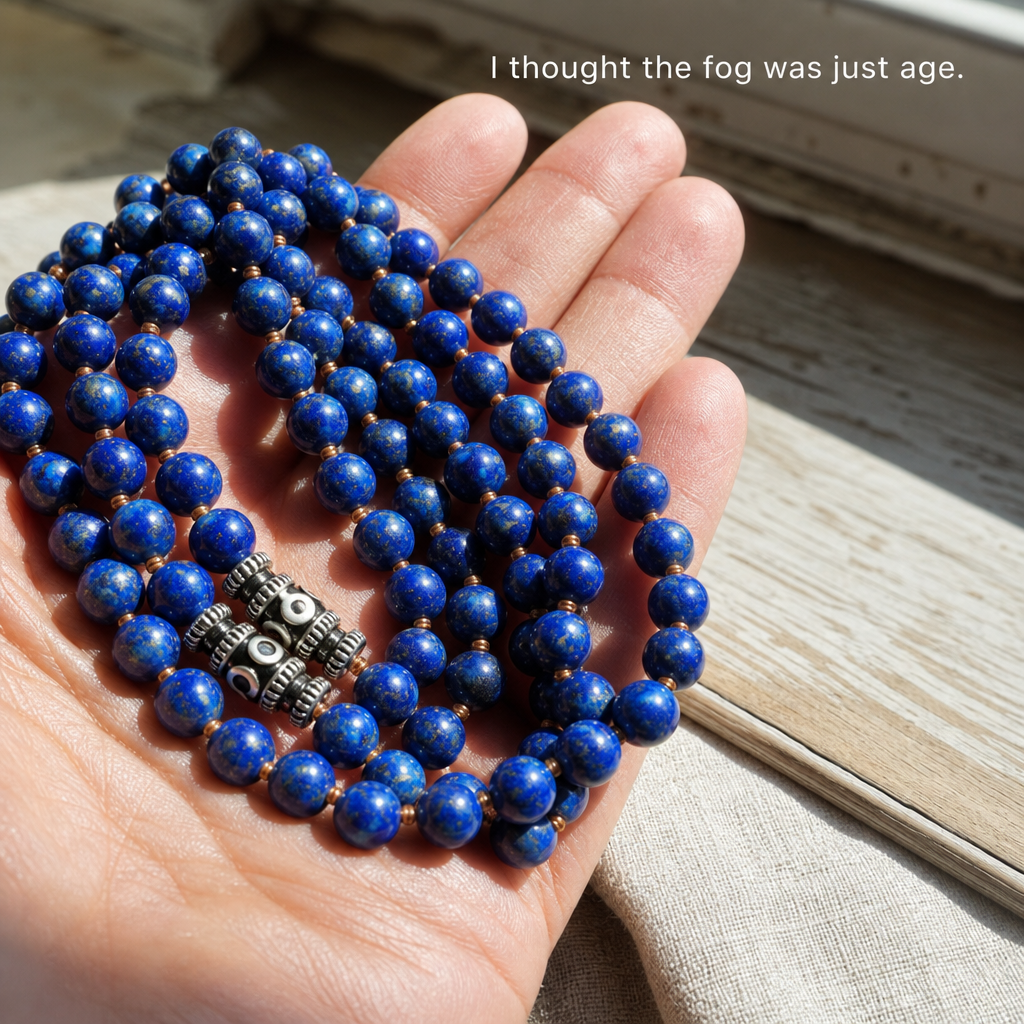
Ran for 38 days, from July 8 to August 15, 2026, the last day Crush saw it.
Run by Karma Items on Facebook. Crush is not the advertiser and does not verify its claims. See this ad in Meta's Ad Library(opens in a new tab)
Make your own version of this ad
Crush makes it, launches it in your own Meta ad account, scales the winners and pauses the losers.
About this ad
- Meta Ad Library ID
- 1005482875637378
- Platforms
- Facebook, Instagram, Audience Network, Messenger and Threads
- Relaunches
- 0
Ad text
I thought the fog was just age. That's the honest place I have to start, because if you'd told me a year ago that I'd be the person writing this — a person recommending a strand of blue prayer beads — I would have quietly decided you'd lost the plot. I am not, by temperament, a crystals person. I roll my eyes at a lot of things. I've returned more "life-changing" gadgets than I've kept. So take this for exactly what it is: a first-person account from the last man on earth who thought he'd ever wear a mala. But I want to walk you through how I got here, slowly and in order, because the reason I changed my mind wasn't a feeling. It was a mechanism. And once I understood the mechanism, I couldn't un-understand it. ## The morning I couldn't find the word It started, like it does for most people, as nothing. A word that wouldn't surface. I was standing in the kitchen trying to tell my wife about someone we'd met — a friend of a friend, perfectly familiar face, I could see them clearly in my mind — and the name simply would not come. It sat right behind my teeth and refused to move. I laughed it off. Everybody does that. Everybody loses a name. Then it kept happening. I'd read a paragraph in an email, get to the end, and realize I hadn't absorbed a single word of it. So I'd read it again. And sometimes a third time. I started re-reading the same paragraph three times as a matter of routine, and I told myself I was just tired, just busy, just stretched a little thin this season. But it wasn't only reading. Decisions that used to take me minutes started taking hours. Small ones. What to prioritize, what to answer first, whether to say yes to a thing that any prior version of me would have decided in a breath. I'd stare at the choice like it was written in a language I half-remembered. My focus, which had always been the one thing I could rely on — the thing I quietly took pride in — had gone soft at the edges. My memory felt like a radio between stations. The signal was in there somewhere, I could hear it flickering, but it kept sliding out of tune the moment I reached for it. And underneath all of it was the fear. The real one. The one you don't say out loud even to the person you share a kitchen with. The fear that this was the beginning of a slow, one-way slide. That this was just what happens now. That my sharp years were behind me and I was going to have to sit and watch myself get duller and slower and more forgetful, month over month, and there was nothing to be done about it but manage the decline gracefully. That fear is the fog talking. I know that now. At the time it just felt like the plain, cold truth, and it followed me around like weather. ## The sentence that stopped me A reader of the same newsletter you're probably reading this on had written in — an anonymized note, just "one man who wears it," no name attached — and the line that snagged me was this: *the fog isn't age. It's a degraded signal.* I almost scrolled past. It sounded like the kind of thing people say to sell you something. But something about the word *signal* held me by the collar and wouldn't let go, because that's exactly what my memory felt like. Not gone. Not erased. Not deleted. Just badly tuned. In and out. Present but not reachable. There, but arriving as static. So, being the skeptic I am, I decided to pull the thread specifically to prove it was nonsense. I went in looking for the seam, the place where the logic falls apart and reveals itself as marketing. What I found instead was the most sober, physical, oddly un-mystical explanation of "brain fog" I'd ever encountered — and it had nothing to do with wishing, nothing to do with vibes, nothing I could easily laugh at. ## Your Third Eye is not a metaphor Here's the reframe that turned me around, and I'm going to give it to you exactly as it landed on me, in the same order it dismantled my resistance. Your Third Eye isn't poetry. It isn't a symbol some ancient culture painted on a wall for decoration. It's a gland. It's the pineal gland — a small structure sitting deep in the center of the brain. Science has been studying it for a very long time. It's real, it's physical, you could point to it on a scan, and here's the part that mattered to me: it runs on signal. It's exquisitely responsive to input, to light, to the body's rhythms. It's a signal organ, not a lump of filler tissue. Now hold that fact next to the old knowledge. For centuries, contemplatives pointed to the exact same spot — between and slightly behind the eyes — and called it the Third Eye. The seat of insight. Of focus. Of inner sight. Same location. Same center. Two completely different vocabularies, separated by oceans and centuries, describing one identical piece of anatomy. The line that finally broke my resistance was this: **Science calls it the pineal gland. Monks called it the Third Eye. Same gland, 700 years apart.** Read that again, because it's the hinge of the whole thing. That's not mysticism dressed up in a lab coat. That's two groups of serious, disciplined people — one measuring, one meditating — separated by seven hundred years, staring at the identical spot in the human skull and each building a whole tradition around it. When the laboratory and the monastery independently point at the same small gland and say *this is the center of clear perception*, I stop rolling my eyes and I start taking notes. And here's why it matters for the fog: if the Third Eye is a physical center that runs on signal, then when that signal degrades, everything downstream of it degrades too. Focus. Memory. The speed you used to think at. The gut instinct that used to tell you which way to go. The fog isn't your mind wearing out and dying by inches. It's the channel getting noisy. The signal's still in there, still broadcasting. It just isn't coming through clean anymore. That single idea — *the fog is a signal problem, not a decay problem* — was the first genuinely hopeful thought I'd had in months. Because a signal you can clear. A noisy channel you can clean. Decay you just endure until it finishes with you. One of those is a sentence. The other is a project. ## Conduction, not magic Now, the part I braced myself to laugh at: how on earth a necklace could possibly do anything about a gland deep in my skull. This is where I fully expected the whole thing to collapse into hand-waving and good intentions. It didn't. If anything, it got more specific, and the specificity is what disarmed me. Lapis Lazuli — the deep blue stone this mala is made from — has been called the Stone of the Gods for one reason, and it isn't the color. It works like an antenna. Not a decoration, not a lucky charm, not a mood ring. An antenna that amplifies the energy of the person wearing it. And an antenna's entire job in the world is exactly one thing: to conduct a signal cleanly. That's it. That's all an antenna does. That framing did something to me, because I understand antennas. I understand, at a gut level, that a signal can be fully present and still fail to arrive because the path it travels is corrupted. Static isn't the absence of a broadcast. Static is a broadcast fighting its way through interference and losing. The song is playing at the station the whole time. You just can't hear it through the noise on the line. So the claim stopped sounding like magic and started sounding like conduction. And here's the crucial part: the mechanism is not one vague thing. It's three minerals, working in a strict, ordered sequence inside the 108 lapis beads, each doing one specific job, in turn, to activate the Third Eye Chakra. The order is not decorative. The order is the mechanism. 🔵 **First, sodalite clears the channel.** This is step one and it has to be. Over years, mental confusion and fog calcify over the channel — they build up like scale inside an old pipe, narrowing it, choking the flow down to a trickle. Sodalite clears that mental confusion and fog away. Notice: it doesn't add anything yet. It doesn't raise anything or grant anything. It just cleans the path so that a signal finally has somewhere clean to travel. You cannot tune a channel that's still clogged. You have to clear before you can do anything else, which is why sodalite goes first. 🔵 **Second, lazurite raises the frequency.** Once the path is clear, lazurite raises the vibrational frequency the signal travels on. Think of it as moving your broadcast off the crowded, staticky low band — where everything is muddy and stepping on everything else — and up onto a clean, high, open band where it can carry properly. A clear channel is necessary but it isn't sufficient on its own; the signal itself has to be lifted so it can travel well. That's lazurite's single job, and it can only do that job after sodalite has cleared the way. Order matters. 🔵 **Third, pyrite locks it open.** This is the part I found genuinely, grudgingly clever. Clearing and raising alone would be temporary — the fog would just creep back in and re-calcify over the channel the way it always has, and you'd be back where you started in a month. So pyrite creates a permanent energetic pathway. It keeps the Third Eye Chakra naturally open. It's the difference between wiping a foggy window with your sleeve and installing something that keeps the window from fogging over again in the first place. Pyrite is why the effect is meant to hold instead of quietly washing back out. It's the seal on the whole thing. Clear. Raise. Lock. Sodalite, then lazurite, then pyrite. In that order, always in that order, because the order is the entire point of it. And that's the sentence I kept circling back to, the one I couldn't argue my way out of: **this is conduction, not a wish.** It's not asking you to believe the stone reaches into your head and installs focus you never had by some act of magic. It's describing a physical-feeling process — clear the calcified channel, raise the frequency, keep the path open — so that your own clarity can get back through. The clarity was always yours. It never left. The mala just clears the line so it can arrive. The gold flecks scattered through the deep blue, by the way, are the pyrite. When the morning light catches them and they glint, you're literally looking at the mineral that's supposed to hold the pathway open. I found that oddly grounding. You can see the mechanism in your own hand. ## The people who knew this first What kept me from dismissing all of this as some clever modern invention was learning exactly how old it is — and, more to the point, who took it seriously. Because it isn't a startup's neat idea. It's a thread that runs back through the highest orders of the ancient world. Lapis was the stone of the most powerful and initiated people who ever lived. The Egyptian Pharaohs wore it. Cleopatra ground it and wore it. Tutankhamun was buried wrapped and enshrined in it — the boy king carried it into eternity, of all the treasures he could have taken. These were not people short on gold. They could have had anything. They chose deep blue lapis on purpose, again and again, and they placed it precisely — at the brow, right over the seat of the Third Eye — because of what they believed it did, not how it looked. And it wasn't only the pharaohs. The High Priestess Nefertari — the one entrusted with the sacred, hidden, guarded knowledge, the keeper of the mysteries that weren't for common eyes — worked with lapis as a tool of sight and insight. Not as jewelry. As instrument. When the person whose entire vocation was clear perception and connection to the divine reaches for a specific stone and positions it at a specific point on the body, that's not fashion. That's a professional using her equipment. And then, closer to us in time but no less serious, the monks of the Drepung Mountain Monastery. They've guarded their techniques for more than seven centuries — over 700 years of unbroken transmission, teacher to student, generation to generation, kept deliberately out of reach. These are people who can hold a single meditation for up to eighteen hours. Sit with that number. Eighteen hours of sustained, unbroken, single-pointed focus. Most of us can't hold clean attention for eighteen minutes before the mind scatters and the paragraph needs re-reading. Whatever these monks understand about keeping the inner channel open and clear, they understand it at a depth that no weekend workshop, no app, no productivity hack has ever touched. They didn't call it conduction and they didn't call it the pineal gland. They called it the Third Eye. But when I lined up what they were describing — a central seat of clear perception that must be kept open — against that small signal-running gland the labs had found, it was the same gland. The same center. The same signal. Just seven hundred years and one vocabulary apart. That convergence is what finally did it for me. Pharaohs at one end. A priestess entrusted with the mysteries. Monks holding eighteen-hour meditations. And a modern understanding of a signal gland deep in the skull — all of them circling the same small point in the head and the same blue stone placed over it. I can dismiss one voice. Anyone can dismiss one voice. I have a much, much harder time dismissing all of them, from every corner of history, quietly agreeing. ## What it was actually like to wear I'll tell you plainly what happened, and — just as plainly — what didn't, because I promised myself I wouldn't oversell this the way I've been oversold on a hundred other things that ended up in a drawer. The mala itself is a necklace — 108 lapis beads, hand-knotted one by one on a long cord, about thirty-two inches, so it settles comfortably against you and you forget it's there. The blue is deep, almost oceanic, with those gold pyrite flecks scattered through it like sparks. It's heavier and more substantial in the hand than I expected. It doesn't feel like a trinket. It feels like an object made with intent, an object that took someone's actual hours to knot. **Week one.** Honestly? Mostly I just noticed I was wearing it. That's the truth. What did happen, though, was that a small ritual formed almost on its own: I'd run the beads through my fingers in the morning, one at a time, and that thirty seconds of deliberate pause became a marker to the day. The dramatic stuff hadn't started. If you'd stopped me at the end of week one and asked whether it "worked," I'd have said I honestly couldn't tell yet — which, looking back, was the honest and correct answer. Nothing had cleared. But something had begun. **Week two.** The first thing I noticed was quiet. Not silence — quiet. The low background hum of mental noise, that constant static I'd stopped even registering as noise because it had been there so long, seemed to drop a notch. And then one afternoon I caught myself reading an email, getting to the end, and realizing I'd actually taken it in the first time. One small thing. One paragraph, read once. But I'd genuinely forgotten what that felt like, and it stopped me cold. **Week three.** The words started coming back a beat faster. That name-behind-the-teeth feeling — the one that had haunted me in the kitchen — eased. Not perfectly. Not every single time. But the retrieval felt smoother, less clogged, like reaching into a drawer that used to stick and finding it slides open now. Which is, I'll point out, precisely what you'd expect if something had cleared the path the words travel on. I don't offer that as proof of anything. I offer it as exactly what I noticed, in the order I noticed it. **Week four and beyond.** Here's the change that surprised me most, because it wasn't the one I was watching for. It wasn't focus or memory directly. It was decisions. The ones that used to take hours started taking minutes again. And underneath that, my gut came back. During the foggy stretch my instinct had gone silent — that inner sense that just *knows* which way to go had simply stopped speaking. And it got loud again. People who wear this talk about wanting their gut instincts loud and clear, wanting clarity and insight for life decisions, and I finally understood what they meant, because mine came back and I hadn't realized how completely I'd lost it until it returned. None of this was fireworks. I want to be precise about that. It was more like a window I hadn't noticed was dirty gradually getting cleaned. You don't see the cleaning happen. There's no moment. You just, one ordinary day, realize you can see through it again, and you can't quite say when it changed. ## Now the part where I try to talk you out of it I'd be doing the exact thing I hate — the thing that makes me distrust every ad I've ever seen — if I stopped there and let you walk away thinking this is a miracle. So here's the honest counterweight, and I mean every word of it. This is not medicine. Let me be as clear as I possibly can: it isn't medicine and it doesn't pretend to be. It's a spiritual tool that clears the channel and lets your own clarity back through — that's the whole of the claim, and I won't stretch it an inch past that. It supports and enhances what is already yours. It does not treat anything. It is not a substitute for a doctor for anything that belongs to a doctor. If something is genuinely, physically wrong, go see one — please — because this isn't that, and it never claims to be that, and anyone telling you a strand of beads replaces real care is lying to you. And it won't happen overnight. Mine took weeks, and it moved gradually, the slow way that clearing a calcified channel would move. If you're looking for a switch that flips the next morning, this will disappoint you, and you'll toss it in a drawer by day three and write it off. The clearing is slow precisely because the fog took years to settle and calcify. It didn't arrive overnight and it won't leave overnight. Give it the same patience you gave the fog without meaning to. It also isn't a shortcut around your own life. Wearing it while you sabotage your sleep, torch your attention, and abuse your own habits won't save you from yourself. It's a tool that clears the line. You still have to be on the line. Think of it as removing the interference — but you still have to have something worth broadcasting on the other end. I say all of this because I'd have trusted the whole pitch less without it. And because it happens to be true. ## Who this is for — and who it isn't It's for you if the description at the very top made you wince with recognition. If you've re-read the same paragraph three times and wondered what was wrong with you. If a familiar name has sat behind your teeth and flat refused to move. If your once-quick decisions have gone slow and heavy and you've started dreading small choices. And especially if, underneath all of it, there's that quiet dread that this is just aging now and there's nothing to be done. It's for you most of all if some part of you already suspects the old knowledge was pointing at something real — that gemstones can carry and transmit energy, that the ancients weren't simply decorating themselves with pretty rocks, that they knew something we misplaced. It's not for you if you need a clinical fix, or if the very idea of a signal-conduction mechanism through a stone antenna makes you want to close the tab right now. That's a completely reasonable place to stand. I stood there for years. If nothing in the mechanism moved you as you read it, then this simply isn't your object, and there are no hard feelings from me. I'd have felt the same. ## The practical part The mala runs about forty-five dollars. Given that I'd braced for the price of anything labeled "ancient" and "sacred" to be an insult to my wallet, that genuinely surprised me. It's the cost of a decent dinner out. Each one is hand-knotted — knotted by hand between every single one of the 108 beads, which is slow, patient, unglamorous work, and that's exactly why they're made in small batches rather than churned out by a machine. The batch I'm looking at is 200 malas. When a batch is gone, the timing of the next one isn't guaranteed, because the making simply doesn't scale the way a factory would. I'm not going to manufacture a fake countdown clock for you — I hate that tactic as much as you do. I'll just tell you the plain fact and let you do what you want with it: small batch, natural stone, made by hand, so supply is what it is and no more. There's a 90-day money-back guarantee, and honestly, that's the thing that let me press the buy button in the first place. Ninety days is more than enough time to run the experiment on yourself — to be your own test case. Wear it, watch what happens to your own channel over three months, and if it doesn't clear — if the window doesn't get any cleaner — send it back and you're out nothing but a little postage. That's a fair deal. It's the exact deal I took, and it's the reason a skeptic like me was willing to try at all. ## Where I landed I'm still not a crystals person. I want that firmly on the record. What I am now is a person who understands that the fog I'd been quietly blaming on age was, at least in significant part, a degraded signal — a channel gone noisy — and that there's an old, specific, three-step way to clear it. Sodalite to clear the path. Lazurite to raise the frequency. Pyrite to keep it open. Conduction, not magic. Not a wish. A channel, reopened, so that my own clarity could finally come back through. I don't know for certain that it'll do for you exactly what it did for me. Bodies and minds and channels all differ, and I'm one man with one story. But I know this much: I spent months quietly certain I was watching myself dim, one lost word at a time, and I'm not certain of that anymore — and the difference between those two states is a strand of deep blue beads I swore I'd never wear. If you recognized yourself anywhere in this, and you want to run the experiment on your own channel, you can find it here: 👉 https://discover.karmaitems.com/llm-1206-hlr-advertorial-ev-002/
Where the ad sends people
discover.karmaitems.com
What if the fog isn't aging — it's a blocked channel?
The hardest part isn't losing focus once. It's realizing it's been months since you held a thought clearly from beginning to end. Names vanish mid-conversation. Reports take twice as long as they should. You sit down to make a decision and surface from the mental fog forty minutes later with nothing...
Learn more: discover.karmaitems.com(opens in a new tab)