Derm Patricia
Derm Patricia Facebook ad: “Why Your Psoriasis Keeps Spreading In Singapore”
Running for 62 days since August 5, 2026. Crush last saw it on October 6, 2026.
Run by Derm Patricia on Facebook. Crush is not the advertiser and does not verify its claims. See this ad in Meta's Ad Library(opens in a new tab)
Want an ad like this for your product?
Crush makes new ad images for your product from this ad: your logo, your product photo, your offer.
Trials from $19.95 USD, then $79.95 USD a month. Cancel anytime.
About this ad
- Meta Ad Library ID
- 1033410212626712
- Platforms
- Facebook, Instagram, Audience Network, Messenger and Threads
- Relaunches
- 0
Ad text
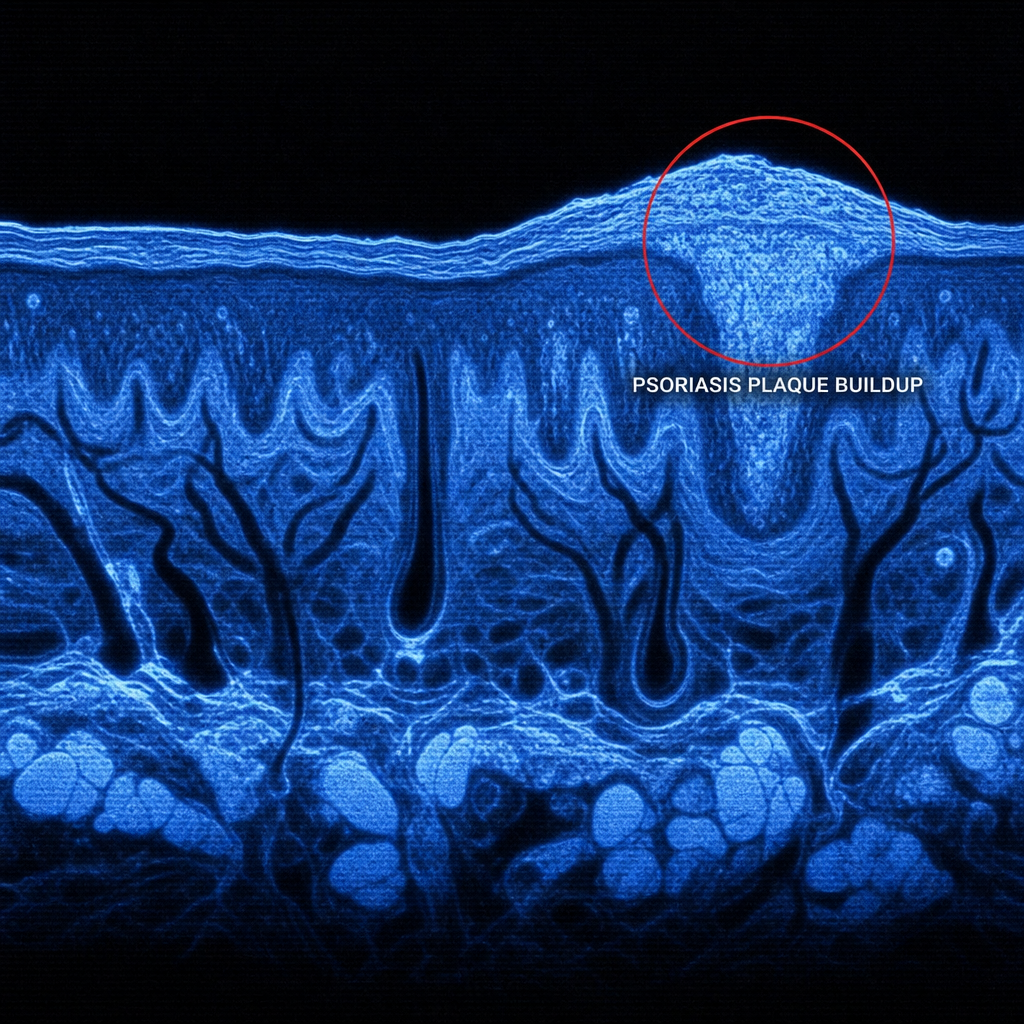
Stop overlooking the triggers that make your psoriasis worse I have been a dermatologist for more than two decades. And if your psoriasis keeps spreading to more skin, your steroid creams stop working after a week, and you keep being told to try a stronger cream, I am going to tell you what I think is actually happening, and why almost nobody discusses the part you can control. Parts of this may make you angry. They made me angry, and I am the one who spent twenty years not asking the question. My name is Dr Patricia Wong. Senior Consultant Dermatologist in Singapore. MBBS Melbourne, MRCP, FAMS, FRCP. More than twenty years treating chronic plaque psoriasis and inflammatory skin disease. And I am going to say something my own profession does not say often enough. Three things are true at once: One, the plaques on your skin are not simply sitting there. Your immune system is driving them, and psoriasis has a documented habit of erupting wherever skin is irritated or injured. Two, the steroid cream you have been prescribed was designed to calm a flare, not to remove whatever keeps provoking one, and it cannot do the second job no matter how consistent you are. Three, almost nobody in a fifteen-minute consultation asks what your skin is exposed to twice a day, every day, in a climate like ours. So let me tell you about a patient, because her case is the one that changed how I run my clinic. Call her Clara. 48. For years, five straight years, she dealt with this. It started with one small patch on her elbow. A rough pinkish circle the size of a coin. She came to me early, month three. I told her we would handle it. No big deal. I prescribed a high-potency topical steroid. Apply twice daily, I said. Be consistent. She was consistent. She rubbed that cream into her skin every morning and night for four months. Religiously. Never missed a day. And what happened? The patch did not go away. It spread. It went from a small pink circle to a thick silvery plaque covering her entire elbow. Cracking. Bleeding every time she bent her arm. Then it jumped. Her other elbow. Then her knees. Then her scalp. Then the backs of her hands. By the end of year two she had thick plaques on both elbows, both knees, her scalp and her hands, and patches creeping up her forearms. She stopped wearing short sleeves, which in Singapore heat is its own kind of punishment. Stopped going to the pool with her daughter. Started wearing her hair down every day to hide the red patches past her hairline. She told me once: "I plan my entire wardrobe around what will hide my skin." And it was not only shame by then. She was frightened it would keep spreading. New patches were forming on her chest. She had a nine-year-old who had started asking what was wrong with her skin at bath time, and Clara would change the subject, terrified her daughter thought she was contagious, terrified her colleagues already did. There was one appointment where she asked me directly. She had her sleeves pushed up on the examination couch and she was looking at the wall rather than at me. "Doctor, is this going to cover me?" I gave her the answer we are trained to give. That psoriasis varies enormously between people. That we would keep it under control. That plenty of people live full lives with it. Every word of that is true, and none of it was an answer to what she had actually asked, which was whether anybody knew why her skin kept losing ground. Here is the part that sits with me. I was the doctor she trusted. Visit after visit, year after year. Appointments, prescriptions, steroid rotations, shampoos. And what did I keep telling her? The cream needs more time. Let us switch to a different steroid. It is manageable, we just need the right combination. Be more consistent with application. Be more consistent. This woman was applying steroid cream twice a day, watching plaques spread to new body parts, watching her skin grow thinner with every tube, and I was implying she was not trying hard enough. I switched her steroid. Then switched again. Added coal tar shampoo for the scalp. Then salicylic acid. Then over-the-counter psoriasis washes. Then phototherapy. The plaques kept spreading. The coal tar wrecked her hair, and she came in one morning with it tied back for the first time in a year so that I could see what it had done. The salicylic acid burned an already raw scalp and she stopped it after four days. The washes did nothing at all. Phototherapy meant two trips across the island a week around a full-time job, and it bought her roughly six good weeks. And every time she stopped a steroid, the plaques returned angrier than before. By year four she had spent, on her own rough accounting, somewhere north of eleven thousand dollars on this. Consultations, private prescriptions, medicated shampoos, phototherapy sessions, and the long parade of things on the pharmacy shelf that promise relief on the front of the box. I watched a woman who did everything I asked get worse, not better. And I did not fully understand why. Now I have to tell you about my own hands, because that is where this actually turned. For most of my career I have washed and sanitised my hands somewhere between forty and sixty times in a working day. In clinical practice that is not optional. About three years ago the skin over both sets of knuckles started splitting. It was not psoriasis. It was irritant hand dermatitis, the occupational kind, the sort I had diagnosed in hundreds of nurses, hairdressers, kitchen staff and cleaners without ever once sitting with what it meant. I treated it the way I treat everything. Emollient. Then a mild steroid. Then a stronger one. It would settle for a week and split open again the moment I went back to a full clinic list. One afternoon at a regional dermatology meeting I was sitting with my hands in my lap so that nobody would see them, listening to a session on occupational skin disease. The speaker was not a dermatologist. She was a barrier physiologist, someone who had spent most of her working life measuring what happens to human skin when it is exposed to water, detergents and disinfectants over and over across a shift. She put up a graph of water loss through the skin in hospital workers across a single day. The line climbed in the morning and never came back down. Then she said something I have not been able to put down since. "The lesion tells you what happened. The exposure tells you why it keeps happening. Our profession is very good at the first one." I went and found her afterwards. I did the thing I would not let a patient do. I apologised for taking her time, and then I held out my hands. She turned them over and looked at the fissures across the knuckles for a long moment. "How many times a day?" "Fifty, give or take." "And you have been putting steroid on this for how long?" "Coming up to two years." She gave the cracks one more look and handed my hands back to me. "Doctor, you are not failing to treat this. You are treating it once and provoking it fifty times. There is no cream on earth that wins that arithmetic." I felt genuinely unwell for a moment. Because I had said the opposite of that sentence to patients, in slightly politer words, for twenty years. Be consistent. Give it more time. Let us try something stronger. She asked whether I had twenty minutes. I had a flight to catch. I stayed. She turned over the conference programme and drew two lines on the back of it. One climbed slowly, and she labelled it repair. The other dropped in sharp steps, and she labelled it insult. "Every skin is doing both of these at once," she said. "Repair is slow and it is steady and it mostly happens at night. Insult is fast and it happens whenever you decide it happens. Your patients are not asking their skin to heal. They are asking it to heal faster than it is being taken apart. Nobody has measured the second line for them. So of course the first one looks like failure." Then she asked me about psoriasis, because that is most of my clinic, and she asked one question I could not answer. "What do your psoriasis patients wash in, how often, and how hot?" I did not know. Not for a single patient in my list. Not for Clara, whom I had by then been seeing for five years. Now pause on that with me for a second, because this is the part that should be insane and somehow is not. Psoriasis erupting at sites of irritation and injury is not a fringe idea. It was described in 1876. It has a name, the Koebner phenomenon, and it is in every dermatology textbook I have ever owned. I have quoted it in teaching. I have used it to explain why a plaque appeared under a watch strap, or along a surgical scar, or exactly where a bra strap sits. And then I would send the patient home without asking a single question about the thing that touches their skin most reliably, most hotly and most often of anything in their entire day. So the following week I stopped looking at Clara's skin and started asking about her day. Not her diet. Not her stress. Her routine. How many showers? Two, sometimes three, because of the heat. How hot? As hot as she could stand, because it calmed the itch for a few minutes. How long? Fifteen, twenty minutes. It was the only part of the day that felt like relief. And what came out of that showerhead? The same thing that comes out of every showerhead in Singapore. Water treated with chlorine-based disinfectants, exactly as it should be for drinking safety. Let me take this apart properly, in order, because once you see it laid out you will not be able to unsee it. Start with what psoriatic skin is actually doing. Ordinary skin runs on a schedule. A cell is born at the base, matures over roughly a month, rises to the surface and sheds without you ever knowing it happened. You lose your entire outer layer constantly and you never notice, because the cells that arrive at the top are finished cells. They interlock. They form a barrier that holds water in and keeps irritants out. In psoriasis the immune system forces that schedule into a matter of days. So the cells arrive unfinished. They cannot interlock properly. They cannot form a competent barrier. And they arrive faster than the old ones can shed, so they stack. That stack is the plaque. That is why it is thick. That is why it is silvery. That is why it splits when you bend the joint underneath it, and why it bleeds in tiny points when it splits. It also means one thing that almost nobody explains at the point of diagnosis. Psoriatic skin has a weaker barrier than the skin next to it. That is structural rather than anything you did or failed to do, and it follows directly from how fast those cells are being pushed to the surface. Now add the second property, the one from 1876. Koebner does not only apply to dramatic injuries. Scratch it, burn it, rub it, or expose it repeatedly to something harsh, and weeks later a plaque can appear in exactly that spot. Repetition counts as much as severity. A small insult delivered twice a day for years is treated by psoriatic skin as a standing instruction, and that is why the condition does not forgive daily provocation the way ordinary skin does. Put those two together and you get a body with a weakened barrier that is also unusually keen to erupt wherever that barrier gets attacked. Now walk into a Singapore bathroom. Our tap water is treated with chlorine-based disinfectants, and it should be. It is what makes the water safe to drink, and I am not going to criticise PUB for doing its job well. But chlorine is an oxidiser, and an oxidiser does not distinguish between bacteria in a pipe and the lipids holding a skin barrier together. In controlled skin studies, chlorinated water produced measurably increased redness and raised the inflammatory marker IL-1alpha, and it shifted skin pH away from where a barrier likes to sit. Heat strips further. Length of exposure strips further still. So here was Clara's actual day. Morning, steroid on the plaques to calm the inflammation. Then twenty minutes of hot chlorinated water over the same skin. Out into the heat, sweat sitting on the plaques for hours, then a second shower, sometimes a third, each one hot, each one long, each one stripping. Then eight hours under aircon pulling moisture out of skin that was already struggling to hold any. Five years of that. Somewhere north of three thousand showers, every one landing on the exact skin we were trying to settle. And here is what the cream was up against in that arrangement. A topical steroid does one job extremely well. It forces a fast local shutdown of the inflammatory response. Redness drops. Itch drops. Within days the plaque flattens and you feel the relief of something finally working. What it does not do, and was never built to do, is remove the thing provoking the response. So the moment you taper or stop, the inflammation floods back into skin that the steroid has also been thinning, and the flare that returns is frequently worse than the one you treated. Then you need a stronger preparation, which works for a slightly shorter stretch, which thins the skin a little further. That loop is not a sign of a difficult patient. It is the predictable result of treating one side of an equation and ignoring the other. The cream was not failing. It was being asked to win an argument that restarted every twelve hours. And in five years I had never once asked. That is the gap I want to close, because I do not think Clara is unusual. I think she is typical, and I think the reasons for it are structural rather than anybody's individual laziness. Consider how a consultation is actually built. I have fifteen minutes, sometimes twenty. In that time I am expected to examine, assess severity, review response to the last prescription, document, and decide the next step. The history form I trained with asks about family history, smoking, alcohol, previous treatments, joint symptoms and drug allergies. It has never, in any version I have used, asked how long you shower for, how hot, how often, or what is in the water. There is no billing code for auditing a bathroom. There is no pharmaceutical representative who books time with me to explain what repeated chlorinated water exposure does to an inflamed barrier, because there is nothing at the end of that conversation for anybody to sell. There is no algorithm step that says stop and ask. What there is, at every level, is an escalation ladder. Mild steroid, potent steroid, very potent steroid, vitamin D analogue, combination preparation, phototherapy, systemic therapy, biologic. The whole apparatus around psoriasis is exquisitely well designed to manage what has already erupted. Almost none of it is pointed at removing what keeps setting it off. And a doctor working inside that system is not being negligent when she reaches for the next rung. She is doing exactly what her training, her clinic timings and her guidelines all point her towards. I know, because I did it to Clara for five years while she paid for the privilege and got worse. So here is what I do differently now, and what I put every psoriasis patient through before I escalate their medication. First, showering. Warm, not hot. Ten minutes, not twenty. A soap-free cleanser only where you actually need it, because psoriatic skin does not need to be scrubbed anywhere. Second, moisturising. Within three minutes of stepping out, on damp skin, generously, and not just on the plaques. That timing does more work than the choice of product. Third, the water itself. Take the chlorine out before it reaches the skin. In my own home I use a filtered showerhead with a calcium sulfite stage that neutralises up to 99.9% of the chlorine, plus a one micron cotton filter for sediment from the pipes. Five minutes to install, no plumber. Fourth, the Singapore variables. Sweat rinsed off promptly rather than left to sit. Aircon set so the bedroom is not desiccating your skin for eight hours. Loose cotton where fabric rubs, because rubbing is provocation too. Fifth, knowing when this is beyond home management. Rapidly spreading plaques, joint pain, nail changes, or anything on your face and hands that is affecting your work. None of this replaces prescribed treatment, and some cases genuinely need systemic therapy. Before any of that, I had to make a phone call. I rang Clara at home on a Sunday, which I do not normally do, and I told her that I had been treating her correctly and thinking about her incorrectly for five years. That the ladder I had been walking her up was designed to quieten what had already erupted, and that I had never once looked at what kept setting it off. That her skin had not been stubborn and she had not been failing to comply. There was a long pause on the line. Then she said, "So it was not me." I have thought about that sentence more than almost anything else a patient has said to me. Five years of applying a cream twice a day, watching it lose ground, being told to be more consistent, and what she had quietly concluded was that the problem was her. Here is what happened with Clara after we changed the routine. Week two, the itch quietened at night. She slept through for the first time in months, and she noticed that before she noticed anything she could see. Week four, the post-shower tightness she had assumed was simply what skin feels like was gone, and the plaques on her elbows were visibly thinner at the edges. Week eight, nothing new had appeared anywhere. For someone who had watched this march across her body for five years, that was the part she talked about most. She was not describing clear skin. She was describing skin that had stopped taking territory. Week sixteen, she wore short sleeves to her daughter's school concert. First time in four years. She told me she spent the first ten minutes of it with her arms folded anyway, out of habit, and then forgot. Now let me be careful, because your skin deserves honesty rather than a sales pitch. Not everyone responds like that. Psoriasis is genetic and immune driven at its root, some cases need systemic therapy or biologics, and a showerhead is not a treatment for an immune disease. I would never present it as one. What I am telling you is that the mechanism is real, the Koebner phenomenon is established and more than a century old, chlorine's irritant effect on skin has been measured in controlled studies, and in my clinic the patients who take the daily provocation out consistently do better than the ones who only chase creams. That has been consistent enough, for long enough, that I now do it before I escalate anybody's medication rather than after. Two things I want to say to two different people reading this. If you have one or two patches right now and you are early in this, you have far more room than you think. The provocation load is the easiest part of psoriasis to change, it costs almost nothing to change, and it is the part that decides whether the ladder you are being walked up is a short one or a twenty-year one. If your plaques are already on your elbows, your knees, your scalp and your hands, and you are being asked to think about systemic treatment, nothing here asks you to stop or delay anything. Have that conversation with your specialist. Then go and remove the daily provocation as well, so that whatever you take next is not being asked to win the same argument Clara's cream was losing. And to both of you. You are not flaring because you are unclean. You are not flaring because you did not rub the cream in hard enough or hold the shampoo on long enough. Psoriatic skin has a weaker barrier and a documented habit of erupting where it gets provoked, and most of us are provoking it twice a day, hot, for twenty minutes, in the hottest climate any of us have lived in. If your psoriasis keeps spreading no matter what you apply, the question worth asking is not which cream to try next. It is what is provoking your skin twice a day that nobody has asked you about. I have written the full protocol, all five steps with the honest caveats, into a free patient guide for Singapore. Tap Learn More to read it. No sign up, about six minutes. I spent twenty years treating the plaque in front of me. I should have been asking about the shower. Dr Patricia Wong, Senior Consultant Dermatologist, Singapore P.S. My own hands took about ten weeks. Not perfect, and they never will be while I am seeing patients, because fifty hand washes a day is not a variable I get to remove. What changed is that I stopped treating the splitting as a failure of the ointment and started treating it as arithmetic. That is the entire idea in this piece, and it took a physiologist at a conference to hand it to me at the age of fifty-one. P.P.S. The guide costs nothing and I have no arrangement with anyone whose products are named in it. I wrote it because the escalation ladder is the only thing most psoriasis patients in Singapore are ever offered, and there is a step underneath the bottom rung that almost nobody gets told about. Clara went five years without being told. I would rather you did not.
Where the ad sends people
dr-wong.pages.dev
Why Your Psoriasis Keeps Spreading In Singapore
Why plaques form, the Koebner phenomenon, the five pillars of control, and an honest look at shower water.
Learn more: dr-wong.pages.dev(opens in a new tab)