
Inactive· since Jun 15, 2026
- 85
- days it ran
- 0
- relaunches
Ad copy
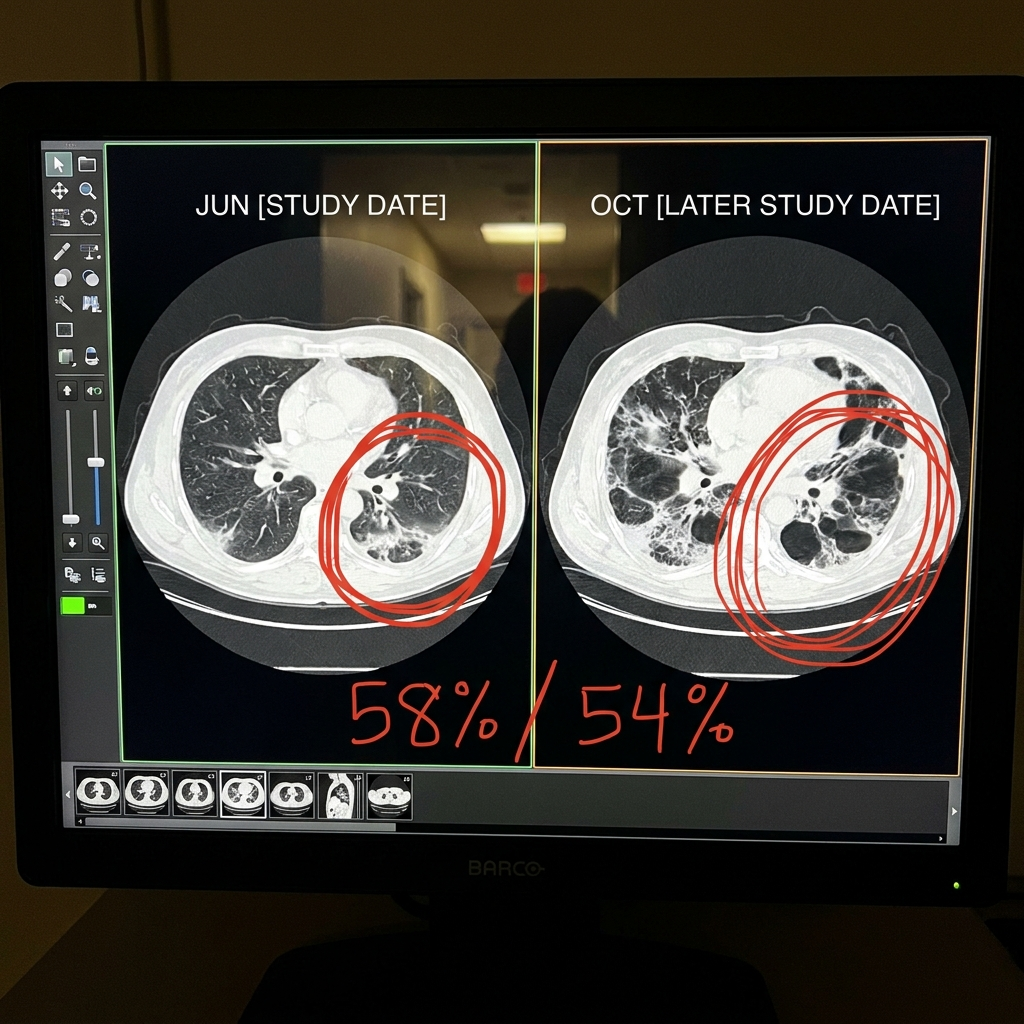
My husband quit smoking on July 8th, 2024. Threw every pack in the kitchen trash. Smashed his Zippo in the garage with a hammer. Started walking three miles a day. Bought a juicer, of all things. He did everything the doctor told him. He died of respiratory failure on October 19th at 4:17 AM. He was 61 years old. Quit smoking on July 8th. Didn't touch a single cigarette. Walked three miles a day, rain or shine. Lost 14 pounds. The hospital bill was $87,000. The funeral was $12,400. His brushed silver Zippo — the one he carried for 32 years, engraved with his initials — is still on the shelf above the sink. I can't move it. If I move it, he's really gone. I need to tell you what happened to Robert. Because I'm seeing the same posts on Facebook that I was making just months before he died — "my husband's doctor said his lung function is down, any tips?" — and it makes me physically ill. If you're over 50 and you smoke, or someone you love does, please read this entire thing. I know it's long. I know you're scrolling. I know you have things to do. Fifteen months ago I would have given anything — everything — for someone to tell me what I'm about to tell you. Robert went in for a routine physical on June 28th, 2024. He felt fine. Better than fine. He'd just turned 60. He still split his own firewood. He still rode his motorcycle on the weekends. He thought he was indestructible and honestly so did I. Two days later his doctor called. FEV1 of 58 percent predicted. Spirometry consistent with moderate COPD. "Robert, your lung function is significantly worse than we'd expect for a man your age. We need to talk about your smoking." Robert was quiet on the call. I was in the kitchen pretending not to listen. "How much do you smoke?" "Pack a day. Couple cigars on the weekend with my brother. Maybe a cigarette at a wedding." "That's enough to do this. You need to stop. Completely. No exceptions. I'll write you a script for the patches. We'll retest in three months." Robert hung up the phone and sat at the kitchen table for forty minutes without saying anything. Then he stood up, walked to the kitchen drawer where he kept his cartons, and pulled everything out. I watched him drop two unopened cartons of Marlboro Reds into the trash. Three half-finished packs from his work jacket, his fishing jacket, his glove compartment. The brass ashtray from the back porch that had been his father's. His travel humidor with two Romeo y Julieta cigars he'd been saving for our anniversary. Then he walked out to the garage and I heard him hit the Zippo three times with a hammer. "That's it," he said. "I'm done." And he was. For 103 days, he didn't touch one. No cigarettes. No cigars. No bumming one from his brother. Not at his nephew's wedding in August. Not at the Bears game in September. Not at his own 61st birthday dinner in October when his brother lit up on the back deck and Robert stood inside with a glass of cranberry juice. He stopped going to the Saturday morning coffee at the diner because his three best friends smoked outside before and after and he couldn't stand watching them. He lost his buddy Mike, who told him "you're no fun anymore" and stopped inviting him fishing. He lost the Tuesday night poker game. He lost a piece of himself he'd been carrying since he was 19 years old. And he did it anyway. Because the doctor said to. He lost 14 pounds in those three months. He bought a juicer — Robert, with the juicer, I still can't picture it. He started walking three miles every morning before work. He used the 21mg patches the doctor prescribed even when they left red rectangles on his upper arm. He took a multivitamin. He ate a salad every day, the man who used to call it "cow food." He did everything right. The follow-up labs came back on October 7th. FEV1: 54 percent predicted. He'd quit smoking entirely for 90 days and the number was actually lower than the first one. The doctor said "give it more time. Lungs heal slowly. We'll retest in 6 months. Keep doing what you're doing." Robert came home that night and sat at the kitchen table again. The same table he'd sat at after the first call. He didn't say anything for a long time. Then he said: "Carolyn, I gave up everything. Everything. And it didn't work." I told him to give it time. I told him the doctor said six months. I told him to trust the process. He nodded. He kept walking. He kept juicing. He took the patches even when his arm was a mess. Five days later — five days — he woke up at 2 AM unable to get a breath. Sitting straight up in bed, both hands gripping the headboard, eyes wide. He couldn't speak. Just shaking his head. I drove him to the ER. By the time they admitted him at 4:30 AM, his lips were blue. Not "a little dusky." Blue. Like someone had drawn over them with a marker. The whites of his fingernails were the same. The ER doctor — a young woman, couldn't have been 35 — looked at his oxygen saturation and her face did this thing. "Mr. Baker, your O2 sat is 71. Your CO2 is 88. You're in acute hypercapnic respiratory failure. We're admitting you to the ICU and we need to intubate." "But I quit smoking three months ago," Robert said. He was breathing into the BiPAP mask. The words came out one at a time. The doctor just looked at him. "I know, Mr. Baker. I'm sorry." Robert spent 11 days in the ICU. I learned things about the lungs I never wanted to know. I learned that when a smoker's lungs reach a certain point, the airway tissue gets so scarred and the cilia — the tiny hairs that sweep mucus and toxins out — get so destroyed that the lungs can't clear themselves anymore. The buildup just sits there. Inflammation keeps cycling. Even if you've stopped smoking. Even if you've quit for 90 days. Even if you've done everything you were told to do. I learned that they put a special steroid into the IV when this happens. The respiratory therapist told me it's the same compound they use for severe asthma attacks. She said it forces the inflammation down so the airways can open enough for oxygen to get through. She said it's the only thing they've got, and at this stage they were hoping it could buy him time. It bought him 11 days. Day 8, his right lung partially collapsed. The doctors talked about a lung transplant. Then they talked about him not being a candidate because of how fast he was declining. Then they stopped talking about transplants altogether. Day 10, his hands and feet started swelling because his heart was working so hard to push blood through scarred lungs that it was failing too. They call it cor pulmonale. I called my daughter. Day 11 — October 19th — I was in the family room down the hall. They'd asked me to step out so they could try a different vent setting. At 4:09 AM I heard the long beep. At 4:17 AM, a doctor I'd never seen walked into the family room. I knew. "I'm so sorry. We did everything we could." I drove home at 6 AM. The juicer was still on the counter. The walking shoes were by the back door. The patches were on the windowsill above the sink, next to the multivitamin. His brushed silver Zippo — the one he'd taped back together after smashing it because he couldn't actually throw it away — was on the shelf above the sink. Where it sits today. I sat in his recliner. I didn't move for six hours. The house was so quiet I could hear the refrigerator hum. 38 years. And now the only sound in my house was the refrigerator. The funeral was October 23rd. Robert's brother flew in from Arizona. Our daughter drove up from Bloomington. The grandkids wore suits that were too big for them. My five-year-old granddaughter asked me: "Grammy, when is Pop-Pop coming home?" I told her Pop-Pop was in heaven now. She said: "Can we call him there?" I had to walk out of the room. After the funeral, I tried to go back to normal. I couldn't. Because every time I opened my phone I saw people my age, men Robert's age, posting things like "doctor said my lung function is a little low, anyone tried the patches?" or "annual physical, slight COPD, no big deal." And I knew — I KNEW — some of them were doing exactly what Robert did. Quitting. Eating clean. Walking. Patches. And dying anyway. I couldn't just sit there and watch it happen. So I started researching. Not because I wanted to. Because I had to. Because if Robert gave up everything for nothing — if I can't save even one person from what happened to him — then I can't live with that. I read for weeks. Medical journals I barely understood. Pulmonology forums. Studies out of Japan and Germany. And one thing kept coming up, over and over, that no doctor ever told us: The reason Robert's numbers didn't come up is that quitting smoking only stops the damage. It doesn't clear what's already there. Specifically: cilia. Cilia are the microscopic hair-like structures that line your airways. They are the master clearance system of your lungs — they sweep out every particle of tar, every toxin, every bit of dead tissue, every drop of mucus. Without them, your lungs cannot clean themselves. And here's what no one told us. After age 40, your body produces about 10 percent fewer functional cilia every year. Smoking destroys them at an accelerated rate. By 55, most long-term smokers have a fraction of the clearance machinery they were born with. And here's the part that made me sit up straight: When your cilia are gone, the cigarette that's supposed to be partially cleared by your airways, instead just builds up. Robert's lungs weren't destroyed because he smoked too much. They were destroyed because he didn't have enough cilia left to clear what he was smoking. Read that again. His lungs weren't damaged by the cigarettes. They were damaged by the empty clearance system the cigarettes were passing through. And here's why quitting alone didn't save him: stopping smoking stops the destruction of cilia. It doesn't restore the cilia that are already gone. It doesn't clear what's already there. Eating clean, exercising, walking — those things slow how fast you deplete what's left. They don't clear the buildup. That's why his FEV1 wouldn't move. He gave up everything he loved to stop the bleeding from a wound that was already inside him. I sat with that for three days. And then I started looking at what I'd been doing. I'd thrown out Robert's patches the week after the funeral. But I bought a bottle of NAC capsules for myself. Because I'm 59. Because I smoked socially in my twenties. Because I was scared. I took it for three weeks. My doctor — a different one to Robert's, who I called because I trusted — sighed when I told her. "Carolyn, NAC capsules are for liver support, not lungs. The capsule has to pass through your digestive tract first. Most of the active compound never makes it to your airway tissue. It sits in your gut." Then she said something I'll never forget: "If Robert had been on something inhaled — something that actually got into the airway tissue and loosened what was stuck in there — the picture might have been very different." I stopped breathing for a second. "Why didn't his doctor prescribe that?" She was quiet for a long time. "Because we don't prescribe herbs. And the version that works isn't a prescription." I went to CVS the next day. I stood in that aisle for forty minutes. Mullein tea. Lung-cleanse capsules. Eucalyptus essential oil. "Respiratory support" 30-day program. Multivitamins with "lung support." Generic NAC capsules — $14.99, 600mg, the cheap stuff. I bought the lung-cleanse capsules. Took them for two weeks. Nothing changed. I started Googling and what I found made me throw the bottle in the trash. A compromised lung cannot be reached by a capsule. The capsule goes through your stomach, into your intestines, into your bloodstream — and by the time the active compounds reach your lungs, almost nothing is left. The airway tissue itself — the cells that are actually damaged — never gets the dose. You're paying for capsules that pass right by the organ they're supposed to help. Inhaled vapor bypasses this entirely. Inhaled vapor reaches the airway tissue directly. I had been doing the right thing in the wrong form. I was furious. I'm still furious. About a week later I was reading a thread on Facebook — one of those COPD support groups, full of people like Robert was, "early-stage COPD" people, "borderline lung function" people — and a woman posted something that stopped me cold. She said her husband had been told to quit smoking at 58. He quit. His FEV1 barely moved for six months — sound familiar? — and then he found an inhaled herbal diffuser that combined mullein with two other herbs that worked together to clear the buildup his lungs couldn't. His FEV1 went from 51 percent to 79 percent in eleven weeks. Without going back to smoking. Without doing anything else different. I read that post six times. I started looking into the formula she mentioned. And what I learned is that there are five things a serious lung recovery has to do at the same time, or it's a waste of your money: It has to loosen the tar and dead tissue already stuck in the airways. That's mullein. The expectorant herb documented in respiratory medicine since the 1800s. Not a vitamin. The actual mechanism that mechanically pulls buildup out of the airway tissue. It has to soothe the inflamed airway tissue so the lungs can stop the inflammation cycle. Mullein does this too — the same plant acts as both an expectorant and a demulcent. The first action clears what's stuck. The second action calms the tissue at the same time. It has to clear the bacterial buildup that smokers' damaged lungs hold on to. That's thyme. The herbal antiseptic that works directly on respiratory tissue. It has to open the bronchial passages so the loosened buildup can actually leave your body instead of sitting there. That's peppermint. The bronchodilator that opens the airways so your lungs can clear what mullein has loosened. And it has to be in inhaled vapor form. Because a compromised lung cannot be reached by a tea or a capsule. The active compounds have to enter directly through the airway tissue. Five things. All five. At the same time. In inhaled vapor form. I went through every product I'd looked at in CVS. Not one of them did all five. Most did one. The expensive ones did two. None of them were inhaled. That's when I found QuitRitual. It was the only formula I could find that hit all five. Mullein. Thyme. Peppermint. Inhaled herbal diffuser. Two draws in the morning. Three at trigger moments through the day. Made in the US. 60-day money-back guarantee — if your lung function tests don't improve, you get every penny back, no questions asked. I almost didn't order it. After the CVS aisle. After the capsules. After Robert. After everything. But I had a brother who was still smoking the way Robert used to smoke. I had a son-in-law with "borderline" lung function. I had myself. I ordered it. My brother. Frank. Came back from a routine appointment with an FEV1 of 62 percent predicted. He didn't know what to do. I sent him a diffuser. I didn't ask. I just sent it. Wrote a note that said "If you don't use this every day I will never speak to you again, Frank, I mean it." He used it. He kept smoking — he wouldn't quit, he's stubborn the way Robert was stubborn — but he used it every morning and every evening. He went back to his doctor four weeks ago for a follow-up. FEV1: 84 percent predicted. Up from 62 percent. In ten weeks. He hadn't stopped smoking. He hadn't changed his diet. He hadn't started exercising. The only thing he changed was what he inhaled in the morning and the evening. He called me crying. My brother. 57 years old. Crying on the phone like a kid. He said: "Carolyn, I think Robert died because nobody told him about this." I had to hang up. Then there's my son-in-law. 44, two kids, "borderline" lung function at his last physical. Started using it six weeks ago. He says his afternoon energy is back. He says the chest tightness he'd been feeling for two years — the one his doctor said was "probably stress" — is gone. My neighbor Karen. Her husband died of lung cancer four months before Robert. Two widows on the same street. She started using it two days after I told her, for her own peace of mind. She says it's the first time since he died that she doesn't feel like she's waiting for a phone call. I told my sister. I told Robert's brother. I told the women in my book club. I told the guys at Robert's old poker game when I went to drop off a casserole. I'm not a doctor. I'm not a scientist. I'm not selling anything and I don't get a penny from any of this. I'm a 59-year-old widow sitting in my dead husband's chair at 2 in the morning because I can't sleep and I can't stop thinking about my brother and whether he's going to end up where Robert ended up. Here's what I know because I lived it: Quitting smoking stops the damage. It doesn't clear what's already in your airways. Patches deliver nicotine to your blood. They don't reach the tissue that's actually damaged. A compromised lung cannot be reached by a capsule or a tea. Only inhaled vapor reaches the airway tissue directly. Robert gave up everything he loved for 103 days and it didn't save him because nobody told him what was actually broken. I wish someone had told us before June 28th, 2024. Before the routine physical. Before the cartons in the trash. Before the Zippo smashed in the garage. Before the 103 days of cranberry juice instead of bourbon at his brother's birthday. Before October 19th at 4:17 AM. I can't go back. Robert can't come back. His Zippo is still on the shelf and it's going to stay there. But you can still go forward. Your husband can. Your brother can. You can. The page that explains all of this — the cilia mechanism, why the FEV1 doesn't move when you quit, what your doctor doesn't know about inhaled absorption, and what QuitRitual actually contains — it's the page I found at 3 AM. Not just quitting. Clearing. That's the line that finally made it click for me. I want you to read it. Not for me. For whoever you'd leave behind. 👇 https://quitritual.co/pages/6-reasons-why Robert used to say: "The smoke is in. But you can stop pulling more in." You can stop pulling more in. And you can clear what's there. — Carolyn Baker, age 59, Springfield, IL P.S. The Zippo is still on the shelf. I still can't move it. Every morning I walk past it and for one second I forget. For one second I think he's about to come down the stairs and tell me he's going for a walk before work. He's not. $87,000 in hospital bills. $12,400 for the funeral. 103 days of him giving up everything he loved for nothing. And an inhaled diffuser that costs less than his Tuesday night poker buy-in — an inhaled diffuser his own doctor told me could have changed everything if we'd known. Please. Don't end up here. Don't let someone you love end up here. 👇 https://quitritual.co/pages/6-reasons-why P.P.S. I don't work for QuitRitual. I don't get a penny from this. I'm writing this at 2:14 AM because I can't sleep and Robert's side of the bed is cold and my brother is 57 and stubborn and I'm scared every time the phone rings. Share this with anyone you love who smokes. Even a little. Even "socially." Even if they already quit. Please.
Like this ad? Make it yours.
Crush rebuilds this exact creative around your product — your brand, your colors, your offer — in about a minute.