

Blood Pressure Daily
Active· since Aug 27, 2026
- 23
- days running
- 0
- relaunches
Ad copy
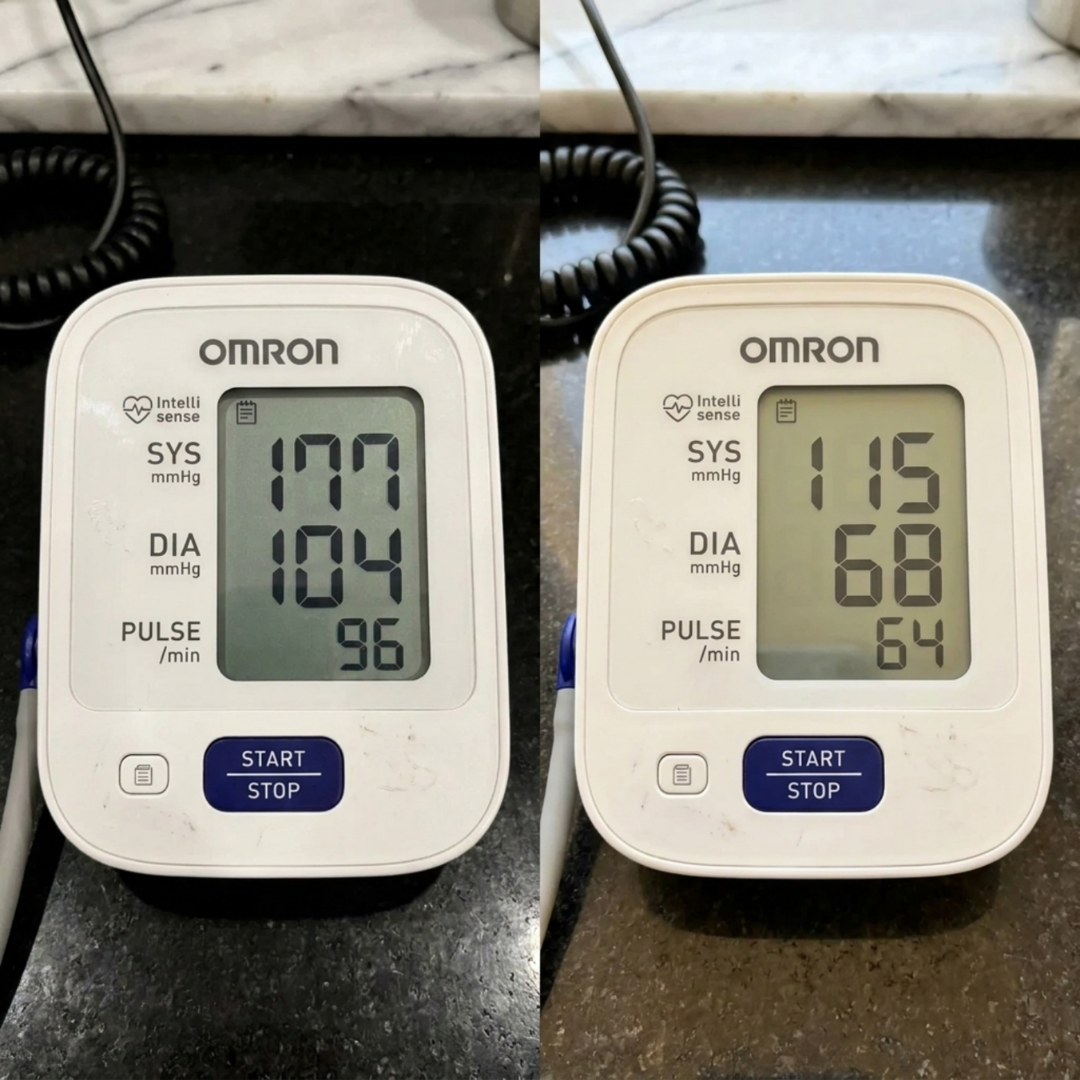
After 2 years of high BP post-menopause 3 doctors couldn't explain, I found the answer at my kitchen table on a Sunday. I found out at a routine physical. The nurse looked at the screen and said, "142 over 91." I asked her to say it again. Because 110/70 is what I'd been my entire adult life. It was 110/70 when I was pregnant with both kids. It was 110/70 at every physical I'd ever had. After that it never came back down. 158/97 on a Tuesday morning. 161/99 the next, sitting in my own kitchen doing nothing at all. I have said the word menopause out loud in three different doctors' offices. My primary told me blood pressure goes up as we age and started me on losartan. Her colleague looked at my chart instead of at me and added amlodipine. And the cardiologist, the one I waited six weeks for, the one I brought two years of handwritten readings to, never opened the notebook. I told him my BP was 110/70 my whole life and only started going up after I went through menopause. I said I thought they were connected. He said, "Your heart is the problem." My heart is the problem. I sat in that parking lot for twenty minutes. Furious. They each look at their own piece of me and nothing else. Like I'm a set of separate parts and not a whole system. I cut the salt. I lost nine pounds. I walked four mornings a week. I drank hibiscus tea every day for a month. I took magnesium at night, garlic capsules, beetroot powder for three months, then the chews when the powder made me gag. I even got on HRT. It's the one thing I'd actually been asking for, because I knew this was hormonal. The hot flashes eased off. I started sleeping again. My number didn't move an inch. For two years I believed there was nothing else to know. Then my niece called me on a Sunday afternoon. She's a nurse practitioner in a cardiology practice. My sister had mentioned what was going on with me. She asked me one question nobody had asked me in two years. She said, "Aunt Sue. What was your blood pressure before menopause?" I told her. 110/70. My whole adult life. She said, "So nothing about you changed except your hormones, and your number went up fifty points. Has anybody actually explained to you why?" Nobody had. Not one person in two years, in three different rooms. She said, "Then let me. Because you were right. You've been telling them the right thing and getting treated for the wrong one." I sat down at my kitchen table and listened to her explain something nobody in two years of appointments and pill bottles had ever explained to me. I want to give it to you. Because if your blood pressure went up after menopause and you've said so out loud and been dismissed, this is what they didn't tell you, and probably don't know. Here is what my niece explained. Estrogen doesn't just run your cycle. Inside the walls of your arteries there's an enzyme called eNOS. It's the thing that keeps your arteries soft and open. And estrogen is what has kept eNOS running since you were about thirteen years old. She said, "When you went through menopause, your estrogen dropped and stayed down. So eNOS went quiet, and it's been quiet ever since. "Your arteries stiffened up. And your blood pressure number rose." Then she said the part I've thought about every day since. She said, "Aunt Sue, over 75% of women end up with high blood pressure after menopause. This is what happens to almost all of us, and almost none of us are told why. "You weren't guessing. You walked into three offices and told them the cause and they treated the readout instead. And there's no test for eNOS. It doesn't show up on a blood panel or an EKG, so every result you ever got came back optimal. "You couldn't have proved it to them. But you were right." I asked her how three doctors could miss it. She said, "They didn't miss it. Missing it means somebody was looking. One of them owns your hormones, one of them owns your number, and eNOS sits in the gap between them where it isn't anybody's job. "Most doctors get a few hours on menopause in four years of medical school. 75% of us end up here and they're still not being taught why. So you get a shrug and a prescription." Then she said, "And here's the part that's going to sting. The meds, the salt, the walking, the hibiscus tea, the magnesium, the garlic, the beetroot. Not one of them goes anywhere near eNOS. They're all just chasing the number instead of the reason it went up. "And the HRT won't do it either. Estrogen is the right key, but eNOS doesn't wait around. The longer it sits quiet, the less it answers when the estrogen comes back. Yours has been quiet for four years." I thought HRT was the answer I'd finally gotten. It wasn't the answer at all. So I asked her what would actually help. She said, "Vera Cacao." I said, "What?" She said, "It's real chocolate. Not the kind you know. It's what chocolate is before it gets roasted and processed into what's on the shelf. Raw, the way it comes off the tree in Latin America. The high flavanols in it go straight to eNOS and switch it back on. That's the key." "It has more published research behind it on this enzyme than almost anything else on the planet." And she wasn't exaggerating. I went and read it myself. In one trial, a single serving of Vera Cacao raised eNOS activity 38% within two hours. In another, thirty days took seven points off the top number on average. And Harvard followed 21,442 adults, and the ones who took it consistently had 39% fewer deaths from heart attack and stroke. Not fewer bad readings. Fewer deaths. 21,000 people. Harvard. Published. I sat in three different doctors' offices, and not one of them mentioned any of that to me. I said I have chocolate in my pantry right now. Why hasn't that done anything? She said, "Because that's the roasted kind. Every chocolate company roasts and Dutch processes theirs, and both of those destroy up to 90% of the flavanols. A dark chocolate bar has between 2 and 50 milligrams left in it. The trials used hundreds." "That's not a weaker version of Vera Cacao. It's a different product entirely." "Real Vera Cacao is never roasted and never Dutched. A high flavanol Latin strain, not the commodity bean. Third party tested for lead and cadmium. No sugar, no fillers. At the dose the trials used." "And there's only one brand actually making it that way. Florin." I ordered it that night. It came four days later. I made a cup the next morning. Hot water, splash of milk, sat at my kitchen table and drank it slowly. It tastes like mocha, delicious. Week one, nothing dramatic. I made myself not check for four days, because I knew if I saw 160 on day one I'd quit. Day five: 149/94. It had been 158/97 the week before. Nine points off the top. Nothing I'd have told anybody about. I wrote it in the notebook the cardiologist never opened. Week two, my husband said at breakfast, "You didn't get up last night." I'd been waking at 2 or 3 almost every night for two years. Week three: 138/86. My husband was standing right there when I took it and his eyebrows went up. He said, "That's the lowest I've seen that thing in two years." Week five, I noticed I'd stopped taking a breath before I pressed the button. I don't know what day that started, and that's exactly why it's the one I think about. Week seven, I flipped back through the notebook and realized the number had been going down for six weeks straight. Two years of watching it only ever go one direction, and it had turned around. Week nine: 124/76. Week twelve I went to my primary. The nurse took it twice because she thought she'd made a mistake. 115/68. Same office where I'd never once read under 140/90. She asked me what I'd changed. I told her. One cup of Vera Cacao every morning, and I hadn't stopped anything she'd given me. She wrote it down. She said she'd look into it. Two years, and that was the first time anybody wrote down something I said. I called my niece to thank her. She said, "Keep drinking it. eNOS is running again and your arteries are staying soft the way they're supposed to. The longer you feed it, the more flexible they get." I posted about it in the menopause group I've been in for two years. About half the women in that thread ordered it. Nine have written back so far. One went from 152/94 to 129/81 in seven weeks. One's diastolic finally came out of the 90s after two years stuck there. Most of them are somewhere between eight and twenty points down on the top number. And every single one of them said some version of the same thing. "I knew it was my hormones. Nobody would listen." I am not associated with this company. Nobody asked me to post this. I emailed Florin just to thank them, because I felt like they should know what it meant to somebody like me. They wrote back a lovely note. I just know what it's like to say menopause out loud in an exam room and be dismissed. To bring a notebook with fourteen months of twice-daily readings in your own handwriting and watch a specialist leave it closed on the desk. You are not imagining the connection. Your hormones did this, you've been saying so, and the only reason nobody confirmed it is that eNOS sits in the gap between the two doctors you've been paying. You are not a blood pressure reading. You're a woman whose estrogen stopped holding an enzyme open, and the number is just the part of it they knew how to measure. Vera Cacao is the only thing I have ever put in my body that went and turned it back on. Florin has a 90 day money back guarantee. If it doesn't work you get every dollar back. But they harvest in small Latin American batches and they do sell out. My last reorder was delayed a week and I was down to the final scoops, measuring carefully so I wouldn't miss a morning. If you click below and they're out, try again the following week. But if they have it, get it. Make the cup in the morning. Keep taking whatever your doctor has you on. And see what your cuff says in a couple weeks. I was right the whole time. It just took my niece on a Sunday afternoon for somebody to say so. https://tryflorin.com/products/veracacaomenopause
Like this ad? Make it yours.
Crush rebuilds this exact creative around your product — your brand, your colors, your offer — in about a minute.