
Inactive· since Jul 14, 2026
- 28
- days it ran
- 0
- relaunches
Ad copy
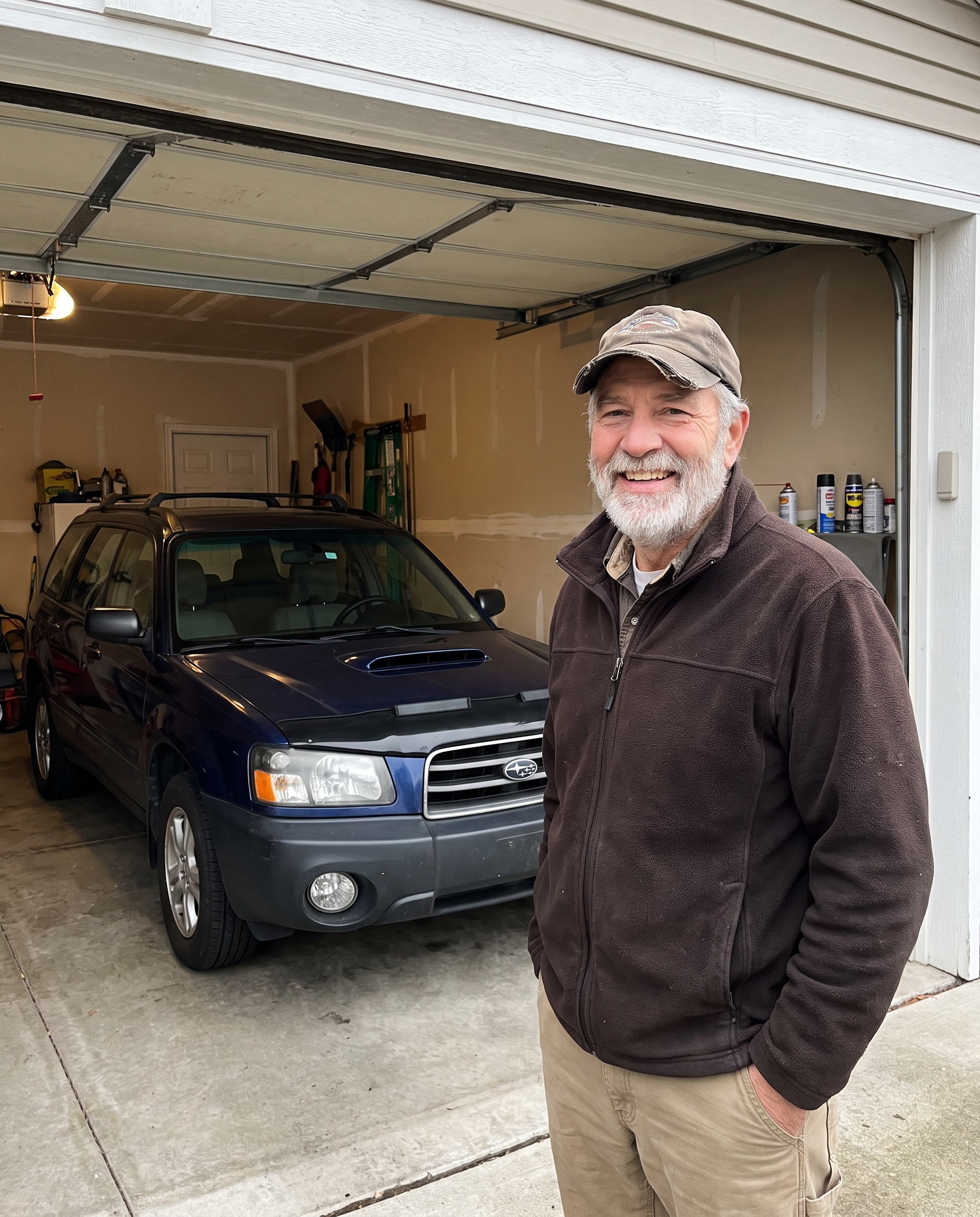
If you've ever owned a Subaru past a hundred and fifty thousand miles, you already know the one job that makes a grown man set his coffee down and just stare at the engine. It isn't the head gasket. It isn't the timing. It's four spark plugs. And it's the reason a dealer can look you in the eye and charge you seven hundred dollars for a part that costs fifteen. I'm Glenn. The Outback in my garage is a 2016 2.5i with a hundred and ninety thousand miles on it, and I've done almost every one of those miles myself. I'm no mechanic. I spent thirty years running land surveys up and down the Cascades, and that wagon is how I got to half the ridgelines in central Oregon. It's paid off. It starts at nine degrees. My wife Carol quit asking when I'd replace it about eighty thousand miles ago. I keep it running because keeping it running is the whole point. Here's what nobody tells you about a boxer engine. The cylinders lie flat on their sides and the spark plugs point straight out at the frame rails, an inch and a half of air between the plug and a solid steel beam. The front two you can reach. The back two you cannot. The worst one, the rear plug on the driver's side, sits buried behind the battery tray and the wiring brackets, where your hand goes in and your knuckles come out bleeding. Last fall I picked up a stumble on the climb out of Sisters, a little buck under load that turned into a check-engine light by the time I got home. Code said cylinder four misfire. I knew what it was. Plugs were past due at a hundred ninety. I'd been quietly putting off the back two since the day I bought the car. So I started in on it on a Saturday. Airbox out, battery out, coil unbolted. I could see the plug. I could touch it with one finger. I could not get a tool on it and turn it. A swivel socket on two extensions flexed under load and walked off the hex. A stubby flex-head ratchet had maybe five degrees of swing before the handle hit the frame rail, and five degrees is nothing on a plug that's been in since the factory. A universal joint bound up and twisted off the head every time I leaned on it. A magnetic socket I bought at the parts store wobbled like a paper fan. Three hours in I had the corner of the plug rounded and a knuckle wrapped in a shop rag, and I sat down on the garage stool and listened to the whole noon hour on the radio without moving. Monday I called the Subaru dealer in Bend. The service writer told me the back plugs meant they had to loosen the engine mounts and raise the engine an inch to fit a socket in there. Two hours of book time plus the rounded plug. Seven hundred dollars, give or take, for four spark plugs. He said it the way you'd read off a weather report. I told Carol at supper. She put her fork down and said, "Seven hundred dollars to change spark plugs. No. They're making it harder than it is." She was right. They were. A few weeks later I drove up to the big Subaru meet they hold every summer, the one where two hundred people park with their hoods up and spend the afternoon under each other's engines drinking gas-station coffee. Three cars down from me a fellow about seventy had a 2009 Outback with two hundred and sixty thousand on it and a tool chest in the back. We got to talking about the misfire. He listened to the whole thing, the rounded plug, the dealer quote, all of it. Then he said, "You ever use a chain bar?" I told him I didn't know what that was. He reached into the chest and handed me a flat blue bar about the length of my forearm. Told me to press my thumb on the end. Something turned inside it. Not a wobble, not a hinge. A chain, sealed in the bar. "The chain carries the turn around the corner," he said. "It stays dead square on the plug, so it can't rock and round it. The only reason that back plug is a dealer job is there's no room to swing a ratchet at it. Nothing to do with the plug. It's the room." He walked over to my Outback, slid the bar down past the frame rail into the gap where my hand wouldn't fit, set the socket on my rounded cylinder-four plug, put a ratchet on the end where there was room, and handed it to me. "Your car. You pull it." It seated flat and broke loose on the first pull. No walk. No rounding. I did all four that afternoon in the field, plugs gapped, no engine raised, no mounts touched. He told me to order it from the people who make it, not off Amazon, where they sell bars that look the same but have a universal joint inside instead of a chain. Without the chain it just flexes, same as the two hundred dollars of tools already in my drawer. The maker sells from their own site, wildbeartools.com. Eighty-nine dollars. Eighty-nine dollars against seven hundred at the dealer, every plug change for the rest of the car's life. It paid for itself before I left the field. But that's not really why it stays on my bench. It stays there because a man who's done a hundred and ninety thousand miles of his own work shouldn't have to hand his car to a stranger over four spark plugs he can see with a flashlight. I've used it a couple dozen times since. The valve cover bolts on the driver side everybody warns you about. A knock sensor buried under the intake the book says needs the whole manifold pulled. The starter bolts on Carol's brother's Forester. It lives on top of the chest now, where I can reach it. If you run a 2.5 boxer in an Outback, a Forester, a Legacy, an Impreza, or a Crosstrek, you already know the plugs I'm talking about. The back two. The dealer pull. You don't have to pay for it, and you don't have to raise the engine. The maker sells direct from their own site, not Amazon, not the dealer. The knockoffs look the same. They don't have the chain. They don't work. https://wildbeartools.com/products/extension-wrench
Like this ad? Make it yours.
Crush rebuilds this exact creative around your product — your brand, your colors, your offer — in about a minute.