Mark Reynolds
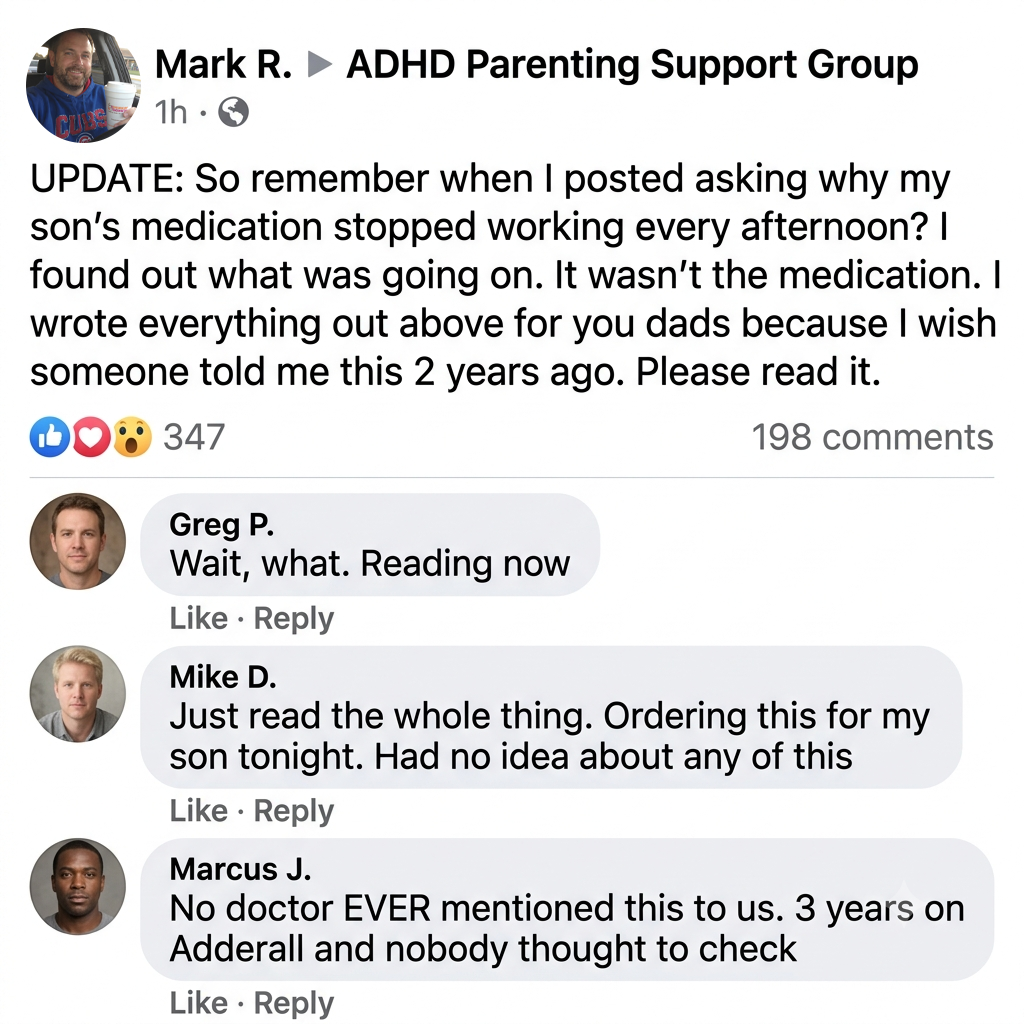
Mark Reynolds Facebook ad: “This helped my ADHD son a LOT”
Ran for 51 days, from July 1 to August 21, 2026, the last day Crush saw it.
Run by Mark Reynolds on Facebook. Crush is not the advertiser and does not verify its claims. See this ad in Meta's Ad Library(opens in a new tab)
Want an ad like this for your product?
Crush makes new ad images for your product from this ad: your logo, your product photo, your offer.
Trials from $19.95 USD, then $79.95 USD a month. Cancel anytime.
About this ad
- Meta Ad Library ID
- 1052745537084350
- Platforms
- Facebook, Instagram, Audience Network, Messenger and Threads
- Relaunches
- 0
Ad text
I saw a statistic that made me sick. Children diagnosed with ADHD are four times more likely to die before they turn 30 than children who weren't. Not twice as likely. Not 3 times. Four. I didn't believe it when I read it. My younger brother had been diagnosed with ADHD at six years old and not one doctor had ever mentioned his death. But here's the truth. Your child's pediatrician tracks their growth. Their psychiatrist tracks their behavior. The thing that's actually killing children with ADHD sits in the middle of all of them... and nobody is paid to look there. That's why most of us never heard this. That's why my mother never heard it either. My brother Danny was part of that statistic. Twenty-two years on stimulants. Adderall, then Ritalin, then back to Adderall, then the cocaine when the prescriptions stopped working. Overdose killed him at 28. I'm 41. Last month my pediatrician told me to put my 9-year-old son on the same medication that started Danny down that road. I refused. And what I found instead... in an Amish farming community in Pennsylvania… took my son from a boy I dreaded waking up every morning, who'd melt down over anything, who only wanted sugar — to a boy I only have to ask once, who eats real food, who comes home and tells me about his day. No Adderall. Nothing my brother ever took. But to understand why I was desperate enough to drive six hours to an Amish farm at 6 AM, you have to know what I watched ADHD medication do to my brother. And what I didn't know it was quietly doing to my own son. ======== For 22 YEARS... over two decades... my brother Danny was trapped on a treadmill nobody would let him off. It started in first grade. He couldn't sit still. The teacher called my parents. The pediatrician called it ADHD. Wrote the first prescription. Adderall, 5mg. Danny was six years old. The first year, the school stopped calling. My mother said the medicine was a miracle. By year three, the dose was 15mg. He couldn't fall asleep without melatonin. Stopped eating breakfast — said the medicine made him not hungry. Lost weight he didn't have to lose. You could see his ribs through his shirt when he raised his arms. By year five he was 11 and on 30mg. The crashes when the medication wore off were so bad he'd lock himself in his room from 6 PM until morning. My mother thought it was just how boys were. By high school he was failing every class — the medicine that worked at 10mg didn't work at 30mg. They added Concerta on top of the Adderall. He started smoking weed at 13 to "calm his brain down." His words. By college, the prescriptions weren't enough. He bought extra Adderall from a roommate. Then cocaine when the Adderall stopped touching him. Then opioids to come down from the cocaine. Then fentanyl, because by 2019 it was in everything. And every time my parents brought him to a new doctor, they said the same thing. "He's showing improvement. The ADHD is real. We just need to find the right combination." For TWENTY-TWO YEARS they kept "finding the right combination." Twenty-two years of dose increases. Twenty-two years of new prescriptions stacked on old ones. Twenty-two years of appointments where they'd switch the stimulant or add another pill... but never once... not ONE TIME... did anyone say, "Maybe something is wrong that this medication isn't fixing." And then the overdose took him anyway. 28 years old. Twenty-eight. My mother found him in his apartment on a Wednesday morning. The pill bottle on the nightstand was three days old. I was the one who had to identify him. I was the one who carried his casket. And I made myself a promise that day that I would never let a doctor do to a kid of mine what they did to my brother. I'm a man who keeps his promises. Or I thought I was. Because nine years later I almost broke that one. ======== So fast forward to about a year ago. I'm 41. Diagnosed with ADHD myself at 15. Twenty-four years on Adderall. I run a contracting crew — I can frame a house, but I couldn't sit through my own son's parent-teacher conference without my leg bouncing under the table. I'm a single dad. Divorced three years. I've got Caleb half the week — split custody. His mom and I do things different, and I'm not here to throw stones at her. But it means whatever I figure out, I'm figuring it out on my own, half the time, with no one to tag in when I'm running on empty. I take Caleb to his pediatrician for his annual checkup. Nine years old. Bright. Funny. Failing third grade. The nurse weighs him. 56 pounds — same as last year, and the year before that. Wraps the cuff around his arm. Pulse 94. The pediatrician pulls up his chart. Reads the teacher's report. Looks at me. "Mr. Reynolds, Caleb is showing every classic sign. Trouble focusing. Disruptive in class. He's not eating breakfast. He's not gaining weight. I'd like to start him on Adderall. 5mg, extended release. Starter dose." My jaw locked up. Adderall. Twenty-two years of watching my brother Danny shrink behind his eyes, year after year, while every doctor told my parents he was responding well to treatment. Twenty-two years of dose increases. Twenty-two years of "finding the right combination." And then the overdose took him anyway. "No," I said. She blinked. "Excuse me?" "I'm not putting him on Adderall. My brother was on stimulants for 22 years. I watched what they did to him. And I watched the overdose kill him anyway." She gave me that look. "Mr. Reynolds, untreated ADHD has serious long-term consequences. Children with ADHD lose up to 13 years off their lifespan. They're five times more likely to end up in prison. They're three times more likely to develop substance abuse problems as adults. We need to act." "I know all that," I said. "My brother was every one of those statistics. The medication didn't save him. It set him up." She didn't have an answer. I told her to give me three months. She wasn't happy. Wrote something in his chart. I didn't care. For three months I did everything right — on my days. Cut sugar from his diet. Added omega-3. Magnesium glycinate at bedtime. I tried the elimination diet for six weeks. I tried the mindfulness app. I read every book on the shelf. And that was the hardest part. Split custody means I only run the show half the week. At his mom's, none of it happened — different house, different rules, and I'm not knocking her, we just do things our own way. So nothing I tried was ever consistent. I was doing it with one hand tied behind my back, telling myself it probably wouldn't work anyway because I couldn't control the other half of his life. But I kept trying. It's all I knew how to do. Three months later we went back. Caleb was still 56 pounds. The dark circles under his eyes were worse. His teacher's report was the same. He was still waking up at 5 AM craving sugar. The pediatrician pulled out the prescription pad. "Mr. Reynolds, it's time." "Give me three more months." "Mr. Reynolds—" "Three more months." She sighed. I didn't care what she wrote. ======== That night I couldn't sleep. I sat at the kitchen table at 2 AM, looking at the prescription printout, thinking about Danny. Same starting dose he had at 6. Same family doctor who said it would help. Same path. And the worst part — the part I couldn't say out loud to anybody — was that I felt like a fraud. I'm the dad. I'm the one who's supposed to handle things. I can fix a transmission in a parking lot. I can run a crew of twelve men. And I could not fix my own son. I'd made a promise over my brother's casket and I was watching myself drive my own kid toward the same cliff. And I was doing it alone — no one in that house at 2 AM to tell me I wasn't crazy for hesitating. At 2:47 AM I gave up. Opened my laptop. I started searching. What actually causes ADHD behavior in kids. Why the medication works for some kids and ruins others. What the difference is — biologically — between a child who responds and a child who spirals. Every site said the same thing. Talk to your doctor. Behavioral therapy. Diet and exercise. Stick with the meds. I'd done all of it. So had Danny. So I kept digging. Looking for parents who'd actually solved this. Not managed it. Solved it. That's when I found the thread. A Reddit post with over 4,000 comments. The title... "Why don't Amish kids have ADHD?" I almost scrolled past. But something made me click. Lancaster County, Pennsylvania. Pediatric ADHD diagnosis rates 76% lower than the rest of the state. Not a little lower. Seventy-six percent. Person after person in the comments. Stories. Studies. Pictures of Amish children — six, seven, eight years old — focused, calm, working farm chores from sunrise without anyone medicating them. Someone posted a Google Maps link. An Amish farm. I looked at the clock. 3:14 AM. It was a Sunday — Caleb was at his mom's until Monday night. For once, the split schedule worked in my favor: I didn't have to explain myself to anybody. By 6 AM I was in my truck. By noon I was in Pennsylvania. ======== I didn't have an address. Just drove until I saw farmland. Turned down a dirt road when I spotted a hand-painted sign. "Vegetables and Herbs." First farm I came to, there was an old woman on the porch. Had to be pushing 80. Small. Thin. Gray hair pulled back under a white cap. She was cracking black walnuts into a clay bowl. Her hands were stained dark from the hulls. The cracking was steady, fast, rhythmic. No reading glasses. No hunched back. Just easy, continuous work. I parked and walked up to the porch. I'm a big guy, and I felt my hands shaking — three coffees, no sleep, and I'd forgotten my morning Adderall. "Excuse me, ma'am," I said. "I don't want to bother you. But how old are you?" She looked up with sharp, clear eyes. "Seventy-eight." I stood there. 41 years old. A grown man, hands shaking. And this woman almost twice my age was cracking walnuts like a metronome. "I'm 41," I said. "I have ADHD. So does my son. My doctor wants him on the same medication that killed my brother. And I don't know what to do. I've never not known what to do." She set down the bowl. Looked at me for a long moment. "You came here for a reason," she said. "Come inside. I'll show you something." ======== Her kitchen smelled like coffee and rising bread. She poured me a cup without asking. Pulled out a chair. "Your son's medicine," she said. "It works on the wrong organ." I didn't understand. "They told you ADHD is a brain problem. So they give him a pill that whips the brain. But the brain isn't where the problem starts." She tapped her stomach. "The problem starts here." She folded her hands on the table. "There's a chemical called serotonin. It's what tells a child's brain to sit still. To focus. To feel calm. To sleep at night. To eat. To not crave only sugars. It's the one chemical your son's brain can't make enough of." She looked at me. "But here's what nobody tells you. Ninety percent of serotonin isn't made in the brain. It's made in the gut. Right here." She tapped her stomach again. "A child's gut makes the serotonin. Sends it up to the brain. The brain uses it to regulate everything they call 'ADHD.' Focus. Mood. Sleep. Appetite. Impulse. All of it." She shook her head slowly. "But when the gut goes silent — when there's bad bacteria, when there's yeast, when there's parasites the doctors aren't trained to look for, when the wall is leaky — the gut stops making the serotonin. And no medication on earth puts serotonin back into a damaged gut." She leaned forward. "That's why the Adderall works less every year. The pill doesn't fix the gut. It just whips the brain to use the little serotonin it has left, harder and faster, until there's nothing left to whip. Then they raise the dose. Then it works for a while. Then it stops working again. And the cycle never ends." She looked me straight in the eye. "More children than anyone admits don't have an ADHD brain. They have a damaged gut. And they're being given a pill that medicates the wrong organ for the rest of their lives." My eyes started to burn. I'm not a man who cries. I hadn't cried since the funeral. I had to look at the table. "That's why your son's behavior is getting worse no matter what diet you try. That's why he won't eat breakfast. That's why he wakes up craving sugar — his body is screaming for the energy his gut can't extract. That's why he can't sit still. His brain is starving." She reached across the table and tapped her finger once. "That is what killed your brother. Not his ADHD. Not even the Adderall, not really. A gut that went silent when he was six years old, a brain that ran on empty for 22 years while his doctors kept treating the wrong organ, and a young man who started looking for the chemicals he was missing in the wrong places." I asked her how she knew. She smiled. A small smile. "My grandmother was a midwife. Her grandmother was a midwife. Every farmhouse in this valley has a black walnut tree. For three hundred years we've given the hulls to our children. From the time they can walk." Black walnut. I'd seen capsules at the health food store. She must have read my face. "That's not what you think it is," she said. "What's in your store is shells. Not medicine." She stood up. Walked to a cupboard. Pulled down a glass jar. Inside was a dark liquid. Almost black-green. "The medicine in black walnut is in a compound called juglone," she said. "It clears out what doesn't belong in the gut. The bad bacteria. The yeast. The parasites the children pick up from the dirt and the water and the food, that no doctor in this country tests for." She held up the jar. "But juglone is delicate. Air kills it. Heat kills it. Light kills it. If you don't extract it cold, fast, in the dark, within hours of opening the hull — it's gone. The factories dry the hulls with heat because it's cheap. They grind them. They put the powder in capsules. The fathers and mothers who buy it get nothing. Their children's guts stay damaged. Their brains keep starving. Nothing changes." She set the jar down. "And the second part. Once the gut is cleared, it has to be fed. The wall has to heal. The good bacteria have to grow back. And the brain has to get the minerals it's been starving for." She looked at me. "Zinc. Magnesium. Tryptophan. The three things missing from every kid being diagnosed today. The body can't absorb them through a damaged gut. So you have to clear the gut, then heal the wall, then deliver the minerals in liquid form, with the right plants, in the right order. That's all of it." I asked her if anyone sold this the way she was describing. She nodded. "My grandson works with one company. Only one. Took them seven years to get it right. Wild-harvested black walnut. Cold extraction within hours. Eleven plants in total — the ones that clear the gut, the ones that heal the wall, the ones that feed the brain. All in one liquid. One dropper a day." She wrote the name on a piece of paper and handed it to me. Nutriveen. I ordered it from her kitchen table. The bottle arrived two days later. ======== I gave Caleb the first dropper that night. Mixed it into his juice — raspberry flavor, he didn't even notice. I waited for something to happen. A flip. A switch. A sign. Nothing happened that night. Nothing happened the next morning either. I almost gave up by Tuesday. I'd convinced myself I'd been desperate enough to drive six hours to Pennsylvania for nothing. Then on day three, I noticed something I almost missed. Getting him out of bed took twenty minutes instead of forty-five. He sat at the table while I made his lunch instead of bouncing around the kitchen. He didn't fight me about putting his shoes on. I didn't say anything. I was afraid to. By the end of the week, the knot I carried in my chest before he even opened his eyes in the morning... was easier. Not gone. Easier. Week one. He ate broccoli at dinner on Tuesday. Broccoli. The thing he'd refused for over a year. He didn't finish it but he ate three pieces. I watched him from across the table and kept my mouth shut. Thursday I made roast chicken — a real dinner, the kind I usually don't have the energy to cook after a day on the job site. He had two helpings. I stood at the counter and watched him eat and didn't say a word. Week two. His teacher emailed us. "I don't know what changed but Caleb participated in math today. He answered three questions in a row. He hasn't done that all year." I read it twice sitting in my truck at a job site. Week three. The dark circles started fading. Not gone. Lighter. He ate breakfast. A whole breakfast. Eggs and toast. Week four and five came and went. Small things kept improving — fewer fights at bedtime, more food at dinner, mornings that didn't end with me white-knuckling the steering wheel before work. I was afraid to count the wins. Week six. Sunday afternoon his little cousins came over. The 4-year-old grabbed a toy out of his hand. I braced for it. The scream. The hit. The hour of damage control I'd have to do in front of my whole family. It didn't come. He looked at her. He took a breath. He said, "I was using that." She gave it back. I know how this sounds, but I felt my throat close up right there at my own kitchen counter. I had to turn to the sink and run the water so nobody in that house would see my face. A grown man, can't get a word out, over a kid sharing a toy. Nothing was wrong. That had never happened before in nine years. Week eight. It was one of my Saturdays with him. I had to run to the hardware store for a few things. The checkout line was always the trigger — and when it's just the two of you, there's nobody to leave him home with. So he came. We got to the register and he picked up a small flashlight off the impulse rack. "Dad, can we get this?" "Not today." "Okay." That was it. Okay. He put it back. Walked next to me to the truck. Buckled himself in. I sat in the parking lot for ten minutes before I drove home. Just staring at the steering wheel. For years I had not been able to take this kid into a store without bracing for a fight. He had just said okay. His follow-up appointment was at the end of month three. The pediatrician put Caleb on the scale. Frowned. Did it again. "Sixty-six pounds. Mr. Reynolds, what are you doing?" She pulled up his chart. Looked at his teacher's latest report. Looked at me. "He's at grade level in reading for the first time. His behavior incidents are down to one this month from twelve last month. What changed?" I told her. The Amish grandmother. The wild-harvested black walnut hull. The liquid plants. The order. She typed. Nodded slowly. "I'm not going to tell you to stop. Whatever you're doing — keep doing it. We can hold off on the prescription." That was four months ago. Caleb this morning? Eating eggs and toast at the kitchen table. Asking when his soccer practice starts. He sleeps from 8 PM to 6:30 AM. No medication. No Adderall. No Ritalin. Nothing my brother ever took. The dark circles are gone. He's at 69 pounds. Up 13 from where he started. He laughed at a joke last Saturday. A real laugh. From his stomach. I realized I hadn't heard him laugh like that in over a year. I called my mother that night. Told her about Caleb. Long silence. "Danny never had this, did he," she said. "No, Mom. He didn't." "You did what we couldn't, honey. You found another way." That's the first time in my life my mother ever said something like that to me. I had to pull the truck over. ======== If you're reading this, you probably see yourself in my story. Maybe you're the dad who feels like he's supposed to have the answer and doesn't. I was you. Maybe you're doing it across two houses, half the week, telling yourself it'll never work because it's not consistent — mom does it her way, you do it yours, and all you can say for yourself is that you're trying. I was you there too. It still worked. Your child is "showing signs." Or already diagnosed. Or already medicated and getting worse no matter what dose. The teacher has called. The IEP meeting is scheduled. The pediatrician has used the word Adderall, or Ritalin, or Concerta, or Vyvanse. You've tried omega-3. You've tried magnesium. You've tried the elimination diet. You've tried earlier bedtimes, later bedtimes, no screens after six, no sugar after lunch, every behavioral chart on Pinterest. None of it touched it. But now you know why. You weren't fixing the problem. You were sanding the wood while the foundation rotted underneath. Your child's brain isn't broken — it's starving. The serotonin isn't being made in the only place it gets made. The minerals aren't being absorbed through a wall that's leaking. And no pill, no diet, no behavioral chart on the fridge will fix a gut that's gone silent. Nutriveen is different. Wild-harvested black walnut hull, not factory-dried capsules. Cold-extracted within hours of opening the hull, not heat-processed powder. Eleven plant extracts total — seven that clear the gut of bacteria, yeast, and parasites; four that repair the wall and feed the good bacteria. Zinc, magnesium, and tryptophan delivered directly through the liquid base. No iodine. Third-party tested. Raspberry flavor with bitter blocker — your child takes it without battles. One dropper a day. Mixable with juice or water. Try Nutriveen for 30 days. Track three things every Sunday morning: sleep duration, behavior incidents at school, weight. If your child isn't sleeping deeper, if the meltdowns aren't fewer, if the weight isn't moving, if your gut tells you nothing has changed... full refund. No questions. ======== You're at a crossroads. One path. Take the prescription. Start the Adderall. Hope your kid is one of the lucky ones. Hope the comedown isn't bad. Hope they don't lose 10 pounds the first month. Hope they sleep at night. Hope they don't hate themselves on the medication. Hope they don't grow up to look for the chemicals they're missing somewhere worse, the way my brother did. Spend the next 15 years adjusting doses while the real problem never gets touched. Watch the same thing happen to your child that happened to mine. Another path. Try what I tried. Wake up the gut. Let your child's brain finally get what it's been missing for years. Track the changes in 30 days. See for yourself. I chose the second path. It gave me my son back. And it may have saved his life. The medical system isn't coming to save your child. The pediatrician isn't trained to look at the gut. The neurologist isn't trained to look at the gut. The psychiatrist isn't trained to look at the gut. Nobody is looking at the place where 90% of serotonin gets made. Every year you wait is another year your child's brain runs on empty. Another year their gut stays damaged. Another year closer to the statistics — the 13 years off their life expectancy. The 5x prison rate. The 3x substance abuse risk. My brother became those statistics. My son won't. Yours doesn't have to either. — Mark Reynolds https://nutriveen.com/products/gut-brain-balance P.S. By day three, mornings were easier. By week one, he was eating food he'd refused for a year. By week eight, he said "okay" when I told him he couldn't have a flashlight at the hardware store — the first time in nine years he'd taken no for an answer without a fight. The pediatrician put the Adderall conversation away at month three. Your timeline might be different. But you won't know until you try. P.P.S. I started taking Nutriveen myself eight weeks after Caleb did. Two droppers a day, the adult dose. I've cut my Adderall in half — first reduction in 24 years. My resting heart rate is down to 70 from 108. I sleep through the night for the first time since my twenties. Last week I caught myself saying something out loud, alone in my kitchen, that I never thought I'd say: "I think I'm actually okay." Danny never got to feel that. Caleb does. So can your child. https://nutriveen.com/products/gut-brain-balance
Where the ad sends people
nutriveen.com
This helped my ADHD son a LOT
Nutriveen
Learn more: nutriveen.com(opens in a new tab)