Annuityai
 Facebook ad: “Strategy Before Product: Take the Assessment”
Running for 69 days since September 15, 2026. Crush last saw it on November 23, 2026.
Run by Annuityai on Facebook. Crush is not the advertiser and does not verify its claims. See this ad in Meta's Ad Library(opens in a new tab)
Make your own version of this ad
Crush makes it, launches it in your own Meta ad account, scales the winners and pauses the losers.
About this ad
- Meta Ad Library ID
- 1053130360936965
- Platforms
- Facebook, Instagram, Audience Network and Threads
- Relaunches
- 2
- Niche
- AI & Software
Ad text
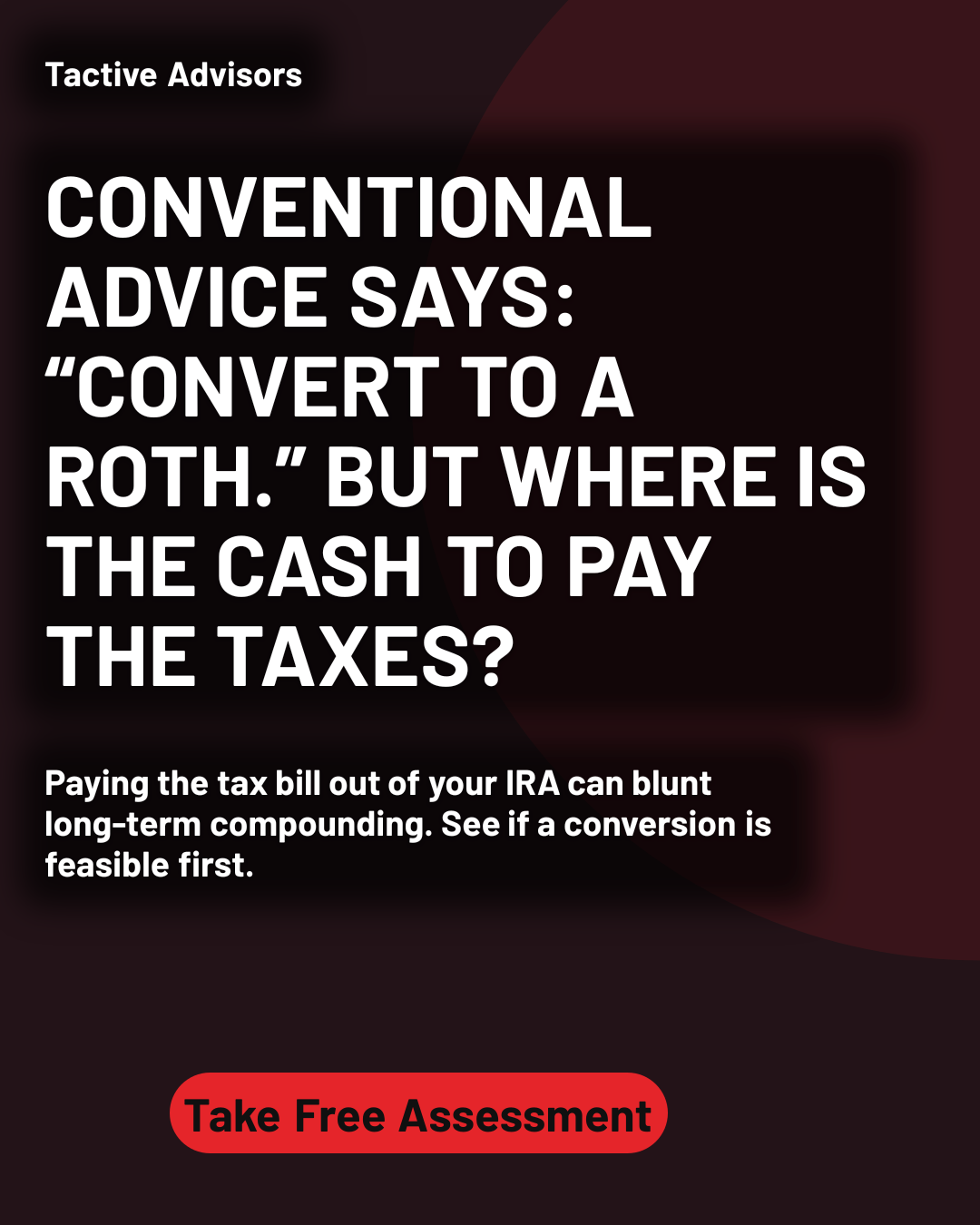
If your IRA or 401(k) is worth $750,000 or more, conventional advice says: “Convert to a Roth before tax rates go up.” You have probably heard the warnings about the national debt, expiring tax cuts, and Required Minimum Distributions. Every financial commentator seems to repeat the same formula: pay the taxes today, lock in zero taxes for life, and leave a tax-free inheritance to your kids. On paper, it sounds simple. Why leave Uncle Sam as an involuntary partner in your retirement savings when you could just pay the toll now and be done with it? For a select group of savers, a Roth conversion makes total sense. Yet in the rush to push people into massive conversions, mainstream financial advice ignores the single most critical question on your balance sheet: Where is the money to pay the taxes coming from? A Roth conversion is not a clerical transfer. It is a taxable event. When you move $100,000, $250,000, or $500,000 from a traditional IRA to a Roth, the IRS treats every dollar as ordinary taxable income in the year you convert. If you have built a nest egg of $750,000 to $2,000,000 or more, moving a meaningful sum does not produce a small administrative charge. It triggers a five- or six-figure tax bill. Evaluating Roth opportunity is easy. Evaluating implementation feasibility is where most plans break down. To see why, look at what happens when that tax bill comes due. Imagine you decide to convert $200,000 from your traditional IRA. At an estimated combined federal and state tax rate of 25%, the tax liability is roughly $50,000. If you have sufficient cash sitting outside your retirement accounts, in high-yield savings or a taxable brokerage account, you can write a $50,000 check directly to the IRS. The entire $200,000 lands inside the Roth IRA completely intact. Every single dollar starts compounding tax-free for the rest of your life. In that situation, the conversion works as advertised. You exchanged taxable cash outside for tax-free growth inside. Now look at what happens if you do not have $50,000 in liquid non-retirement cash. You do what thousands of retirees are quietly told to do: you have the taxes withheld directly from the IRA conversion itself. $50,000 goes straight to the government, and only $150,000 actually arrives in your Roth. You did not have to write a separate check, but you just paid what financial professionals call the Compounding Penalty. By taking money out of the IRA to pay the tax, you permanently wiped out $50,000 of working capital from your balance sheet. That money is no longer compounding in your traditional IRA, and it never made it into your Roth IRA. It is gone forever. For that transaction to break even, the remaining $150,000 in your Roth has to outperform the market just to make up for the 25% loss of capital on day one. In many cases, liquidating retirement assets to cover the tax blunts your wealth so severely that you would have been far better off leaving the money alone and taking gradual distributions later. If you cannot pay the tax bill with outside cash, the feasibility of an aggressive conversion drops dramatically. Even if you have the cash, converting large amounts can trigger a chain reaction of tax surprises. The tax code is full of hidden thresholds that standard planning software frequently misses. First is the Medicare IRMAA cliff. If you are 63 or older, the income you report this year directly determines what you pay for Medicare Part B and Part D two years from now. Unlike income tax brackets, Medicare surcharges operate on strict cliffs. If your Roth conversion pushes your income just one dollar over an IRMAA tier, your monthly healthcare premiums can jump significantly for an entire year. When you add those healthcare surcharges to the conversion bill, your true marginal tax rate on that money could climb well above 35%. Second is the Social Security tax torpedo. If you are already collecting Social Security, adding taxable conversion income can trigger rules that make up to 85% of your benefits subject to income tax. Many retirees who believe they are converting in a modest 12% or 22% bracket end up paying effective rates over 30% because of the simultaneous tax on their benefits. Third is capital gains and investment surcharges. Higher income from a conversion can push your adjusted gross income over statutory limits, triggering the 3.8% Net Investment Income Tax on your dividends and pushing long-term capital gains into higher brackets. Does this mean Roth conversions are a mistake? Not at all. It means the timing of the conversion matters just as much as the decision itself. One of the biggest mistakes pre-retirees make is converting while still in their peak earning years. If you are 60 years old and earning a high salary, converting an extra $100,000 means paying top-dollar taxes today just to avoid an unknown tax rate tomorrow. For many households, the ideal window is the Tax Valley. The Tax Valley is the gap between the day you retire and the day Required Minimum Distributions begin at age 73 or 75. During those bridge years, your employment income drops to zero. You may choose to delay Social Security until age 70. And because you have not reached RMD age, the IRS cannot force you to withdraw funds from your pre-tax accounts. Your taxable income may drop to historic lows, placing you in modest tax brackets for the first time in decades. That is where surgical, gradual bracket-filling makes sense. Instead of converting everything at once, you convert just enough each year to fill lower brackets, keeping taxes manageable without triggering Medicare penalties or draining your reserves. Why does conventional advice rarely explain this? First, most free online calculators are oversimplified. They ask for your age, balance, and assumed tax rate, but ignore outside cash, Medicare cliffs, state taxes, and Social Security timing. Second, tax fears are often used to sell predetermined products. You may have heard claims that an annuity bonus pays your conversion taxes, or that an insurance product makes taxes disappear. No financial product eliminates your tax obligations to the federal government. A Roth conversion is a tax-management process, not an investment product. Any strategy that prescribes a product before evaluating your outside liquidity and retirement timeline is putting the cart before the horse. When households evaluate both opportunity and feasibility, their situation usually aligns with one of three potential discussion pathways: Pathway 1: The Feasible Partial Conversion For households with meaningful pre-tax balances, dedicated outside cash to cover taxes, and a clear Tax Valley before RMDs begin. You methodically convert just enough each year to fill lower brackets without crossing into higher tiers. Pathway 2: The Strategic Preservation Pathway For households where most wealth is tied up in pre-tax accounts, projected retirement spending is modest, or charitable giving through Qualified Charitable Distributions will naturally reduce future taxes. Preserving the traditional accounts is often mathematically superior to forcing an expensive conversion. Pathway 3: Multi-Bucket Asset Coordination For households prioritizing long-term flexibility by balancing pre-tax, taxable, and tax-free accounts. This allows you to draw income efficiently while keeping a tax-free reserve for unexpected healthcare or major life expenses. Because every household balance sheet is different, there is no one-size-fits-all rule. Under current tax law, a Roth conversion is permanent. Once completed, it cannot be undone. Before making an irreversible tax decision, see whether a conversion is even feasible for your situation. The Roth & Tax Strategy Assessment analyzes your total household picture: outside liquidity, retirement timing, and potential discussion pathways to review with a qualified advisor. It is free, educational, and takes just a few minutes. Tap below to complete the free Roth & Tax Strategy Assessment.
Where the ad sends people
harmonious-pyramid-reign.heyflow.site
Strategy Before Product: Take the Assessment
See details: harmonious-pyramid-reign.heyflow.site(opens in a new tab)