Stacy Larson
 Facebook ad: “The Bible Question Pastor Brian Couldn't Forget”
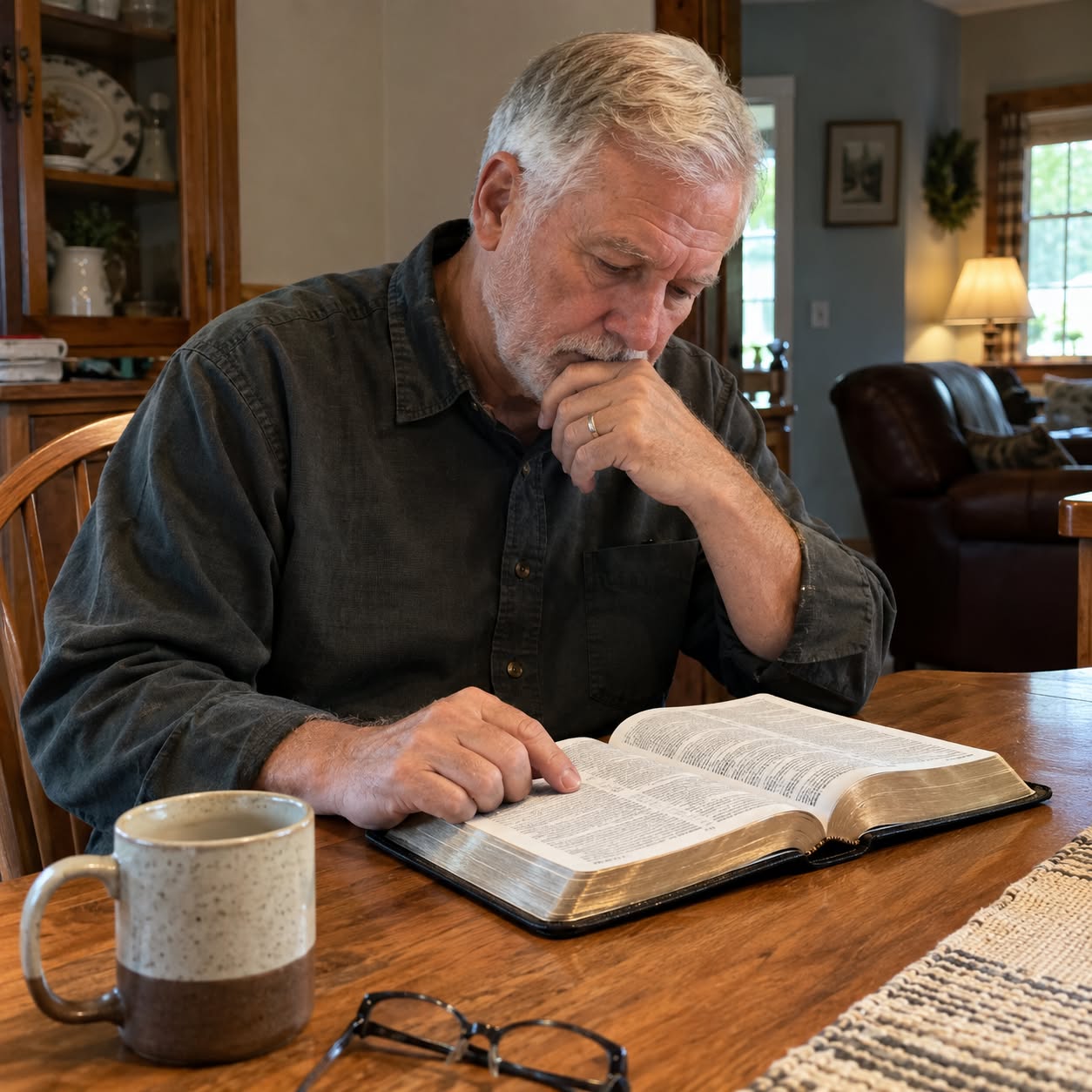
Ran for 2 days, from October 22 to October 24, 2026, the last day Crush saw it.
Run by Stacy Larson on Facebook. Crush is not the advertiser and does not verify its claims. See this ad in Meta's Ad Library(opens in a new tab)
Make your own version of this ad
Crush makes it, launches it in your own Meta ad account, scales the winners and pauses the losers.
About this ad
- Meta Ad Library ID
- 1110974765164086
- Platforms
- Facebook, Instagram, Audience Network, WhatsApp and Threads
- Relaunches
- 0
- Niche
- Education & Courses
Ad text
My pastor spent 32 years teaching from the same Bible. Then he discovered a passage in the New Testament that led him to a book he had never read. His name was Pastor Brian. And the question he asked me one Sunday afternoon is something I haven't been able to forget. "Why does Jude quote Enoch if most of us have never been given the chance to read Enoch?" I didn't know what he meant. I've been a Christian for most of my life. I have a King James Bible beside my bed, another in the living room, and a smaller one that belonged to my mother. I've read through the New Testament more times than I can count. But I had never heard anyone ask that question. Not once. And Brian was the last person I expected to hear it from. He wasn't one of those preachers who chased strange theories or claimed to know secrets nobody else understood. He believed in studying Scripture carefully, comparing passages, and being cautious about anyone who claimed to have discovered something the whole church had missed. For 32 years, he had preached from the same worn Bible. He knew it so well that he could find almost any passage without looking at the table of contents. And if someone brought him a book about hidden scriptures, he'd usually tell them to spend more time reading the Bible they already owned. That's why what happened next surprised me. It started with a question from a young man in our Wednesday Bible study. We were reading the little book of Jude. Just one chapter. Most people overlook it because it's so short. But halfway through the discussion, the young man raised his hand. "Pastor Brian, who's Enoch?" Brian smiled. "The seventh from Adam." The young man looked down at his Bible. "No, I mean where can I read what he said?" Brian turned to Jude 1:14. "And Enoch also, the seventh from Adam, prophesied of these, saying, Behold, the Lord cometh with ten thousands of his saints." Then he stopped. Because the young man had asked a perfectly reasonable question. And Brian didn't have a complete answer. He knew the name Enoch from Genesis. He knew the New Testament passage. He had studied the history of the biblical canon in seminary. But he had never actually sat down and read the ancient Book of Enoch from beginning to end. For a man who had spent three decades encouraging people to study Scripture, that bothered him. He told us afterward that he went home and pulled out his old seminary notes. Then he went to the library. Then he started comparing translations and reading about the Ethiopian Orthodox Church. What he discovered wasn't that every Bible had once contained the same 88 books. The history was much more complicated than that. Different Christian traditions had preserved different collections of sacred writings over the centuries. But one thing kept coming up in everything he read. The Ethiopian Christian tradition had preserved books he had spent his entire ministry barely discussing. The Book of Enoch. The Book of Jubilees. The books of Meqabyan. And other writings that were unfamiliar to most people sitting in our church. He kept thinking about that young man's question. Where can I read what Enoch said? Three weeks later, Brian came to our Sunday class carrying something I'd never seen before. It was a thick Bible with a brown hardcover and gold lettering. He set it on the table beside his old King James Bible. And he asked us to look at the two. "How many books are in your Bible?" Someone said sixty-six. "That's right," Brian said. "Now, how many of you have ever heard of the Ethiopian Bible with eighty-eight?" Nobody raised a hand. Not even me. He opened the larger book and showed us the contents. Then he did something I didn't expect. He told us not to buy anything. "Before you decide whether these writings deserve a place on your bookshelf, I want you to do some reading." He gave us three assignments. First, read Jude 1:14 in the Bible we already owned. Second, find the opening chapter of First Enoch and compare the language. Third, look up the history of the Ethiopian biblical canon for ourselves. He said we didn't have to agree with every interpretation or treat every ancient Christian writing the same way. But we should at least know what they contained. I went home thinking that would be the end of it. It wasn't. That evening, I opened my King James Bible to Jude. I had read that verse before. Many times, probably. But this time I paid attention to something I had never thought about. Jude was referring to a prophecy attributed to Enoch. I looked up the passage in First Enoch. And there it was. The same ancient tradition, preserved in a book I'd never read. Now, I understand that quoting a writing doesn't automatically settle whether it belongs in the Bible. Brian explained that himself. But it raised another question. How many other connections had I missed simply because I had never opened these texts? The next morning I started reading about Jubilees. Then about the Ethiopian Orthodox Church. Then about the Dead Sea Scrolls, where ancient manuscripts of Enoch and Jubilees had been discovered. I had always imagined the history of the Bible as one straight line. A single collection of books, passed from generation to generation, exactly the same everywhere. Instead I found a history that was older, richer, and more complicated than I realized. And I couldn't believe I had reached my age without learning more about it. That Friday, my husband noticed the notebook on the kitchen table. "What are you working on?" I told him about Pastor Brian and the Ethiopian Bible. He laughed a little. "Don't tell me we're getting another Bible. We already have enough to fill a shelf." I told him I wasn't planning to buy anything. I only wanted to understand something. Then I showed him Jude 1:14. He read it. I showed him the corresponding passage in Enoch. He read that too. Then he asked for the notebook. For the next twenty minutes he sat there comparing the passages while I made dinner. Eventually he looked up. "Why didn't we ever study this in church?" I said I didn't know. He closed the Bible and pushed it toward me. "Ask Brian where we can get a copy." That's the part that stayed with me. My husband isn't someone who gets excited about buying books. Especially religious books. He has owned the same King James Bible since we got married. But he wanted to read these writings for himself. Not because someone had frightened him. Not because he thought the end of the world was coming next Tuesday. Because he was curious. And because, after all those years, he had found something about the history of Scripture he wanted to understand better. The following Sunday, I asked Pastor Brian which edition he had brought to class. He showed me the brown-and-gold hardcover again. It was called The Complete Ethiopian Bible in English, by Abundina. He explained why he'd chosen it as a study edition. It brought together 88 books in English, including Enoch and Jubilees, in one large hardcover volume. The pages were spacious enough for him to follow along comfortably, and there was digital access for reading away from home. But what mattered to Brian wasn't the cover or the size. It was having the texts together where he could actually compare them. He said something I wrote down that afternoon. "You don't have to stop loving the Bible you grew up with to become curious about the books another Christian tradition preserved." I think that was what finally settled it for me. I didn't want to replace my King James Bible. It belonged to my mother. There are handwritten dates in the front cover, prayers in the margins, and passages she underlined before I was even born. Nothing is replacing that. I simply wanted another book beside it. One that would let me read the ancient writings Brian had introduced to us. And maybe answer a few questions I'd been carrying around for years. So I started looking into the edition he had shown us. The Abundina Bible was a substantial brown-and-gold hardcover, not a thin paperback. It contained 88 books, with Enoch, Jubilees, and other writings collected in English. It came with digital reading access, too. And there was a 30-day money-back guarantee, which made the decision easier. But before ordering, I found something that I thought was even more helpful. An article explaining five reasons why the Ethiopian Bible might deserve a place in a Christian home. It walked through the difference between the 66-book Protestant Bible and the broader Ethiopian tradition, introduced writings such as Enoch and Jubilees, and explained why so many readers were interested in them. That was exactly the kind of explanation I had wished someone had given me years ago. Not a demand to throw away my Bible. Not a demand to believe a stranger. Just an invitation to read, compare, and decide. I sent the article to my sister. Then I sent it to my daughter. Because I remembered something Pastor Brian had said at the end of our class. "Don't let somebody else's confidence substitute for your own understanding. Open the books. Read the words. Ask the questions." After all these years of sitting in church, that seems like pretty good advice. So that's what I'm passing along. If you've read your Bible your whole life but have never opened the Book of Enoch, start with Jude 1:14 tonight. Read the verse. Then look up First Enoch. And if you want to understand why the Ethiopian Christian tradition has preserved a broader collection of writings, read the five reasons below. You don't have to agree with every conclusion. You don't have to replace the Bible you already love. You only have to be willing to look. 👉 Read the 5 Reasons Why This Ethiopian Bible Belongs in Every Christian Home: https://abundina.com/pages/5-reasons-why-this-ethiopian-bible-belongs-in-every-christian-home P.S. If you're wondering whether the Ethiopian Bible is meant to replace your King James Bible, that was my first question too. I found it much more useful to think of it as an additional resource for studying a different Christian biblical tradition. P.P.S. The edition Pastor Brian showed us was the Abundina brown-and-gold hardcover. It's an 88-book English collection with digital reading access included. Every order is covered by a 30-day money-back guarantee. P.P.P.S. If you're not sure where to begin, try the same three things Brian gave our class: Jude 1:14 in your own Bible, First Enoch chapter one, and a little reading about the Ethiopian Orthodox canon. You may end up with questions you never thought to ask. P.P.P.P.S. The one thing I wish I'd done sooner was take that young man's question seriously. Sometimes a question you've never asked can lead you to an entire shelf of books you've never opened. 👉 https://abundina.com/pages/5-reasons-why-this-ethiopian-bible-belongs-in-every-christian-home
Where the ad sends people
abundina.com
The Bible Question Pastor Brian Couldn't Forget
By Sarah Mitchell · June 2026 · 5 min read What if the Bible you've been reading your entire life was missing 22 books? Not accidentally — but deliberately removed by religious councils in 90 AD. Ethiopia never accepted those removals. For over 1,600 years, the Ethiopian Orthodox Church preserve...
Learn more: abundina.com(opens in a new tab)