Manakkal Remedies Coimbatore
Manakkal Remedies Coimbatore Facebook ad: “Call our Doctors”
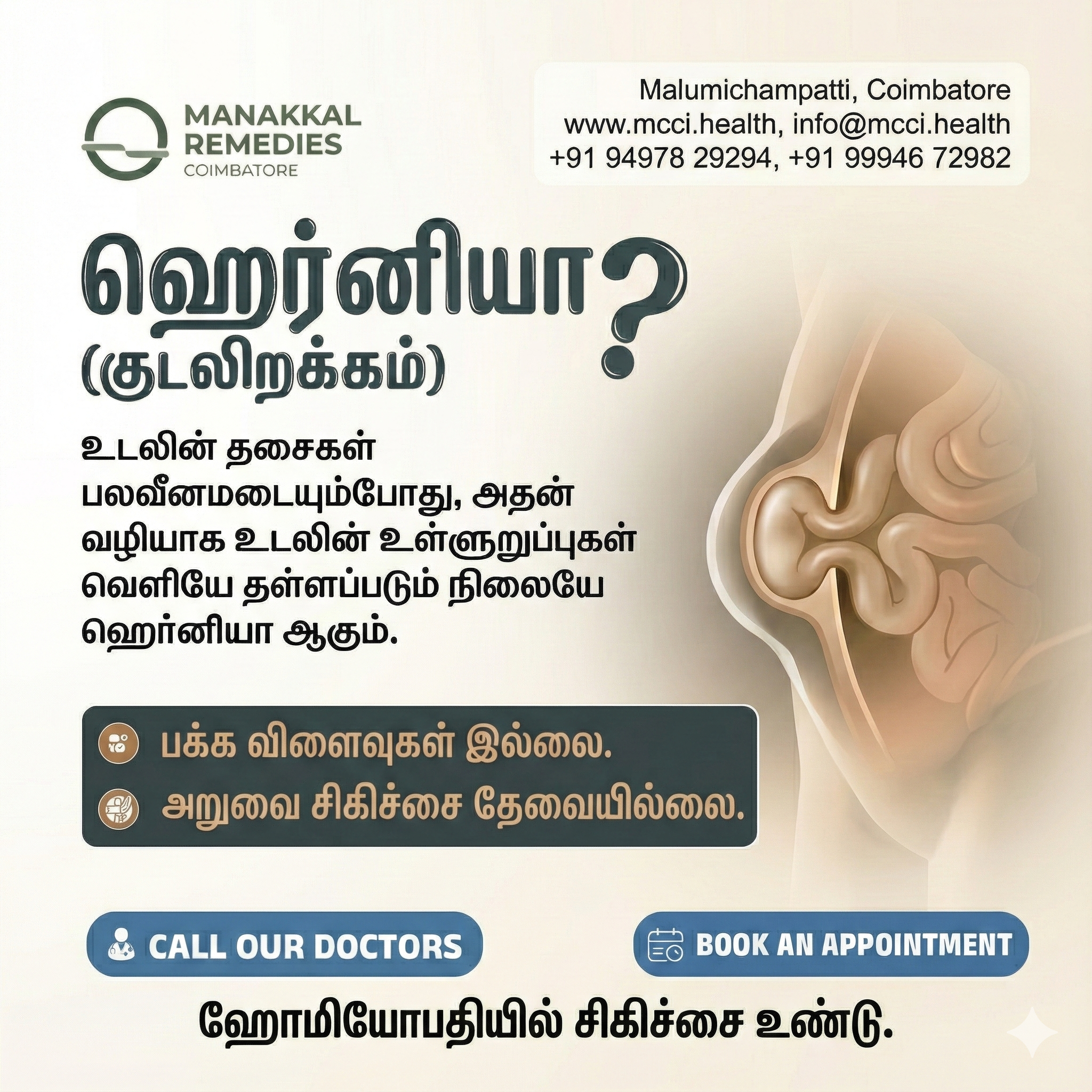
Ran for 34 days, from March 6 to April 9, 2026, the last day Crush saw it.
Run by Manakkal Remedies Coimbatore on Facebook. Crush is not the advertiser and does not verify its claims. See this ad in Meta's Ad Library(opens in a new tab)
Want an ad like this for your product?
Crush makes new ad images for your product from this ad: your logo, your product photo, your offer.
Trials from $19.95 USD, then $79.95 USD a month. Cancel anytime.
About this ad
- Meta Ad Library ID
- 1183616553665670
- Platforms
- Relaunches
- 1
Ad text
Specific types of Hernias include: Inguinal hernia. Inguinal hernias are the most common type, accounting for 75% of all hernias. They mostly affect men. They happen when part of your bowel protrudes into your inguinal canal, a passageway that runs down your inner thigh. Femoral hernia. A femoral hernia is a less-common type of groin hernia that occurs in the femoral canal, which runs underneath the inguinal canal. Fatty tissue may poke through. Hiatal hernia. A hiatal hernia is another common type of hernia that you acquire during your lifetime. It happens when the opening in your diaphragm — where your esophagus passes through — widens, and the top of your stomach pushes up through the opening into your chest. Congenital diaphragmatic hernia. A congenital diaphragmatic hernia is a serious birth defect in which the diaphragm doesn’t close all the way during fetal development. It can cause abdominal organs to slip up into the chest cavity while the organs are still growing, crowding the lungs. Incisional hernia. An incisional hernia occurs when tissue protrudes through a former incision in your abdominal wall that weakened over time. It’s a common side effect of abdominal surgery. Umbilical hernia. An umbilical hernia occurs when part of your intestine pokes through an opening in your abdominal wall near your belly button. Most umbilical hernias are congenital (present from birth). Ventral hernia. A ventral hernia is any hernia that occurs through the front wall of your abdomen. It includes umbilical hernias and incisional hernias. An “epigastric hernia” is a ventral hernia above the belly button. Perineal hernia. A perineal hernia occurs when organs or tissue push through an opening or weakness in your pelvic floor into your abdominal cavity. These hernias are relatively rare. How common are hernias? Overall, hernias are common, though some types are more common than others. Inguinal hernias affect around 25% of all men. Hiatal hernias affect around 20% of people in the U.S. and 50% over the age of 50. Congenital hernias occur in about 15% of newborns, mostly umbilical. Incisional hernias make up about 10% of hernias, and all other types make up another 10%. How serious is a hernia? Most aren’t serious, but they can be. They can also become more serious over time. A hernia becomes serious when it gets stuck in the hole that it’s pushed through and can’t go back in. This can become painful, and in severe cases the tissue can become cut off from blood supply, causing necrosis (tissue death). Since hernias tend to worsen over time, most will need surgical repair sooner or later. Symptoms and Causes What are hernia symptoms? Not all hernias cause symptoms and different types of hernias may cause different symptoms. One telltale sign of a hernia is a visible lump or bulge that appears during certain activities or in certain physical positions and goes back in at other times. You may also feel pressure, a dull ache or pinching when the hernia comes out. It may come out when you’re straining, lifting, laughing or coughing. What does a hernia look like? When you can see it, it looks like a bulge where you shouldn’t have one. Some typical places are in your abdomen or at the top of your inner thigh. It may be visible sometimes but not others. Some hernias are too deep to be visible from the outside, including femoral hernias and hiatal hernias. What does a hernia feel like? You may not feel it at all, or you may feel pressure, a dull ache or a sharp pain when the hernia comes through the opening. If you have frequent discomfort, you should see a healthcare provider right away. A hiatal hernia, in particular, may cause chronic acid reflux. You may feel it as heartburn or indigestion.
Where the ad sends people
Call our Doctors
A hernia occurs when an internal organ or tissue pushes through a weak spot in the surrounding muscle or connective tissue (fascia), often causing a visible bulge. They are generally classified by location, and their severity ranges from asymptomatic to life-threatening. While most hernias do not di...
Whatsapp message: api.whatsapp.com(opens in a new tab)