
Inactive· since Jun 19, 2026
- 10
- days it ran
- 0
- relaunches
Ad copy
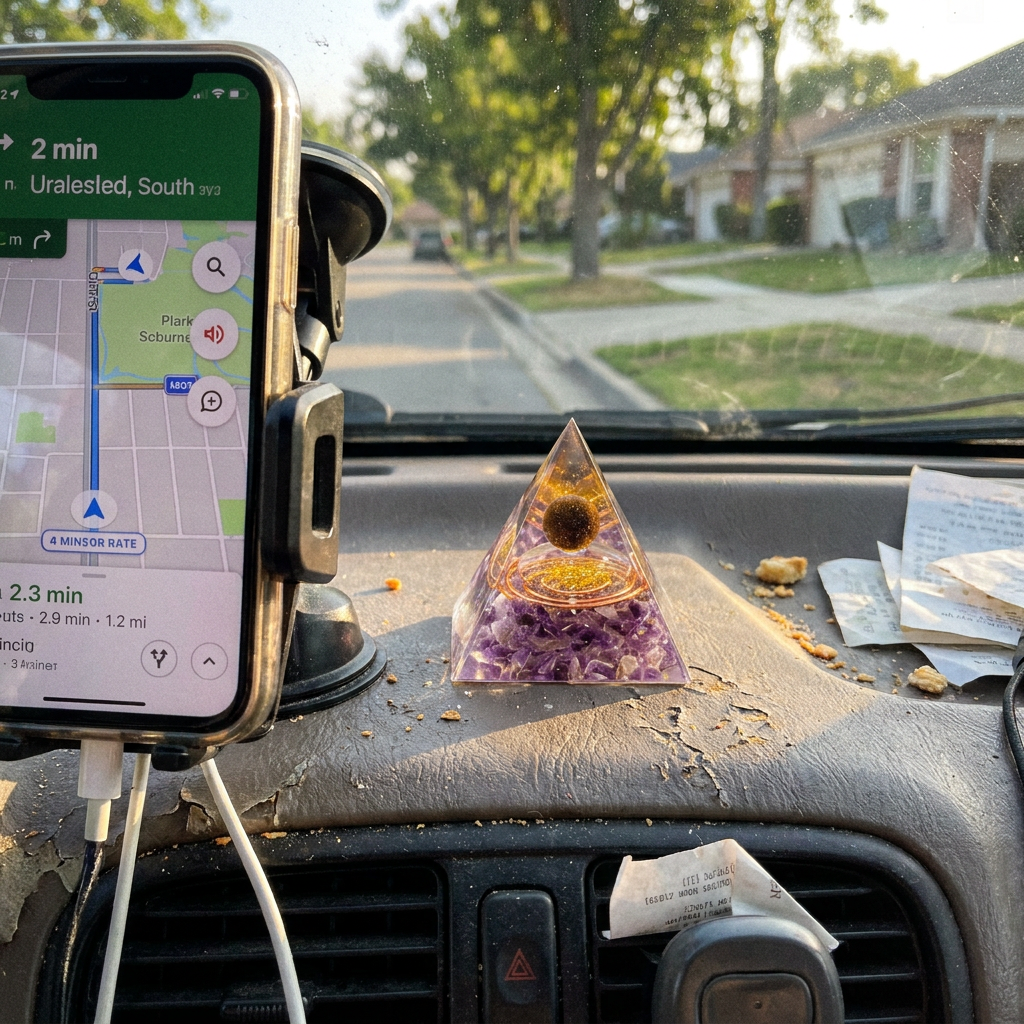
The phone on the dashboard is generating a field the entire drive. The navigation app is running on cellular data. The pyramid between the phone mount and the gearshift is doing something to that field. The commute used to take 47 minutes. The cognitive cost of arriving was the part nobody measured. My name is Dr. Marcus Webb. I am 49. I am a neurologist at a hospital in Chicago, Illinois. I have spent 21 years studying what chronic low-level environmental stressors do to the brain's executive function — the specific cognitive machinery that governs focus, decision-making, processing speed, and the sustained mental performance that professional life requires. I commute 44 minutes each way. I have commuted 44 minutes each way for nine years. For nine years I have been doing that commute with a phone on the dashboard running navigation, cellular data, and Bluetooth simultaneously — generating a field inside a metal enclosure that concentrates rather than disperses the ambient electromagnetic output. I did not think about this until a colleague made me think about it. In September 2022 Dr. Yemi Adeyemi — a biophysicist whose work on electromagnetic field effects on neuronal function I had been citing in my own papers for three years — sent me a paper with one line: "Marcus. The car. Think about the car." The paper described the specific electromagnetic field conditions inside a vehicle during active navigation and cellular use. The concentration effect of a metal enclosure around a field-generating device. The average field intensity at driver head height during active phone navigation: 74-96 V/m. For the duration of the commute. Every day. In both directions. I had been treating executive function decline in professionals for 21 years. I had never considered the commute. The mechanism Yemi's paper proposed was in the neuroinflammatory literature I work within. Chronic ambient chaotic incoherent electromagnetic field exposure activates the blood-brain barrier's tight junction proteins — the system that governs what enters and exits the brain's internal environment. Under chronic low-level neuroinflammatory conditions the barrier becomes selectively permeable. The cognitive domains most sensitive to the brain's internal electrochemical environment — processing speed, sustained attention, verbal fluency — begin to show the effects. Not acutely. After enough commutes. After enough years. I measured my car. 91 V/m at driver head height with navigation running. I had been sitting in 91 V/m for 44 minutes each way for nine years. I had been studying executive function decline in professionals for 21 years without once considering what the commute was doing to mine. I tested six blocking products in the car over eight weeks. 72 hours each, continuous monitoring. Not one meaningfully reduced the reading. The physics is always the same: A metal enclosure concentrates the field from inside the phone and reflects it. A partial barrier inside the enclosure intercepts one vector. The field reflects off every surface. The meter does not move. The geometry of a car makes the blocking problem worse than a room. There is no partial barrier that works inside a reflective metal enclosure. The transmutation mechanism was in a materials science paper Yemi forwarded two weeks after the first one. Permanently compressed crystalline mineral inside cured organic resin generates a continuous coherent electrical output from the day the resin sets. The piezoelectric effect — documented since 1880, in every precision timing device on earth — running continuously. The continuous coherent output converts the character of the ambient field from chaotic to coherent across the surrounding environment. Not blocking. Converting. The proposed neurological relevance: A coherent field does not produce the same tight junction protein activation that a chaotic field produces. The neuroinflammatory signal may not be initiated. The executive function machinery may run in the environment it was designed to run in. I placed the Spirad pyramid on my centre console and opened a monitoring log. Week 1–2: In-car field before pyramid at driver head height with navigation running: 91 V/m. 48 hours after placement: 24 V/m. Continuous monitoring across 14 commutes: Field held between 21 and 27 V/m throughout. Pyramid repositioned once. Reading held at both positions. Meter recalibrated. Reading confirmed. Personal cognitive observations — not clinical data, personal tracking only: I had been logging my cognitive performance across a standardised self-assessment at the start of each working day for two years. Baseline for morning sessions after the commute: average 6.2 out of 10 across attention, processing clarity, and verbal fluency sub-scales. End of week 2: averaging 7.8. The specific cognitive fog that arrived with me at my desk at 8:15am and required until 9:30 to clear: Absent from day 8 onward. Week 3–4: In-car field held: 22–25 V/m. Standardised cognitive battery versus baseline from 9 months prior: Processing speed, working memory, sustained attention: all noted as meaningfully improved across all three domains. I sent the data to Yemi. He called within the hour. "Marcus," he said. "The commute data." "24 V/m inside the car," I said. "Consistent across 14 trips." "And the morning cognitive assessment?" he said. "7.8 average," I said. "Up from 6.2." "In two weeks," he said. "In two weeks," I said. "What does your commute read now?" he said. "Twenty-four," I said. He was quiet. "I'm measuring mine tomorrow," he said. His commute reading: 89 V/m. He ordered three pyramids. Week 5–6: In-car field: 23 V/m. Standard inflammatory markers — personal quarterly panel, observational tracking only: Both markers tracked within low-normal range for the first time in two years of quarterly monitoring. Personal observation only. Not a clinical finding. Week 7–12: In-car field: 23 V/m. Cognitive battery at week 12: Continued improvement across all three domains. Morning cognitive self-assessment average: 8.1. Prior two-year baseline: 6.2. Yemi's data at week 10: Comparable improvement across all tracked cognitive variables. The pyramid on the dashboard in this photograph is sitting between the phone mount and the gearshift. It is smaller than the phone. It is smaller than the coffee cup in the cupholder. It weighs less than a deck of cards. Inside it: Brazilian amethyst crystal under permanent resin compression. A rose copper coil. A bronzite sphere. The piezoelectric charge has been running since the day the resin cured. It is running during every commute. Your commute is not a rest period. Your commute is 44 minutes of your brain inside a metal enclosure with a field-generating device running navigation and cellular data at driver head height. Your field reading during that commute is between 74 and 96 V/m. Every day. Both directions. For however many years you have been making that commute. You arrive at your desk. You need 90 minutes to feel like yourself. You call it the morning. It is not the morning. It is the commute. The pyramid takes the commute from 91 V/m to 24 V/m. At 24 V/m I arrive at my desk already present. At 24 V/m the 90-minute fog window does not exist. At 24 V/m the commute stops taking something it was never supposed to take. The field is running every commute. Both directions. The pyramid determines what kind of field it is. I'll leave the link below. https://spirad.co/pages/orgonite-protection-sp-emf-protection-251225
Like this ad? Make it yours.
Crush rebuilds this exact creative around your product — your brand, your colors, your offer — in about a minute.