
Inactive· since Apr 29, 2026
- 5
- days it ran
- 0
- relaunches
- 60
- EU reach
Ad copy
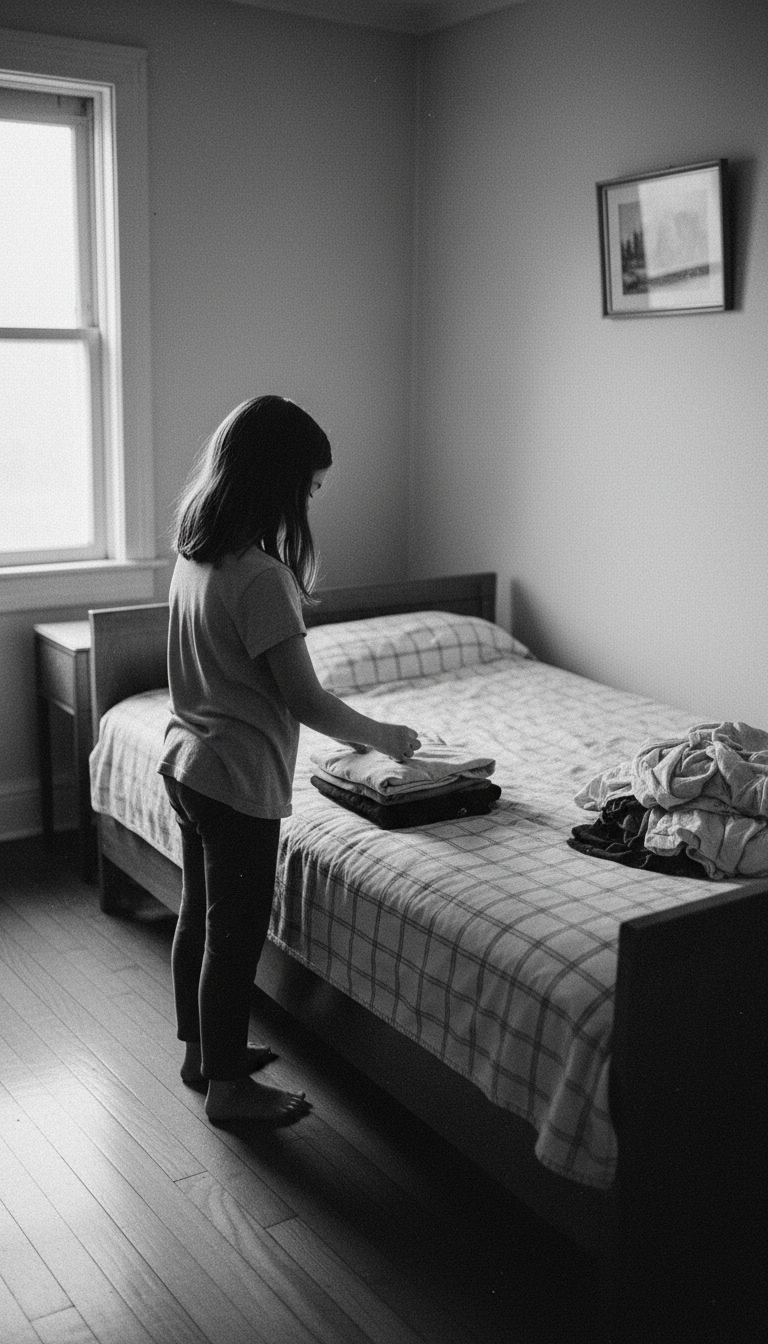
I went downstairs at 7:30 AM on a Saturday last month and my ten-year-old daughter was at the kitchen counter making her seven-year-old brother breakfast. She had pulled the cereal from the cabinet she could just reach. She had poured the milk into a bowl too large for him because the smaller bowls were in the dishwasher. She had cut a banana into pieces because he cannot eat one whole yet. She had put a glass of orange juice on the table. She had set it all up across from where he was sitting in his pajamas, watching cartoons on his iPad. She had not asked him whether he wanted any of it. She had just made it. When she saw me, she said: "Mom, you can go back to bed if you want. I've got him." I said nothing for what was probably four seconds. Then I said, "Thank you, sweetheart." I went back upstairs. I sat on the edge of my bed in the room where my husband was still asleep. I did not move for fifteen minutes. What I had been watching, in my own kitchen, was my own childhood happening in real time, with a different cast. I am 39. I have a husband, two kids, a senior position at a company you have heard of, and a phone that has not gone three hours without a family-related text in approximately fifteen years. I am the eldest daughter of a mother who was not well, and a father who was not present, and a brother who is younger than me by four years and has never managed his own life. I started making my brother's breakfast when I was eight. I am 39 now and I have not stopped. Let me describe this carefully, because the inside of it is hard to see from the outside. When I was eight, my mother could not get out of bed some mornings. Sometimes most mornings. The 1990s did not have the language for what was happening in her, or the support to address it, and my father — who worked long hours and was checked out when he was home — handled it by not handling it. He left early. He came home late. He paid the bills. I made breakfast. I packed my brother's lunch. I helped him with homework. I told him our mother was tired when he asked. I told him to be quiet in the mornings. I made grilled cheese for dinner when my mother could not. I learned the laundry machine when I was ten. I cleaned the bathroom when I was eleven. By thirteen I was, by any definition that mattered to the household functioning, the mother of the house. My mother's friends, when they came over, would say to me — in front of her — "Look at you. So mature for your age. Your mother is so lucky." My mother would beam. I beamed back. The praise was the air. I learned, before I had words for it, that being needed and being praised for not needing were the same currency, and that currency was love. I went to a good college on my own merit. I came home every weekend my freshman year because my mother had panic attacks when I did not. My grades were perfect anyway. I became a manager at 28. A senior manager at 32. A director at 36. My brother, who is four years younger than me, has lived in an emotional state somewhere between teenage and unfinished for the last fifteen years. He calls me about his job. About his girlfriend. About his mortgage. About our parents. The parents are also my parents. I am also his sister. He calls me as he calls me. My mother is 67 now. She is on better medication than she had in the nineties. She is still my mother in the sense that she is still the person I am organizing the holidays for, calling about her doctors, talking through her loneliness, planning her birthday for. She is not, in any practical sense, a person who organizes anything for me. My father is 70. He retired three years ago. He plays golf. He has never asked me how I am, in a way that wanted an answer, in my entire adult life. I have a husband. He is good. I love him. He is, in the best sense of the word, easy to be married to. He is also, I notice now, a man who waits for me to plan things, manage things, decide things, organize things. He says "you're so good at it" when I do. He is not wrong. I am. I have two children. The eldest is the one who made breakfast for her brother last Saturday. I have known something was wrong for about six years. I have read the books. I know the word for what I am. I can tell you, at a brunch where it comes up, the standard arc of how a daughter becomes a household manager at age eight and never stops being one. I have given that arc to my friends. I have given it to my therapist when I was briefly in therapy in 2022. I gave it to a coworker last spring after she had a baby and I noticed she was about to start running her family the same way. I told her: be careful. She nodded. We never spoke about it again. I have given the arc to everyone who would listen. I have not been able to apply it to myself. Here is what the inside of being the eldest daughter looks like at 39. My phone has not been quiet since I was eight. It has changed shape, but it has not been quiet. When I was nine it was the actual ringing landline that meant my brother needed to be picked up. When I was sixteen it was my mother asking me to come home from a friend's house because she "did not feel right." When I was twenty-two it was my brother during his first breakup. When I was twenty-eight it was my mother, in an actual ER, calling me before she called my father — because my father, by then, was a person you informed afterward. When I was thirty-seven my mother had a fall. She called me. I was in a meeting. I drove ninety minutes. I sat in the ER until 1 AM. I came home. I made breakfast for my children at 7 AM. I went to work at 9 AM. I did not tell anyone at work what had happened the night before. I had a Q3 review that morning. I did fine. I came home at 6 PM. I made dinner. I checked on my mother by phone at 9 PM. I was asleep by 11 PM. I was at my desk at 7 AM the next day. Nobody, in any of those hours, asked me if I was okay. That is what I am supposed to say next, in this kind of essay — that nobody asked. The honest version is sharper. Nobody asked because I had spent thirty years training everyone in my life not to need to ask. I had built the architecture of my own loneliness, brick by brick, and I had been the contractor, the architect, the mason, and the family member who paid for it all. I am very good at being told "I do not know how you do it all." I am very bad at being asked "are you tired?" I cannot accept help that I have not requested. I cannot request help. I have a friend, Lisa, whom I have known since college. She has called me in crisis, on average, eleven times a year for the last fifteen years. About her divorce. About her father's death. About her son's autism diagnosis. About her job. I have shown up for her every single time. I have also never called her in crisis. Not once. She did not realize that until last month. When she did, she texted me a sentence I am not going to forget. "I have been calling you when I am falling apart for fifteen years. I have never once asked you how you are. I just realized this. I am sorry. I am sending you a link a woman in my office sent me. It is not a self-help thing. It did something to me. Click it when you can." She had attached a link. I did not click it for two weeks. I did not click it because I had something to do for someone every night for two weeks, and clicking a link my friend had sent me as a favor to me felt like a thing I did not have permission to do. I clicked it the night I came back upstairs from the kitchen on Saturday, after I had watched my daughter pour her brother's orange juice. It was not a self-help quiz. It did not ask me to rate things one to ten. It told me, in three or four observations, things I had not told it. It told me I had probably been the eldest daughter of a mother who was not well. It told me I had probably married a man who was kind, and who had been allowed by everyone in his life to leave the planning to other people, and that I had likely entered into that arrangement without noticing it because it had been familiar. It told me I had probably been the friend who shows up for everyone and is privately known by no one. It told me I had probably been told, since I was small, that I was "so mature for my age," and that this praise had been the form love took, and that I had been chasing more of it for thirty years because the alternative — having actual needs that I gave to other people to carry — was a thing I had not been allowed to learn how to do. It told me I had probably not had a person, in my adult life, hand me a thing without my asking, after noticing that I needed it, in a decade. It told me, in language that did not lecture me, that what I had was not exhaustion from the work. It was an injury from the role. I had not just been a child who took on too much. I had been a child who learned, before I had any choice in the matter, that having no needs was the price of being allowed to take up space in my family. I had built my entire adult identity on top of that lesson. The competence was the disguise. The disguise had become the woman. I had been performing not-having-needs for thirty-one years. I cried on my couch in the dark, after my husband and children had gone to bed, in a way I had not let myself cry in a decade. Not from sadness, exactly. From the relief of being seen. What changed was not less competence. I am still the eldest daughter. My mother still calls. My brother still calls. My phone is still rarely quiet. I am still good at the things I am good at. What changed was that I have, in the eleven weeks since that Saturday morning, said sentences I had not been allowed to say. The first one was to my daughter, the next Saturday, when she came down to make breakfast for her brother again. I went down before her. I made the breakfast. When she came down and saw me there, she said: "I don't mind doing it, Mom." I said: "I know. I will do it anyway. It is not your job. It is mine." She looked at me for that exact half-second I had been looking at my own mother at her age. Then she said, "Okay." Then she went to watch cartoons. The second one was to Lisa. She called me on a Wednesday night to tell me her ex was being difficult about custody again. I listened for fifteen minutes. Then I said something I had not said to her in fifteen years. I said: "Lisa, I am not okay this week. I cannot hold this with you tonight. Can I call you Friday?" She paused. Then she said: "Yes. I will call you Friday. I will ask you what is going on." I cried after I hung up. The third one was last Sunday. My brother called me from his car. He was upset about something at his job. He started telling me. I let him talk for a few minutes. Then I said, "I am not the right person for this conversation. You should call our father." He said, "He won't pick up." I said, "I know. Call him anyway. I love you. I cannot be him. I am stopping being him." He hung up. He was angry. He has not called me back yet. I was not okay about it for two days. I was somewhat okay about it on the third day. I have not called him. Last weekend my daughter asked me if I was okay. I said: "I am tired this week. Thank you for asking. You do not have to take care of me." She said: "I know. But I wanted to." I said: "Okay. You can ask. I will tell you the answer. But you do not have to fix it. That part is mine." She nodded. She went to play. 💙 I am still 39. My mother is still 67. My brother is still angry. My phone still buzzes more than I would like. The architecture of my life is the architecture I built, and it is mostly the architecture I am still living inside. But I have been doing a thing my eight-year-old self was not allowed to do. I have been letting the people who are supposed to take care of themselves take care of themselves. I have been letting my daughter not be me. I have been letting myself need things, and ask for them, and watch what happens when I do. The chain breaks here. Imperfectly. In sentences I had to make myself say. The quiz I took on a Saturday night, after I watched my own daughter perform the role I had been performing since I was eight, was the first thing that mirrored back to me what I had been carrying for thirty-one years. It is from an app called Liven. If you have been the adult in your family since you were small, and you have just watched your own daughter start to do it, and you have been wondering for ten years why nobody in your life asks you how you are — link below. Link below.
I have been the adult in my family since I was eight.
LEARN MORELike this ad? Make it yours.
Crush rebuilds this exact creative around your product — your brand, your colors, your offer — in about a minute.