Linda Calloway
Linda Calloway Facebook ad: “Read this if you suffer from hammertoes”
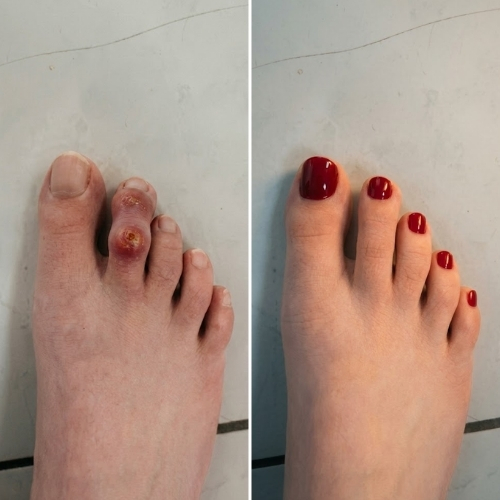
Ran for 91 days, from April 17 to July 17, 2026, the last day Crush saw it.
Run by Linda Calloway on Facebook. Crush is not the advertiser and does not verify its claims. See this ad in Meta's Ad Library(opens in a new tab)
Want an ad like this for your product?
Crush makes new ad images for your product from this ad: your logo, your product photo, your offer.
Trials from $19.95 USD, then $79.95 USD a month. Cancel anytime.
About this ad
- Meta Ad Library ID
- 1305115901547391
- Platforms
- Facebook, Instagram, Audience Network, Messenger and Threads
- Relaunches
- 0
Ad text
Surgery is not the only way to fix a hammertoe. I didn't believe that either until I found out what's actually causing the pain. Let me give you some context. By 5 PM every day, the burning on top of my second toe felt like someone holding a lit match to the knuckle and just leaving it there. My crooked toe collided with the top of every shoe I owned. Sneakers, flats, the "comfort" shoes I paid $120 for that were supposed to fix everything. I'd drive home with my shoes off. Sit in the driveway, eyes closed, feet on the dashboard. Waiting for the throbbing to fade. The corns on top of my curled toes were hard, angry ridges that rebuilt themselves no matter how much I filed them down. I was 54 years old and walking at granny speed through my own life. So I did what you've probably done. Gel spacers, foam tubes, night splints for two months straight. You know the cycle. Temporary softening. Partial relief. Then right back to where I started. But the worst part wasn't the money or the time. Every few months I'd look down in the shower and see the same thing getting worse. That inverted V on my second toe. A little more pronounced than last time. The knuckle pushing up a little higher. The joint a little stiffer than it was six months ago. I'd press the toe flat with my finger and it would go down. Still flexible. Still movable. But the second I let go it curled right back up like a spring. And I knew, somewhere in my gut, that one day I'd press it down and it wouldn't move at all. My podiatrist had already said the word. Surgery. He said it casually. Like a weather forecast. "If this keeps progressing, we'll need to look at a surgical option." Then he moved on like he hadn't just described the thing that kept me awake at 2 AM. Because I knew what hammertoe surgery looked like. I'd read the posts. Women describing permanent metal pins screwed into their toe bones. Pins that looked like bear claws sticking out of the end of their foot. The nerve block wearing off in the middle of the night and the wall of pain moving in. Women four months later saying the toe was already curling back. One woman wrote "my tendons were totally severed. I have no movement or control of my toes now. This was not explained to me." Another said she spent all of 2023 recovering. She was 27 years old. Her toes are still super stiff. She regrets it. The more I read, the more I saw the same thing. Post after post. Women whose toes came back. Women who lost all movement. Women who said it was the worst decision they ever made. Not all of them. But enough to make me sick to my stomach. And here's the thing that sat with me the longest. Someone on a forum wrote: "Surgery will make it look straight, but it doesn't address the issue of what's actually going on in the feet." I almost scheduled it. Not because I was ready. Because the daily pain had gotten so bad I couldn't see another option. I had the number pulled up on my phone. But something made me try one more thing first. Not another product. An appointment. I booked a session with a physical therapist who specialized in foot and ankle mechanics. Not my podiatrist. She looked at my toes for less than a minute before she said something no one else had said in three years of appointments. "You're treating this like a surface problem. But this isn't a surface problem." She pressed my second toe flat with her thumb. It went down. Still flexible. "The joint isn't fused. It's being held there by a tendon that's shortened over time. The tendon on top has tightened. The one underneath has gone slack. That's the force pulling your toe up into the shoe and holding it there." She let go. It curled right back up. "Every gel pad you've tried sits between your skin and the shoe. It absorbs a fraction of the friction. But the force pulling the toe upward? Completely unaddressed." I wasn't treating friction. I was treating a tendon imbalance with a band aid. When I understood that, everything I'd been through made sense. The spacers that cushioned but never corrected. The night splints that lost the fight the second I stood up. The wider shoes that never changed the position of the toe. Three years. Not one product was even aimed at the force that was actually driving the progression. She didn't sell me anything. She told me what to look for. Something rigid enough to hold the curled toe flat during walking. Under real body weight. Inside regular shoes. During the hours the tendon is actually under load. Not while you're sleeping. Not while you're sitting on the couch. During the part of the day when the burning starts and the corns grind and your shoe becomes a torture chamber. Because that's the only way the toe stays below the friction point. And that's the only way it gradually retrains toward its natural position. Consistent, gentle, structural pressure applied during real movement. The same principle braces use to straighten teeth. Not overnight. Not instantly. But step by step, the same way the toes got into this mess. Only in reverse. That night I found the Virellaflow Corrector. Built on a principle called Downward Correction. A slim, structured device designed to hold the toe in its corrected position during actual walking, inside regular shoes, under real body weight. I ordered it that night. It cost me less than one of those gel pad 4-packs that never worked. I didn't believe it would work. Three years of failed products had burned that out of me. But the first morning I put it on and slid my foot into my work shoe, I felt something I hadn't felt in over two years. Space above my toe. I just stood there for a second. The knuckle wasn't pressing into the roof of the shoe. There was no pressure point forming. No hot spot starting its slow familiar build. I took a step. Then another. I kept waiting for it to start. That tightening. That first whisper of friction that always meant the burning was on its way. It didn't come. By 2 PM... nothing. By 5 PM... nothing. I walked into my house that evening with my shoes still on. I didn't even realize it until my husband pointed it out. I'd been driving home barefoot for two years. That was eleven months ago. The corns on top of my toes have flattened. There's nothing grinding against them anymore so they stopped rebuilding. My second toe sits visibly straighter than it did a year ago. Not perfect. But the trajectory has reversed. Last month I walked nine miles on a family trip. I didn't ask to stop once. I didn't scan for benches. I just walked. Like a normal person. At my last podiatrist visit, he pressed down on my second toe and looked up at me. "It's still fully flexible," he said. "Whatever you're doing, keep doing it." He didn't bring up surgery. I didn't bring it up either. I'm telling you all of this because I spent three years exactly where you might be right now. Watching it get worse. Trying everything. Dreading the appointment where the word "surgery" stops being a warning and starts being a date on the calendar. If your toes are burning by 5 PM, if the corns keep coming back, if your podiatrist has started using that word, please hear me. The friction doesn't stop because the toe doesn't come down. And every day without correction, that tendon shortens a little more. Press your toe flat right now. Does it still go down? That's your window. That flexibility is the only reason correction is still possible. But there is a point, you won't feel it cross the line, where the joint locks and the corrector can't help and the conversation with your podiatrist becomes the only conversation left. This is fixable. But only while it's still flexible. The "Walk Normal" Guarantee: Try Downward Correction for a full 30 days, completely risk-free. If you don't feel a noticeable difference, if the burning doesn't ease, if the correction doesn't hold through your day, send it back for a full refund. No questions asked. You'll know within the first week whether this works for you. Click below to try it risk-free. No special shoes needed. No lifestyle change. Just your regular shoes and a completely different principle. You have two options. Keep feeling that burning build by 5 PM. Keep filing down corns that come right back. Keep watching the toe curl tighter every few months. Keep dreading the next appointment. Or try the one approach that holds the toe where it belongs and see if the trajectory changes. Your feet have carried you your whole life. They deserve better than another piece of silicone that can't do enough. P.S. The 30-day guarantee gives you a full month to see if the trajectory changes. If it doesn't, full refund. The only thing you're risking is finding out what your feet feel like when the burning finally stops.
Where the ad sends people
virellaflow.com
Read this if you suffer from hammertoes☝️
Fix your hammertoe.
Shop now: virellaflow.com(opens in a new tab)