
Inactive· since Apr 29, 2026
- 3
- days it ran
- 0
- relaunches
- 2
- EU reach
Ad copy
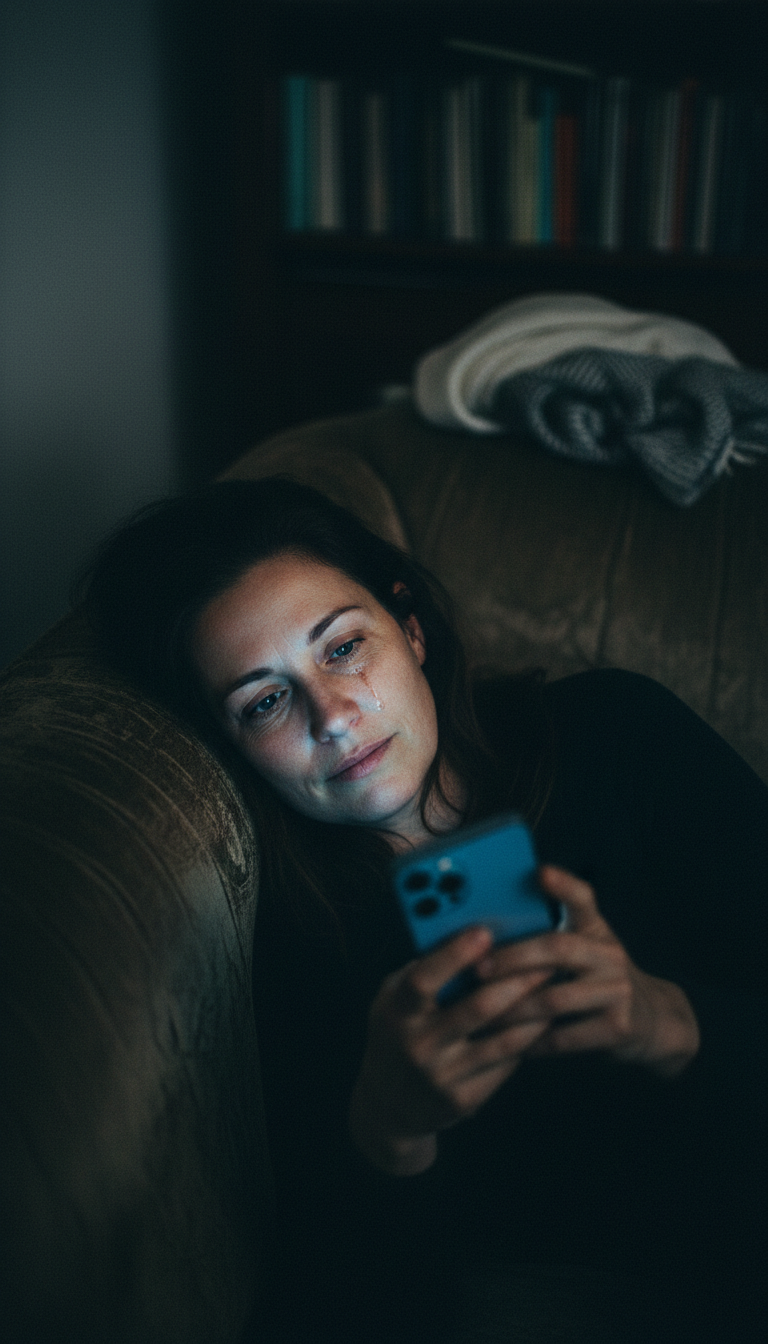
My daughter brought home a math test on a Tuesday afternoon last month. She had gotten a 94. She came in waving the page, breathless, the way nine-year-olds wave a thing they need you to see. I said: "Very good, sweetheart." She looked at me for half a second longer than she should have. Then she took the page back. Then she went to her room. I sat at the kitchen counter and I did not move for what was probably four minutes. Because what I had said, in the tone I had said it, was a perfect echo of what my mother had said when I had brought home a 96 on a math test in fifth grade. "Very good, sweetheart." In her case, accompanied by an immediate "what about the four points." In my case, this time, there had not been a "what about the four points." But there had also not been a "you must have worked so hard." There had not been a "show me." There had not been an "I'm proud of you." There had been only "very good, sweetheart" — which is exactly what my mother had said for thirty-eight years, and which, until that Tuesday at my own kitchen counter, I had not realized I had been saying back. I am 41 years old. I have a husband, two children, a job I have been good at for eleven years, and a phone in my pocket that has not heard the words "I'm proud of you" in any voice that mattered, ever. My mother is 73. She is in good health. She lives a 90-minute drive away. We talk on Sundays. She has never said the sentence. She has, on a few specific occasions over the last 41 years, come close. After my high school valedictorian speech, she said: "You did well." I had been waiting for the other thing. After I got into the college I had wanted, on the phone, she said: "We will see how you do there." I had been waiting for the other thing. After my college graduation, after my first job, after I made manager, after I bought my first house, after I called her from the hospital with my first baby, after my partner-track promotion at 36 — she said many gracious sentences to me. She has never said that one. I have known this about my mother since I was about 27. I read the books. I have a label for what she is and a label for what I have become. I can describe the dynamic at a dinner party in three minutes if it comes up. I have done the work in the room with the right people. I can tell you what triggered me at brunch last week and what corner of my childhood it came from. None of that has stopped me from being a 41-year-old woman who has built her entire life around chasing one sentence from one specific person who was never going to say it. I cannot accept a compliment. I have taught myself, through reading the books, to say "thank you" instead of "no I haven't" — but the "no I haven't" is still what is happening in my chest while my mouth says the better thing. My husband stopped telling me I looked good in 2019, after the third year of me deflecting. He still loves me. He has stopped saying things he knows will not land. I work at a level no one can sustain. I always have. When I made partner-track at my firm at 36, I called my mother on the drive home. She said the gracious-sounding thing she says. I sat in the car in my driveway for thirty-five minutes before going inside, because I had needed to hear the other thing more than I had needed her to congratulate me, and what I had needed had not arrived, and I did not know what to do with the gap between what I had wanted and what I had received. I had thought partner-track might do it. The way I had thought college might do it. The way I had thought my first baby might do it. The way I had thought, at nine, the 96 on the math test might do it. There has never been an achievement large enough. I take a long time to receive any praise from any other person, in any context, because somewhere underneath my mind I am still scanning for the source of the sentence — and only one person can deliver it, and the person will not. I am, and have been since I was small, a daughter holding her hand out for a coin from a vending machine that was never going to drop one. I have been doing this for so long that I can no longer feel where my hand is. The Tuesday at the kitchen counter was not the first time I had heard myself echo my mother. It was the first time I had heard myself echo her with my own daughter in the room. She had been waiting for the other thing. She had walked back to her room thinking the same thing I had thought when I was nine, which was: I will get a higher grade next time, and then she will say it. I sat at the counter for those four minutes, and what I understood was something I would not have been able to say at any of the dinner parties. I had not just been a daughter who had not received the sentence. I had built my entire identity around being the daughter who would, eventually, earn it. The shape of my life was the shape of that chase. Every job I had taken. Every decision I had made about what to be. Every man I had ended up with — including my husband, who is good, whom I love, but who is, if I am honest, also a man who does not entirely see me. Which had been familiar to me before I knew that "familiar" was a category. I was a child trying to extract a sentence from a vending machine that was never going to give it to her. I had been doing it for thirty-eight years. The chasing was the shape of me. And on a Tuesday afternoon, in my own kitchen, I had handed that shape to my own child. A friend had sent me a link three weeks earlier. She had said: "I know you are going to roll your eyes at this. I rolled my eyes at it. Do it anyway. It does something different." I had not clicked it. I clicked it the night after the kitchen counter. After my daughter was asleep. After my husband was asleep. In the dark, on my couch. It was not what I expected. It did not ask me about my mother. It did not ask me to rate things one to ten. It asked me three things, and then a few more like them — and then it told me things I had not told it. It told me I had probably built my professional identity around being more impressive than I had been the year before, and that the new line of "more impressive" kept moving every time I crossed it. It told me I had probably married a man who was kind, and somewhat unavailable, and that the unavailability was almost certainly the part I had recognized first. It told me I had probably been the friend who showed up for everyone and was known by no one. It told me I was probably very good at receiving criticism and very bad at receiving care. It told me I had probably looked, for most of my adult life, for one specific person's approval — usually a woman, usually older, usually withholding — at every job I had ever taken. It told me my current boss was probably a version of her. It told me, in the gentlest possible language, that the woman whose approval I had been waiting for since I was eight years old had not been able to give it then, and was not going to give it now, and was not going to give it on her deathbed either, and that the version of me who had been waiting was the version of me running my entire life. I had not told it any of these things. I sat on my couch in the dark and read what it said about me, and I cried, and I did not stop crying for a long time. What changed was not less wanting the sentence. The wanting did not go away. I do not think it does. I do not think there is a version of me who picks up the phone on a Sunday and stops wanting the wanting. The wanting is what is left after thirty-eight years of waiting. What changed was that I have, in the eleven weeks since that Tuesday, said three sentences to my daughter that nobody had ever said to me. The first one was on a Friday evening, when she had gotten a 71 on a science test and was crying about it. I had been about to say "we will work harder next time" — the close cousin of "what about the four points." I caught it before it left my mouth. I sat down next to her on the floor, and I said: "I am proud of how hard you tried." She looked at me for that same half-second. Then she leaned her head against my shoulder. We sat on the floor for maybe twenty minutes. The second one was the Sunday after that. She drew me a picture. I usually say "very nice, sweetheart" — my mother's exact register. I made myself say something else. I said: "I love that you put us all in the same color." She looked at the picture, then at me, and she said, "You noticed." The third one was last Tuesday. She came home with an 88 on a math test. Lower than the 94 that had started this. I caught my mouth opening to say "what happened to the 94" — my mother's voice, my mother's vending machine. I stopped. I said: "I'm proud of you for showing me even when it wasn't your best." She did not look up at me at all that time. She just nodded. Then she set the test down on the counter. Then she went and got herself a snack from the fridge and ate it standing up. She did not need to wait for the other thing. That was the thing. 💙 I am still 41. My mother is still 73. We will talk on Sunday. She will not say the sentence. I do not think she ever will. The vending machine is what it is. But I have been doing something my mother could not. I have been saying things to my daughter that my daughter does not have to chase me for. The chain breaks here. Imperfectly. Slowly. In sentences I almost did not say. The quiz I took on my couch the night after I caught myself echoing my mother was the first thing that mirrored back to me what I had been carrying for thirty-eight years. It is from an app called Liven. If your mother never said it, and you have been quietly waiting for thirty years, and you have just heard yourself say something to your child that you do not want to be saying — link below. Link below.
My mother never said "I'm proud of you."
LEARN MORELike this ad? Make it yours.
Crush rebuilds this exact creative around your product — your brand, your colors, your offer — in about a minute.