Garage Sale Tips
Garage Sale Tips Facebook ad: “The yard sale game is rigged”
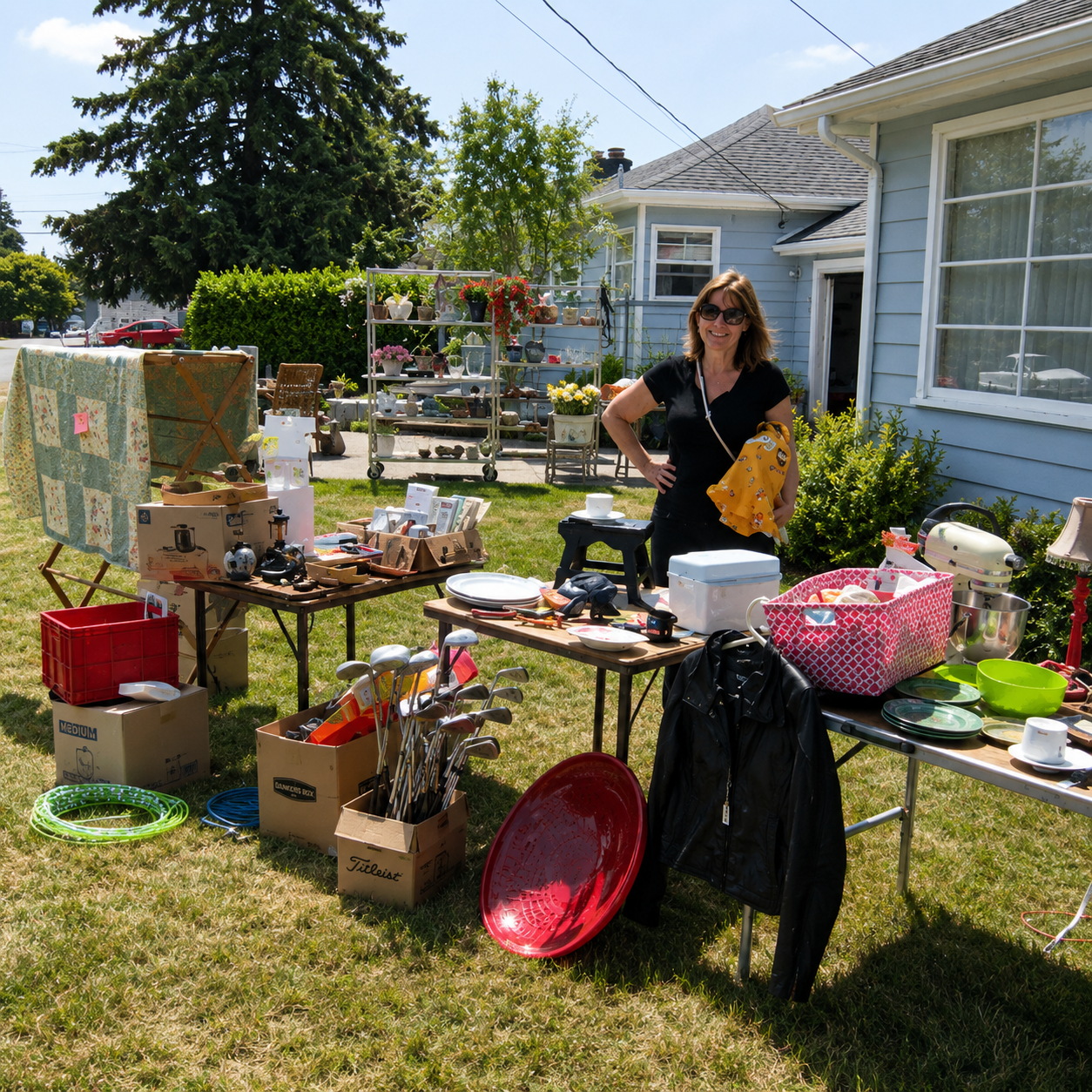
Ran for 25 days, from June 18 to July 13, 2026, the last day Crush saw it.
Run by Garage Sale Tips on Facebook. Crush is not the advertiser and does not verify its claims. See this ad in Meta's Ad Library(opens in a new tab)
Want an ad like this for your product?
Crush makes new ad images for your product from this ad: your logo, your product photo, your offer.
Trials from $19.95 USD, then $79.95 USD a month. Cancel anytime.
About this ad
- Meta Ad Library ID
- 1336613051172808
- Platforms
- Facebook, Instagram, Audience Network, Messenger and Threads
- Relaunches
- 0
Ad text
I need to warn every person who spends their Saturday mornings at yard sales about what I just figured out. There, I said it. I've been going to garage sales, estate sales, and church rummage sales for about two years now, and for most of that time I thought my only problem was inexperience. I had no idea that the way I was deciding what to buy — the way every weekend treasure hunter I know decides what to buy — was quietly costing me money and handing the real finds to someone else. Let me start from the beginning, because I think my story is a lot more common than any of us realize. I got into yard sales because of a TikTok video. Some guy found a lamp at a garage sale for $5 and sold it online for $275. Then another video. A woman who found vintage Pyrex for $3 a piece and flipped it for $60 each. Then another. And another. I thought — these people aren't geniuses. They're just showing up on Saturday morning and finding stuff. I can do that. So I started going. My first few weekends, I drove around to whatever sales I could find on Facebook and Craigslist. No strategy. No system. Just enthusiasm and a vague sense that "old stuff" was probably worth something. At my very first estate sale I saw a set of brass candlesticks on a table. They looked heavy. Looked old. The seller wanted $12 for the pair. I figured anything brass and vintage had to be worth more than that, so I bought them. Got home. Googled "vintage brass candlesticks value." Found eBay listings ranging from $8 to $180. Etsy listings from $15 to $95. A blog post from 2019 saying "brass is back." An antique forum saying most brass candlesticks are worth almost nothing. I had no idea what mine were worth. I listed them on Marketplace for $35 and they sat there for three weeks. Eventually sold for $18 after I dropped the price twice. I'd paid $12 plus gas plus an entire Saturday morning. Net gain: roughly $6 before fees. Probably negative once you count the drive. That became the pattern. Every Saturday I'd walk through sales picking up things that "looked promising." I'd hold a piece of pottery, a leather bag, a set of vintage glasses, and try to make a decision on the spot with nothing but my gut and a vague hope that I was right. Sometimes I'd buy something and get home to discover it was a reproduction worth less than I'd paid. Sometimes I'd pass on something and google it later only to realize I'd walked away from a $200 item with a $10 sticker on it. Both felt terrible. But the second one was worse. The worst was a denim jacket at a neighborhood garage sale. Vintage. Some kind of patch on the back. The seller wanted $8. I thought it was cool but I didn't know if vintage denim was actually worth anything, and I'd already wasted money that morning on a set of plates that turned out to be worthless. I put the jacket back. That night I looked it up. The patch. The wash. The cut. It was a specific maker from the 1970s. Jackets like that were selling — actually selling, not just listed — for $150 to $220. I'd held a $200 jacket in my hands and put it back because I didn't know what I was looking at. I tried going back the next morning. The sale was over. That one stuck with me for weeks. Not because of the money. Because I realized something I couldn't un-realize: the people who were getting the good finds at these sales weren't luckier than me. They just knew something I didn't. After about six months of this, I started keeping track. What I bought, what I paid, what I could actually sell it for, what I couldn't sell at all. The numbers made me sick. In six months I'd spent $410 at yard sales. I'd managed to resell $195 worth of it. The rest was sitting in a bin in my closet or had been donated out of frustration. I was negative $215 — and that's before gas, before time, before the emotional cost of feeling like an idiot every Saturday. My roommate asked me one night how the whole yard sale thing was going. "I'm learning," I said. "Expensive education." She wasn't wrong. I tried every approach I could think of to get better. I watched YouTube videos. "How to spot valuable items at garage sales." "Top 10 things to look for at estate sales." Most of them were from full-time resellers who'd been doing this for 15 years and could identify a McCoy vase from across a room. Their advice boiled down to "develop an eye for it." Which is like telling someone who can't swim to "just feel the water." I downloaded apps. One was supposed to identify antiques from photos. It told me a ceramic bowl was "possibly mid-century, value unknown." Thanks. Another one scanned barcodes — great for retail products, useless for the vintage and secondhand items that are the whole point of yard sales. I joined Facebook groups for pickers and flippers. Posted photos of items asking "is this worth anything?" Got 14 different answers, three people trying to buy it from me for cheap, and one person telling me I should "just google it." I'd been googling it. That was the entire problem. I even tried tagging along with an experienced picker named Ron who I'd met at a Saturday morning sale. He moved through a sale in ten minutes flat. I watched him pick up a lamp, glance at his phone for three seconds, set it down. Pick up a leather messenger bag, phone, into his pile. A set of cocktail shakers, phone, back on the table. "How do you know what to grab?" I asked him. "Sold data," he said, like I was supposed to know what that meant. I didn't. That night I went down a rabbit hole that changed everything I thought I knew about yard sales. I started reading about something called "sold data" — and I felt sick to my stomach. Here's what I found out. Every time you google "vintage brass candlesticks value" or check eBay to see what something's "worth," you're looking at asking prices. What people hope to get. What they've listed the item for. Not what it actually sold for. Asking prices are fantasies. I can list a coffee mug for $500 right now. That doesn't make it worth $500. The number that actually matters — the one that tells you what something is really worth — is the sold price. What a real buyer actually paid. For that exact item. Recently. Professional pickers and resellers have known this for years. They use tools with access to hundreds of millions of completed sales records. They walk into your garage sale with this data on their phone and can price any item in three seconds. That's why Ron moved so fast. He wasn't guessing. He wasn't "developing an eye." He was checking sold data. And the rest of us — the weekend hobbyists showing up with nothing but Google and gut instinct — were competing against people with a fundamentally different level of information. We weren't losing because we were bad at yard sales. We were losing because we were playing blind against people who could see. I went back and looked at every bad decision I'd made. The brass candlesticks I overpaid for? A three-second sold-data check would have shown me they were $8 items. I'd have walked past them. The denim jacket I put back? A three-second check would have shown me $180 average sold price. I'd have bought it before anyone else could. The plates, the pottery, the leather bag I second-guessed, the vintage radio I bought for $25 that turned out to be worth $12 — every single bad call came down to the same thing: I was making decisions based on asking prices and guesses instead of sold prices and data. I'd been doing research. Just the wrong kind. Once I understood the problem, I started looking for the solution. WorthPoint came up first. Over 610 million price records. Sounded perfect. Forty dollars a month. I signed up. The dashboard looked like it was built for someone running an antique shop. Search filters for "era," "finish," "provenance." I just wanted to know if the thing in my hand was worth buying for $10 at a garage sale. After three weekends of fumbling with it in driveways while other buyers grabbed items off the table, I cancelled. I tried a barcode scanner app. Useless at yard sales — vintage items don't have barcodes. I tried screenshotting items and reverse-image-searching them. Sometimes it worked. Usually it didn't. And it took two to three minutes per item — an eternity when you're standing in someone's driveway with five other buyers. Nothing was fast enough. Nothing was simple enough. Nothing was built for someone like me — a weekend hobbyist who just wants to point at something and know if it's a $5 item or a $500 item before the person next to me grabs it. That's when I found what Ron had been using. A woman in my picker Facebook group posted about an app she'd been using for a few months. She said she'd been exactly where I was — burned by bad buys, frustrated by missed finds, sick of standing in driveways googling — and that this app had completely changed her Saturdays. Most of us were skeptical. We'd all been through the cycle. Download an app, get excited, realize it doesn't actually work for what we do, delete it, feel stupid. The last thing anyone wanted was another "game-changing" tool that would change nothing. But she wasn't done. She said she understood exactly why we were skeptical because she'd been skeptical too. And she asked us to just hear her out. She explained that after years of asking-price research and gut-feel buying, she'd stopped asking "does this look valuable?" and started asking "what has this actually sold for, recently, on real platforms?" — and that shift had changed everything. The app was called ValueScout. You point your phone camera at any item. In about three seconds, it identifies it. Not "a lamp." The brand. The era. The model. The condition factors that matter. Then it shows you actual sold prices from recent completed sales across real marketplaces. Not asking prices. Not what some hopeful seller listed it for six months ago. What real buyers actually paid. This week. This month. This quarter. Three seconds. Camera. Sold data. Done. I downloaded it that night expecting to be disappointed again. The next Saturday I walked into an estate sale with it open on my phone. First thing I saw was a set of mixing bowls on a kitchen table. Old-looking. Colorful. The sticker said $15. Before ValueScout, I'd have stood there for five minutes googling "vintage mixing bowls" and probably walked away unsure. I scanned them. Three seconds. The app identified the exact pattern, the maker, the era. Showed me 19 completed sales in the last 90 days. Average sold price: $85. I picked them up immediately. I scanned a leather satchel hanging on a coat rack. $94 sold average. Sticker: $8. I scanned a wooden chess set. $12 item. Sticker was $10. I put it back. Three seconds saved me from a bad buy. I scanned a vintage Polaroid camera sitting on a shelf between some paperbacks. $135. The sticker said $15. I stood in that estate sale and felt something I'd never felt at a yard sale before. I wasn't guessing. For the first time, I had the same information that Ron had. The same information the professional pickers had. The same information that every experienced reseller who'd ever beaten me to a good find had been using while I stood there googling. Sold data. On my phone. In three seconds. I spent $48 that morning. Based on the sold prices the app showed me, the resale value of what I bought was somewhere around $530. That was more than my entire previous six months of yard-saling combined. In one Saturday morning. But here's the part I didn't expect. It wasn't just that I was finding better stuff. The entire experience of going to yard sales changed. The anxiety was gone. The second-guessing was gone. The "did I just overpay for junk" drive home was gone. The "did I just walk past something worth $200" regret was gone. I'd scan something, see the number, and either grab it or move on. No hesitation. No dread. No rabbit holes. I stopped avoiding estate sales because I was afraid of making bad buys. I started looking forward to Saturdays again. Last month I picked up a vintage wool blanket at a church rummage sale. Scanned it in the parking lot — $165 sold average. Paid $12. Sold it in four days. I found a set of cast iron bookends — the real ones this time, not reproductions — at a neighborhood sale. Scanned them. $78. Paid $5. My roommate came with me one Saturday. She'd never been to a yard sale. I handed her my phone and told her to scan anything that caught her eye. She scanned a pair of cowboy boots. $85. A brass desk lamp. $62. A framed print leaning against a garage wall. $45. "This is like a treasure hunt except you can actually see what the treasure is worth," she said. That's exactly what it is. I went back and thought about all the finds I'd missed. The denim jacket for $8. The mixing bowls I would have bought months earlier. The dozens of items I'd walked past because I didn't know what I was looking at, or the dozens I'd bought because I thought they were valuable and they weren't. All of it came down to one thing: I was making every decision based on asking prices — which is to say, fictional prices — while the serious buyers around me were using sold prices. We were standing at the same tables playing completely different games. Nobody had warned me. Not the YouTube videos. Not the Facebook groups. Not the apps that promised to help and delivered confusion. I think about the woman at the estate sale six months ago who watched me put that denim jacket back on the rack. I'm almost certain she picked it up after I walked away. She probably scanned it, saw the number, and bought it in three seconds while I was still in the driveway second-guessing myself. She wasn't smarter than me. She wasn't more experienced. She just had the data. Now I have it too. ValueScout has a free 30-second quiz that figures out what kind of treasure hunter you are and why you've been missing the good stuff. It takes half a minute and it's actually kind of fun. Take the free 30-second quiz → https://valuescout.ai/garage/fb And please share this with anyone you know who spends their Saturdays at yard sales and comes home wondering if they bought the right things or walked past the wrong ones. Because the silence around how rigged this game actually is — that's what's been keeping us in the dark.
Where the ad sends people
valuescout.ai
The yard sale game is rigged
Upload a photo and instantly discover your item’s true market value. ValueScout uses AI and millions of verified auction sales to identify antiques, collectibles, and everyday items. Fast results, accurate valuations, digital certificate included.
Learn more: valuescout.ai(opens in a new tab)