
Active· since Dec 10, 2025
- 279
- days running
- 0
- relaunches
Ad copy
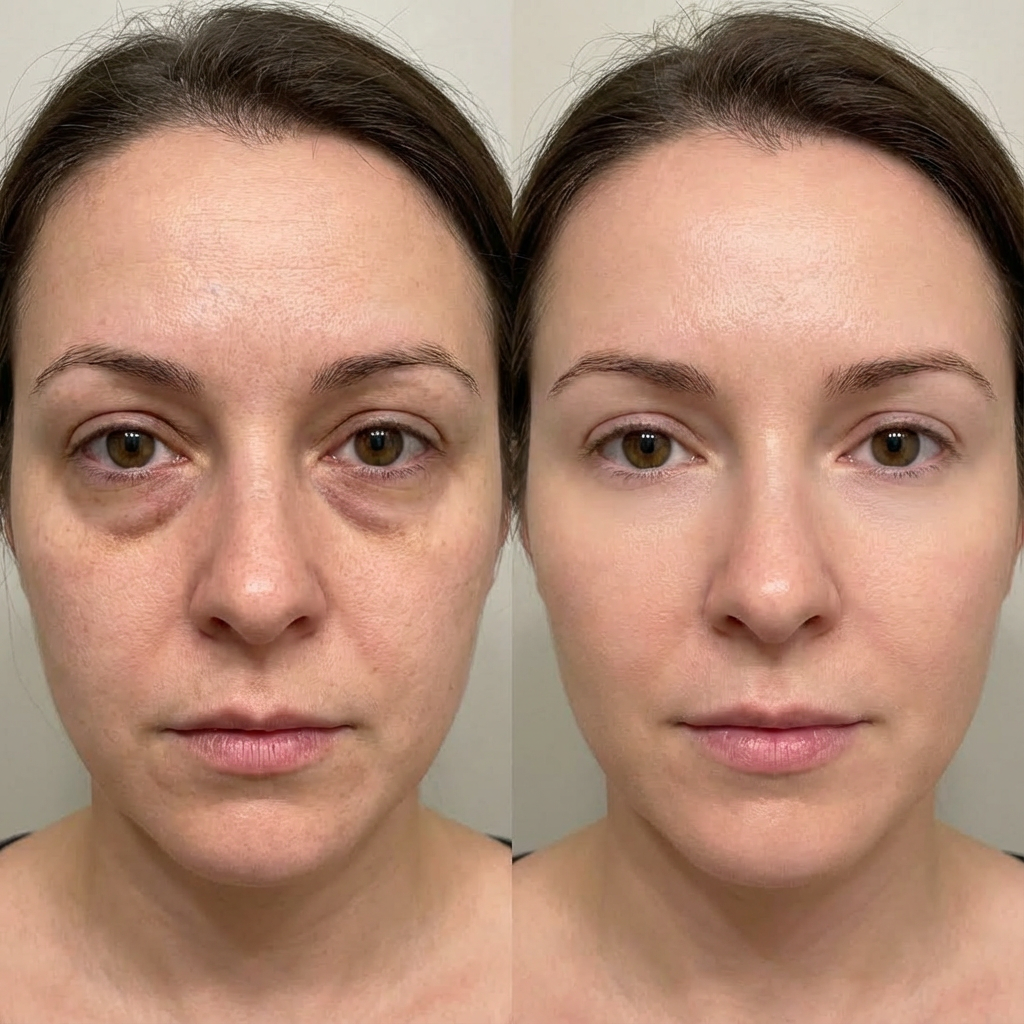
My coworker asked if I'm feeling okay during today's team meeting. For the fourth time this month. I slept 8 hours last night. I feel fine. Actually, better than fine—I'm energized, sharp, prepared for my presentation. But my face? My face tells a different story. On that little Zoom square in the corner of my screen, I look exhausted. Hollowed out. Like I've been awake for 36 hours straight. My under-eyes have become this dark, shadowy thing that no amount of concealer can fully hide. And the bags—God, the bags—make me look ten years older than I am. I'm 42. I look 52. Not everywhere. Just my eyes. Everything else? Fine. Good, even. I take care of myself. I exercise. I eat well. I look put-together. But my eyes… they're betraying me. And in a professional setting, "looking tired" reads as: Less competent. Less energetic. Less capable. Less promotable. I know what they're really thinking when they ask "Are you feeling okay?" *Is she overwhelmed?* *Can she handle this project?* *Should we give this to someone else?* I've worked my ass off to get where I am. I'm a director of marketing at a tech company. I manage seven people. I'm the person people come to when they need something done right. I'm sharp. I'm on top of my game. I'm respected. But my face is sabotaging me. --- ## Here's what nobody tells you about working from home: You spend 3-5 hours a day staring at your own face. Conference calls with the executive team. Client presentations. One-on-ones with my manager. Team check-ins. Interviews with candidates. Every single day, there I am—trapped in that little video box, watching myself look progressively more tired as the day goes on. I've tried everything to fix it: **Repositioned my laptop** (higher, lower, farther away, closer—nothing helps) **Bought a ring light** ($89 at Best Buy—made my forehead look great, under-eyes still looked like hell) **Adjusted the "touch up my appearance" Zoom filter** (just blurs everything and makes me look weird and fake) **Sat with my back to a window for "natural lighting"** (now I'm a silhouette with a bright halo) **Applied more makeup** (cakey by noon, settles into every line, makes me look older) **Bought a second ring light** ($65—even worse, now I just have two expensive lights illuminating my exhaustion) Nothing fixes it. Because the problem isn't the lighting. The problem isn't Zoom's camera quality. The problem is my actual under-eyes. --- ## The comments started about a year ago. "You look tired today. Everything okay?" From my boss, Karen, during our weekly one-on-one. I forced a smile. "Oh no, I'm fine! Just a long week." But inside I was thinking: *I slept 8 hours. I had my coffee. I'm not tired. I just LOOK like this now.* Then it happened again two weeks later. Different person. Then again. And again. Now I hear it constantly. From clients. From my team. From recruiters during informational interviews. My husband sees me at my actual worst—first thing in the morning, no makeup, actual bedhead—and he doesn't say it as much as my coworkers do. Every time someone says it, I have to smile and reassure them: *"Oh, I'm fine! Just busy."* *"Long week, you know how it is."* *"Didn't get my coffee yet, ha ha."* But what I want to scream is: **I'M NOT TIRED. I JUST LOOK LIKE THIS NOW.** And it's affecting how people see me professionally. Last month, there was a conversation about who should lead a high-visibility client pitch. I'd been working toward that for months. They gave it to Marcus. Marcus, who joined the team eight months after me. Marcus, who I've had to coach through basic presentations. I heard through the grapevine that someone said, "She just seems really stretched thin right now." I'm not stretched thin. I'm hitting every deadline. My team's performance is strong. My work is excellent. But I *look* exhausted on Zoom. And apparently that's enough. --- ## I've spent $847 on eye creams in the last two years. I'm not exaggerating. I keep the receipts because I expense my Sephora purchases as "professional appearance maintenance." (Don't judge me. LinkedIn headshots are tax-deductible. Eye cream should be too.) **La Mer Eye Concentrate.** $340. Everyone said it was the best. Used it religiously for four months. Morning and night. Tapped it in with my ring finger exactly like the beauty counter woman showed me. Zero improvement. **Drunk Elephant C-Tango Eye Cream.** $68. Vitamin C supposedly "brightens dark circles." It didn't. It just made my bathroom smell like oranges. **SkinCeuticals A.G.E. Eye Complex.** $102. My dermatologist specifically recommended this one. "This is what I use," she said. After 12 weeks, my under-eyes looked exactly the same. Maybe slightly more moisturized. That's it. **Estée Lauder Advanced Night Repair Eye.** $65. My mom swears by this brand. Said it "changed her life." Didn't change mine. **Kiehl's Avocado Eye Cream.** $34. Felt nice. Did absolutely nothing. **Ole Henriksen Banana Bright Eye Crème.** $42. The packaging was cute. The results were nonexistent. **The Ordinary Caffeine Solution 5% + EGCG.** $7.49. I figured, "Let me try the cheap stuff, maybe expensive doesn't matter." It stung. And it didn't work. **Sunday Riley Auto Correct Eye Cream.** $65. Beautiful blue bottle. Useless. **Tatcha The Pearl Tinted Eye Illuminating Treatment.** $88. This one *claimed* to "instantly illuminate." It made me look like I smeared highlighter under my eyes. I followed the directions. I was patient. I gave each one at least 6-8 weeks. Not one worked. I tried other things too: **Jade roller.** $35. Felt nice. Temporarily reduced puffiness for maybe 45 minutes. Then it came back. **Eye masks from Target.** $12 per box. Cool and refreshing. Gone in an hour. **Prescription tretinoin.** $28 copay. My dermatologist prescribed this as a "stronger option." It made my under-eyes so dry and irritated that they *looked worse.* Flaking skin. Redness. I had to stop wearing makeup for three weeks because it was too painful. **Caffeine eye patches.** $24. Worked for about 90 minutes. Then my under-eyes looked exactly the same. **Ice cubes in the morning.** Free. Helped for approximately 20 minutes. I even—I'm embarrassed to admit this—tried putting cold spoons under my eyes. You know what that did? Made my face cold. $847 over two years on products alone. Plus the $89 ring light. And the $65 second ring light. And the laptop stand ($45). And the upgraded webcam ($120) that I thought might somehow make me look less tired. Over $1,100 spent trying to fix how I look on Zoom. And my under-eyes looked exactly the same. Maybe slightly more moisturized. But still just as dark. Just as puffy. Just as *exhausted-looking*. --- ## Then three weeks ago, something happened. I had a big client presentation. Huge account. I'd been preparing for weeks. The presentation went well. Really well. The client loved our strategy. They verbally committed to moving forward. After the call ended, I stayed on Zoom for our internal debrief with the team. My boss Karen said, "Great job today. Really strong presentation." Then she paused. Looked at her screen. And said: "Are you sure you're okay? You just seem… I don't know. Worn down?" I felt my face get hot. "I'm completely fine. I feel great, actually. That went really well." "I know, I know. You did great. You just… you look really tired lately. I'm wondering if you're taking on too much." There it was. *"Taking on too much."* Translation: *Can she handle more responsibility?* I logged off the call and just sat there staring at my reflection in my now-black laptop screen. I wasn't tired. I wasn't worn down. I wasn't "taking on too much." I'd just closed a huge client and my boss was questioning my capacity because of how my face looked on a Zoom call. That night, I couldn't sleep. I kept replaying it. "You look really tired lately." The implication that I couldn't handle more. I'm 42 years old. I'm at the stage in my career where I should be getting promoted, not sidelined because I look exhausted on video calls. --- ## 2:47 AM. Wednesday night. Technically Thursday morning. I was lying in bed, staring at the ceiling. I picked up my phone. Typed into Google: "Why do I look so exhausted on Zoom when I'm not tired" I'd searched variations of this dozens of times. Usually I'd just find articles about ring lights and camera angles. Advice I'd already tried. But this time, one result caught my eye. A medical journal article. I clicked it because I was desperate and couldn't sleep anyway. "Periorbital aging and fibroblast senescence: Understanding structural collapse in the under-eye region" I had to Google half those words. But here's what I understood: **Under-eye bags aren't caused by lack of sleep or dehydration.** **They're caused by structural tissue breakdown at the cellular level.** The skin under your eyes has cells called fibroblasts. These cells produce collagen—the protein that keeps your skin firm and lifted. But over time, these cells get damaged. Not just "old." Damaged at the DNA level. From what? **15,000+ blinks per day.** That's mechanical stress—every single blink creates micro-trauma to the delicate under-eye area. **UV exposure.** All those years I didn't wear sunscreen religiously in my twenties. All those beach vacations. All that time driving with sun on my face. **Blue light from screens.** I've been staring at a computer for 8-10 hours a day for the last 15 years. My phone before bed. My laptop all day. **Chronic stress.** High-pressure career. Deadlines. Big presentations. My body producing cortisol constantly. **Environmental pollution.** I live in a city. I'm breathing in particulates daily. **Sleep deprivation in my twenties and thirties.** All those years of staying up late, waking up early, pushing through. All of that—accumulated over years—creates thousands of tiny injuries to the DNA inside the fibroblast cells under your eyes. And once that DNA damage reaches a certain threshold, those cells stop functioning properly. **They can't produce collagen anymore.** The study said damaged fibroblasts can only produce about **18-24% of normal collagen output.** So what happens? The "scaffolding" under your eyes—the structural support that keeps everything lifted and firm—collapses. You get sagging. Hollows. Bags. That exhausted, aged look. Because the internal structure has broken down. I sat up in bed. Read that section three times. Then I read the next part. The researchers tested what happened when they applied **high-concentration collagen peptides**—the expensive stuff in $300 eye creams—to these damaged cells. Collagen production increased by **3-7%.** Three to seven percent. **The cells were too damaged to respond to the treatment.** It's like trying to renovate a house when the foundation is crumbling. You can paint the walls all you want. You can buy the most expensive paint in the world. But if the foundation is broken, nothing you do on the surface will fix it. That's why my $340 La Mer didn't work. That's why the peptide serums did nothing. That's why nine different eye creams and $847 later, my under-eyes looked exactly the same. **Not because they were bad products.** **Not because I was using them wrong.** **Because my cells were too damaged to use them.** I felt this overwhelming wave of... relief? Finally—FINALLY—an actual explanation. I wasn't crazy. I wasn't doing something wrong. I wasn't buying the "wrong" products. The products literally couldn't work because my cells couldn't respond to them. But then immediately: devastation. Because what the hell was I supposed to do about DNA damage? I couldn't un-blink the last 20 years. I couldn't go back in time and wear sunscreen every single day in my twenties. I couldn't undo 15 years of staring at screens. If the cells themselves were broken, what option did I have? More expensive creams clearly weren't the answer. My dermatologist had already prescribed tretinoin and it just made things worse. Was I supposed to just accept this? Look exhausted and "worn down" in every video call for the rest of my career? I almost put my phone down and tried to go back to sleep. But I kept scrolling. And then I saw it. --- ## The study mentioned a treatment that could repair cellular DNA damage. PDRN. Polydeoxyribonucleotide. DNA fragments extracted from salmon. I know. It sounds completely insane. But apparently it's been used in medical settings for decades. Wound healing. Diabetic ulcer treatment. Post-surgical tissue repair. Sports medicine for torn ligaments and damaged tendons. And the reason it works is because these DNA fragments can trigger cellular repair at the genetic level. When PDRN molecules come into contact with damaged cells, they bind to receptors on the cell surface. That binding sends a biological "repair signal" directly to the cell's nucleus. Essentially, it tells the damaged cell: **"Fix yourself."** And the cell... does. The study showed that PDRN could: ✓ Activate DNA synthesis in damaged fibroblasts ✓ Increase cellular energy (ATP production) by up to 60% ✓ Restore the cells' ability to produce collagen normally ✓ Improve tissue structure and reduce inflammation In other words, it could potentially **repair the cellular damage** that was preventing my under-eye cells from responding to all those expensive creams. Not mask the damage. Not temporarily plump the skin. Not deflate puffiness for two hours. **Actually repair the root cause.** I spent the next hour—from 2:47 AM to almost 4 AM—reading everything I could find about PDRN. Study after study showing it triggering cellular repair. Collagen synthesis increasing. Skin structure improving. Tissue regeneration happening at a biological level. Most of the studies were about injections. PDRN injections administered in dermatology clinics. $600-$900 per session. Multiple sessions needed. Downtime. Needles in your face. I wasn't about to start getting injections in my under-eyes. But then I found a study from Seoul National University from 2020. They tested topical PDRN delivery through hydrogel patches. 212 participants. Ages 38-58. Moderate to severe under-eye aging. The patches used a special hydrogel system that created a seal against the skin, forcing PDRN molecules to penetrate deep enough to reach the dermal layer where damaged fibroblasts live. **Results after 8 weeks:** **89% showed measurable improvement in under-eye structure** **84% reported visible reduction in puffiness and sagging** **91% maintained results for months after stopping treatment** This wasn't just cosmetic. This was actual cellular repair that lasted because the cells themselves had been fixed. I immediately started searching for PDRN eye patches. Found a bunch of Korean brands I'd never heard of. Most of them had PDRN listed way down in the ingredients—like the eighth or tenth ingredient. Probably barely any real concentration. Just marketing. Reviews were mixed. Some people said they worked. Others said they were just like every other hydrogel patch (temporary depuffing that fades in an hour). Then I found these patches. The ingredient list was completely different from everything else I'd seen. **PDRN wasn't buried in the list—it was the second ingredient.** **Clinical-grade concentration: 500+ ppm.** (Most other "PDRN patches" had 50-100 ppm, if they even listed the concentration.) The hydrogel system was specifically designed to create that occlusive seal the study mentioned. The patches turn from pink to translucent as the PDRN penetrates—the color change is actually an indicator that it's absorbing into the dermal layer. Marine collagen and peptides were included too—but here's the thing: they'd only work AFTER the PDRN repaired the damaged cells. That's when the cells could finally utilize those ingredients. It wasn't just a patch with PDRN thrown in as a marketing gimmick. It was designed around the mechanism. Around fixing the cellular damage first, THEN delivering the building blocks the cells needed. The reviews convinced me: *"I'm a 44-year-old consultant who lives on Zoom. This is the only thing that's made a visible difference in two years of trying products."* *"I spent over $900 on eye creams. Wish I'd found this first."* *"After three weeks, my manager asked if I was on vacation because I looked so refreshed. I wasn't. I just finally didn't look exhausted."* *"My dermatologist asked what I was using. She'd never heard of PDRN patches."* I added them to my cart. $79 for 8 pairs. I hesitated. I'd been burned so many times. Nine times, to be exact. What if these were just another disappointment? Another $79 wasted? But then I thought: I've already spent $847 on products that couldn't possibly work because my cells were too damaged to use them. I've spent over $1,100 total trying to fix how I look on Zoom. At least with these, I was addressing the actual problem—the damaged cells. If they didn't work, I was only out $79. If they did work... I clicked buy at 3:52 AM. --- ## They arrived four days later. I used them that morning before my 9 AM staff meeting. The instructions said: Apply to clean, dry under-eye area. Leave on for 20-30 minutes until the patch turns from pink to translucent. I applied them at 8:15 AM. They felt different immediately. Thicker than the caffeine patches I'd tried. More of a seal against my skin. Not sliding around. Not peeling at the edges. I made coffee. Checked emails. Watched the patches slowly fade from bright pink to almost completely clear. Took about 26 minutes. When I peeled them off and looked in the mirror, I actually said "whoa" out loud. My under-eyes looked... better. Not "Instagram filter" better. Not "I got filler" better. Just... better. The puffiness was noticeably reduced. The sagging looked lighter. Even the darkness seemed a shade lighter. I kept staring at myself, tilting my head, checking different angles. But I told myself: This is just like the caffeine patches. It's temporary vasoconstriction. Give it two hours and it'll be gone. I joined my 9 AM call. Looked at myself in the Zoom square. I looked... normal. Not exhausted. Not ten years older. Just normal. I checked my reflection again at 11:30 AM, right before a client call. Still better. Checked again at 2 PM after lunch. Still better. By 4 PM, I was genuinely confused. Every other patch I'd tried—the caffeine ones, the gold ones, the cooling gel ones—they all wore off within 90 minutes, two hours max. But these? Seven hours later, my under-eyes still looked noticeably better than they had that morning. That night, I took a photo next to the "before" photo I'd taken that morning. The difference was still there. I used them again three days later. Then two days after that. --- ## By the end of week two, something strange was happening. Even on the mornings I didn't use the patches, my under-eyes looked better than they had before I started. Not "better than yesterday." Better than two weeks ago. Better than a month ago. Better than they'd looked in *years.* I pulled up that medical journal article again. Re-read the section about PDRN's effects: *"Sustained collagen synthesis observed for 48-72 hours post-treatment"* *"Cumulative regenerative effects with repeated application"* *"Improved baseline cellular function maintained between treatments"* Oh. This wasn't like other patches that just temporarily deflated puffiness with caffeine or plumped skin with hyaluronic acid that evaporated by lunch. This was actually repairing my damaged cells. And once those cells were repaired, they could produce collagen again on their own—even on days I didn't use the patches. The effects were building on themselves. My cells were healing. And once healed, they could do their job again. --- ## Week three. I had my weekly one-on-one with Karen. Midway through discussing Q2 strategy, she suddenly stopped and said: "Okay, I have to ask. What are you doing differently?" I felt my stomach drop. "What do you mean?" "You look... I don't know, really refreshed? Rested? You just look really good lately." I wasn't wearing more makeup. Same lighting. Same Zoom setup. "Oh, um... just been sleeping better, I guess." But I wasn't sleeping better. I was sleeping the same amount I always had. My cells were just finally working again. "Well, whatever you're doing, keep it up. Seriously, you look great." I logged off that call and just sat there for a minute. Three weeks ago, she'd said I looked "worn down" and asked if I was "taking on too much." Now she was telling me I looked "really good." Nothing had changed except my under-eyes. And apparently, that changes everything. --- ## Week four. I had a video interview with a recruiter for a VP position at another company. (I wasn't actively looking, but when an opportunity like that comes along, you take the call.) The interview went well. Really well. At the end, the recruiter said, "I have to say, you present incredibly well on camera. So polished and energetic. That's actually rare—most people look exhausted on video." I thought about that for a long time after the call ended. Four weeks ago, my own boss was questioning whether I could handle more responsibility because I looked tired. Now a recruiter was complimenting how energetic I looked. My skills hadn't changed. My experience hadn't changed. My work quality hadn't changed. Just my under-eyes. And apparently, that's enough to change how people perceive your capability, your energy, your competence. --- ## Week six. I was cleaning out my desk drawer at home—the one where I keep all my "professional appearance" stuff. Found the receipt for the $89 ring light. The $65 second ring light. The La Mer eye cream. The SkinCeuticals. Added it all up again. Over $1,100 spent trying to fix how I looked on Zoom. I looked at the nearly-full jar of La Mer. $340 worth of cream I'd used faithfully for four months. It didn't work because it couldn't work. Because my cells were too damaged to use it. I felt angry for a second. Not at the product. It probably works great for people whose cells aren't damaged. But angry that nobody—not my dermatologist, not the beauty counter saleswoman, not a single article I'd read—ever mentioned that cellular DNA damage is why products stop working as you age. That there's an actual biological reason why $340 cream does nothing. That you can't fix damaged cells with expensive moisturizer any more than you can fix a broken bone with lotion. But also: relieved. Because now I understood. Now I knew why everything had failed. And now I finally had something that was actually working. --- ## I'm in week ten now. My under-eye bags haven't disappeared completely. I'm not going to lie and say I look 30 again. But they're measurably smaller. The sagging is significantly reduced. The darkness has faded substantially. The hollow, exhausted look is gone. I look like myself. The way I looked five years ago, before everything seemed to suddenly collapse. I don't obsess over my appearance in that little Zoom square anymore. I don't spend the first 30 seconds of every call checking my under-eyes in the video preview. I don't panic when someone schedules an early morning meeting because I know I won't look like death. Last week, my team nominated me for a leadership award. The kind that requires you to present to the executive team. Two months ago, I would have been anxious about that. Not because of the content—I know my work is strong—but because of how I'd look on camera presenting it. Now? I'm just excited about the opportunity. Because I finally look the way I feel: capable, energetic, sharp. Not exhausted. Not worn down. Not like I'm "taking on too much." Just myself. --- ## I'm not telling you this to make you feel bad about the money you've spent. God knows I spent over $1,100 trying to fix this before I understood what the actual problem was. I'm telling you this because I wish someone had told ME before I bought my first $340 eye cream. Before I bought two ring lights. Before I spent two years wondering why nothing worked. If your eye creams haven't worked, it's probably not because you bought the wrong ones. It's probably because your cells are too damaged to use them. And if that's true—if your cells are damaged—then buying cream number ten isn't going to help any more than creams one through nine did. You need to repair the cells first. Then everything else can work. That's what I finally figured out at 2:47 AM after spending $847 on products and months of feeling like I was sabotaging my own career with how I looked on Zoom. I just wish I'd figured it out sooner. If you spend hours on video calls every day—if you've heard "you look tired" one too many times—if you've tried expensive creams that did nothing— It might not be the products' fault. It might be cellular DNA damage preventing your skin from responding. That's what PDRN repairs. 30-day money-back guarantee. If it doesn't work, you pay nothing. If it does work—if your cells repair and start functioning again—you might finally look on camera the way you feel inside: capable, energetic, professional. Worth trying after everything else has failed.
Like this ad? Make it yours.
Crush rebuilds this exact creative around your product — your brand, your colors, your offer — in about a minute.