Wellness Network
Wellness Network Facebook ad: “I Wish I Learned This Sooner”
Ran for 9 days, from August 4 to August 13, 2026, the last day Crush saw it.
Run by Wellness Network on Facebook. Crush is not the advertiser and does not verify its claims. See this ad in Meta's Ad Library(opens in a new tab)
Want an ad like this for your product?
Crush makes new ad images for your product from this ad: your logo, your product photo, your offer.
Trials from $19.95 USD, then $79.95 USD a month. Cancel anytime.
About this ad
- Meta Ad Library ID
- 1403275721701784
- Platforms
- Facebook, Instagram, Audience Network, Messenger and Threads
- Relaunches
- 0
- EU reach
- 12,682
Ad text
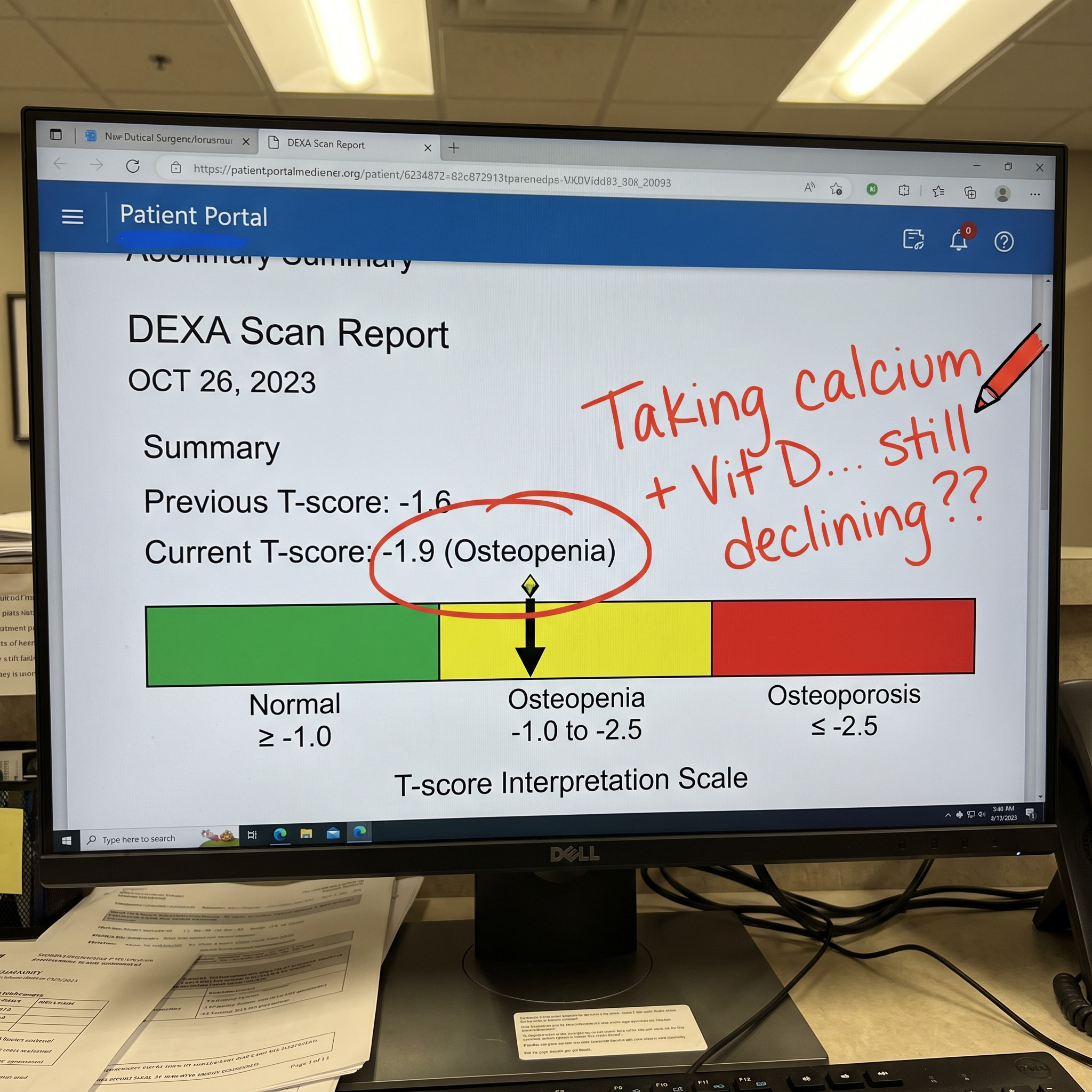
I owe an apology to every woman I've told to take calcium and vitamin D in the last 16 years. I didn't know it at the time. I do now. And I can't keep quiet about it anymore. I'm a primary care doctor. 16 years in practice. In that time, I've said the same sentence to thousands of women sitting across my desk with a DEXA scan in their file. "Take calcium. Take vitamin D. Stay active. We'll rescan in two years." That was my training. That was the standard of care. I never questioned it. Until last year, when it happened to me. I'm 59. Menopause hit me at 51 and I handled it the way I told my patients to handle it — responsibly. I took my calcium. I took my D3. I walked four mornings a week. I did everything I told my patients to do because I believed it worked. But my body had been sending signals I kept reclassifying as "normal." The cracking. Every morning when I went downstairs, my knees sounded like someone stepping on bubble wrap. I'd grip the railing tighter than I used to. Not because I was unsteady — but because I didn't trust what would happen if I let go. The stiffness. Some mornings I'd sit on the edge of the bed for five minutes, flexing my fingers, rolling my ankles, testing my back — like I was negotiating with my own skeleton before asking it to stand up. The shrinking. I measured myself at my own office. I'd lost almost three-quarters of an inch since my mid-forties. I stared at the measurement and thought of my mother. She lost three inches before she died. I watched her become smaller every year like her spine was slowly folding in on itself. Then the moment that scared me. I was at my granddaughter's birthday party. She ran at me — the way 4-year-olds do, full speed, no warning — and I braced for impact. She hit my legs and I felt my hip take the weight and something inside me whispered: be careful. I was afraid of being hugged by a 4-year-old. The next day I ordered my own DEXA scan. Two weeks later I was looking at numbers I'd seen hundreds of times in other women's files. T-score: -1.6. Osteopenia. Accelerating loss at the hip. And I felt exactly what every woman feels when she hears that number. The quiet terror. The math you do in your head — how many years until it crosses the line into osteoporosis? How many years until the fall? So I did what I always told my patients to do. I increased my calcium to 1,200mg. Kept my D3 at 600 IU — the dose I'd prescribed for sixteen years. I added weight-bearing exercises three days a week. My own protocol. By the book. Exactly the way I'd instructed hundreds of women. The calcium tore up my stomach. Constipation that had me sitting in the bathroom between patients. Bloating that started at lunch and didn't stop until I fell asleep. I tried different brands. Tried taking it with food. Tried splitting the dose. My gut was miserable. I told myself what I'd told every patient who complained about the same thing: it's worth it. Your bones need this. Push through. Thirteen months later I got rescanned. T-score: -1.9. Worse. Not stable. Not improved. Worse. After thirteen months of doing everything I preach to patients eight times a week. I sat in the radiology office reading my own results and I couldn't move for a while. Because I'd been sitting on the OTHER side of that desk for sixteen years. Handing women their declining numbers. Telling them to keep going. "Give it more time." "Stay consistent." "We'll check again in two years." And now I was the woman with the declining number and the doctor who had nothing else to offer. That night I did something I'm ashamed of. I stood in front of my bathroom mirror and thought: maybe this is just what my body does. My mother had osteoporosis. My grandmother broke her hip at 71. Maybe this is genetic and I'm just watching the same movie play out in my own bones. A doctor. A woman with 16 years of medical training. Blaming her own genetics. Here's what I know after 16 years: when a treatment fails across dozens of patients, it's not the patients. It's the TREATMENT. I'd watched this protocol fail over and over in my practice. Women who did everything right. Took the calcium. Took the D3. Walked. Did yoga. And their numbers kept sliding. I'd prescribe Fosamax and tell them it was the next step. I never once stopped and asked: why isn't the first step working? That question kept me up until 2am. I made coffee and sat at my kitchen table with my laptop and started reading. Not the clinical guidelines I'd been following since residency. The actual published research. What I found DESTROYED me. The vitamin D3 I've been prescribing for sixteen years — 600 IU — is not even close to what the research uses. The clinical trials that showed real impact on bone density used 5,000 to 10,000 IU. Some used higher. Six hundred is what the RDA says, and the RDA was set to prevent rickets. Rickets. A childhood disease. That's the standard I'd been building a bone-health protocol around. I'd been prescribing a dose designed to prevent a childhood disease to postmenopausal women losing bone density. For sixteen years. But the dose was just the first problem. Vitamin D doesn't work the moment you swallow it. It arrives in your body in a storage form — completely inactive. Before it can do anything for your bones, your liver and kidneys have to convert it. And every single enzyme involved in that conversion requires a cofactor. Magnesium. Without adequate magnesium, vitamin D sits in your blood in its storage form. Inactive. Doing nothing. Your lab work shows "sufficient vitamin D levels" — and your doctor says you're fine. But the vitamin D isn't functioning. It can't. The engine is there but the ignition key is missing. Roughly half of Americans don't get enough magnesium. Which means roughly half the women I told "your vitamin D looks good" were carrying around vitamin D that couldn't do its job. Their levels looked fine on paper. I documented it in their charts. Checked the box. Moved on. Their bones kept deteriorating. And I kept telling them the protocol was working because the lab values said so. But I need to tell you the part that made me put my laptop down and sit in the dark for a while. Because the vitamin D not activating? That's a failure. A passive failure. The treatment doesn't work. That's bad enough. What I found next is an ACTIVE harm. And it's the reason I can't stay quiet. Calcium. When you take a calcium supplement, it enters your bloodstream. That part works. But calcium in your blood is undirected. It doesn't know where to go. It doesn't automatically seek out your bones. It just circulates. And it has to deposit somewhere. There is one vitamin — one — that controls where calcium goes. It activates a protein called osteocalcin that pulls calcium INTO bone. And it activates another protein called Matrix GLA that keeps calcium OUT of your arteries. That vitamin is K2. I'd never heard of it in medical school. I'd never seen it in a prescribing guideline. In 16 years, not one protocol, not one continuing education course, not one specialist I referred to ever mentioned it. Without K2, the calcium I prescribed had no traffic cop. No direction. No signal telling it where to go. So where was it going? A research team in New Zealand analyzed data from over 28,000 subjects. They found that calcium supplements — taken without K2 — were linked to a 27% increase in risk of heart attack. Twenty-seven percent. They calculated that treating 1,000 women with calcium for five years would cause 14 additional heart attacks, 10 additional strokes, and 13 additional deaths. More women harmed than helped. I read that sitting at my kitchen table at 3 in the morning and I felt my face get hot. For 16 years, I told women to take calcium to protect their bones. I never told them about K2. Not once. Because I didn't know. Because nobody taught me. Because the protocols don't mention it. And without K2, the calcium I prescribed wasn't building their bones. It was depositing in their arteries. Hardening them. Quietly. Year after year. While I told them they were doing the right thing. I wasn't just giving them a treatment that didn't work. I may have been giving them a treatment that was actively working against them — weakening their bones AND hardening their arteries at the same time. I called my friend Sarah the next morning. She's an endocrinologist. Sees bone density cases all day. I told her everything. The K2 research. The magnesium activation. The calcium without direction. She was quiet for a moment. Then she said: "This isn't new, Lisa. The Rotterdam Study showed this in 2004. The Japan data goes back to 2001. K2 with D3 and magnesium is what the research has supported for over twenty years. I honestly don't know why primary care still hands out calcium and basic D3 like it's 1995." OVER TWENTY YEARS! The research existed before I finished residency. Before I wrote my first prescription. Before I told my first patient to take calcium and come back in two years. And it never reached my prescribing pad. Because the guidelines haven't been updated. Because we got one lecture on vitamin D in four years of medical school. Because nobody teaches K2. So women sit across from me, doing everything right, watching their numbers decline, blaming their bodies. And I sat across from them with nothing to offer except "more calcium" and eventually Fosamax — which only slows breakdown and doesn't build anything. I spent two weeks after that phone call evaluating every bone-health supplement I could find. Most of them have the same problem. D3 by itself — no K2, so calcium still has no direction. Or D3 with K2 but no magnesium — so the D3 still can't activate. Or all three but no fat source — and D3 and K2 are fat-soluble, which means without fat they pass through the gut barely absorbed. Every formula I found was missing at least one piece. Like four legs of a chair and every product only had two or three. Then I found one that had all four. 10,000 IU of D3. The clinical dose. Not the 600 IU I'd been handing out for sixteen years. 300 MCG of K2. The traffic cop. The one that activates the proteins that put calcium where it belongs and keep it out of where it doesn't. Triple magnesium. The activation key. The cofactor every D3 enzyme requires. The thing half my patients were missing while I told them their vitamin D was "fine." And coconut oil built into the capsule — so the fat-soluble vitamins actually absorb regardless of whether you take it with food. I cross-referenced every ingredient and dose against the published literature. The D3 matched the clinical trials. The K2 matched the Rotterdam and Japanese studies. The magnesium forms matched the bioavailability research. The fat-source approach matched the absorption data showing 32% better uptake with dietary fat. It checked out. All of it. It's called TrueNutra Vitamin D3 + K2. 👉 https://truenutrawellness.com/products/fb-en-vdk002 I ordered it that night. The first thing I noticed was what DIDN'T happen. No stomach problems. After thirteen months of calcium destroying my gut, I braced for the bloating and constipation. It never came. Two weeks in and my stomach felt normal for the first time in over a year. By week three, something shifted that I almost missed. I went downstairs in the morning and I was four steps down before I realized — no cracking. My knees were quiet. It was so normal-feeling that I almost didn't register it. But when I stopped and thought about it, I couldn't remember the last time I'd gone downstairs without sounding like a bag of popcorn. By week four, the morning negotiation was over. I wasn't sitting on the edge of my bed anymore, testing my body before I stood up. I just got up. The way I used to. The way you're supposed to. By week six, I was at the gym doing goblet squats. Goblet squats. Two months earlier I'd been afraid of being knocked over by a 4-year-old. My trainer looked at me like I was a different patient. Because I was. Month THREE. I got rescanned. T-score: -1.2. I sat with that number for a long time. Because I knew what it meant. Not just for me — for every woman I'd told to take calcium and come back in two years. -1.9 to -1.2. In three months. After thirteen months of the standard protocol made it WORSE. The radiologist who read my scan — a woman I've known for a decade — called me personally. She said: "Lisa, I don't usually call about DEXA results but I wanted to ask — what are you doing?" That's when I changed my practice. Every woman in my office with bone density concerns is now on this protocol. D3 at clinical dose. K2 to direct calcium. Magnesium to activate the D3. Fat source for absorption. All four. Together. Numbers I couldn't move in two years of calcium and basic D3 are stabilizing in months. I wasn't a bad doctor. I was following bad guidelines. But my patients were the ones whose bones paid for it. And their arteries may have been paying for it too, in a way none of us could see on a DEXA scan. If your bone density is declining and you've been on calcium and vitamin D for months or years with nothing to show for it — it's not your body. It's not your genetics. It's the protocol. The calcium has no direction without K2. The vitamin D can't activate without magnesium. The dose is too low. And the absorption is crippled without fat. I've linked what I now take — and what I now recommend to my patients — below: 👉 https://truenutrawellness.com/products/fb-en-vdk002 Right now they're running buy one, get one free. Over 80,000 people are already on this formula. And they offer a 90-day money-back guarantee — which is more than any prescription I've ever written has offered a patient. P.S. — Give it 2 to 3 weeks for the sleep and stiffness to shift. That's the magnesium working. By week 4 to 6, the joint aches quiet down. By month 6, ask for a DEXA rescan. You'll want the number. Trust me. P.P.S. — I need to say this because someone will ask. I'm not paid by TrueNutra. I'm not affiliated with them. I don't have a code. I don't get a commission. I recommend this formula because I spent two weeks cross-checking every D3+K2 supplement I could find against the published research — and this was the only one that had all four in the right forms and at the right doses. The clinical D3. The K2. The triple magnesium. The fat source built in. Most brands get two out of four. Some get three. This was the only one that didn't cut a corner. If I find a better one tomorrow, I'll recommend that instead. I don't care about the brand. I care that my patients stop taking a protocol that doesn't work — or worse, works against them.
Where the ad sends people
truenutrawellness.com
I Wish I Learned This Sooner
"This actually worked, thank you so much." - Pat D.
Learn more: truenutrawellness.com(opens in a new tab)