
Inactive· since May 15, 2026
- 2
- days it ran
- 0
- relaunches
- 61
- EU reach
Ad copy
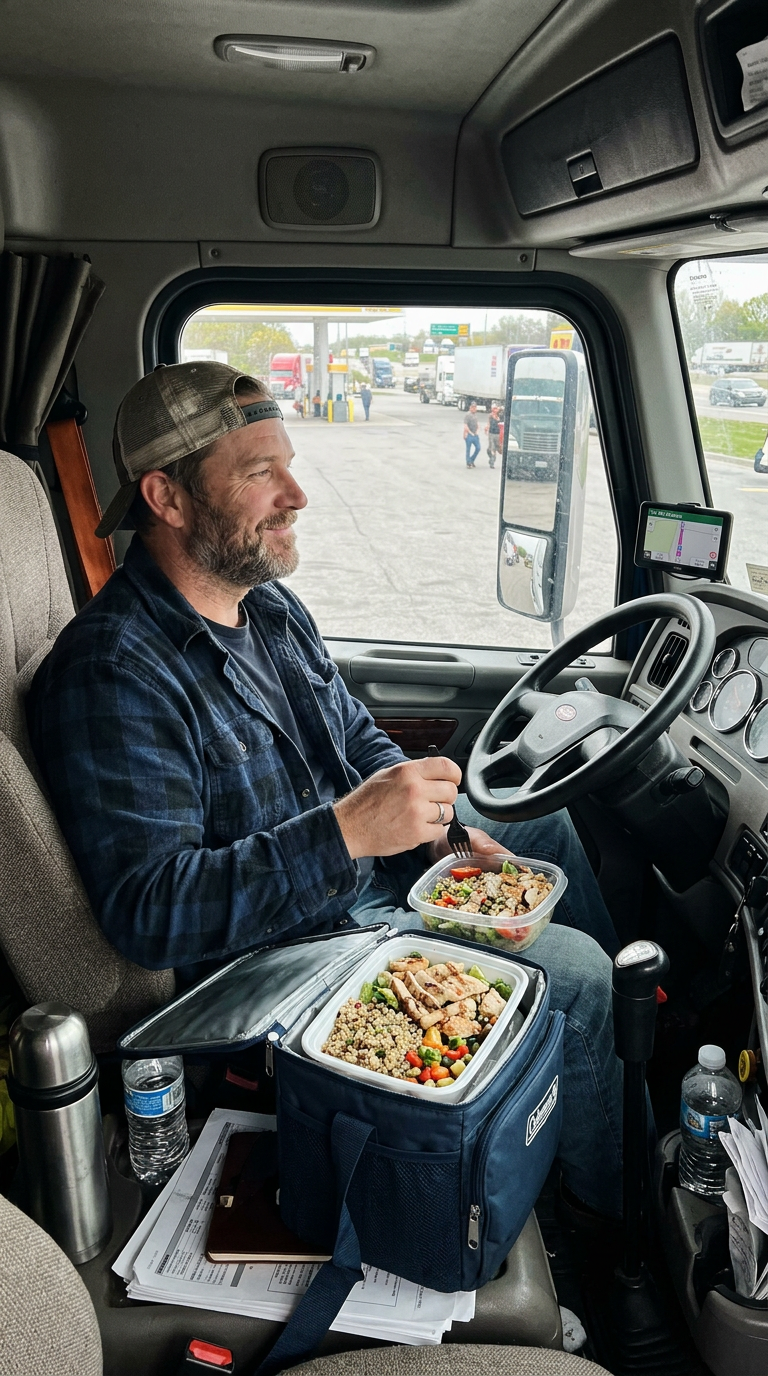
My husband drives a truck for a living. Long haul. Five days on the road, two days home. He used to come back looking the same as when he left. Now he comes back looking heavier every trip. He was a 34 waist when he got his CDL at 33. He's a 42 at 45. Twelve years behind the wheel. Eight waist sizes. His doctor said "the job" and left it at that. As if "the job" was a medical diagnosis. The thing about trucking is everyone blames the sitting. "Of course he gained weight — he sits for twelve hours a day." But my husband doesn't just sit. He loads. He chains. He wrestles tarps in wind and rain. He does more physical work at truck stops than most office workers do in a week. And on his two days home he's in the garage, in the yard, on his feet. He's not sedentary. He's stressed. There's a difference nobody in his doctor's office understands. Let me tell you what I watched from the home side of a trucking marriage. At 35, he came home from a five-day run and his jeans didn't button. He laughed it off. "Road food." He bought new jeans and went back out. At 37, the new jeans didn't button either. He stopped laughing. He started packing coolers — meal prepped containers, clean food, no truck stop garbage. He ate better on the road than most people eat at home. Grilled chicken in Tupperware at a rest area while other drivers ate burgers. The discipline of a man fighting his body from a cab. He gained weight. At 39, he joined a gym chain with locations near his routes. He'd stop after his drive, find the nearest location, train for an hour. After ten hours behind the wheel. After loading and unloading. After carrying the stress of deadlines and traffic and dispatchers and weather in his shoulders for a full day. Then he'd go train. And come back to the cab. And eat his meal-prepped chicken. And gain weight. His doctor said "it's the sitting." His doctor didn't ask about the sleep — the way a trucker sleeps in a cab at a truck stop with rigs idling around him and the lot lights bleeding through the curtain. His doctor didn't ask about the cortisol of driving 600 miles a day with a 40-ton load on a deadline while other drivers cut you off and dispatchers call every two hours. His doctor didn't ask about the vibration — the constant, low-level, twelve-hour vibration of the cab that keeps the nervous system at a baseline of activated that most people never experience. His doctor said "eat less, move more." To a man who was meal-prepping from a cooler and training at gyms along I-40. At 40, his wedding ring stopped fitting. I wrote about that in a different conversation. The ring went in the truck's glove box because it was safer there than on a swollen finger under a tarp strap. But the glove box was the symbol. My husband's wedding ring lived in a glove box for three years because his body wouldn't let it live on his hand. At 42, he stopped fighting. Cancelled the gym chain membership. Stopped packing the cooler. Ate whatever was available. Accepted a 42 waist. Accepted that the kid who got his CDL at 33 in a 34 waist was someone who drove away and wasn't coming back. The two days home became different. He used to arrive with energy — for me, for the kids, for the yard. Now he arrived depleted. Like the five days on the road took everything and the two days home weren't enough to refill. He'd sit on the couch and stare. "I'm good." "I'm just tired." "Let me rest." Five days of stress. Two days of recovery that never actually recovered. Then back out. The cycle that runs a body into survival mode without the body ever knowing it's there. Then one night — one of his two nights home — we were in bed. Both on our phones. The parallel scrolling of a trucking marriage where two days isn't enough time for real conversation so you settle for proximity. He turned his phone to me. A post from a trucking forum. Not about weight. About a driver who couldn't sleep no matter how tired he was. Who felt wired at truck stops at midnight. Who gained weight despite eating clean. The driver wrote: "Twelve years of running loaded. Twelve years of deadlines. My body forgot how to stop running. Even at a truck stop at midnight with the engine off — my engine was still running. That's not fatigue. That's a nervous system in permanent haul mode." My husband read that paragraph four times. "That's me," he said. "My engine never turns off. Not at truck stops. Not at home. Not in our bed. Never." The post mentioned Liven. Micro-Cycle Method. Five minutes a day. Something for the engine. The nervous system running underneath everything. He took the quiz on his phone in our bed. Clicked yes to everything about the wired-but-tired, the never-coming-down, the body bracing. Downloaded Liven. "I can do five minutes in the cab," he said. "Before I start the engine." Five minutes before the engine. That became his thing. Every morning in the cab at 5 AM. Before the key turns. Five minutes for the engine that matters. Here's what I watched from the home side. Week 1: he called me from a truck stop at 10 PM and his voice was different. Not the wound-tight road voice. Something underneath had eased. "I slept four hours straight," he said. For a trucker in a cab, four unbroken hours is a miracle. Week 2: the cooler came back. Not because I asked. He started packing again. "I'm not as hungry on the road," he said. "The 2 PM thing stopped." The 2 PM thing was the daily crash where his body screamed for gas station sugar. For years the cab had a gas station bag by 2:15. Now it didn't. Week 3: he came home on a Friday. Walked in the door and went to the yard instead of the couch. Raked. Moved things. Stood in the garage talking to our neighbor. He had two days of home and he was USING them instead of recovering through them. Week 4: "Twelve pounds," he said. Saturday morning. Standing in our bathroom. The scale back from wherever he'd hidden it. "Without the gym chain. Without changing the routes. Just five minutes before the engine." Twelve pounds from a body that hadn't released anything in three years. Week 6: his jeans were loose. The 42s. He dug out the 40s from the closet. They buttoned. He stood in the bedroom and looked at himself and I saw something crack in his expression — the flat road-face he'd been wearing for years. Something alive underneath. Week 8: he came home on a Friday wearing a shirt I hadn't seen in two years. Not the baggy dark road shirt. A regular shirt. It fit. He walked through the door and picked up our daughter with one arm and I thought: there he is. Behind the 42 waist. Behind the glove-box ring. Behind three years of "I'm good" on the couch. There he is. It's been five months. He's a 38 waist. Not at his 34 yet — but the ring is back on his hand. Not in the glove box. On his hand. It fit at week ten. He called me from a truck stop to tell me. "It's on," he said. Two words. From a rest area off I-40. The most romantic sentence of our marriage. He sleeps in the cab now. Actually sleeps. The lot lights don't keep his system running. The engine underneath has learned to idle instead of hauling. He comes home with something left. The two days aren't recovery anymore — they're living. He plays with the kids. He initiates. "Let's go somewhere." Not "let me rest." And he packs the cooler again. Not from discipline — from choice. His body isn't screaming for truck stop sugar at 2 PM because the survival mode isn't driving the cravings. Twelve years of running loaded. Twelve years of an engine that never turned off. Because every doctor saw a trucker and said "the sitting" without asking one question about a nervous system that had been hauling for 600 miles a day, five days a week, for twelve years. It wasn't the sitting. It was a body in permanent haul mode. And once he addressed that — five minutes before the engine — his body finally learned to park. If your husband drives for a living. If the road is taking more than miles. If he comes home heavier every trip and the two days aren't enough to bring him back. It might not be the sitting. His body might be stuck in haul mode. And haul mode holds everything — weight, tension, the ring that doesn't fit. Liven has a quiz. A few minutes. Doesn't cost anything. Show it to him on one of his two nights home. Tell him: "Your engine never turns off. This might explain why." Link is below. 💙
THIS IS what you need to do
LEARN MORELike this ad? Make it yours.
Crush rebuilds this exact creative around your product — your brand, your colors, your offer — in about a minute.