
Active· since Jan 23, 2026
- 237
- days running
- 1
- relaunches
Ad copy
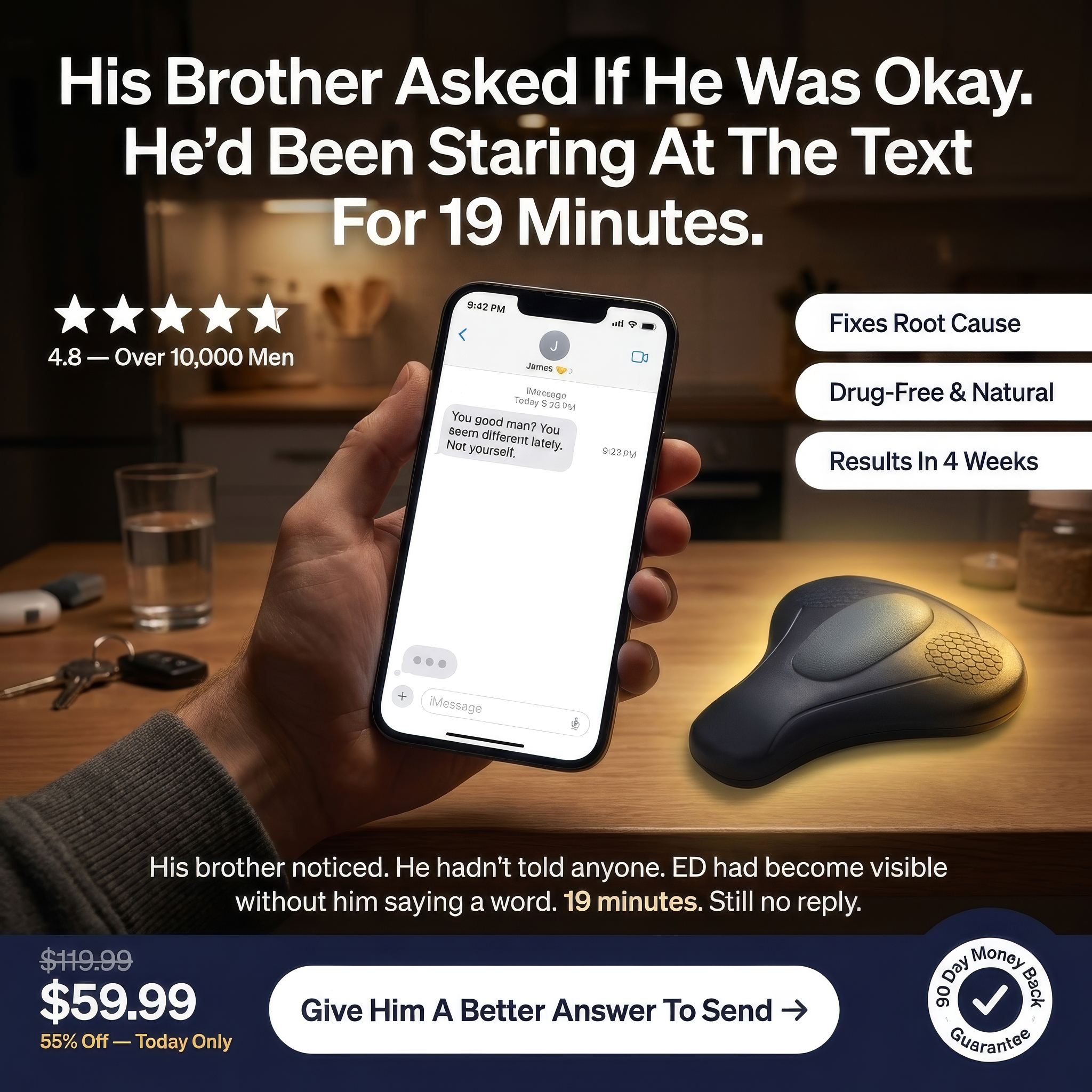
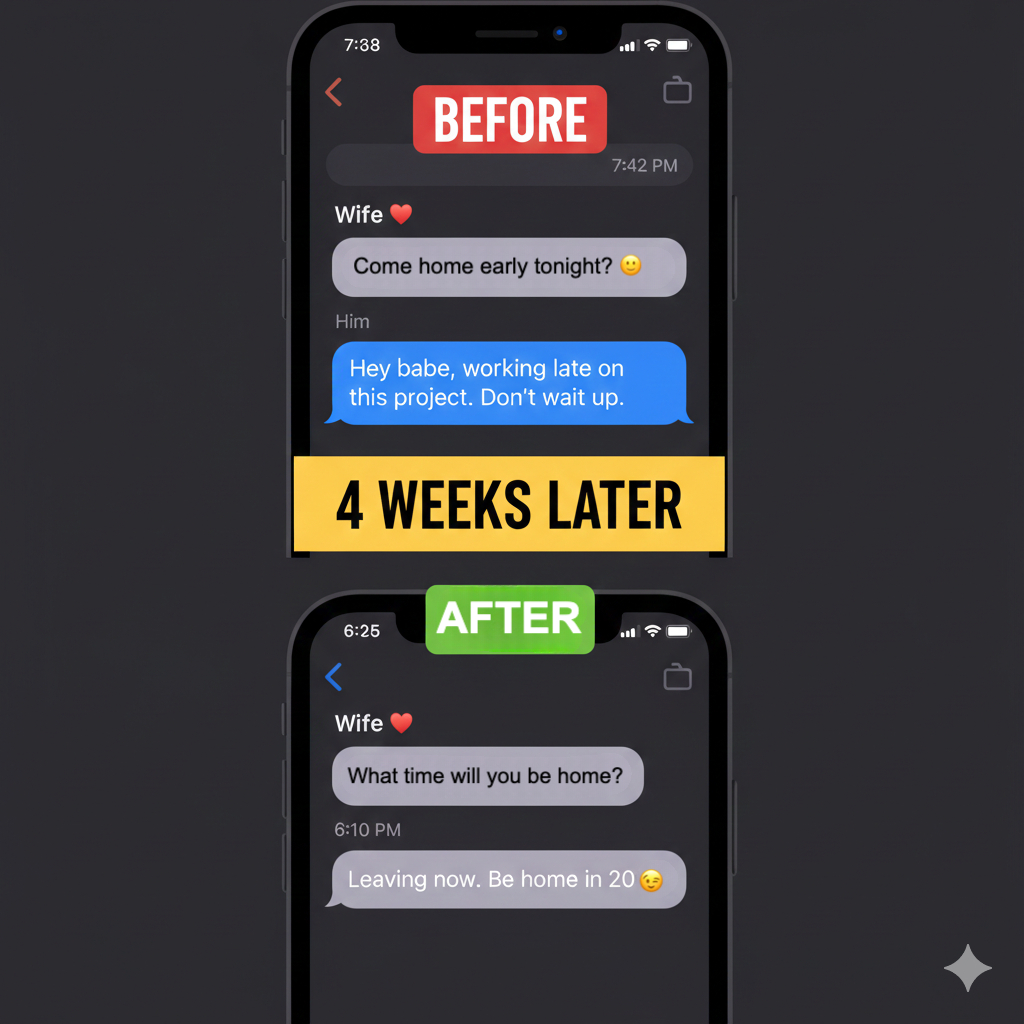
I saved the screenshot because I knew I'd want to remember. Not the "after" text. The "before" one. The lie I'd been telling for seven months. "Hey babe, working late on this project. Don't wait up." I sent that text 47 times between March and September. I know because I scrolled back through our messages one night and counted. 47 excuses. 47 ways of saying "I'm avoiding coming home because I'm scared to try and fail again." My wife never called me out on it. She'd just text back "OK" or "See you tomorrow" or sometimes nothing at all. But I knew she knew. And that made it worse. I'm 42 years old. Married for nine years. For the first seven years, I'd rush home from work. For the past 18 months, I'd been finding reasons to stay away. Not because I didn't love her. Because I couldn't perform. And every time I came home "early" and we tried, I'd fail. So I stopped coming home early. I'd sit in my car in the parking lot after work, scrolling my phone for 45 minutes. Then I'd text her some excuse about being busy. Then I'd drive around. Go to the gym. Sit at a coffee shop. Anything to avoid the moment when she'd reach for me and I'd have to disappoint her again. By month six, the excuses were automatic. "Working late." "Traffic is bad." "Stopping at the store." She stopped asking me to come home early. That's when I knew we were in real trouble. Not because she was angry. Because she'd stopped trying. One night in late August, I was sitting in my car at 7:30 PM. She'd texted me at 6:15: "What time will you be home?" I'd replied: "Late night. Finishing this report." There was no report. I was parked outside a Target, scrolling Reddit, killing time. I felt pathetic. I opened a new search: "why do I avoid intimacy with my wife." Most results talked about emotional distance. Communication issues. Lack of attraction. None of that fit. I loved my wife. I was attracted to her. I was avoiding her because my body didn't work. And I didn't know how to fix it. I'd been on pills for four months. It helped sometimes. But even when it worked, the anxiety was so bad that I'd lose the erection halfway through. And on the nights it didn't work at all, I'd see the disappointment in her eyes. So I started avoiding those nights entirely. Easier to make an excuse than to fail. I kept searching. That's when I found an article about avoidance behavior in men with ED. The headline: "Why Men Stop Initiating: The Cycle of Anticipatory Performance Anxiety." I clicked it immediately. The article described exactly what I was experiencing: You fail once. Then twice. Then you start anticipating failure before it even happens. The anticipation creates anxiety. The anxiety makes failure more likely. More failures create more anxiety. Eventually, you stop trying altogether. Not because you don't want intimacy. Because the fear of failure is stronger than the desire to connect. I sat in my car reading this article, and I felt seen for the first time in months. But the article didn't stop there. It explained something I'd never considered: Anticipatory anxiety is a symptom of unreliable performance. And unreliable performance is usually caused by weak pelvic floor muscles. When your pelvic floor is strong, erections are consistent. When performance is consistent, there's nothing to anticipate. The anxiety doesn't develop in the first place. But when your pelvic floor is weak, performance is unpredictable. You never know if tonight will be a success or a failure. That uncertainty creates anticipatory anxiety. And the anxiety makes everything worse. The article cited a study: Men with weak pelvic floor muscles and anticipatory anxiety were split into two groups. One group received anti-anxiety medication. One group received pelvic floor muscle training. The anti-anxiety medication reduced worry—but didn't improve performance. So the anxiety came back as soon as the medication wore off. The pelvic floor training improved performance reliability. And once performance became predictable, anticipatory anxiety disappeared naturally. Because there was nothing to anticipate anymore. I read that section twice. Then I started searching for everything I could find on pelvic floor training. I'd heard of kegel exercises. I'd tried them for two weeks and quit when nothing changed. But the research explained why manual kegels don't work: Most men can't isolate the right muscles. And even if you do them correctly, manual squeezes are too weak to strengthen the deep muscles that control erections. I found studies on vibration-based training. Targeted vibration automatically contracts the exact muscles responsible for blood retention during erections. One device appeared repeatedly: PelviPulse. I read reviews. Research papers. Clinical trials. I was skeptical. But I was also sitting in a Target parking lot at 8:15 PM, avoiding going home to my wife. I ordered it from my phone at 8:31 PM. When it arrived, I didn't tell her what it was. I just started using it every night. 20 minutes while watching TV after she went to bed. Day 1-5: Nothing changed. I still avoided coming home. Day 7: I woke up with an erection. Not a full one, but there. First natural morning wood in over a year. Day 10: Woke up fully hard. Day 14: I realized I'd stopped checking my phone compulsively at 6 PM, looking for excuses to delay going home. Day 16: She texted me at 5:45 PM: "What time will you be home?" I stared at that text. Usually, I'd feel the anxiety spike immediately. Start crafting an excuse. But this time... I didn't. I typed: "Leaving now. Be home in 20." I sent it before I could overthink it. When I got home, we had dinner. Talked. Watched TV. And when she reached for me later that night, I didn't freeze. I stayed hard the entire time. Not because the anxiety was gone—I was still nervous. But because my body did what it was supposed to do. Performance was reliable. And when you can rely on your body, there's nothing to be anxious about beforehand. That was four weeks ago. I haven't sent a "working late" excuse since. Not because I "conquered my anxiety." Because I fixed the physical problem that made performance unpredictable. Once performance became consistent, anticipatory anxiety had nothing to feed on. I didn't need to avoid anymore. Because there was nothing to be afraid of. Last week, she texted me at 6:10 PM: "What time will you be home?" I replied: "Leaving now. Be home in 20 😏" The emoji felt significant. Not just because I was eager to come home. But because I wasn't scared. I'm not saying anxiety isn't real. I'm not saying it doesn't make ED worse. It absolutely does. But in my case, the anxiety was a response to unreliable performance. And unreliable performance was caused by weak pelvic floor muscles. I spent seven months treating the anxiety. Breathing exercises. Meditation. "Staying present." None of it worked—because I was treating the symptom while ignoring the cause. What worked was strengthening the muscles that control blood retention. Once those got stronger, performance became predictable. Once performance became predictable, anticipatory anxiety disappeared on its own. I didn't "work through" it. I just removed the reason for it to exist. I still have the screenshot of that "working late" text. I keep it on my phone as a reminder. Not of where I was. But of what I was really saying. "I'm scared to come home because I don't trust my body." I don't send those texts anymore. Because I trust my body now. Not perfectly. Not every time. But enough that I don't spend my evenings parked outside Target, making excuses. I'm sharing this because I know there are men reading this who recognize those texts. The excuses. The delays. The avoidance. If that's you, consider this: What if the problem isn't fear? What if it's unreliability? What if you're avoiding because your body's been unpredictable—and once you fix that, the avoidance stops naturally? The device I used is called PelviPulse. It's not therapy. It's not meditation. It's not anti-anxiety medication. It's targeted muscle training for the physical structure that was causing unpredictable performance. 20 minutes a day. Most men see improvement in performance reliability within 2-3 weeks. That matched my experience exactly. They have a 90-day money-back guarantee. Try it. If your performance doesn't become more consistent, return it. But if it works for you the way it worked for me? You'll stop making excuses. You'll stop avoiding going home. Your texts will change. Because you'll change. My wife asked me last week why I've been coming home early so much lately. I told her the truth: "I'm not scared anymore."
Like this ad? Make it yours.
Crush rebuilds this exact creative around your product — your brand, your colors, your offer — in about a minute.