Save Our Planet
Save Our Planet Facebook ad: “Is It Better To NOT Recycle Detergent Jugs?”
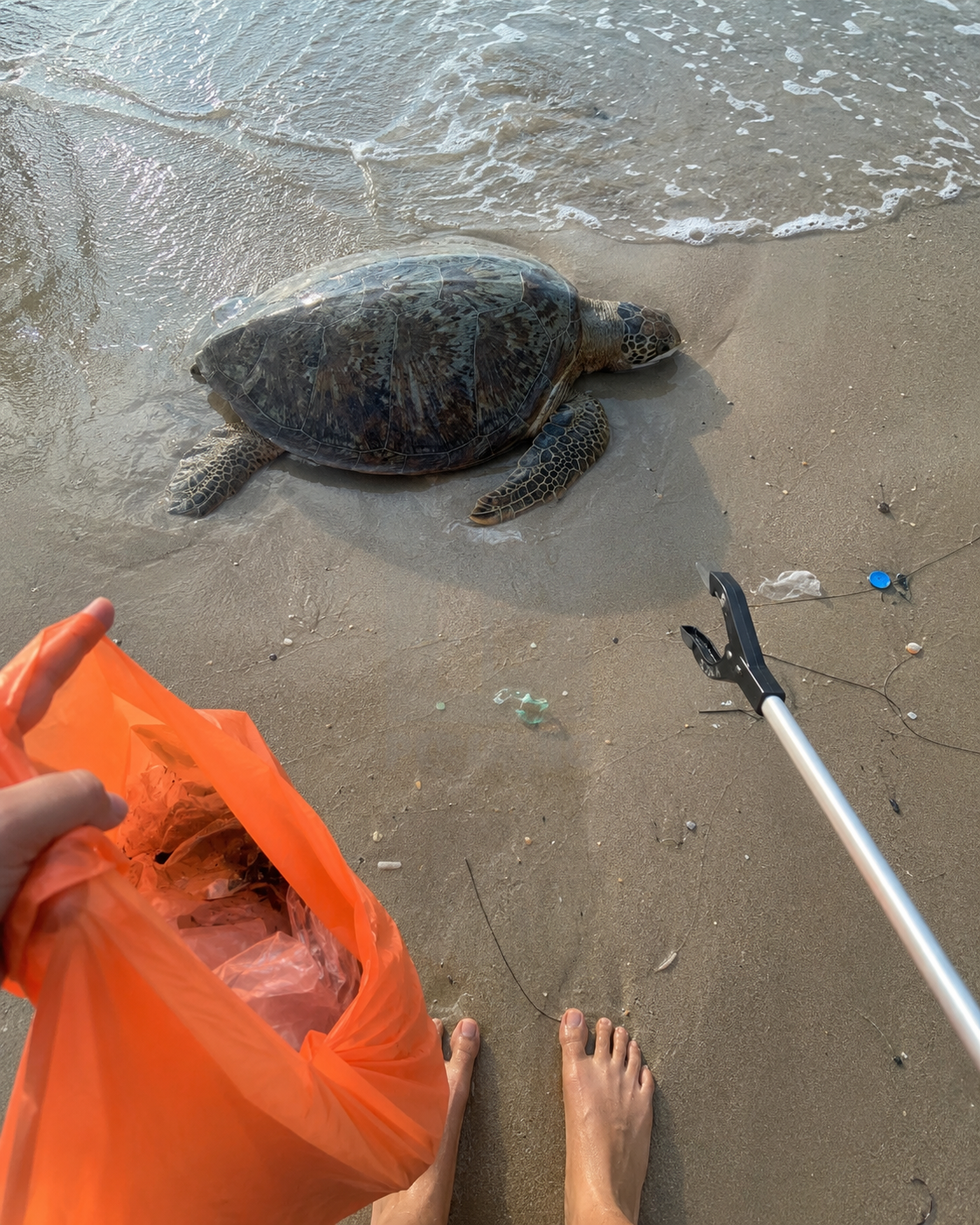
Ran for 2 days, from August 3 to August 5, 2026, the last day Crush saw it.
Run by Save Our Planet on Facebook. Crush is not the advertiser and does not verify its claims. See this ad in Meta's Ad Library(opens in a new tab)
Want an ad like this for your product?
Crush makes new ad images for your product from this ad: your logo, your product photo, your offer.
Trials from $19.95 USD, then $79.95 USD a month. Cancel anytime.
About this ad
- Meta Ad Library ID
- 1414970507202629
- Platforms
- Facebook, Instagram, Messenger and Threads
- Relaunches
- 0
Ad text
I recycled faithfully for fifteen years. It turns out I was part of the problem the whole time. Let me back up. That's my foot in the photo. Bare, in the wet sand, standing over her. I'd been doing beach cleanups for years. Orange bag, grabber, every Saturday I could manage. My husband says I can't walk past anything that needs help — a stray cat, a kid who dropped their ice cream, a turtle on a beach. He says it like it's a character flaw. I say somebody has to care. I came over the dune that morning and stopped cold. She was right at the tide line, the water washing up over the back of her shell and pulling away again. A green sea turtle, older — you could tell from the worn, mossy plates on her back and the pale scarring on one flipper. She wasn't thrashing. She wasn't doing anything. Just lying there, letting the ocean touch her and leave. I got close. Closer than you're supposed to. And she turned her head — slow, heavy — and looked at me. I've thought about that look a hundred times since. Not scared. Past scared. The look of something that has been trying for a long time and is starting to run out of trying. There was a woman who I've seen every time I go to the beach, she was also cleaning up the plastic.. Marge. Seventy-something, leather-tanned, been cleaning beaches for thirty years. She came up beside me and looked down and went very still. The kind of still that told me she'd stood exactly here before, over exactly this, more times than she'd ever tell me. Marge and I sat on the seawall with gas-station coffee going cold in our hands, and she asked if I wanted to know the truth. Because most people, she said, really don't. I said yes. She didn't answer me. She asked me a question instead. "That plastic you put in your recycling bin every week. What percent of it do you think actually gets recycled?" I've recycled for over fifteen years. Faithfully. I rinse everything, I sort everything, I know which number goes in which bin. I was proud of it. So I said — most of it, surely. Ninety percent. We work hard at this. She looked at me for a second. Then she said one word. "Nine." I laughed. I actually laughed, because it had to be a joke. Nine percent. The other ninety-one gets shipped to a landfill or set on fire. Fifteen years of rinsing and sorting and feeling like one of the good ones, and nine out of every hundred things I did it for ever made it. I told her that couldn't be true. Everyone recycles. My family. My neighbors. Everyone I know does it right. And she told me the thing I have not been able to stop thinking about since. The huge corporations that make the plastic are the ones who invented plastic recycling. The whole idea of it. They spent a fortune convincing us it works — the bins, the arrows, the numbers, all of it — because as long as we believed we could recycle our way out of it, we'd keep buying. They knew the whole time it would never be enough. They just needed us to feel okay while they made more. I sat with that. And then Marge reached into the trash bag between us — the one we'd filled that morning — and dug around for a second. She pulled out a piece of blue plastic and turned it over in her fingers. "You know what this is?" I didn't. It was a piece of a laundry detergent jug. "This," she said, "is the one of the things you should NEVER try to recycle" And she explained why. Detergent jugs are some of the worst plastic there is. Thick. Dyed dark so you can't see through them. Usually too hard and too expensive to recycle. And the soap residue left inside can contaminate whole batches at the recycling plant — one dirty jug can ruin everything around it in the load. So the plants don't fight it. They pull the jugs off the line and send them straight to the landfill. Half a billion of them thrown out every year. And a landfill near a coast is a short, easy trip to the sea. More than half of all the sea turtles alive right now have already eaten plastic. More than half. And the one I'd just stood over — the one whose eyes I still see — probably had a stomach full of it. I drove home in silence. No radio. Just Marge's voice and that blue plastic in the bag on the seat beside me. I walked into my kitchen and the first thing I saw was my own recycling bin. Rinsed. Sorted. Perfect. I'd done it that morning before I left. And then I looked under the sink — and there it was. A big plastic detergent jug, three-quarters gone, sitting exactly where it always sat. The same blue. I stood in my own kitchen holding the edge of the counter and I did the math I'd spent fifteen years not doing. How many jugs. One a month, call it. Twelve a year. Over a hundred and eighty of them. Every single one I'd rinsed and set in the bin like a good person. Every single one that was never, not once, going to be recycled. A hundred and eighty jugs I'd personally sent toward a landfill, toward the coast, toward the water. I'd been so proud. That's the part that still burns. I felt good the entire time I was doing it. I'd been rinsing mine. Setting it in the bin. It was theater. It was always theater. I tried to do better on my own first. I bought the jugs labeled "eco" feeling good about the little green leaf on the front — until I learned they end up rejected at the plant just like all the others. I tried a powder to skip the jug, and it clumped in the bottom of the box and never fully dissolved. Some powders can even put particles in the air that are dangerous to inhale. Plus many of them come with a plastic spoon. Every option was either a hassle or a lie in a nicer costume. Then I found a small company out of Kentucky that had done the only thing that actually mattered. They'd gotten rid of the jug completely. It's called Earth Breeze. Laundry sheets — pre-measured, no jug, no goo, no pouring. You drop one in the drum and it dissolves the second it hits the water. Works in every machine, HE included, at any temperature. The whole pack is thin cardboard; a year's worth fits in the corner of a cupboard. Over three million people had already made the switch and I'd never once seen it — because the companies that make the detergent in plastic jugs own the shelf space in every store, and they'd like to keep it that way. So Earth Breeze found a better way to reach people: they ship straight to your door. And here is where it looped all the way back to that beach. Earth Breeze doesn't just say nice things about the ocean. They partnered with a group called SEE Turtles and helped protect over fifty thousand baby sea turtle hatchlings. They've pulled more than a million pounds of plastic out of the oceans and waterways. They plant trees, they offset their carbon, and they've donated over three hundred million loads of laundry to women's shelters, homeless shelters, veterans, and animal shelters — because everyone deserves clean clothes. Fifty thousand hatchlings. I keep coming back to that number, because I keep thinking about the one turtle I couldn't save, and how somewhere out there are fifty thousand small ones that somebody did. I went back to that beach a few months later. Marge was on the seawall, same bad coffee. I asked her — did you see that sea turtle again? She shook her head - "I didn't but You just have to decide to believe that it made it, or you can't keep coming out here." I told her what I'd learned. What I'd thrown out. What I'd switched to. She listened the whole way through, and when I finished she just looked out at the water and said, "Then tell them." So I'm telling you. I don't know if my turtle made it. I'll never know. But I know exactly what put that plastic in her, and I know the one thing under your sink that's most likely to become the next piece of it. It's the jug. It's one of the worst offenders and it's the easiest thing in your whole house to replace. You don't get to know how your turtle's story ends either. None of us do. But you do get to decide whether you're still adding to the pile. P.S. — Right now Earth Breeze is running a special: 64% off with 4 free gifts when you subscribe. P.P.S. — It's backed by a 60-day money-back guarantee. If you don't love it more than your old detergent, every penny back, no questions asked. P.P.P.S. — Over 57,000 five-star reviews. I don't think you'll be sending it back. Tap below and join the jug-free community. And if you ever stand over one of them at a tide line the way I did — you'll be glad you're not still adding to the pile. 👉 https://earthbreeze.com/scratcher
Where the ad sends people
earthbreeze.com
Is It Better To NOT Recycle Detergent Jugs?
70,000+ 5-star reviews
See details: earthbreeze.com(opens in a new tab)