
Inactive· since Feb 17, 2026
- 10
- days it ran
- 0
- relaunches
Ad copy
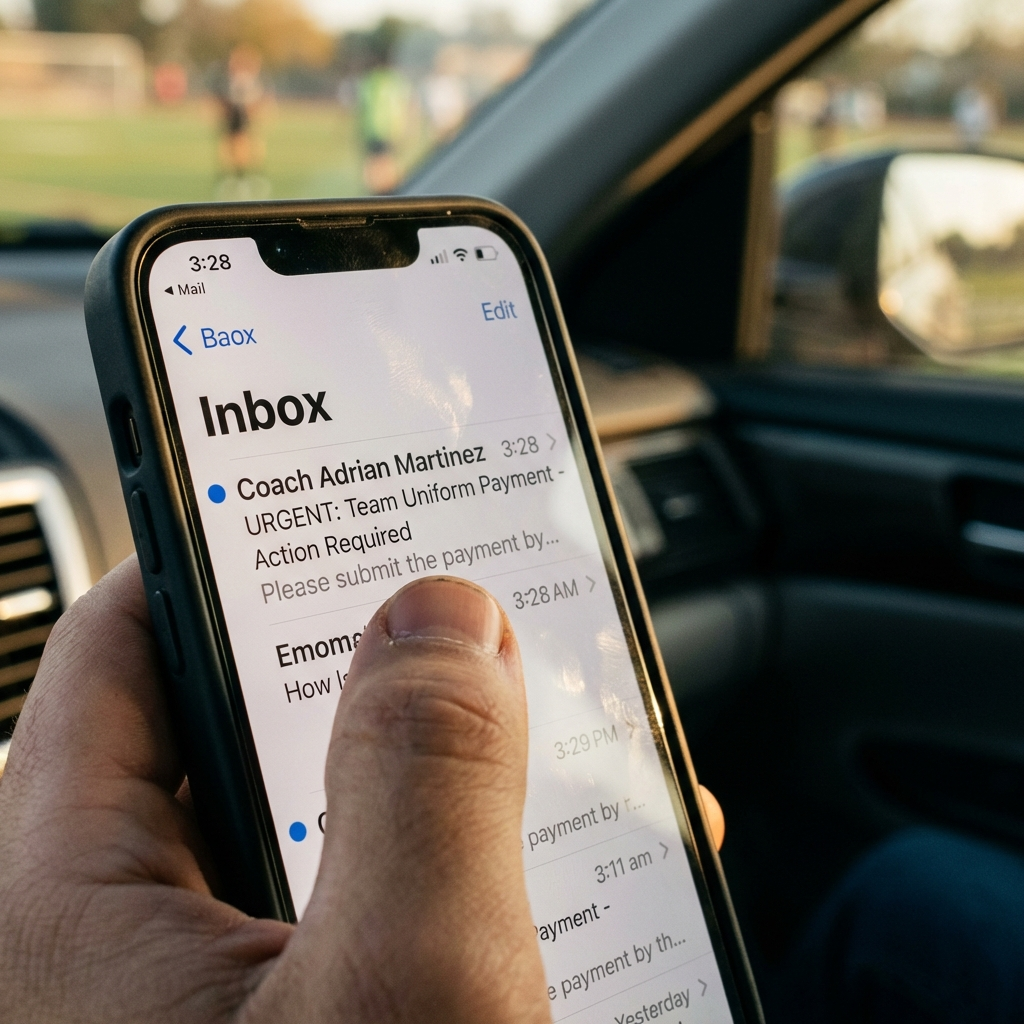
The email from Coach Martinez arrived while I was waiting in the car during soccer pickup, and I almost deleted it thinking it was spam. The email from Coach Martinez arrived while I was waiting in the car during soccer pickup, and I almost deleted it thinking it was spam. I sat in the parking lot, engine idling, scrolling through the usual flood of messages. Parent group chat notifications. Work emails I'd deal with later. A coupon for the pizza place we'd stopped going to. Then I saw it - sender name: Coach Adrian Martinez. Subject line: "URGENT: Team Uniform Payment - Action Required." My thumb hovered, a small bead of sweat forming. This wasn't just any email; it was from Coach Adrian Martinez, the revered figure at the helm of the competitive soccer program my son, Jake, had been dreaming of joining for two years. Tryouts were only a month away, and Jake’s entire world revolved around securing a spot. This program wasn't just about playing soccer; it was the gateway to college scouts, a pathway to potential scholarships, a legacy of winning that Jake recited nightly at dinner. Missing out on anything related to it, especially something 'urgent,' felt like a betrayal of his dreams. I reread the email, then scanned it a third time. Every word seemed to fit. The tone was perfectly calibrated - friendly enough to feel personal, yet professional enough to convey authority. The urgency about securing uniform orders by a specific deadline felt entirely plausible; coaches were perpetually wrestling with vendors, team logistics, and the ever-present pressure of bulk orders. And the sender address, at first glance, appeared legitimate: [email protected]. Everything pointed to it being real, demanding my immediate attention. Yet, beneath the surface of perfect plausibility, something felt undeniably- off. It was a faint, almost imperceptible whisper of unease, a flicker in my gut I couldn't immediately place. Was it the timing, given Jake hadn't officially made the team yet? Or the almost aggressive 'THIS FRIDAY' screaming from the text in all caps? Perhaps it was just exhaustion, my mind overthinking a perfectly mundane team email, a side effect of having consumed too many news reports about online scams and identity theft lately. I tried to dismiss it, telling myself it was just parental anxiety. I scrolled down. The email listed uniform pieces: jerseys, shorts, socks, warm-up jacket. Total cost: $340. "Discounted from $425 - save $85 if paid by Friday!" That actually seemed reasonable. I'd paid more for Jake's travel team last year. At the bottom: a blue button. "Pay Now - Secure Team Rate." I stared at my phone. The car next to me pulled away. Through the windshield, I could see the fields - kids in bright jerseys running drills, parents clustered on the sidelines with coffee cups and folding chairs. This was the world we'd been trying to break into. The program that could change Jake's future. What if this was real and I missed the deadline? Despite the nagging doubt, the pressure of the deadline and the fear of Jake missing out won. I tapped the blue button. The page began to load with an almost hypnotic smoothness. A clean, white background emerged, soon crowned by a crisp logo at the top - 'Elite Youth Soccer' emblazoned in bold, professional lettering, complete with a shield emblem that looked authentic. The entire layout was professional, sleek, and reassuringly legitimate - exactly the kind of polished website a prominent youth sports program would invest in. My earlier unease began to recede, replaced by a sense of relief that my suspicions had been unfounded. Then, there it was, dead center on the screen: a form titled 'Secure Payment Portal.' It had all the familiar fields - credit card number, expiration date, CVV, billing address. My finger, now confident, moved purposefully towards the first input box. I was literally milliseconds away from entering my first digit, from committing to this transaction, when it happened. The screen flickered, not in an error, but in a deliberate, almost graceful transition. A dark, opaque overlay slid across the screen, a digital curtain drawing over the payment form, covering absolutely everything. I blinked. What just happened? The overlay was solid - dark navy, almost black. At the center, bold text in red: "Hold up - this site is malicious." My breath stopped. Below the warning, more text in white: "It might look and feel legitimate, but it's designed to steal your personal details, your money, and even your identity. We really recommend you not to visit this site." At the bottom, a blue button: "Stay Safe." I stared at the screen, heart hammering. The form was gone. The payment page was completely blocked. I couldn't access it anymore even if I wanted to. I clicked "Stay Safe," hands shaking. The overlay disappeared. I was back at my email inbox. The message from Coach Martinez still sat there, innocent and urgent. What in the world just happened? My heart, which had been beating a casual rhythm moments before, now thudded against my ribs like a trapped bird. I sat there in the parking lot, the engine still idling, my phone a black rectangle on my lap, my mind racing to process the abrupt interruption. A warning. An undeniable, forceful block. Something had intervened, actively preventing me from typing my credit card details into that payment site. But why? Was it genuinely fake? Could my initial, fleeting unease have been valid? I picked up the phone again, rereading the email, but this time, with a new, scrutinizing lens. 'Hope this email finds you well' - a generic pleasantry, I realized, the kind that could open any mass-sent communication. 'I wanted to reach out personally' - a sudden red flag. Had Coach Martinez ever, in fact, emailed me personally before? Or even emailed me at all, for that matter? My memory drew a blank. A cold knot began to form in my stomach. I quickly opened my phone's browser and typed 'Elite Youth Soccer' into the search bar. Within seconds, I found their official website. The logo, though similar, wasn't quite identical. The color scheme was distinct, the font subtly different. It was like looking at a professionally produced knock-off. The real site was cleaner, more established. My stomach dropped further, a chilling realization beginning to set in. I revisited the sender address in the suspicious email: [email protected]. I scrutinized it, zooming in on the small text. 'Eliteyouthsoccer-team' - with two hyphens, and the additional '-team' suffix. Then I compared it to the URL of the legitimate program's website: eliteyouthsoccer.com. No hyphens. No '-team' at the end. The difference was minuscule, almost invisible at a casual glance, but now it screamed deceit. Oh my God. The realization hit me like a physical blow. I had been seconds, mere heartbeats, away from handing over my entire financial identity. My credit card number - all sixteen digits. The expiration date. The three-digit CVV code on the back. My full billing address. They would have had everything they needed, not just to steal $340, but to drain my entire bank account, open new lines of credit in my name, or worse, completely hijack my identity. The thought made my blood run cold. My hands were still shaking uncontrollably, a tremor that ran right up my arms and into my chest. I stared blankly out the windshield. Practice was clearly winding down. Kids, a blur of bright jerseys and boundless energy, were streaming off the field, their cheers and shouts carrying faintly through the glass. Any second now, Jake would burst through the car door, sweaty and grinning, probably asking if I'd remembered his water bottle. What would I have told him? How would I have explained that his dad, the one who was supposed to protect him and provide for his future, had fallen for such an obvious trap? The loss of $340 would have been a painful blow, but the thought of $3,400, or even ten times that amount, being siphoned away before I even noticed, was truly terrifying. The financial implications alone were staggering, let alone the emotional toll of knowing I had almost jeopardized my family's security. I took a breath. Then another. That warning. That dark overlay. That "Stay Safe" button. What was that? Where did it come from? I sat there, replaying the last few months in my mind, searching for an answer. Had I consciously clicked on some obscure setting? Installed a new app or extension without remembering? I didn't think so. My phone was just... my phone. A familiar extension of my daily life, filled with the usual suspects: messages from friends, work emails, a quick scroll through Instagram, weather updates, the occasional game. Nothing that screamed 'advanced security system'. But undeniably, something had been watching. Something incredibly smart and unseen had been quietly working in the background, a silent digital sentinel. It had recognized that intricately crafted fake site for what it was - a malicious trap - and had blocked it decisively, preventing me from making a truly terrible, irreversible mistake. Jake opened the passenger door, dropping his gear bag on the floor with a thud. "Hey, Dad. What's for dinner?" I looked at him. Fourteen years old. Tall for his age. Still had his baby face but was growing into his features. He had no idea how close I'd just come to ruining our week. Our month. Maybe more. "Pizza," I said. "Let's do pizza." That night, after Jake went to bed, I sat at the kitchen table with my laptop open. I couldn't stop thinking about it. The email. The fake site. The warning that appeared out of nowhere. I Googled "fake coach emails" and fell into a rabbit hole. Article after article. Reddit threads. News reports. Parents all over the country getting scammed by fake youth sports programs, fake team fees, fake tournament registrations. The scammers scraped real coach names from league websites, copied logos, built fake payment sites that looked identical to the real thing. One parent lost $890 to a fake travel tournament fee. Another lost $1,200 for a "training camp" that didn't exist. A mom in Ohio had her identity stolen after entering her credit card and social security number into a fake scholarship application. The scammers knew exactly what buttons to push. Urgency. Deadlines. The fear of your kid missing out. The trust parents place in coaches and athletic programs. I thought about that email again. How natural it felt. How reasonable the price seemed. How easy it was to believe. And I thought about that warning. The one that saved me. I opened my browser settings. Clicked through to extensions. Started scrolling, looking for anything I didn't recognize. There were a few. An ad blocker I'd installed years ago. A password manager my wife had made me set up. And then - Guardio. I stopped. Stared at the name. I didn't remember installing that. I clicked on it. A description appeared: "Online security and privacy protection. Blocks malicious sites, harmful extensions, and unwanted threats." Blocks malicious sites. I sat back in my chair. That was it. That was the thing that had stopped the payment page from loading. Guardio. But how did I - Then, like a forgotten memory resurfacing from the depths, it clicked. Emily. My daughter, home from college for winter break, perhaps six or seven months ago. She had been sitting right here at this same kitchen table, my laptop open between us. 'Dad,' she'd said, shaking her head with a familiar mix of affection and exasperation, 'you seriously need better protection. You click on *everything*.' She’d been teasing, yes, but her tone had carried a serious undercurrent. She’d spent a good twenty minutes, maybe more, patiently installing something, showing me a dashboard I hadn't really paid attention to, explaining features I'd barely listened to, my mind already drifting to the next item on my endless to-do list. I'd nodded, grunted, and promptly forgotten all about it. I'd forgotten about it completely. And it had just saved me from handing my credit card to a scammer. I opened the Guardio dashboard. A dark blue sidebar appeared on the left: Overview, Browsing, Extensions, Notifications, Identity, Hijackers, Exposure Report. I clicked "Browsing." A table loaded. "Browsing Activity." Two tabs at the top: "Recent" and "Allowed." I clicked "Recent." Rows of data appeared. Columns labeled: EVENT | SOURCE | DATE & TIME. The first entry was from today. 3:47 PM. "Blocked Site." The source: eliteyouthsoccer-team.com. The malicious URL highlighted in red. I scrolled down. More entries. Not just from today. From last week. Last month. Going back months. "Blocked Site" - a fake banking alert I'd clicked on in an email. "Blocked File" - a PDF download that looked like a work document. "Blocked Site" - a link from a Facebook ad I didn't even remember clicking. I kept scrolling. Page two. Page three. Eleven threats. Over the past six months, there had been eleven instances where that dark overlay had appeared, that 'Stay Safe' button had intervened, and each time, I had simply dismissed it. I'd moved on, completely forgotten about the interruption, casually assuming it was a browser glitch, a temporary network issue, or just a website that was momentarily down. The sheer volume of these silent interventions was chilling. Eleven times I'd been seconds away from disaster. And I'd had no idea. I sat there in the quiet kitchen, laptop glowing, looking at the logs. Each entry was a stark reminder of a moment. A thoughtless click. A terrifying near-miss. A digital landmine I had blithely walked right into, trusting and utterly careless, and something - Guardio - had quietly, efficiently, caught it before I ever knew I was in danger. The scary part? I'd thought I was careful. I'd thought I could spot a scam. I'd thought the obvious ones were obvious and the dangerous ones would feel dangerous. But that email from "Coach Martinez"? It hadn't felt dangerous in the slightest. It had felt utterly normal. Routine. Just another item on the endless checklist of parental duties, another expected team expense in the long, expensive journey of youth sports. It was precisely its normalcy, its seamless integration into my expectations, that made it so insidious. If that warning hadn't appeared, I would have typed in my card number without a second thought. I closed the laptop. Sat in the dark for a minute. Then I texted Emily: "Thanks for installing that thing. It just saved me from a fake coach scam." Three dots appeared immediately. Then: "GUARDIO?? Dad I told you to actually USE it, not just let it run in the background 😂" I smiled. Typed back: "Apparently running in the background is exactly what it needed to do." The next morning, I forwarded the fake Coach Martinez email to the real Elite Youth Soccer program. They replied within an hour: "Thank you for reporting this. You're the fourth parent this week to receive this scam. We NEVER send payment requests via email. Please delete and report as phishing." Fourth parent this week. How many had clicked? How many had paid? I thought about the parent group chats I was in. The families I saw at games and practices. Good people. Busy people. People who trusted coaches and teams and official-looking emails because why wouldn't you? That night at dinner, I told Jake and my wife the whole story. Showed them the fake email. Explained how close I'd come. Jake's eyes went wide. "Wait, so you almost paid a fake person pretending to be Coach Martinez?" "Almost," I said. "But something stopped it." My wife looked at me. "What stopped it?" I glanced at my phone, sitting face-down on the table. "Something Emily installed on my browser a while back. Guardio. It blocked the site before I could enter any information." She was quiet for a second. Then: "I need that on my phone." That weekend, I helped her install it. Showed her the dashboard. Explained what Emily had explained to me - how it watches in the background, how it catches threats you don't even realize are threats. And then I did something I don't usually do. I posted in the parent group chat: "PSA: Got a fake email this week pretending to be Coach Martinez asking for uniform payments. The site looked totally legit. If you get anything like this, don't click. The program confirmed they NEVER send payment requests by email. Be careful out there." Responses flooded in within minutes. "OMG I got that too!" "Wait I almost paid that - the link wouldn't load though." "My friend's kid's team got hit with this last month. She lost $400." "How did you know it was fake?" I stared at that last question. How did I know? I didn't know, not at first. Not until my browser suddenly blocked the site and flashed a stark warning that it was malicious. It was a wake-up call, a realization that without dedicated protection, you're merely gambling, hoping against hope that you'll somehow spot the subtle red flags in time. I got lucky, incredibly lucky. But it wasn't luck. Not really. It was something far more deliberate, far more intentional, than mere chance. It was Emily, caring enough to install something I didn't ask for. It was Guardio, running quietly in the background, watching every link, every site, every click. It was a system I'd forgotten existed, doing exactly what it was designed to do. Sometimes the people who protect us best are the ones we never see coming. And sometimes, it's the tools we install once and forget about - until they save everything. Over 2 million people already know what's standing between them and disaster. The next scam email with a coach's name, a school's logo, your trust embedded in every word - will something catch it before you click? Or will you be the one typing your card number into a fake form, sixty seconds from losing everything? Sometimes the people who save us are the ones we never see coming. And sometimes, it's the tools quietly running in the background - the ones we forget we installed - until they stop disaster in its tracks. That little warning changed everything. Now I make sure everyone I care about has that same quiet guardian watching over them.
Like this ad? Make it yours.
Crush rebuilds this exact creative around your product — your brand, your colors, your offer — in about a minute.