According to Helen
According to Helen Facebook ad: “I spent $1,400 on plantar fasciitis. The fix cost me one…”
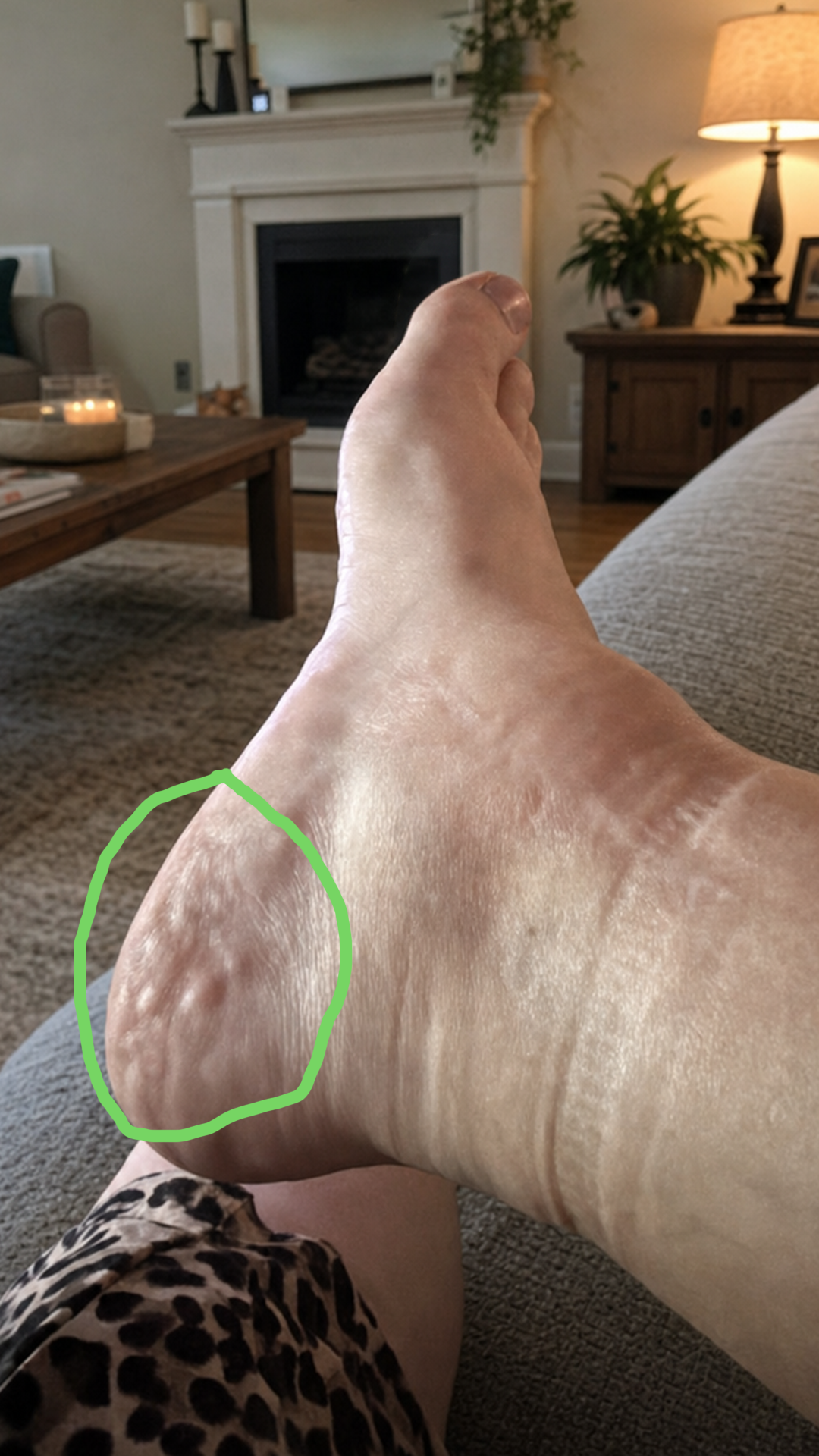
Ran for 9 days, from July 31 to August 9, 2026, the last day Crush saw it.
Run by According to Helen on Facebook. Crush is not the advertiser and does not verify its claims. See this ad in Meta's Ad Library(opens in a new tab)
Want an ad like this for your product?
Crush makes new ad images for your product from this ad: your logo, your product photo, your offer.
Trials from $19.95 USD, then $79.95 USD a month. Cancel anytime.
About this ad
- Meta Ad Library ID
- 1445426884091063
- Platforms
- Facebook, Instagram, Audience Network, Messenger and Threads
- Relaunches
- 0
Ad text
I was diagnosed with plantar fasciitis back in 2021. Hard to believe that was almost six years ago now. I'm 54. I'm an elementary school administrator. I'm on my feet from the second the bell rings until the buses pull out. I'm the one who walks the building. I do laps in the cafeteria. I'm in and out of classrooms all day, and at 3pm I'm standing at the curb in whatever the weather is doing. The first morning it happened, I thought I'd slept on it weird. I got out of bed and my left heel felt like I'd stepped on a piece of glass that wasn't there. I limped to the bathroom. By the time I'd brushed my teeth it had eased up a little. By lunch I'd forgotten about it. It came back the next morning. And the morning after that. By the end of the second week, the first 20 steps from my bed to my coffee maker were a 7 out of 10. I want to tell you what I've spent on this foot. Not to complain. Just so you understand who I am when I tell you what finally worked. Two pairs of Hokas. One pair of Brooks. Three different drugstore inserts. A pair of custom orthotics from the podiatrist that cost me $387 after insurance. A night splint that I wore for six weeks and threw in the back of the closet because it kept waking my husband up. Three rounds of physical therapy. One cortisone shot that worked for about ten days. The frozen water bottle. The little blue ball. The Voltaren. The stretching app on my phone that pings me at 7am every morning to remind me I still have this thing. Every single one of those was recommended by someone with credentials. Every single one made sense. None of them stuck. About 14 months ago I hit a wall. I was sitting on the edge of my bathtub at 5 in the morning, holding the orthotic I'd just pulled out of my work shoe, looking at the dent my heel had worn into it, and I thought: I cannot keep doing this for the rest of my life. That's the thing nobody warns you about with chronic foot pain. Chronic foot pain makes you a mathematician. You start running a step budget. You know every step costs something, so you make less of them, and it gets into your head. You count the steps from your bed to the bathroom. You park closer to the door. You stop volunteering for the field trip. You decline the wedding two states away because you can't imagine being on your feet that long in dress shoes. Your life gets smaller in a hundred ways nobody else notices because they happen one decision at a time. My husband said something to me that week that stuck. He said, “You used to walk Sasha around the lake. When was the last time you did that?” I couldn't remember. That's what got me. I literally couldn't remember the last time I'd walked the lake. A friend of mine, she's a teacher at the same school, she'd had her own bad year with a knee, told me she'd been seeing a PT who'd helped her. Not a podiatrist. Not an orthopedist. A physical therapist who specialized in gait and foot biomechanics. She said he'd told her something about feet that nobody else had told her in five years of treatment, and within two months she was hiking again. She gave me his number. I went to see him in March of last year. His office is in a strip mall next to a smoothie place. He's maybe 40. He sat me on a table and watched me walk barefoot across the room twice. Then he asked me to take off my sock and hand it to him. I thought that was strange but I did it. He turned the sock inside out, stretched the toe end open with both hands, and let it go. The whole front snapped back into a tight tube. He said, “This is the shape your foot has been held in for fifteen hours a day. On top of everything else”. He explained it like this, and I'm going to say it the way he said it, because the way he said it is what I needed to hear. Your arch isn't held up by your shoe. It's held up by the small muscles inside your foot. The ones that run from your heel to your toes. Those muscles only fire when your toes can spread and grip the ground. When your toes are jammed into a single chamber for fifteen hours a day, those muscles stop firing. The arch loses its active support. The fascia, which is the ligament that runs along the bottom of your foot, ends up carrying load it was never designed to carry alone. That's when it gets inflamed. That's the pain. He said: your orthotic is holding your arch up from below while your sock is preventing the muscles that should be holding it up from doing their job. Every sock you've ever owned has been quietly sabotaging every shoe you've ever bought. I sat there with my sock in my hand. It wasn't that I'd failed at treating my foot. I'd been treating it out of sequence. Every input I'd added was being undone by an input I didn't know was working against me. And once he said it, it was obvious. A compression shirt still feels tight under a bulky jacket. That's what was happening to my foot every day. The orthotic was lifting the arch and the sock was squeezing the forefoot back into a tube right on top of it. Then he handed me a pair of socks. Slots for each toe, like gloves for your feet. He told me to wear them every day for six weeks and call him if nothing was different. He said the brand was MARO. They were merino wool, and the only ones he'd found that didn't have nylon or polyester running through the toe pockets. I'm going to tell you what happened, and I'm going to be honest, because I've been on the receiving end of too many ads from women who claim they were cured in three days. Week one, nothing. If anything it felt weirder. My toes weren't used to being separated. Week two, I noticed that the first 20 steps in the morning were a 5 out of 10 instead of a 7. That was the first time anything had moved the needle on the morning pain in a year and a half. By week four I'd stopped flinching when I got out of bed. By week six I walked Sasha around the lake. It took us 38 minutes. I cried a little in the car after. Not because my foot hurt. Because it didn't. I'm not telling you the fasciitis is gone. There are still mornings, usually after a long day on hard floors, where the first few steps remind me what it used to be. But the flares don't stack on top of each other the way they did. The math has changed. I'm not counting steps to the bathroom anymore. My husband noticed before I did. He said, "You're walking different. You're not limping out to the car." I hadn't realized I was limping to the car. I thought I'd been hiding it. Here is what I want you to take from this if you're still reading. You haven't failed at treating your foot. You've been doing real work, the shoes, the inserts, the stretches, the shots, and you've been doing it on top of an input you didn't know was there. The closest layer to your foot, the one you put on without thinking every morning, has been quietly pulling your forefoot back into a tube for as long as you've been doing the rest of the work. A note on what I learned about these socks. After a few months of using the pair the PT handed me, I thought the magic was just the toe-pocket design. So I went on Amazon and bought two cheap pairs of toe socks to fill out my drawer. Both were synthetic, made from nylon and polyester, which is what most toe socks are made of. They worked mechanically, the slots were there, but my feet sweated in a way they hadn't in months, and one pair wore through at the big toe in about six weeks. That was when I understood it wasn't only the toe pockets. It was also what sat against my skin all day. MARO, the brand that the PT actually recommended, uses Australian merino wool, organic cotton, and a tiny amount of spandex that's fully encased in cotton so it never touches your skin. The merino is what holds up under boots and work shoes for a 10-hour day. They also make an organic cotton version for warmer weather and indoor work. I keep both. The merino is what I wear to school. The cotton is what I wear around the house. I've now bought MARO for my mother, who has had Morton's neuroma in her right foot for nine years and had given up on finding anything that helped. I bought a pair for my sister, who teaches third grade. I bought a pair for my friend from work, the one who sent me to Bob in the first place. I bought four pairs for myself and I rotate through them every week. If you've spent the last few years upgrading your shoes and your inserts and your stretches and you've quietly stopped expecting anything to actually change, this is the one thing I'd ask you to try before you give up. The toe socks are here: https://wearmaro.com/collections/socks — Helen
Where the ad sends people
wearmaro.com/toesocks
I spent $1,400 on plantar fasciitis. The fix cost me one conversation with a PT.
This is the one input nobody ever told me to check.
Learn more: wearmaro.com(opens in a new tab)