
Active· since Apr 5, 2026
- 166
- days running
- 1
- relaunches
Ad copy
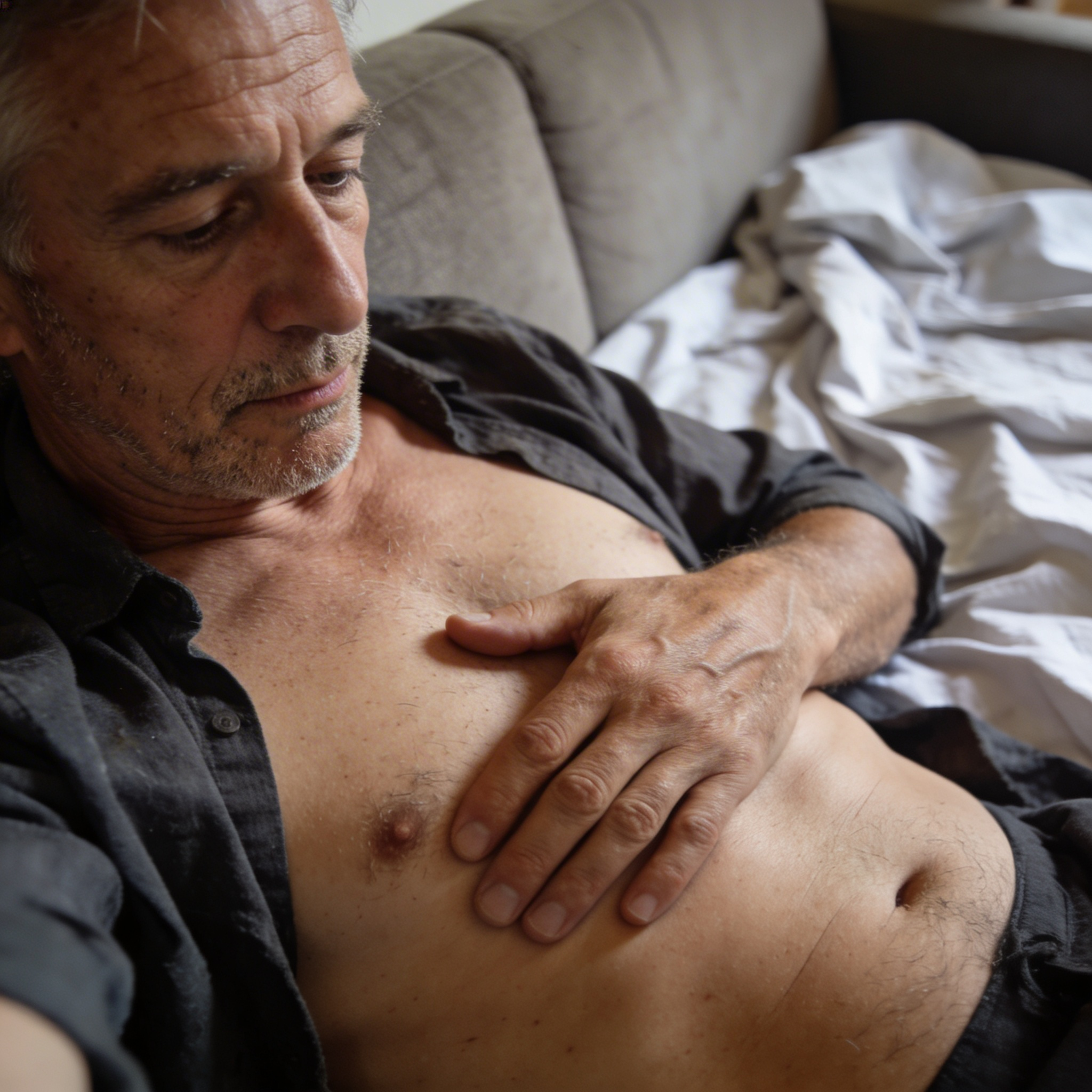
My wife found me sitting on the bathroom floor. I hadn't fallen. I'd just sat down. Because the alternative was staying upright and I wasn't confident I could do that anymore. She'd heard the thud of me dropping down against the cabinet and come in to find me with my back against the vanity and my legs out in front of me on the tile, still in my work clothes, tie loosened, looking up at her from the floor of our bathroom at 6:30 on a Tuesday evening. She didn't scream. My wife is not a woman who screams. She crouched down in front of me and put both hands on my face and looked at me very carefully and said: tell me what's happening right now. I told her I just needed a minute. She stayed crouched in front of me for the entire minute. Then she helped me up. She didn't make it into a thing. She got me to the bed, sat next to me, didn't say anything while I got my breath back. When she finally spoke she asked me, quietly, when the last time something like this had happened was. I told her it was the first time. That was not true. I have been lying to my wife for two years. Not in the way people usually mean when they say that. Not with intention. Not to protect myself. In the way that men lie when they are frightened and have decided that frightening the person they love most is not an option they're willing to take. In the way that feels, in the moment, like protecting someone and only later reveals itself as something lonelier than that. My blood pressure had been a problem for two years. I knew it. My wife didn't. I had managed the knowing alone, the way I manage most things that feel like weakness, by not giving them any more space than absolutely necessary. By handling it. By appearing to handle it. Here's what handling it actually looked like. It looked like checking my monitor in the morning before she woke up and putting it back in the drawer before she came downstairs. It looked like declining things I used to love because I'd learned which situations made the pressure spike and which didn't. Skipping the longer hike we'd planned because I wasn't confident about the elevation. Leaving parties earlier than we used to because the noise and heat and stimulation of a room full of people did something to my readings that I'd learned to be careful about. Letting her drive on long trips and giving her reasons that had nothing to do with the real reason. It looked like becoming, gradually and without announcement, a smaller version of the man I'd been. Less of everything. Less range. Less spontaneity. Less willingness to say yes to things that required my body to show up fully. My wife noticed. Of course she noticed. She's been watching me for 36 years. She noticed the way perceptive people notice things they're not being told, not all at once but in accumulation. A comment here about how I seemed tired. A look there when I declined something I would have said yes to two years ago. A question occasionally, gently, about whether I was okay, asked in a way that left room for me to tell the truth and that I filled instead with reassurance. She didn't push. That's the thing about a good marriage after three decades. You develop a sense for what the other person can hear and what they can't. She knew I wasn't ready to talk about it. She waited. She watched. She stayed close in the quiet way she stays close when she's worried about something and isn't saying so. The bathroom floor ended the waiting. After she helped me up and sat with me and I got my breath back, I told her. All of it. The numbers. The monitoring in the mornings before she came downstairs. The hike I'd declined. The driving. The parties. The two years of managing something alone that I should have been managing with her. She listened without interrupting. When I finished she was quiet for a moment. Then she said: I knew something was wrong. I've known for a long time. And then: I wish you had told me. Not angry. Not relieved exactly. Something more complicated than either of those. The particular feeling of a woman who has been watching her husband disappear one small refusal at a time and finally understands why. That conversation was the end of one version of this and the beginning of another. What I want to tell you now is what I've learned since then. Because I spent two years treating this problem without understanding it. And that misunderstanding, that fundamental gap between what I thought was happening and what was actually happening, is what let it get to a bathroom floor on a Tuesday evening. Here is what was actually happening. Blood pressure that stays persistently elevated is not a simple input-output problem. Cut sodium, pressure drops. Lose weight, pressure drops. Walk more, pressure drops. That's the model most men are given. That's the model I worked from for two years. And it contains enough truth to feel accurate and not enough truth to actually fix anything. The deeper reality is structural. The vessels themselves change over time. When you're younger, the walls of your blood vessels are elastic and responsive. They flex under pressure. They widen when blood flow needs to increase. They adapt automatically, constantly, without you ever thinking about them, to whatever your body is experiencing at any given moment. That adaptability depends on a compound produced inside the cells that line the vessel walls. Nitric oxide. Its function is to signal those walls to relax and open. To stay responsive. To keep the entire system flexible enough to handle the normal demands of a normal day without pressure spiking to a level the body can't manage. Nitric oxide production declines with age. Gradually. Quietly. Without pain or obvious announcement. Over years it accumulates into a vascular system that is progressively less elastic, less adaptive, less capable of doing automatically what it once did without effort. The pressure behind the eyes. The heaviness that settles across the back of the skull. The moments where the body simply refuses to keep going, in a hallway, in a bathroom, against a cabinet in the middle of an ordinary Tuesday evening. All of it is the vascular system communicating, in the only language it has, that the mechanism that kept it responsive has been quietly failing. No amount of sodium reduction addresses that mechanism. No amount of walking addresses that mechanism. Those things matter. I'm not dismissing them. But they operate at the level of symptoms while the root keeps doing what it's doing. What addresses the mechanism is supporting nitric oxide production in the vessel lining itself. That's where flavanols come in. Flavanols are compounds that activate specific pathways inside endothelial cells, the cells that form the inner lining of your blood vessels, that produce nitric oxide. The research on this is not new. It spans decades and serious institutions. The mechanism is understood and documented. What most people don't know is that one of the most concentrated natural sources of these compounds on the planet is cacao. Real cacao. Ceremonial grade. Processed without the alkalization that industrial manufacturing uses and that destroys somewhere between 60 and 90 percent of the flavanol content before the product reaches you. What you find in grocery stores, in chocolate bars, in the cocoa powder that's been sitting in your cabinet, has been through that process. The flavor remains. The function has been stripped out. Which is why no amount of dark chocolate has ever moved anyone's blood pressure and never will. Ceremonial grade cacao keeps the flavanols intact. That's what MAÏA uses. Read More: https://shop.trymaia.co/shocking-discovery-bp I started it two weeks after the bathroom floor. My wife sat with me on the first morning while I mixed it. She didn't make a ceremony of that either. She just brought her coffee to the kitchen and sat across from me while I tried it for the first time and we talked about ordinary things. That has been her way throughout this. Present. Steady. Not making it bigger than it needs to be and not letting me make it smaller. What changed in the first two weeks was the mornings. The pressure across my forehead that had been the first thing I noticed every day for as long as I could remember started arriving later. Then less heavily. Then some mornings, nothing. Just waking up and feeling like myself. Which I had forgotten was something I used to take completely for granted. End of week three my readings had moved to a range that felt different. Not a dramatic drop. A consistent one. Sustained across multiple mornings in a way the numbers hadn't sustained in years. Month two my wife started driving less on our longer trips. Not because I asked her to. Because I wanted to again. She noticed that too. Month three I suggested the hike we'd postponed. Not the easy version. The actual one. The elevation I'd declined eighteen months ago and given her a reason for that had nothing to do with the truth. She looked at me for a long moment. Then she got her boots. We did the full trail. Four hours. The elevation I'd been afraid of. I won't tell you it was effortless because it wasn't, it's a real hike and we're in our 60s, but the effort was the right kind. The kind that comes from legs and lungs and has nothing to do with a vascular system working at capacity just to keep you upright. We stopped at the top and looked at the view. My wife didn't say anything for a while. Then she took my hand and held it and we just stood there. She knew what we were actually doing there. We were both doing the same thing. Standing on a trail I hadn't been willing to try for a year and a half and feeling the distance between who I'd become and who I was supposed to be start, finally, to close. My numbers the morning after that hike: 124 over 77. I am writing this because I know the man reading it. I know the monitoring in the mornings before your wife wakes up. I know the small refusals that accumulate into a smaller life. I know what it costs to be the man who holds everything together for everyone around him while quietly, privately, in bathrooms and parked cars and anywhere else nobody is watching, falling apart. I know because I was that man for two years. And I know that the thing making you smaller has a mechanism. And the mechanism can be addressed. And you don't have to wait for the bathroom floor to start addressing it. MAÏA is linked below. One scoop in hot water every morning. Thirty-day money-back guarantee. Nothing to lose in finding out if your body responds the way mine did. But I want to say something directly before the link. Tell your wife. Whatever you've been managing alone, tell her. Not because she can fix it. Because she already knows something is wrong and she is waiting for you to trust her with it. And you carrying it alone is not protecting her. It is just making you both lonelier. The bathroom floor taught me that. Read More: https://shop.trymaia.co/shocking-discovery-bp
Like this ad? Make it yours.
Crush rebuilds this exact creative around your product — your brand, your colors, your offer — in about a minute.