Antwon D'Amore
 Facebook ad: “2026 Must-Read Stories Read Now”
Ran for 1 day, from November 10 to November 11, 2026, the last day Crush saw it.
Run by Antwon D'Amore on Facebook. Crush is not the advertiser and does not verify its claims. See this ad in Meta's Ad Library(opens in a new tab)
Make your own version of this ad
Crush makes it, launches it in your own Meta ad account, scales the winners and pauses the losers.
About this ad
- Meta Ad Library ID
- 1464273005652843
- Platforms
- Facebook, Instagram, Audience Network and Threads
- Relaunches
- 0
- Niche
- Jewelry & Watches
Ad text
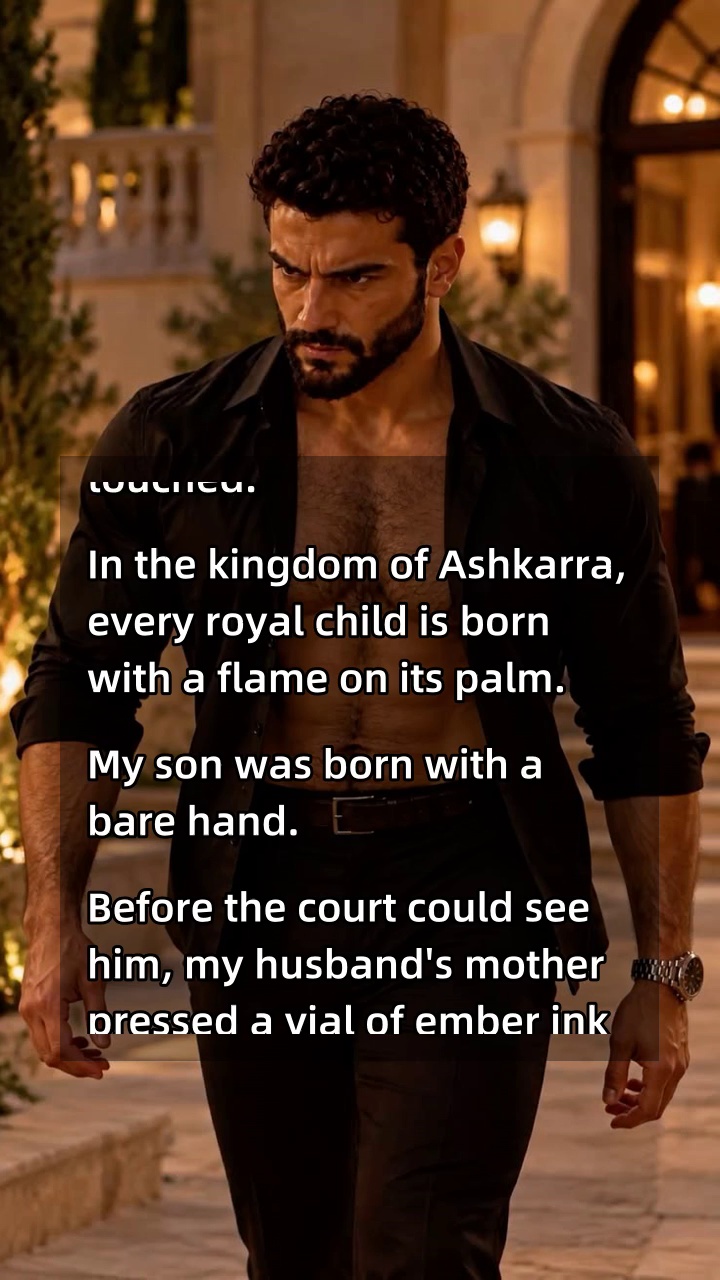
Maelis Making my husband regret it took forty days and one stone he had never touched. In the kingdom of Ashkarra, every royal child is born with a flame on its palm. My son was born with a bare hand. Before the court could see him, my husband's mother pressed a vial of ember-ink into my fingers. "Paint it," she whispered. "It's what I'd do." I wouldn't lie about my son. So Crown Prince Corvane held up our baby's empty palm before three hundred nobles, called him a bastard, and slapped me with the hand that bore the brightest flame in the kingdom. By nightfall he had chosen a new bride, a cousin with a real flame and a habit of fainting. He never once wondered how his mother knew the paint would work. ... My son was born an hour before sunset on the eve of the first frost, and the first thing I did after the midwife laid him on my chest was count his fingers. Ten. I counted them twice, because I was a stonewright's daughter from Frostmere and we checked everything twice. Then I turned his left hand over to look for the flame. There was nothing there. His palm was pink and creased and perfect, and it was as bare as mine. The midwives saw it at the same moment I did. I watched it travel around the birthing room the way a crack travels through ice, silent and fast. One of them made the sign against bad luck. Another one backed toward the door. The oldest, a woman who had delivered half the royal cousins in Emberhold, looked at the baby's hand and then at me, and she didn't say anything at all, which was worse. In Ashkarra the royal line was born marked. Every child of the Vaelor blood came into the world with a small flame drawn on the left palm in living light, warm to the touch and faintly glowing, like an ember under a sheet of paper. The mark was how the kingdom knew its kings. It was painted on the banners and carved over the city gates, and it was the first thing any child in Emberhold learns to draw. Within the hour of a royal birth, the baby was carried into the Hall of Hearths and shown to the court. They called it the Palm Showing. The father lifted the child's left hand, the flame glowed, and three hundred nobles went down on one knee. I had an hour. I held my son against me and felt his heartbeat, quick and light as a bird's, and I didn't feel afraid for myself. I felt furious on his behalf, which surprised me. He was nine minutes old, and already the room had decided he was a problem. My hands were warm, as they always were. In the north we say a Thane's hands never go cold, and the southern ladies at court found it unladylike. I pressed my warm palm over his small bare one and told him in the old northern tongue that he was mine and that was enough. The door opened, and the midwives scattered like sparrows. Queen Halvinne came in. She was fifty-eight and still the most beautiful woman in any room she entered. She wore gray silk and a single ruby at her throat, and she moved without a sound. In the two years since I'd come south to marry her son, she had been the only person at court who was kind to me without wanting something for it, or so I'd thought. When I'd cried with homesickness my first winter, she'd sent me furs and northern tea. When I'd lost my first pregnancy, she'd sat with me through the night and never once said it was my fault. Now she sent the last midwife out with a flick of her fingers, and she came to the bed, and she looked at my son's hand. She didn't gasp, and she didn't make any sign. She looked at it for a long moment the way a jeweler looks at a flaw in a stone, measuring how bad it was and whether it could be hidden. Then she reached into the folds of her sleeve and took out a small glass vial no longer than my finger. It was full of something dark red that moved like syrup and caught the candlelight as though there were a spark trapped inside it. She pressed it into my hand and closed my fingers around it. "Ember-ink," she said quietly. "There's a brush in the drawer of the washstand. Paint it in the shape of a candle flame, small, and blow on it until it sets. It will glow. No one in that hall will look closer than that." She smoothed my damp hair back from my forehead, the way my own mother used to. "Paint it, Maelis. It's what I'd do." I looked down at the vial in my fist. It was warm. Through the glass I could feel the faint heat of whatever magic was folded into it. It's what I'd do. She hadn't said what anyone would do. She'd said what she would do. And she'd said it the way you'd tell someone how to bank a fire, as though she'd done it a hundred times. "And when he's grown?" I asked. "When he's crowned? Does it glow then?" Something moved behind her eyes and was gone. "That's a long way off. Paint it." I thought of my father, who had spent his whole life telling true stone from false. He used to say you could cover a crack with good mortar and nobody would ever know, until the day the wall came down on someone you loved. I held out the vial. "No." The queen didn't take it back. She looked at me for a long, cold moment, and the kindness slid off her face like water off a window. "Then God help you," she said, "because my son won't." *** The Hall of Hearths was the largest room in the palace. It had forty fireplaces along its walls, all lit, and in the middle of it, on a dais of black stone, stood my husband. Crown Prince Corvane Vaelor was thirty-three years old, golden-haired and broad through the shoulders, and when he held up his left hand at state occasions the flame on his palm glowed so bright that people said they could see it from the back of the hall. He had shown it to me on our wedding night, half proud and half shy, like a boy showing off a scar. It was the brightest flame in three generations. He looked at it before every decision he made, a quick glance down at his own palm, the way other men touched their swords. Three hundred nobles stood in rows below the dais. I was carried in on a litter, because I could barely stand. The baby was given to his father. Corvane smiled down at our son. He turned the small left hand over to show the court. The silence was the loudest thing I had ever heard. He stared at the bare palm. Then he lifted his eyes and looked at me across the hall, and his face changed into something I'd never seen on it. "Whose is he?" he said. "Yours." "No Vaelor has ever been born without the flame. Not one, in four hundred years." His voice rose. "Whose is he, Maelis?" "He's yours," I said again. "I've never been with anyone but you." He handed the baby to the nearest steward without looking at him. He came down off the dais and across the floor to my litter, and the court parted for him, and before anyone understood what he meant to do, he raised his left hand and struck me across the face. The sound rang off the stone. My head snapped sideways. I tasted blood. When I looked up, my husband was standing over me with his hand still raised. The flame on his palm glowed brighter than any in the room, steady as a lamp, and he looked at it the way he always did, as if to check it was still there.Maelis "Name him," Corvane said. He meant the father. He meant the lover he'd decided I had. Three hundred people were watching me, and every one of them had already decided too. I could feel it like a draft through a cracked window. "There's no one to name," I said. "He's yours." "Stop saying that." "Then stop asking." A ripple went through the hall. Northern women didn't talk back. That's what they'd been told about me when I arrived, and I'd spent two years proving them right out of politeness. I was finished being polite. At the front of the crowd, a young woman in rose silk swayed, put the back of her wrist to her forehead, and folded gracefully toward the floor. Corvane caught her before she landed. Of course he did. He'd been catching Lady Brisa Varn since they were children. Brisa was his cousin on his mother's side, twenty-six, with chestnut curls and enormous brown eyes and a flame mark on her palm that she held out to people when she wanted to make a point. She had fainted at our wedding. She had fainted at the treaty signing. She had fainted the night I told Corvane I was pregnant, in the middle of supper, into his lap. I'd started to think the floor of the palace had a particular affection for her. "I'm sorry," she whispered, from the circle of his arms. "I'm so sorry. It's only that it's so dreadful. That poor little thing." The poor little thing was being held at arm's length by a terrified steward, and had begun to cry. "You see?" Corvane said, turning to the court with Brisa against his chest. "This is what a Vaelor woman feels at a sight like this. She can hardly bear it." He looked at me on my litter, with my split lip and my empty arms. "You're northern. You can bear anything, can't you? That's what your father told mine when he sold you to us." The steward finally carried my son to me because nobody told him not to. I took the baby back and held him against me, and he stopped crying at once. He was very warm. He was always warm, though I didn't know yet what that meant. The queen had come into the hall behind the litter. She stood at the foot of the dais in her gray silk, and when the court looked to her, she spoke for the first time. "My son has been deceived," she said. Her voice was soft, regretful. "I'm grieved to say it. I would ask the council to consider whether the princess should be set aside. For the good of the line." The council considered it right there, by murmur. It didn't take them long. Corvane didn't look at me again. He gave Brisa his arm and walked her out of the hall himself, murmuring to her, and the court flowed after them like water after a broken dam. Within a minute I was alone on my litter in the middle of that enormous room, with my son and the forty fires and one steward who didn't know what he was supposed to do with us. I thought about what he'd said. When he sold you to us. My father had wept the morning I left Frostmere. He'd held my face in his scarred hands and told me the treaty would keep our people fed through ten hard winters, and that he'd never forgive himself for it, and that I was to write to him every month and tell him the truth about how I was treated. I'd written every month for two years. I'd never once told him the truth. I'd thought, until today, that there was nothing to tell. *** They carried me back to my rooms and left me there with a guard at the door. Nobody brought supper. The midwives didn't come back to see how I was bleeding. I fed my son and walked him up and down by the window, and below me the city of Emberhold glowed with ten thousand hearths, every one of them lit with a spark carried from the palace fires, the way they'd been lit for four hundred years. The queen came at midnight. She didn't knock. She closed the door behind her and stood with her back to it, and in the firelight her face was all sharp lines. "You should have taken the ink," she said. "I know you think so." "You've ruined yourself. You've ruined the child." She looked at him in my arms with something that might, in another woman, have been pity. "Brisa will have him by spring, you understand. Corvane's already asked the council about the annulment. A flameless child can't be his heir, and a wife who bore one can't be his queen. There's nothing left for you here." I shifted my son higher on my shoulder. He'd fallen asleep with his bare left hand curled against my neck, warm as a coal. "There's one thing I keep thinking about," I said. "What?" "You didn't even hesitate. You looked at his hand, and you went straight to your sleeve, and the vial was already there. You'd brought it with you, to the birth." I watched her face. "So I keep wondering. How do you know it would have worked?" For a long moment the queen didn't move at all. The fire popped in the grate. Somewhere far below us, a bell rang the half hour. Her face went perfectly still, the way a pond goes still right before it freezes.Maelis The queen left without answering me, and in the morning nobody would tell me anything. I was still a princess of Ashkarra until the council finished its paperwork, which meant I could still walk where I liked inside the palace as long as a guard walked two steps behind me. So I wrapped my son in a northern wool shawl, tied him against my chest the way the quarry women carried their babies in Frostmere, and walked to the royal archive. Everyone I passed in the corridors stopped talking. Ladies who had sat beside me at supper a week ago turned to study the tapestries. A page dropped a tray of cups at the sight of me and didn't stop to pick them up. Two of the queen's maids stood aside to let me pass and then, when they thought I couldn't hear, one of them whispered the word witch. It had taken the court less than a day to decide what I was. Northern women were strange, everyone knew that, and a northern woman who bore a flameless child into the oldest royal line in the south was stranger still. The archivist was a thin, nervous man who'd heard about the Palm Showing like everyone else. He looked at my split lip and then very hard at his desk. "I'd like the Showing records," I said. "All of them, back to the founding." He brought them because I was still technically entitled to them and because, I suspected, he was afraid of me. They were bound in red leather, one book for every generation, and each Showing had its own page. The date and the hour were there, with the child's name and the witnesses, and the same phrase written in every entry for four hundred years: The flame was shown and seen. I didn't know exactly what I was looking for. I only knew that my husband's mother had walked into my birthing room with a vial of forged fire in her sleeve, and that a woman didn't carry a thing like that on a guess. I found Corvane's page near the end of the last book. He'd been born thirty-three years ago in the spring, at dawn. The Showing, by law, should have been held by the next hour. Instead there was a line in a different ink, squeezed in above the usual phrase: Showing postponed one day. The prince taken with fever. The next morning's entry was in Queen Halvinne's own hand: The flame was shown and seen. I looked at that line for a long time. My son slept against my heart, a warm weight, breathing slow. A newborn with a fever bad enough to keep him from being shown, I thought, and well enough the very next day to have it written down by his mother instead of the keeper of the records. I turned back through the other records, looking for anything like it. In four hundred years there had been fevers, plagues, a fire in the east wing, and one Showing held in a cellar during a siege. Not once had the Showing been delayed. Every other Vaelor child had been carried into the Hall of Hearths within the hour, sick or well, because the law said so and because a royal flame was the one thing the kingdom never doubted. Only Corvane had waited a day. Only Corvane's flame had been written down by his mother's hand. I closed the book and gave it back to the archivist and thanked him, and he looked at me as though I'd stabbed him. *** On the way back to my rooms, I passed the royal chapel. The Hearthstone sat on the altar there, where it had sat for four hundred years, a smooth dark-red stone the size of a loaf of bread. Every king of Ashkarra laid his palm on it at his coronation, and the stone was supposed to answer the king's flame with its own. I'd seen it a dozen times. I'd never touched it. Nobody touched it, except kings. The chapel was empty. My guard stopped at the door, bored. I walked up to the altar. I didn't mean anything by it. It was the same thing I'd done to every piece of stone I'd ever walked past since I was four years old in my father's quarry: I reached out and knocked on it once with a knuckle, lightly, just to hear it. Good stone rang low, like a bell under water. Quartz rang higher. Marble had a dull voice, and granite had almost none at all. The Hearthstone rang high and thin and clear, the way glass rings. I stood very still. Then I knocked again, to be sure, and it rang the same. "My lady," said my guard from the doorway, uneasy. "You can't touch that." I took my hand away. I walked back to my rooms with my heart beating faster than it had during the birth. A steward was waiting at my door with a folded paper sealed in red wax, stamped with a flame. It was a decree in my husband's handwriting. Until she named the father of the child, the Princess Maelis was to be removed from the palace to the Ash Tower, with the child, under guard. It was effective at once. At the bottom was Corvane's signature, steady and neat, and the faint scorch mark his flame always left beside it, the way other men pressed a seal. I read it twice. Then I folded it carefully along its creases, the way my father folded a surveyor's map, and put it in my pocket beside the vial of ember-ink. The steward was waiting for me to cry, I could see it in his face. I didn't. I asked him what time the carriage would come, and whether I might bring the cradle, and he said the morning, and no.
Where the ad sends people
h5.reelshortnovel.com
2026 Must-Read Stories 🔞💥 Read Now👈
Learn more: h5.reelshortnovel.com(opens in a new tab)