High Five Cincinnati
High Five Cincinnati Facebook ad: “Subscribe For More!”
Ran for 43 days, from March 9 to April 21, 2026, the last day Crush saw it.
Run by High Five Cincinnati on Facebook. Crush is not the advertiser and does not verify its claims. See this ad in Meta's Ad Library(opens in a new tab)
Want an ad like this for your product?
Crush makes new ad images for your product from this ad: your logo, your product photo, your offer.
Trials from $19.95 USD, then $79.95 USD a month. Cancel anytime.
About this ad
- Meta Ad Library ID
- 1484324600369346
- Platforms
- Facebook, Instagram, Audience Network and Messenger
- Relaunches
- 0
Ad text
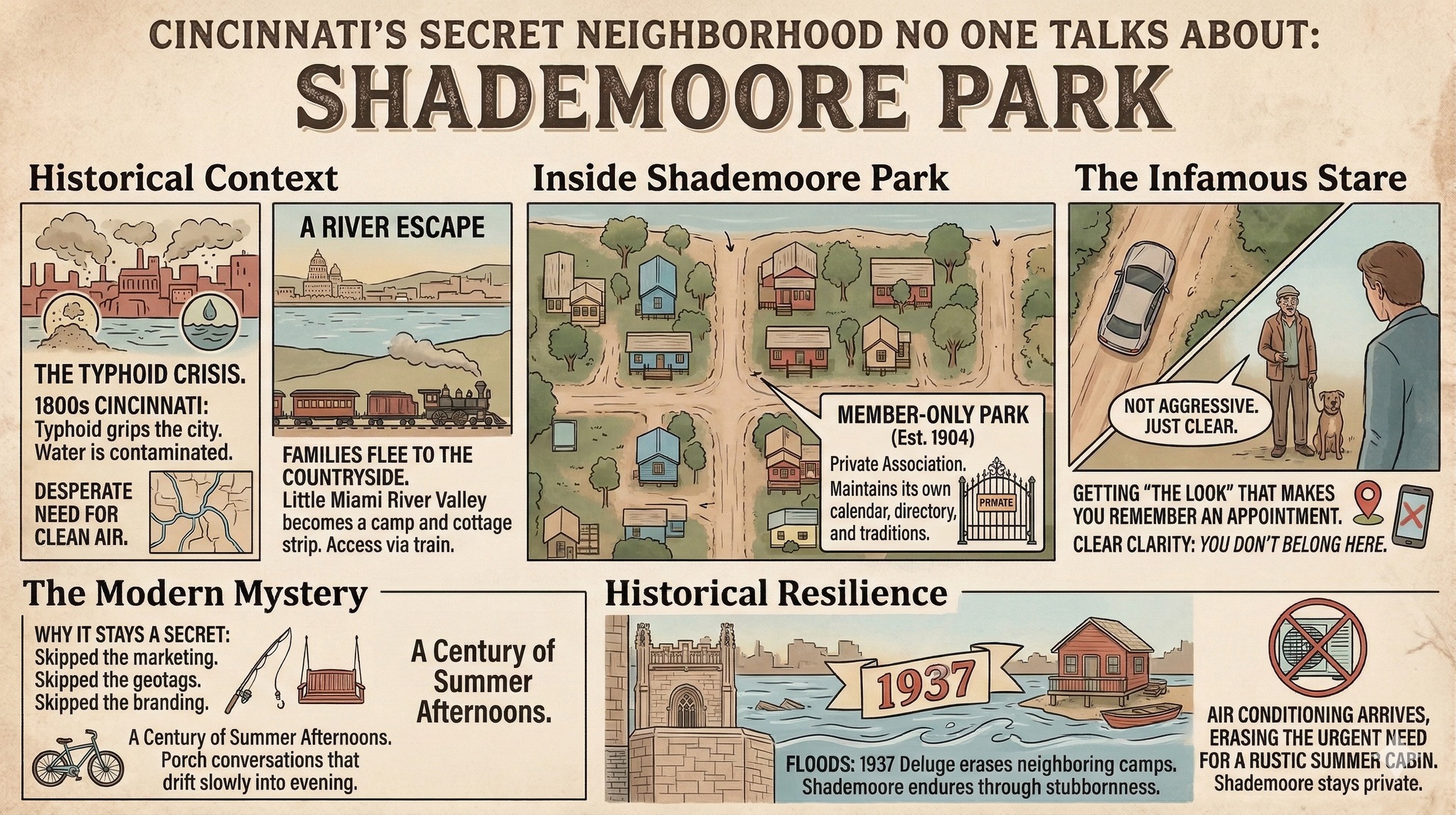
The Cincinnati Neighborhood No One Talks About. There’s a stretch of the Little Miami River near Newtown where the road gets quiet in a very particular way. Not rural quiet. Cincinnati doesn’t really do that. Too many roads, too many subdivisions, too many people who bought kayaks during the pandemic. This is a different kind of quiet. The kind where you get the feeling you’ve wandered into someone else’s story. The first time someone told me about Shademoore Park it sounded like the setup to a bad urban legend. A friend said it the way people say things they’re not completely sure they should be saying. “You ever heard of that place down by the river? The one where they don’t let you in?” Naturally, that’s the kind of sentence that gets your attention. Cincinnati has its share of weird little pockets. Old German social clubs. Private garden societies. Churches that double as fraternal lodges. But this sounded different. Something older. Something that had managed to stay mostly invisible while the rest of the region paved itself into strip malls and drive-through pharmacies. Shademoore Park. If you look it up online you’ll find almost nothing. A small website. A few references buried in planning documents. The occasional confused internet thread where someone asks, essentially, “What is this place?” The rumors are always the fun part. People say they drove down a narrow road and suddenly found themselves in the middle of a small cottage village along the river. Gravel lanes. Little houses on stilts. Porch chairs facing the water. And then someone noticed them. A guy walking a dog. A woman watering plants. Someone leaning on a porch railing. The look, according to multiple internet accounts, is usually the same. Not aggressive. Just… clear. You don’t belong here. A few people claim they were politely told the area was private. A few say they were escorted back to the road. One guy online described the experience as “getting the kind of stare that makes you remember an appointment you suddenly need to be somewhere else for.” Which of these stories are true is hard to say. The internet is a carnival of exaggeration. But the place itself is very real. And it’s older than most people realize. Shademoore Park was incorporated in 1904 as the Shademoore Essenic Park Association. The land had belonged to a couple named Charles Moore and Sarah Shade Moore. Combine the names and you get Shademoore, which feels like the sort of tidy Victorian wordplay people loved back then. The original idea was simple. Get out of the city. In the late 1800s Cincinnati had a problem that would make modern public health officials wake up screaming. Typhoid fever moved through the city with frightening regularity. Water supplies were contaminated. Sanitation systems were primitive. People were desperate for ways to escape it. So they did what people have always done when cities get too hot or too dangerous. They fled to the countryside. The Little Miami River valley became a kind of improvised vacation strip for Cincinnati residents. Small camps appeared along the water. Tent colonies at first. Then cottages. Families would pack up for weekends or entire summers, convinced that the fresh air and open space along the river offered some kind of immunity. You could even take a train out there. Campers rode the Pennsylvania Railroad to a stop near the river. The returning train was apparently known by the charming nickname “the Hog-train,” which shuttled people back toward Cincinnati when the weekend ended. Imagine it. Men in straw hats. Women in long summer dresses. Kids with fishing poles. A whole city briefly emptying itself toward the river in search of clean air and the vague hope that disease might not follow them. By the early 1900s, the riverbanks were dotted with camps and cottage communities with names that sounded like postcards from a forgotten era. Stevenson cottages. Hartman’s Grove. Idle Hours. Canoe clubs and YMCA retreats. Fourth of July regattas with boat races and swimming competitions. For a while it worked. Then the river reminded everyone who was in charge. Floods swept through the valley repeatedly. The most devastating came in 1937, when water erased entire stretches of river settlements. Many of those old camps never came back. The Great Depression didn’t help. Neither did World War II. And after the war, something even more practical arrived. Air conditioning. Once you could cool your house in the city, the idea of maintaining a rustic summer cabin by a flood-prone river started to lose its appeal. One by one, the camps disappeared. Except Shademoore. For reasons that probably have more to do with stubbornness than strategy, the association held together. Members maintained the cottages. Families kept coming back. The place remained private, run by the same kind of member organization that had founded it decades earlier. Today it’s still there. A small riverside colony of cottages along the Little Miami. Many of them weathered. Some raised on stilts against the inevitable floods. Gravel roads winding between them. Families who have been connected to the place for generations. It floods sometimes. In 2015 the river surrounded parts of the community and residents had to move around by boat for a while. If you live along the Little Miami long enough, the river eventually reminds you that you are merely borrowing the land. That’s part of the deal. The secrecy, though, is mostly accidental. Shademoore was never meant to be a public attraction. It was always a members-only park. Private land maintained by the people who belong to it. The association still exists as a nonprofit. They maintain their own calendar. Their own directory. Their own traditions. This is not a secret society. It’s just a community that never felt the need to advertise itself. Which, in modern America, can feel suspicious. We live in an era where everything is marketed, documented, and geotagged. Every bar has an Instagram strategy. Every neighborhood has a logo. Entire city districts now exist mainly as hashtags. Shademoore skipped all of that. It sits along the river the way it has for more than a century, quietly hosting summer afternoons that probably look a lot like they did in 1910. Kids riding bikes down gravel lanes. Someone fishing off the riverbank. Porch conversations that drift slowly into evening. If you drive past, you might notice the road. You might even feel the urge to turn down it. If you do, you’ll probably understand pretty quickly why the internet stories exist. Not because anything sinister is happening there. Just because sometimes a place decides it would prefer to remain its own small world. And after more than a hundred years, the people who belong to it have gotten pretty good at protecting that.
Where the ad sends people
highfivecincinnati.com
Subscribe For More!
Local Cincinnati | Great Things | Every Tuesday
Sign up: highfivecincinnati.com(opens in a new tab)