The Way We Move
The Way We Move Facebook ad: “Discover The Simple Lifestyle Switch To Help Relieve…”
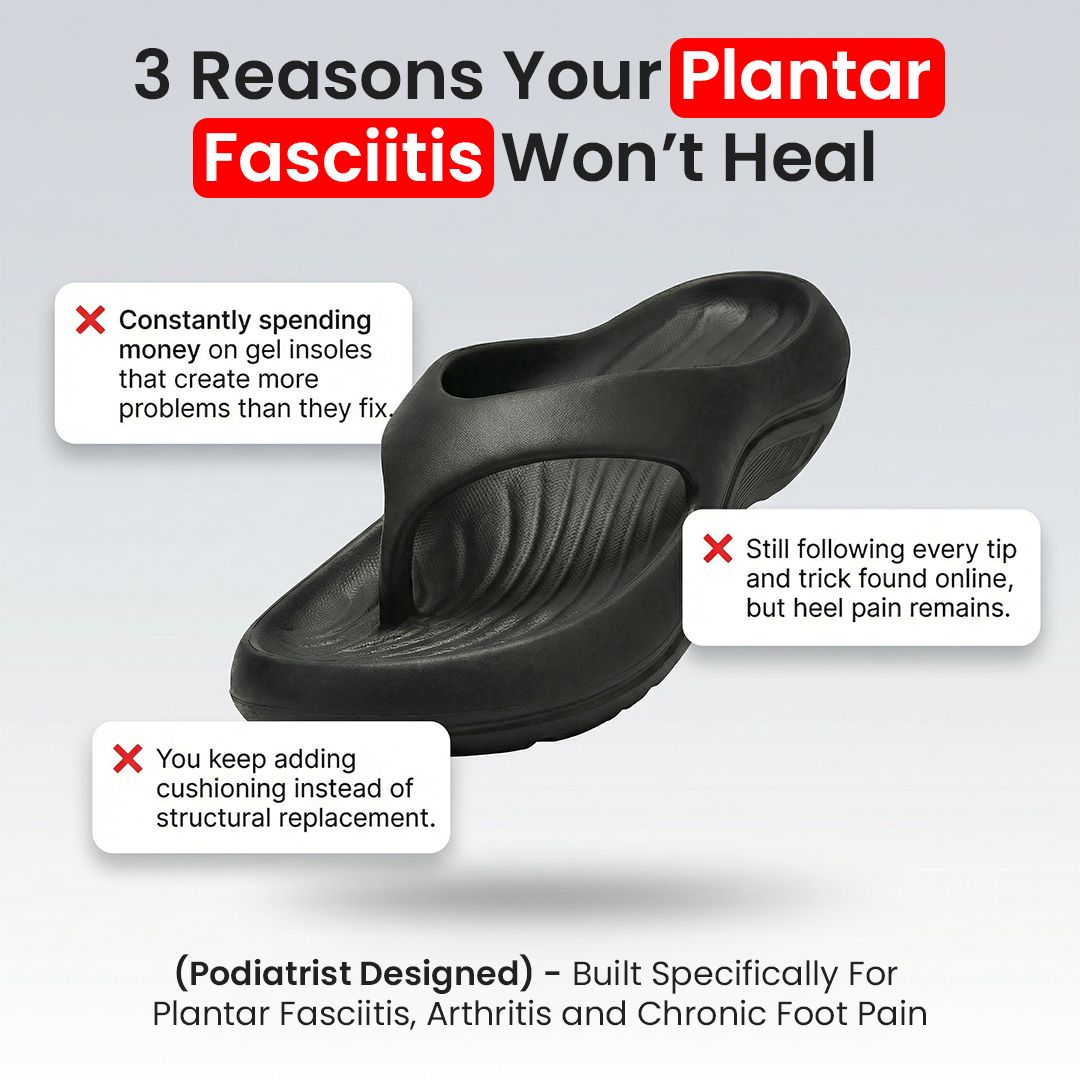
Ran for 86 days, from May 15 to August 9, 2026, the last day Crush saw it.
Run by The Way We Move on Facebook. Crush is not the advertiser and does not verify its claims. See this ad in Meta's Ad Library(opens in a new tab)
Want an ad like this for your product?
Crush makes new ad images for your product from this ad: your logo, your product photo, your offer.
Trials from $19.95 USD, then $79.95 USD a month. Cancel anytime.
About this ad
- Meta Ad Library ID
- 1491181549126098
- Platforms
- Facebook, Instagram, Audience Network, Messenger and Threads
- Relaunches
- 0
Ad text
Your feet don't need more cushioning. Your fascia needs structural replacement from underneath. I'm terrified of the knife. My podiatrist said we've tried everything else. Surgery is the next step. But I've read the stories. The nerve damage. The chronic pain that never goes away. People who walk worse after surgery than before. "I wish I'd never done it." Once you cut, you can't go back. I'm desperate. I've spent thousands on alternatives. Cortisone injections. Physical therapy twice a week. Custom orthotics that cost $450. Compression socks. Night splints. The walking boot. Every stretching protocol in existence. I'm religiously compliant. I do everything they tell me. Calf stretches. Toe curls. Ice baths. Roll the frozen water bottle. Wear the night brace. Follow the program. But I'm still in pain. Every morning. Every step. The sharp stabbing. The deep ache. The burning sensation. And now they want to cut. I knew something was wrong when the expensive gel insoles made it worse, not better. I'd paid $85 for them. Medical-grade cushioning. Shock-absorbing technology. The pharmacy assistant said they were podiatrist-recommended. I wore them faithfully. Every day. For two months. They created pressure points under my heel. A constant, dull ache that radiated up my leg. By afternoon, I was limping. I thought maybe they needed more time. Maybe my feet needed to adjust. I added more cushioning. Bought premium insoles. Still worse. I tried everything else. Cortisone shots that hurt like hell and only worked for three weeks. Shockwave therapy. Deep tissue massage. Kinesiology tape. I wore the night splint every single night like they said. Nothing worked. The physical therapy exercises made my calves stronger but my heel pain angrier. The inflammation would spike every evening, throbbing until I couldn't sleep. I spent hours online. Reading medical journals. Watching surgery recovery videos. Searching for the miracle solution that saved someone else from the operating table. After eighteen months of this, I'm exhausted. Financially drained. Mentally broken. My surgery date is scheduled. Eight to twelve weeks non-weight bearing. Six months until full recovery. I can't afford to lose half a year. But I can't afford to keep living like this either. I'm trapped. The pain is unbearable. But surgery is terrifying. Permanent. Irreversible. A coin flip between relief and worse disability. I'm looking for the last resort. The Hail Mary. Anything that might save me from the scalpel. That was four weeks before I ran into Michelle at the beach. I was sitting on the sand. Couldn't walk barefoot anymore. The pain was too intense. She walked past wearing thongs, no visible limp, no hesitation on the hard-packed sand. I recognized her immediately. We'd met at the podiatrist's office eight months earlier, both scheduled for plantar fascia release surgery around the same time. We'd commiserated about how nothing worked. But she was walking like a normal person. No careful heel-strike pattern. No favoring one side. Wearing simple flip-flops, not the clunky orthotic sandals. "Did you already have your surgery?" I asked. "I canceled it," she said. "Four months ago." I stared at her. She was walking on sand. Standing without weight-shifting. I'd seen her barely able to walk six months prior. "How?" She sat down next to me. Pulled up photos on her phone. Her pain tracking journal. The week-by-week improvement over ten weeks. "I finally understood what was actually broken," she said. "All that cushioning we were adding? That's not the problem. Your heel pad has atrophied. The fat pad that used to cushion your heel bone is gone. You can't cushion your way out of a structural problem." I watched her stand up from sitting. No grimace. No bracing. "What did you do?" "Dr Arch's," she said. "They're not insoles. They're orthotic thongs with built-in arch support. You wear them instead of regular shoes. The contoured footbed replaces the structural support your heel pad used to provide from underneath." I pulled out my phone. "How do you spell that?" I was skeptical. I'd tried every cushioned insole on the market. What made sandals different? I started researching heel pad atrophy. What I found changed everything. When you add cushioning on top of an atrophied heel pad, you're not replacing the lost structure. You're just adding a soft layer that compresses under your body weight. Your heel bone still impacts the ground with every step because there's no structural support from underneath. It's basic biomechanics. Your heel pad used to be 18mm thick. Now it's compressed to 3-4mm or less. Adding a cushioned insole on top doesn't restore that lost thickness where it matters—directly under your heel bone. That's why the gel insoles created pressure points. That's why they never stopped hurting. That's why the cortisone shots and physical therapy didn't work. I was walking on a structurally deficient heel 10,000 times per day. The heel doesn't need more cushioning on top. It needs structural replacement from underneath at the exact point where the fat pad used to be. I'd been treating a symptom with the wrong solution. And my podiatrist had never explained the difference between cushioning and structural replacement. When I researched Dr Arch's, the engineering made immediate sense. 2.2cm orthotic footbed. Contoured arch support. Biomechanically aligned. Podiatrist-designed specifically for plantar fasciitis. But here's what convinced me. The built-in arch support redistributes pressure away from the exposed heel bone. The contoured footbed provides structural support from underneath—exactly where your heel pad used to be. Your heel never hits the ground unprotected. Unlike cushioned insoles that compress and bottom out, this replaces the structural function your body has lost. The 2.2cm footbed prevents the heel bone from impacting the ground. The arch support redistributes your body weight across your entire foot, not just the damaged heel insertion point. It wasn't just another footwear category. It was a completely different mechanical approach. One that addressed the actual structural deficit instead of trying to cushion a missing foundation. And it cost $69.95. Not $450 orthotics. Not $600 cortisone injection series. Not twelve weeks in a boot and months of surgical recovery. If this didn't work, they had a 90-day guarantee. Surgery can't be undone. I ordered them that night. They arrived three days later. I put them on immediately. First morning: the stabbing sensation was softer. Still there, but noticeably duller. By week three, I wasn't hobbling to the bathroom anymore. The pressure points were gone. No more concentrated pain under my heel. No more burning sensation by end of day. No more feeling like I was walking on broken glass. Within six weeks, I could stand in the kitchen cooking. Walk to the mailbox without planning my route. I wasn't calculating every step anymore. It's been five months. The morning pain is 85% gone. I canceled my surgery. I'm not just managing anymore. I'm walking. I called my podiatrist's office. Left a voicemail explaining what actually worked. I don't know if he cared. But someone else in that waiting room might hear about it. The body can heal itself. It just needs the structural support it's missing. Not cushioned. Not compressed. Just replaced. If this is your life right now, you know exactly what I'm talking about. The terror every time you read another surgery horror story. The $450 wasted on orthotics that never worked. The desperation of being told "we've tried everything else." This isn't about finding softer cushioning. This is about understanding that your heel pad has atrophied and no amount of gel insoles will replace that structural loss. Every day you spend in cushioned insoles, you're re-injuring the fascia. The inflammation cycles. The tissue degrades further. Surgery becomes more complicated, not less. And I'm telling you: this is reversible. Dr Arch's offers a 90-day money-back guarantee. That's not marketing language. That's because you need time to let the tissue stop being traumatized and actually heal. Track it yourself. Your first-step pain. Your end-of-day inflammation. Your ability to walk without favoring one leg. You'll see measurable improvement within three to four weeks. Right now, they're $69.95. Under $40 compared to $450+ orthotics or thousands in medical procedures. drarchs.com You deserve to try the reversible option before the permanent one. Your fascia deserves structural replacement, not more cushioning. Surgery can wait. Your healing can't.
Where the ad sends people
drarchs.com
Discover The Simple Lifestyle Switch To Help Relieve Plantar Pain
It didn't happen overnight. It crept up on me slowly. A little heel pain here. Some stiffness there. Nothing I couldn't ignore.
Learn more: drarchs.com(opens in a new tab)