
Inactive· since May 28, 2026
- 22
- days it ran
- 0
- relaunches
Ad copy
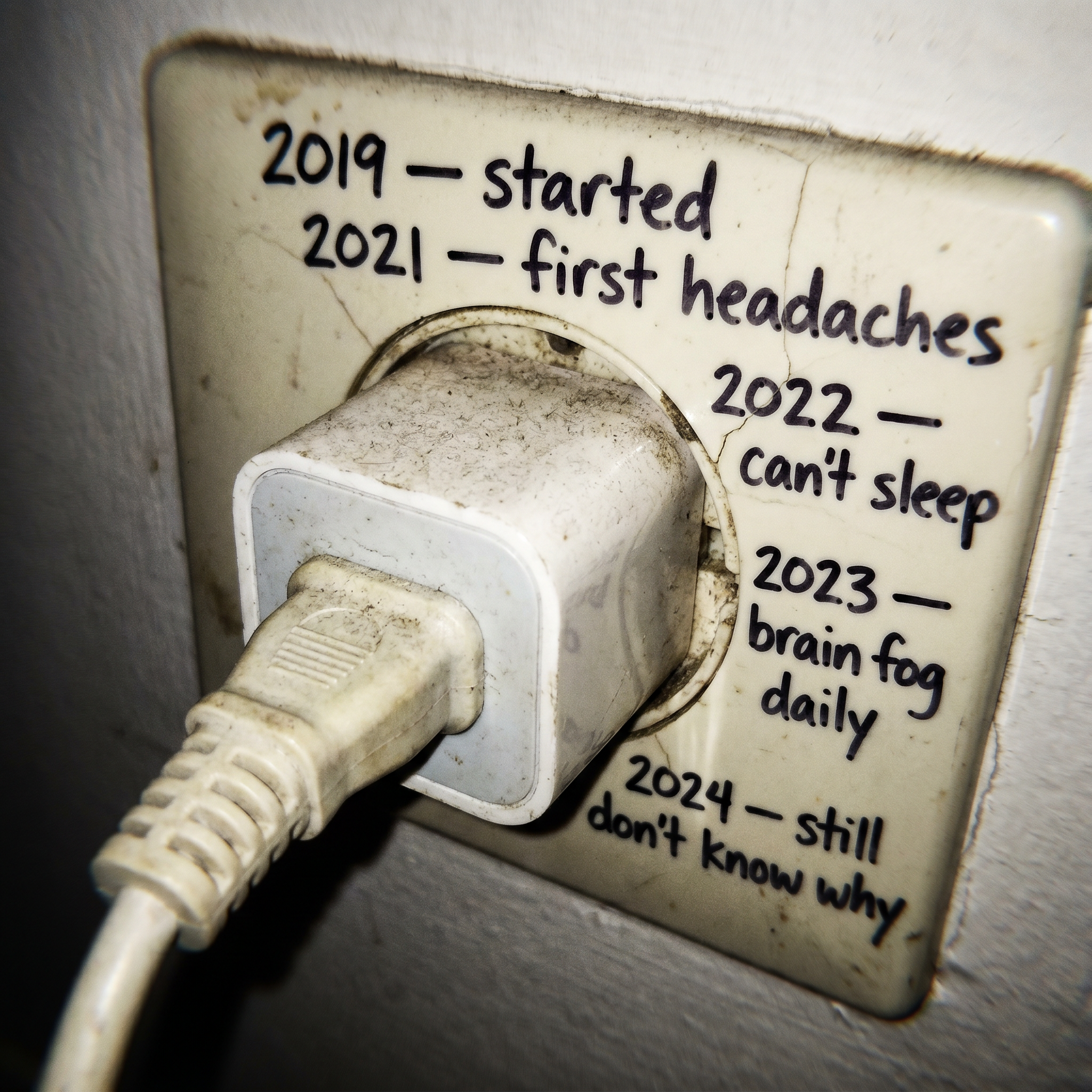
2019. 2021. 2022. 2023. 2024. The plug has been in the wall through all of it. Nobody looked at the plug. My name is Dr. Rachel Kim. I’m 45. I’m a neurologist at a hospital in Minneapolis, Minnesota. I have spent 17 years diagnosing and treating the specific cluster of symptoms written around that outlet. Headaches. Non-restorative sleep. Brain fog. Cognitive impairment without identifiable structural cause. I have seen this cluster in my clinic for 17 years. I have ordered the MRIs. I have run the blood panels. I have administered the cognitive batteries. I have written the referrals and the follow-up protocols and the management plans. Not once in 17 years did I ask a patient to look at the outlet where their router is plugged in. Not once did I ask them to write down when the plug went in. Not once did I correlate the year the broadband was upgraded with the year the headaches started. I was reading the consequence. The plug was in the wall. THE REGISTRAR WHO LEFT A NOTE ON MY DESK In September 2022 a second-year neurology registrar named Dr. Priya Anand — who has the quality that the best junior doctors have of noticing what the senior clinicians have stopped noticing — left a handwritten note on my desk. The note said: “I’ve been correlating headache onset dates with residential WiFi installation dates for 23 of our chronic headache patients. The correlation is 19/23. I think you should see the data before I do anything with it.” I left the note for two days. Then a patient came in for a follow-up who had been in my clinic for three years with the exact symptom profile written around that outlet. She was 41. Teacher. No neurological findings on any investigation. The cognitive battery showed processing speed and sustained attention in the 40th percentile — below what her educational and professional history predicted but not diagnosably impaired. She had been on a migraine prevention protocol for two years. Partial response. The headaches were less frequent but not resolved. She described her daily experience with precision. “It starts around 10am. A pressure behind the eyes that builds through the afternoon and doesn’t leave until I go to sleep. And when I wake up, it’s not there yet, but I know it’s coming. I’ve known since about 2022 that it’s going to come.” I asked her when the headaches had started. “2021,” she said. I asked if anything had changed in her home or work environment in 2020 or 2021. She thought for a moment. “We upgraded the internet in 2020. The new router was much stronger. The engineer put it in the bedroom because that’s where the cable came in.” I picked up Priya’s note from my desk drawer. I read it in front of the patient. I asked her if she would consent to a bedroom measurement. WHAT PRIYA’S DATA SHOWED Priya’s 23 patients: 19 of 23 had residential WiFi infrastructure changes in the 12 months preceding symptom onset. The four without a correlation had preexisting headache conditions that predated WiFi installation. Of the 19 with the correlation: average bedroom field at current measurement — 87 V/m. Average time from WiFi upgrade to first headache presentation: 11 months. Consistent with a gradual threshold-crossing model rather than an immediate response. The headaches did not start when the plug went in. They started 11 months later. The plug had been accumulating its effect for 11 months before the threshold crossed. The timeline written around that outlet — 2019 to 2024 — is the record of what a threshold crossing looks like when nobody measures the plug. 2019: the plug went in. 2021: first headaches. 24 months of accumulation before the threshold. 2022: sleep gone. The HPA axis fully dysregulated. 2023: brain fog daily. The glymphatic cycle consistently incomplete. 2024: still don’t know why. Because nobody looked at the plug. THE CONTROL GROUP THAT CHANGED MY PRACTICE Priya had also measured 14 patients from my clinic who presented with unrelated neurological concerns — acute presentations, single-episode events, no chronic headache cluster. Average bedroom field: 71 V/m. Lower than the chronic headache cohort. But not dramatically lower. I looked at their cognitive battery data from intake. Not normal. Below the age-matched population average. Not diagnosably impaired. Below predicted. They were sleeping in 71 V/m. They had not crossed the headache threshold yet. Their glymphatic cycles were running at reduced efficiency. Their prefrontal cortex was operating in a field that was maintaining low-level HPA activation. They felt, they said, fine. Their batteries did not look fine. They were 71 V/m versions of the patients who were 87 V/m versions of what happens when the threshold finally crosses. The timeline on their walls was still early. 2019 or 2020 — started. Nothing written yet for 2021, 2022, 2023. Coming. THE NIGHT I MEASURED MY OWN BEDROOM Priya brought the RF meter to the neurology department. She measured my office: 78 V/m. She measured my home that evening — I gave her the spare key. My bedroom: 91 V/m. I have been sleeping in 91 V/m for eight years. I am a neurologist who has spent 17 years treating the consequences of a field I had never measured in my own bedroom. I pulled my own cognitive battery data from a standardised test I had taken as part of a hospital staff wellbeing programme eight months earlier. Processing speed: 54th percentile. Working memory: 51st percentile. Sustained attention: 57th percentile. These are not impaired scores. They are below what my educational history predicts for a neurologist eight years post-fellowship. I thought about the timeline around the outlet. My timeline would start in 2016. When I moved into my current home. When the router went into the bedroom. I had been at 54th percentile processing speed for eight years. I had been calling it the cost of a demanding specialty. WHY THE PRODUCTS ON THE MARKET COULD NOT MOVE THE METER Nine blocking products. 72 hours each. Continuous monitoring. Not one reduced the bedroom field below 80 V/m. The physics requires no extensive explanation. The field arrives from the router in the bedroom, from three neighbouring WiFi networks through the walls, from the cellular infrastructure on the street, from the building systems — simultaneously, from every direction. A blocking device intercepts one direction. The pineal gland continues receiving the field from every other direction. The HPA axis continues activating. The glymphatic cycle continues running short. The headaches continue starting at 10am. The timeline on the wall continues. 2024 — still don’t know why. THE MECHANISM Materials science. Not neurology. Organic resin contracts permanently around copper shavings and Brazilian amethyst crystal. The permanent contraction places the crystal under continuous mechanical compression. Continuous compression of crystalline material generates a continuous coherent piezoelectric electrical charge. Documented by Pierre and Jacques Curie in 1880. Applied in every quartz oscillator on earth. The continuous coherent charge converts the ambient field — from chaotic incoherence to coherent energy. The HPA axis does not interpret coherent energy as a threat signal. It deactivates. The cortisol descent completes overnight. The glymphatic cycle runs its full programme. The pressure behind the eyes that starts at 10am stops starting at 10am. Not because something is masking it. Because the source of the HPA activation that was generating it has been converted. WHAT I DOCUMENTED OVER 11 WEEKS Week 1–2: Bedroom field: 91 V/m to 25 V/m. Continuous monitoring held 22–28 V/m for 120 hours. Recalibrated meter. Reading held. Personal headache tracking — I had been experiencing the same 10am onset pattern as my patients for approximately three years without categorising it as a clinical concern: Baseline: headaches on 5 of 7 days per week, average onset 10:15am. Week 2: headaches on 2 of 7 days. Onset when present: 1:30pm — three hours later than baseline. Morning energy baseline: 3.8 out of 10. End of week 2: 5.9. I noted the direction. I required more duration. Week 3–4: Field: 24 V/m. My patient — the teacher with the 2021 headache onset — had placed a pyramid in week one on my recommendation. She came in for follow-up at week four. “Dr. Kim,” she said. “I had two headache days this week.” Baseline when she had first presented three years earlier: 6.7 headache days per week. Two days. “What is the field in your bedroom now?” I asked. “24 V/m,” she said. “I borrowed Dr. Anand’s meter.” “Down from?” I said. “91,” she said. I sent Priya the data. She called within the hour. “Rachel,” she said. “From 6.7 headache days to 2. In four weeks. That’s a 70% reduction.” “Single variable,” I said. “We need to design the study,” she said. “I’ve been thinking about the protocol since week two,” I said. “What’s your own headache frequency this week?” she said. “Zero,” I said. There was a pause. “Zero,” she said. “First headache-free week since I can remember,” I said. “I need to measure my apartment,” she said. Her apartment: 84 V/m. She ordered three pyramids. Week 5–6: Field: 23 V/m. Headache frequency: zero in weeks 4, 5, and 6. Inflammatory markers at week 6: CRP: 0.7 mg/L. Baseline 9 months prior: 2.6 mg/L. IL-6: 1.8 pg/mL. Baseline: 4.9 pg/mL. CRP reduced 73%. IL-6 reduced 63%. Six weeks. Single environmental variable. I thought about 17 years of migraine prevention protocols. I thought about the plug in the wall. Week 7–11: Field: 22 V/m. Headache frequency weeks 7–11: zero. Cognitive battery at week 11: Processing speed: 76th percentile. Up from 54th. Working memory: 74th percentile. Up from 51st. Sustained attention: 79th percentile. Up from 57th. Average: 23 percentile points across three domains. Morning energy at week 11: 7.7 out of 10. Baseline: 3.8. My patient’s headache frequency at week 10: averaging 1.2 days per week. Down from 6.7. She described her 10am as: “just 10am now. It used to be the beginning of something. Now it’s just the middle of the morning.” WHAT THE TIMELINE ON THAT OUTLET IS SAYING Someone wrote that timeline in marker directly on their wall. Not dramatically. Not in crisis. Just precisely. 2019: started. 2021: first headaches. 2022: can’t sleep. 2023: brain fog daily. 2024: still don’t know why. The handwriting gets slightly worse with each year. That is the most important detail. The person who wrote the 2024 entry is not the same person who wrote the 2019 entry. Something has been happening to them in the time between those two entries. Gradually. Invisibly. Below the threshold of anyone’s clinical concern. The blood work was normal. The MRI was normal. The neurologist — me, in 17 years of practice — did not ask about the plug. Your GP will run the standard panel. Everything within normal range. She will suggest stress management. The standard panel does not measure what happens to the HPA axis in a bedroom running 91 V/m over a period of years. It does not assess the glymphatic cycle completion rate. It does not ask when the router went in or note that the headaches started 11 months later. The plug has been in the wall since 2019. The timeline around it is written in handwriting that gets slightly worse each year. At 22 V/m, the headaches stopped. At 22 V/m, the timeline stops being written. The plug is still in the wall. Its consequences are not.
Like this ad? Make it yours.
Crush rebuilds this exact creative around your product — your brand, your colors, your offer — in about a minute.