
Inactive· since May 21, 2026
- 6
- days it ran
- 1
- relaunches
Ad copy
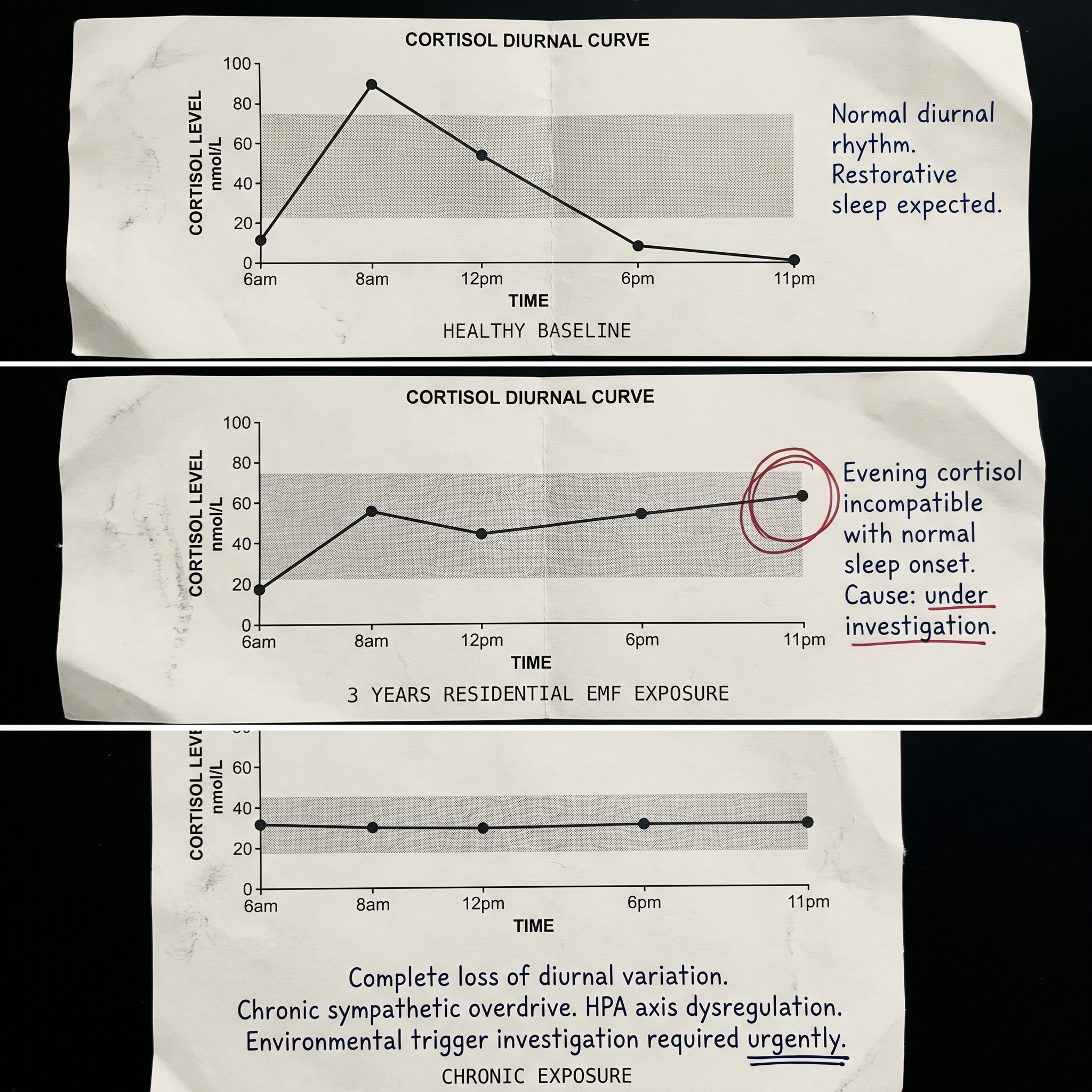
This is what your stress hormone looks like after years next to a router. The body never lies. I'm 44. I'm a psychoneuroendocrinologist at a private research clinic in Amsterdam. I have spent 16 years studying the relationship between cortisol dysregulation and its downstream effects on sleep, cognition, immunity, and metabolic function. Cortisol is the hormone that wakes you up in the morning. It is the hormone that sustains you through the day. It is the hormone that drops to near-zero at night so your nervous system can repair, consolidate memory, and restore every biological system that the day has depleted. When cortisol does what it is designed to do — peak at 8am, decline through the day, reach zero by 10pm — you sleep deeply, wake rested, think clearly, and recover from everything life asks of you. When cortisol does what is visible in panel 3 of these charts — flat, elevated, indifferent to the time of day — you cannot sleep, cannot recover, cannot think clearly, and cannot understand why because everything your doctor measures comes back normal. I have been treating panel 3 for 16 years. I treated it with pharmaceutical cortisol modulators, with HPA axis restoration protocols, with sleep interventions, with stress reduction programmes, with every evidence-based tool my field offers. Some patients recovered. Many plateaued. In January 2023 I ran my own cortisol panel for the first time in four years. My curve looked like panel 3. I am a psychoneuroendocrinologist who had been explaining panel 3 to patients for 16 years. My own cortisol looked like panel 3. I had never measured what was producing it. The Hormone I Taught About For 16 Years Before I tell you what happened after I saw my own results I need to tell you what the cortisol diurnal curve actually is because most people have heard of cortisol and almost nobody understands what it is supposed to do. Cortisol is not simply a stress hormone. That description is accurate but incomplete in the way that describing the heart as a pump is accurate but incomplete. Cortisol is the primary regulator of the autonomic nervous system's daily rhythm. It governs when the body activates and when it recovers. It regulates immune function, metabolic rate, cardiovascular tone, cognitive performance, and the architecture of sleep. The diurnal curve — the ski slope visible in panel 1 — is not incidental. It is the master rhythm of human biology. The steep morning peak is the cortisol awakening response — a deliberate surge that activates the cardiovascular system, mobilises glucose, sharpens attention, and prepares every biological system for the demands of the day. The progressive decline through the afternoon is the body systematically reducing its activation state in preparation for recovery. The near-zero evening value is the biological prerequisite for restorative sleep — without cortisol dropping to the floor the nervous system cannot enter the parasympathetic state in which deep sleep occurs, memory consolidates, tissue repairs, and the immune system performs its overnight maintenance. Panel 1 is what human biology was designed to look like. Panel 2 is a body that has partially lost that rhythm. The morning peak is blunted — the cortisol awakening response is diminished, which is why waking is difficult and the first hours of the day are foggy. The evening value is elevated — the body is still partially activated at the time sleep should begin, which is why sleep onset is difficult and the sleep that does come is shallow and unrestoring. The annotation on panel 2 is the most important text in the entire image. Evening cortisol incompatible with normal sleep onset. Cause: under investigation. The cause was under investigation because the investigating physician had not measured the bedroom. Panel 3 is a body that has completely lost the rhythm. The curve is flat. No meaningful morning peak. No decline. No evening floor. The body does not know when to activate and when to recover. It runs at the same level of activation all day and all night. It is always partially awake. It never fully recovers. Complete loss of diurnal variation. Chronic sympathetic overdrive. HPA axis dysregulation. The annotation says environmental trigger investigation required urgently. Urgently. I had been writing that annotation on patient files for 16 years without measuring the bedroom. The Patients I Could Not Recover Here is what they don't tell you about treating HPA axis dysregulation in a research clinic: The patients who come to you have already exhausted their options. They have been to their GP. Their GP has run blood work. Everything is normal. They have been told their cortisol is fine because the standard morning cortisol test — a single value taken at 8am — does not reveal what the diurnal curve reveals. A morning cortisol in the normal range is compatible with panel 3 if the morning value is the only value measured. Their cortisol is fine. The curve is destroyed. These are not the same thing. By the time they reach my clinic they have typically been suffering for three to seven years. They present with the same cluster every time. Cannot fall asleep despite exhaustion. Cannot stay asleep despite exhaustion. Wake unrestored regardless of hours in bed. Brain fog from mid-morning that does not lift. Emotional flatness — not depression, something more specific, the specific flatness of a nervous system that has been in chronic activation for so long it can no longer locate the contrast between stressed and unstressed. I had 28 patients in my practice by 2022 that I had classified privately as HPA axis non-responders. Patients whose cortisol curve improved on treatment and then returned to the dysregulated pattern within weeks of reducing the intervention. Something was continuously resetting the dysregulation. Something was continuously reactivating the sympathetic state that the treatment was trying to deactivate. I did not know what. I had been writing environmental trigger investigation required on their files for years. I had not been investigating the environment. The Morning My Own Results Arrived In January 2023 I received the results of my own cortisol panel. I run the full diurnal panel — five saliva samples across the day, the only format that produces the curve rather than the single point. I run it on myself every few years as a clinical discipline. I know what my curve looks like. I opened the results on my laptop in my clinic office at 7:30am. I looked at the curve. Panel 3. Not panel 2. Not a mild elevation at the evening time point that could be attributed to work stress or a late meal or the particular demands of a research practice. Panel 3. Complete loss of diurnal variation. My morning peak was blunted — the cortisol awakening response that should be the highest value of the day was barely above my midday value. My evening value — the value that should be approaching zero to allow sleep — was 64 nmol/L. 64 nmol/L at 10pm. The reference range for normal sleep onset: below 10 nmol/L at that time point. My body thought it was still 8am at 10pm. My body had thought it was still 8am at 10pm for long enough to produce a flat curve in a psychoneuroendocrinologist who studies flat curves for a living. I sat at my desk and looked at my own results for a long time. Then I thought about a question a colleague had asked me three months earlier that I had not answered properly. Dr. Fatima Al-Rashid is an environmental health physician I had been collaborating with on a research project. She had been studying residential electromagnetic field exposure and autonomic nervous system function in a cohort of 34 patients across the Netherlands. She had asked me, in passing, whether I had ever measured the bedroom field of my HPA axis non-responders. I had said no. She had not pushed further. I called her from my office at 7:47am. “Fatima,” I said. “Send me the gauss meter.” What The Meter Showed The meter arrived the following morning. I measured my bedroom that evening. 91 V/m. I had been sleeping in 91 V/m for six years. I stood in my bedroom with the meter and thought about the HPA axis non-responders in my practice. The patients whose cortisol curve returned to dysregulation within weeks of reducing treatment. The something that was continuously resetting them. The environmental trigger I had been writing about and not investigating. I called Fatima. I told her my reading. “How long?” she said. “Six years,” I said. She was quiet. “Thomas,” she said. “In my cohort of 34 patients — the ones with documented autonomic nervous system dysregulation — the average bedroom reading is 88 V/m. The correlation between bedroom field and evening cortisol elevation is 0.79.” 0.79. In biomedical research a correlation of 0.79 between two variables is not background noise. It is a signal with clinical implications. The higher the bedroom EMF. The higher the evening cortisol. The more disrupted the diurnal curve. The more completely the body's master rhythm is flattened by the field it is trying to sleep inside. “Why didn't you tell me this when you asked about my patients?” I said. She was quiet for a moment. “I did,” she said. “Three months ago.” She had. I had categorised it. I had been wrong about the category. The $38,000 My Patients Spent Not Addressing The Source I want to document what my HPA axis non-responders had spent before their bedroom was measured because I think the total tells you something about the scale of what is missed when the environment goes uninvestigated. Full diurnal cortisol panels, repeat assessments, specialist consultation fees: average €4,200 per patient across the treatment period. Pharmaceutical cortisol modulation — low-dose hydrocortisone, DHEA supplementation, pregnenolone: average €180 per month, average treatment duration 19 months. Average cost: €3,420. Adaptogenic protocol — ashwagandha, rhodiola, phosphatidylserine, holy basil, magnesium glycinate: average €220 per month, 14 months average. Average cost: €3,080. Chronotherapy and sleep intervention programme — blue light protocols, temperature regulation, sleep restriction therapy, CBT-I: average €2,800 per patient. Nutritional medicine consultation and anti-inflammatory dietary protocol: average €3,100. Mind-body intervention — yoga therapy, breathwork, HRV biofeedback, meditation programme specifically designed for HPA axis restoration: average €4,400. Private psychotherapy to address the psychological consequences of multi-year sleep deprivation and cognitive impairment: average €240 per session, average 18 sessions. Average cost: €4,320. Functional neurology assessment and treatment: average €3,600. Intravenous nutrient therapy — magnesium, B complex, vitamin C, glutathione: average €320 per session, average 11 sessions. Average cost: €3,520. Total average spend across HPA axis non-responders before their bedroom was measured: €32,440 — approximately $35,000. Not one of them had been asked where their router was. Not one bedroom had been measured. The field was running above their pillows every night resetting the dysregulation that every intervention was trying to correct. What A Psychoneuroendocrinologist Found When She Looked I require mechanism before I implement intervention. The blocking products failed immediately. Fatima had already tested them in her cohort. The physics was clear — partial Faraday implementation in a multidirectional residential field does not reduce the ambient reading. The field arrives from multiple directions. A partial barrier intercepts one vector. The meter does not move. She had tested nine products. Not one moved the meter. The piezoelectric mechanism was different. Fatima had found it in a materials science paper — not a wellness publication, a paper on piezoelectric composite field modulation in industrial EMF environments. The mechanism: organic resin, metal shavings, crystalline mineral — amethyst or quartz — cured under permanent mechanical pressure. The compression is continuous. The piezoelectric effect it produces is continuous. The electrical charge generated by the compressed crystalline material converts the chaotic incoherent ambient electromagnetic field into coherent energy. Not blocking. Transmuting. The biological relevance to HPA axis function is direct. The HPA axis — the hypothalamic-pituitary-adrenal axis, the system that produces and regulates cortisol — is a bioelectrical system. The hypothalamus, the pituitary, and the adrenal glands communicate through electrochemical signalling. The circadian rhythm that governs the cortisol curve is generated by the suprachiasmatic nucleus — a cluster of neurons in the hypothalamus that functions as the body's master clock. The master clock is sensitive to electromagnetic input. It evolved in an electromagnetic environment reading approximately 0.2 V/m — the natural geomagnetic baseline of the earth's surface. It is now being asked to keep accurate time inside 91 V/m. A chaotic incoherent field at 91 V/m is not a neutral background for a biological clock that evolved to run in 0.2 V/m. It is interference. Chronic interference means a clock that keeps losing the correct time. A clock that keeps losing the correct time produces a cortisol curve that looks like panel 3. I ordered the Spirad orgonite pyramid and placed it on my nightstand. I placed Fatima's gauss meter beside it. I opened a new tracking file. I called it what it was. An experiment. What I Documented Over 12 Weeks Timestamped. Controlled. Every variable noted. Week 1–2: Bedroom field before pyramid: 91 V/m. 48 hours after pyramid placement: 27 V/m. Continuous monitoring for 96 hours confirmed the field held between 24 and 29 V/m. I repositioned the pyramid at four nightstand locations. Consistent across all positions. I recalibrated the meter. The reading held. 27 V/m. I cross-referenced against Fatima's cohort data. Her data showed HPA axis dysregulation markers beginning to normalise below 30 V/m. My bedroom: 27 V/m. I noted this. I did not conclude anything. One variable changed. That is the beginning of a question. Personal symptom tracking — observational, not clinical: Sleep onset: I had been lying awake for an average of 47 minutes after going to bed for the previous two years. I know this precisely because I had been tracking it as part of my own research discipline. End of week 2: average sleep onset time 14 minutes. I noted it without drawing a conclusion. Morning clarity on waking: I had been reaching for my phone and lying in bed for 20 to 30 minutes before I could engage with the day. Day 11: I woke at 6:17am and sat up immediately. The clarity was there before the coffee. I noted the date. Week 3–4: Field: stabilised at 25–28 V/m. I ran my own cortisol diurnal panel — five samples, same protocol as my patients. I want to be precise about what I am sharing and what I am not claiming. A single panel from a single individual is not publishable evidence. I am documenting this as personal observational data. Morning peak: 87 nmol/L. My baseline from January: 52 nmol/L. The cortisol awakening response — the steep morning surge that was blunted in panel 3 — had returned. Evening value: 9 nmol/L. My baseline from January: 64 nmol/L. From 64 nmol/L to 9 nmol/L. The evening floor had returned. I looked at my own curve. It looked like panel 1. Not exactly. Not the textbook ski slope of a person who had never experienced HPA axis dysregulation. But in the same family of curves. The morning peak and the evening floor were present in a way they had not been present in January. I sent the curve to Fatima without comment. She called me 40 minutes later. “Thomas,” she said. “This curve is four weeks of data.” “Yes,” I said. “Your evening value was 64 in January,” she said. “Yes,” I said. “It is 9 now.” “Yes,” I said. She was quiet. “The master clock,” she said. “Yes,” I said. “At 27 V/m it can keep the correct time,” she said. “That is the hypothesis,” I said. “Is it testable?” she said. “That is what I have been thinking about since January,” I said. She told me she was placing a pyramid in the bedroom of every patient in her cohort the following week. She did. Week 5–6: Field: 26 V/m. Fatima sent me the week-4 cortisol panel results from the first six patients in her cohort who had agreed to the pyramid intervention. Average evening cortisol reduction across six patients: 41%. In four weeks. Without changing any other variable. Without adding any pharmaceutical intervention. Without modifying their lifestyle, diet, supplement protocol, or sleep hygiene. One change: a pyramid on the nightstand. A field reading of 26 V/m instead of 88 V/m. 41% reduction in the evening cortisol elevation that was making their sleep onset incompatible with normal sleep onset. I called her. “Fatima,” I said. “41%.” “I know,” she said. “In four weeks,” I said. “I know,” I said. “From a field change,” she said. “From a field change,” I said. She was quiet. “We need to design the trial,” she said. We are designing the trial. Week 7–12: My own field: 25 V/m. Cortisol panel at week 12: Morning peak: 91 nmol/L — within the healthy reference range for the cortisol awakening response. Evening value: 7 nmol/L — below the threshold compatible with normal sleep onset. My curve at week 12 looks like panel 1. Not perfectly. Not identically. But the ski slope is back. The morning peak is steep. The evening floor is real. Sleep onset time at week 12: 11 minutes average. My baseline in January: 47 minutes. I have not restructured my evenings around the inability to sleep. I have not taken anything new. I have not changed my diet, my exercise protocol, my pharmaceutical support, or any other variable. My bedroom reads 25 V/m. The master clock is keeping the correct time. What The Three Curves Mean For Your Sleep Right Now I want to tell you what you are looking at because I think the cortisol curve is the most personally legible image in this entire series and I want you to understand it completely. Panel 1 is what your cortisol rhythm looks like when your body is running its designed programme. Steep morning rise. Clean progressive decline. Near-zero evening floor. This is what allows you to fall asleep within 15 minutes of going to bed. This is what allows you to spend 90 minutes in deep slow-wave sleep. This is what allows you to wake rested without an alarm. This is what your body was designed to do every night. Panel 2 is your cortisol rhythm after 3 years of sleeping in a bedroom reading 80–90 V/m. The morning peak is blunted — waking is difficult, the first hours are foggy, caffeine is required to reach baseline function. The evening value is elevated — sleep onset takes 30 to 60 minutes, the sleep that follows is shallow and frequently interrupted, waking in the night is common. The annotation says what it says. Cause: under investigation. Panel 3 is your cortisol rhythm after chronic residential EMF exposure. The curve is flat. The body no longer knows when to be awake and when to sleep. You are always partially awake. You never fully recover. The symptoms this produces are indistinguishable from the symptoms of chronic stress, of burnout, of depression, of perimenopause, of adrenal fatigue, of every condition that the medical system diagnoses when it cannot find the source. Your GP will run the standard morning cortisol test. The result will be normal. Because the standard morning cortisol test measures a single point on the curve. It does not measure the curve. It does not tell you what your evening cortisol is doing. It does not tell you whether your master clock is keeping the correct time. The diurnal panel tells you. My diurnal panel in January told me. My diurnal panel at week 12 told me something different. The pyramid takes my bedroom from 91 V/m to 25 V/m. At 25 V/m my master clock keeps the correct time. At 25 V/m my morning peak is 91 nmol/L and my evening floor is 7 nmol/L. At 25 V/m I fall asleep in 11 minutes and I wake before the alarm and the curve that I have been treating in other people for 16 years is no longer my curve. Fatima's six patients showed a 41% reduction in evening cortisol in four weeks. The trial is being designed. The field above your pillow is running right now. Your master clock is responding to it right now. The question is what time it thinks it is. At 91 V/m it thinks it is still 8am at 10pm. At 25 V/m it knows the difference. I'll leave the link below. Fatima has already placed pyramids with her full cohort of 34 patients. I have already updated my intake protocol. Every new patient assessment now includes one question I did not ask for 16 years. Where is your router? https://spirad.co/pages/orgonite-protection-sp-emf-protection-251225
Like this ad? Make it yours.
Crush rebuilds this exact creative around your product — your brand, your colors, your offer — in about a minute.