
Inactive· since Dec 9, 2025
- 78
- days it ran
- 0
- relaunches
Ad copy
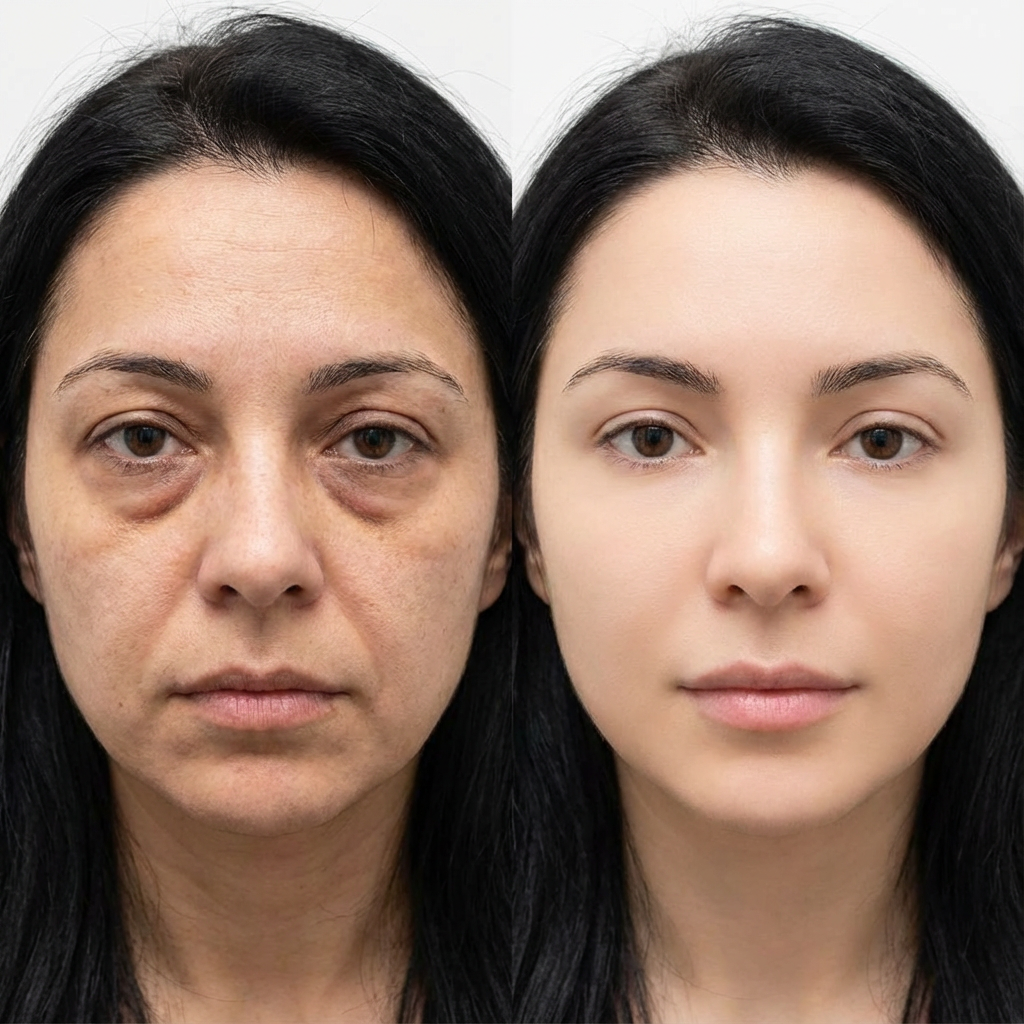
I paid $950 for tear trough filler. Dr. Chen's office. Upper East Side. March 2023. I remember sitting in that chair, signing the consent forms, trying not to think about the cost. $950 for one syringe. One appointment. 30 minutes. But I was desperate. I'd tried everything else. Nine different eye creams over three years. Jade rollers. Caffeine patches. Prescription tretinoin that made my under-eyes peel for six weeks. Nothing worked. My under-eyes made me look exhausted. Hollow. Ten years older than I was. So I paid $950. And I let someone inject hyaluronic acid under my eyes with a needle. And you know what? It was amazing. For six months, my under-eyes looked incredible. Plump. Smooth. Like I'd slept for 12 hours straight every night. People noticed. "You look so refreshed!" "Did you go on vacation?" "What are you doing differently?" I felt like myself again. Like the 38-year-old I was, not the 48-year-old I looked like in the mirror. For six months. --- ## Then it started to fade. September 2023. Six months post-injection. I was putting on makeup one morning and I noticed it. That hollow look was coming back. The darkness under my left eye was more visible. The bags were starting to return. I texted my injector. "Hey, I think it's fading already. Is that normal?" "Yes! Hyaluronic acid typically lasts 6-12 months in the under-eye area. We can get you back on the schedule for a touch-up!" A touch-up. Another $950. I stared at that text for a long time. I'd known filler was temporary. She'd told me that upfront. But somehow I'd convinced myself mine would last longer. That maybe I'd be one of the lucky ones who got 18 months, 2 years. But six months? I did the math. $950 every six months. $1,900 per year. For the rest of my life. If I live to 75, that's 37 more years. $70,300. Seventy thousand, three hundred dollars on filler. Just to maintain my under-eyes. I felt sick. But what choice did I have? I booked the appointment. --- ## October 2023. Appointment #2. $950. Same office. Same injector. Same consent forms. "You're doing great!" she said, tilting my face under the bright light. "We'll just refresh what we did last time." Another 30 minutes. Another needle. Another $950 charged to my credit card. And again—it looked great. For a while. But this time, something else started to happen. --- ## April 2024. Five months after injection #2. I was in my bathroom getting ready for work. Natural light from the window. No makeup yet. I was examining my under-eyes—a habit I'd developed ever since this whole thing started—and I saw something. A small bump. Under my right eye. About the size of a grain of rice. I touched it. It was hard. Like a tiny nodule under the skin. My stomach dropped. I immediately Googled: "hard lump under eye after filler" The results made me want to throw up. "Filler migration." "Nodule formation." "Sometimes filler doesn't stay where it's injected and can migrate to surrounding tissue, creating lumps or bumps." I spent the next two hours looking at photos on Reddit and RealSelf. Women with visible lumps under their eyes. Lumps that had been there for months. Years. Some had to get them dissolved. Some couldn't get them dissolved and just... lived with them. I texted my injector. "I have a small hard bump under my right eye. Is this normal?" "It's probably just some product settling. Come in and I'll take a look. We can massage it or dissolve it if needed." Dissolve it. She said it so casually. Like it was no big deal. But to me, it was terrifying. I had injected something into my face that might have migrated. That might need to be dissolved. That might leave me worse than when I started. I went in the next week. She massaged it. Said it should settle. It did, mostly. But I could still feel it if I pressed on the area. A tiny hardness that hadn't been there before. And I kept thinking: This is supposed to be the easy option? --- ## That's when I started questioning everything. I'd spent $1,900 on two filler appointments. Plus the $847 I'd spent on eye creams before that. $2,747 total over three years. And now I had a lump. And the filler was already starting to fade again. I was looking at my third appointment in a few months. Another $950. And then six months after that. And six months after that. Forever. I started researching alternatives. "Permanent filler for under eyes"—turns out that's a terrible idea. High complication rates. Not recommended. "Under eye surgery"—blepharoplasty. $4,000-$7,000. Scary. Permanent. Risk of looking worse. "Non-surgical under-eye treatments"—all the creams I'd already tried and wasted money on. Everything led back to the same conclusion: If I wanted my under-eyes to look good, I needed to keep getting filler. Forever. $1,900 per year. Minimum. Unless something went wrong—migration, Tyndall effect (that blue shadow some people get), or worse. I felt trapped. --- ## May 2024. Appointment #3. I didn't want to go. But I also didn't want to look exhausted again. Didn't want to go back to the hollow, aged look I'd had before. So I went. Different injector this time. Dr. Chen had moved practices and I didn't want to follow her to New Jersey, so I found someone new. Dr. Martinez. Midtown. Highly reviewed. $950. Same price. She was more conservative than Dr. Chen. Said she didn't want to "overfill." The results were... fine. Good, even. But I kept thinking about that $950 charge on my card. And the fact that I'd be back here in six months. And the fact that I now had a standing appointment. Like I was on a subscription plan for keeping my face from looking tired. --- ## June 2024. 2:34 AM. I couldn't sleep. I was lying in bed, staring at the ceiling, thinking about my next appointment. It was already on my calendar. November 2024. Six months out. I'd be paying $950 again. And then again in May 2025. And then again. And again. I picked up my phone. Typed into Google: "Alternatives to under-eye filler that actually last" I'd done this search before. Many times. Always found the same results. Filler or surgery. Those were the options. But this time, something different came up. A medical journal article from Seoul National University. I clicked it because I was desperate and couldn't sleep anyway. "Polydeoxyribonucleotide-induced regeneration of periorbital tissue: A non-invasive approach to structural rejuvenation" I had to Google most of those words. But here's what I understood: Under-eye bags and hollowing aren't just about lost volume. They're about structural collapse at the cellular level. The skin under your eyes has cells called fibroblasts. These cells produce collagen and elastin—the proteins that keep your skin firm and supported. But over time, these cells get damaged. At the DNA level. From years of: - Blinking (15,000+ times per day, every day) - UV exposure (all those years without sunscreen) - Blue light from screens - Chronic stress - Environmental damage - Aging All of that creates thousands of tiny injuries to the DNA inside the fibroblast cells under your eyes. And once that DNA damage reaches a certain threshold, those cells stop functioning properly. They can only produce about 18-24% of normal collagen output. So the structural support under your eyes collapses. You get hollowing. Bags. That sunken, aged look. And here's the part that made me sit up in bed: Filler doesn't fix that. Filler just adds volume on top of a broken foundation. It's like propping up a collapsing building with temporary scaffolding. It looks fine from the outside. But the foundation is still crumbling. That's why it fades. That's why you have to keep going back. Because you're not fixing the problem. You're just covering it up. Temporarily. --- ## I kept reading. The study tested what happened when they tried to stimulate collagen production in these damaged cells using peptides and growth factors—the expensive stuff in $300 eye creams. Collagen production increased by 3-7%. Three to seven percent. The cells were too damaged to respond. That's why my nine eye creams didn't work. That's why the $340 La Mer did nothing. The cells couldn't use them. And filler? Filler doesn't even try to fix the cells. It just adds volume artificially. But the study mentioned something that could actually repair the cellular damage. PDRN. Polydeoxyribonucleotide. DNA fragments extracted from salmon. I know. It sounds insane. But apparently it's been used in medical settings for decades. Wound healing. Diabetic ulcers. Post-surgical tissue repair. Sports injuries. It works because these DNA fragments can trigger cellular repair at the genetic level. When PDRN molecules contact damaged cells, they bind to receptors and send a "repair signal" to the cell's nucleus. The cell starts fixing its own DNA. And once the DNA is repaired, the cell can produce collagen again. Normally. The study showed that PDRN could: - Activate DNA synthesis in damaged fibroblasts - Increase cellular energy by up to 60% - Restore normal collagen production - Rebuild structural support from within In other words: It could repair the foundation. Not just prop it up temporarily with filler. Actually repair it. So the structure could support itself again. --- ## I found a 2020 study. 212 participants. Ages 38-56. They tested topical PDRN through hydrogel patches. Results after 8 weeks: 89% showed measurable improvement in under-eye structure 76% saw reduction in hollowing and bags **68% who were scheduled for filler cancelled their appointments** 91% maintained improvement for months after stopping Sixty-eight percent cancelled their filler appointments. People like me. People who were on the filler treadmill. People who'd found something that actually worked. I started searching immediately. Found mostly Korean brands with PDRN buried way down in the ingredients list. Then I found patches with clinical-grade PDRN concentration—500+ ppm (versus 50-100 in most other brands). The hydrogel created an occlusive seal to force penetration to the dermal layer where damaged fibroblasts live. The patches turned from pink to translucent as PDRN absorbed—you could actually watch it penetrate. Reviews: "I was three months from my next filler appointment when I found these. After 6 weeks, I cancelled." "I've spent $3,200 on filler over two years. This is the first thing that's given me results without needles." "My injector asked what I was using because my under-eyes looked 'more natural' than with filler." $29 for 8 pairs. I'd just paid $950 for filler that would fade in six months. If these didn't work, I was out $29. If they did work, I could potentially stop the $1,900/year cycle. I clicked buy at 3:18 AM. --- ## They arrived five days later. I used them that morning. Instructions: Apply to clean, dry under-eye area. Leave on for 20-30 minutes until patch turns from pink to translucent. I applied them at 7:45 AM. They felt different from other patches I'd tried. Thicker. More of a seal against the skin. I watched them slowly fade from bright pink to almost clear while I had coffee and checked emails. Took about 27 minutes. When I peeled them off and looked in the mirror, I was surprised. My under-eyes looked... better? Not "filled" the way filler makes them look. But firmer. Like there was structure underneath. The hollowing looked less pronounced. The bags looked smaller. I told myself: This is temporary. Like caffeine patches. It'll fade. But eight hours later, it still looked better. I used them again three days later. Then two days after that. --- ## Week two. Something strange was happening. Even on days I didn't use the patches, my under-eyes looked better than before I started. Not just "better than yesterday." Better than two weeks ago. Better than a month ago. The area looked... lifted. From within. Not plumped artificially like filler. Lifted. Like there was actual structure supporting it again. I pulled up that medical journal article and re-read it. "Sustained collagen synthesis observed for 48-72 hours post-treatment" "Cumulative regenerative effects with repeated application" "Improved baseline cellular function maintained between treatments" Oh. This wasn't like filler that just sat there and faded. This was actually repairing my cells. And once repaired, those cells could produce collagen on their own—even on days I didn't use the patches. The effects were building on themselves. My cells were healing. --- ## Week four. I had a standing filler appointment scheduled for November. Six months after appointment #3. It was marked on my calendar. I'd already gotten the reminder text. I looked at my under-eyes in the mirror. They looked better than they had with filler. Not "more filled." Better. The structure looked natural. The lift was coming from underneath, not sitting on top. There was no lump. No hardness. No worry about migration or Tyndall effect. Just... my face. Looking the way it used to look. Before everything started collapsing. I texted my injector. "I need to cancel my November appointment." "No problem! Would you like to reschedule?" "No. I don't think I need it anymore." There was a long pause. Then: "What are you using?" I told her about PDRN patches. "I've heard of PDRN injections but never patches. Send me the link?" I did. --- ## Week eight. My best friend Sarah got filler last week. Same injector I used to go to. We met for lunch today and she kept staring at my face. "Okay, when did you get it done?" "Get what done?" "Filler. You look amazing. Did you go to someone new?" I smiled. "I stopped getting filler three months ago." Her jaw dropped. "What? No way. Your under-eyes look better than mine and I literally got it done last week." "PDRN patches." "What's PDRN?" I explained the whole thing. The DNA damage. The cellular repair. How filler just covers up the problem but PDRN fixes the foundation. She was writing it down on her phone. "How much?" "$29 for a month's supply." "Are you kidding? I just paid $950." "I know. I did too. Three times." --- ## It's been four months now. I haven't gotten filler since May. My under-eyes look better than they did in any of my post-filler photos. Not because they're more "filled." Because the structure has rebuilt itself. The cells are working again. Producing collagen. Supporting the area from within. I don't have lumps. I don't have Tyndall effect. I don't have that overfilled look some people get. I just look like myself. The way I looked before my under-eyes collapsed. Before I started this whole journey. Let me do the math one more time: **Filler:** - $950 per appointment - Every 6 months - $1,900 per year - For the rest of my life - If I live to 75: $70,300 **PDRN Patches:** - $29 for 8 pairs (one month supply) - Used 2-3 times per week after initial 8 weeks - Maybe $87 every 3-4 months for maintenance - Per year: ~$260 - Over lifetime: ~$9,620 **Savings: $60,680.** But honestly, it's not even about the money. It's about not being trapped. Not having standing appointments every six months for the rest of my life. Not worrying about migration or complications. Not wondering if this injection will be the one that goes wrong. Not paying $950 every six months to maintain something that's artificially propping up a broken foundation. --- ## I'm not saying filler is bad. It worked. It really did. For six months at a time, my under-eyes looked great. But it was a temporary solution to a permanent problem. I was covering up structural collapse with artificial volume. And I would have had to keep doing it forever. PDRN doesn't cover up the problem. It repairs the foundation. It tells your damaged cells to fix themselves. To start producing collagen again. So the structure can support itself again. Naturally. And that lasts. Not six months. Not twelve months. It lasts because your cells are functioning again. --- ## If you're on the filler treadmill— If you've gotten tear trough filler once, twice, three times— If you're looking at your calendar and seeing your next appointment and feeling that sick feeling of "$950 again"— If you've done the math and realized you'll be paying $1,900 a year for the rest of your life— If you've had lumps, or Tyndall effect, or migration scares— If you're just tired of being trapped in the cycle— I'm not telling you to cancel your next appointment. I'm just telling you what I found. I found that the reason filler keeps fading isn't because filler is bad. It's because the underlying foundation is still broken. And I found something that repairs the foundation. So the structure can support itself again. I spent $2,850 on three filler appointments over 18 months. I spent $29 to try PDRN patches. Four months later, I haven't been back for filler. And my under-eyes look better than they did with it. --- ## Here's what I wish someone had told me before I paid $950 for my first syringe: Filler is a temporary solution. You'll be paying for it forever. But under-eye bags are caused by cellular damage that prevents your skin from supporting itself. If you repair the cells, you repair the foundation. And then you don't need the temporary props anymore. That's what PDRN does. It repairs the damaged fibroblast cells that are supposed to be producing collagen and supporting your under-eye area. Once those cells are repaired, they work again. And the structure rebuilds itself. From within. Not artificially. Not temporarily. For real. --- ## 30-day money-back guarantee. $29 for 8 pairs. After spending $2,850 on filler that faded, $29 to try something that might actually fix the problem feels like nothing. If it doesn't work, you get your money back. If it does work—if your cells repair and start functioning again—you might finally escape the filler cycle. That's what happened for me. I just wish I'd found this before I spent $2,850 and 18 months going back to that chair every six months. Worth trying if you're tired of being trapped.
I paid $950 for tear trough filler. It lasted 6 months. Then I had to pay again."
clarae.com
LEARN MORELike this ad? Make it yours.
Crush rebuilds this exact creative around your product — your brand, your colors, your offer — in about a minute.