Robert Callahan
Robert Callahan Facebook ad: “The neck hump fix practitioners don't know about”
Ran for 78 days, from June 25 to September 11, 2026, the last day Crush saw it.
Run by Robert Callahan on Facebook. Crush is not the advertiser and does not verify its claims. See this ad in Meta's Ad Library(opens in a new tab)
Want an ad like this for your product?
Crush makes new ad images for your product from this ad: your logo, your product photo, your offer.
Trials from $19.95 USD, then $79.95 USD a month. Cancel anytime.
About this ad
- Meta Ad Library ID
- 1511084374387953
- Platforms
- Facebook, Instagram, Audience Network, Messenger and Threads
- Relaunches
- 0
Ad text
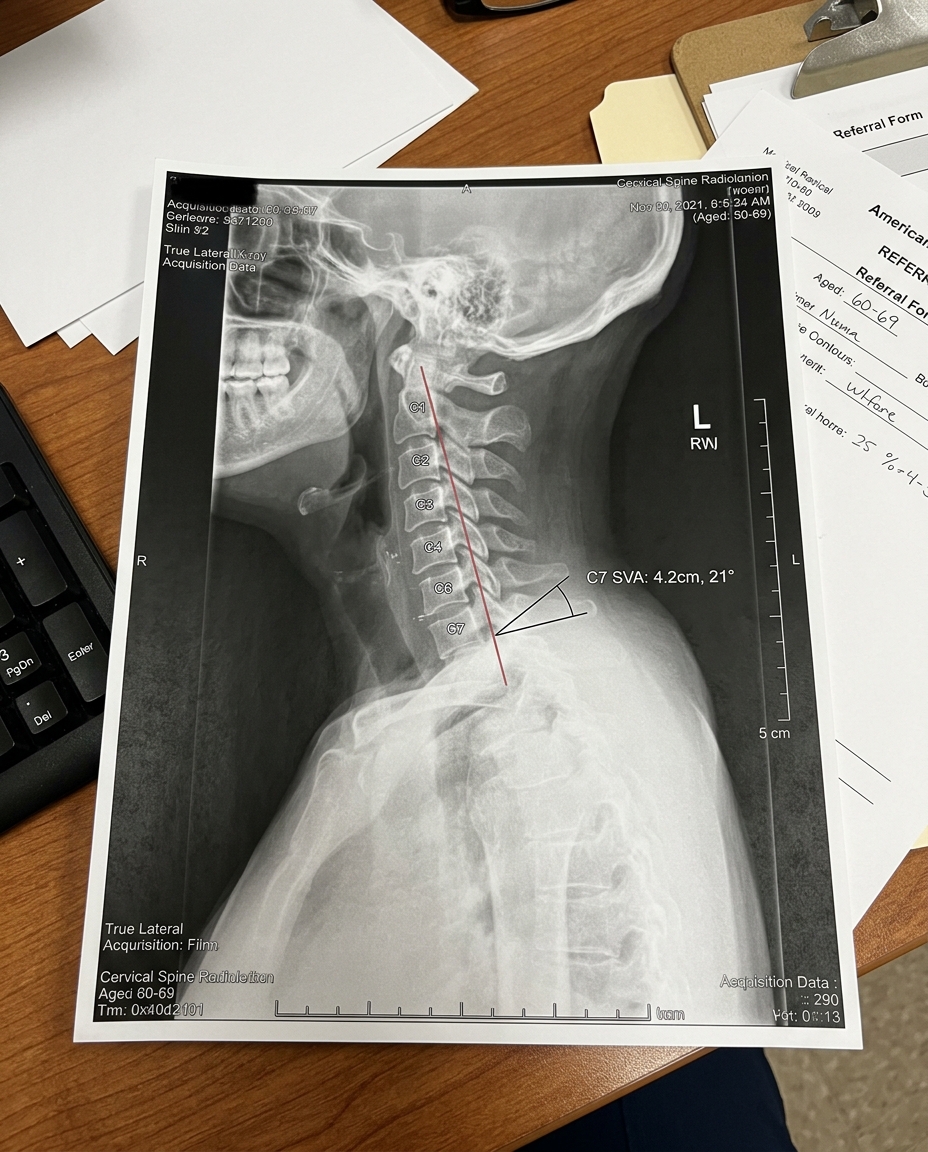
If your wife's neck hump keeps growing no matter what she tries, if her posture keeps getting worse and her specialist keeps saying the same useless thing — just keep doing your exercises and we'll monitor it — then I need you to read this. Because I'm about to tell you what they are not telling her, and why they will probably never tell you the real answer. And by the time you finish this, you're going to be furious. Because there are three things happening right now. One. Her neck is telling you that something is seriously wrong. Two. The whole system is quietly making both of you believe this is just her posture, or her age, or something she has to accept. It isn't. Three. The thing that actually turned it around for my wife is simple, it can't be patented, and there's no profit in it, so almost nobody ever hears about it. Let me tell you what happened with my wife, because once you hear her story you're going to see how broken this really is. For almost three years, I watched my wife disappear in front of me. Her head had shifted 3.2 centimeters forward from where it should sit. The specialist showed us on the scan. The tissue at the base of her neck had thickened visibly. At her last appointment the word "irreversible" got used out loud in that room. She is sixty-three years old. The brace was the part you could see. She wore it religiously, the way they told her to. And the moment she took it off, her head drifted forward again. Every time. She stopped wearing open collars. She started pulling her hair down over her neck in photos. She'd turn sideways in pictures and then find a reason to step out of frame entirely. The withdrawal was worse. She'd decline invitations she would have accepted without a second thought two years before. Family dinners she used to host. Church socials she used to stay at until the last person left. She stopped suggesting day trips. She stopped sitting at the center of any room. Every afternoon there was this version of her that just wasn't fully there anymore. There was a self-consciousness she carried that never fully went away. Some days I'd watch her adjust her collar before she walked into a room. Other days she'd just stay in the car. Her shoulders drew in. Her world got smaller. And the fog — not a mental fog, but a social one. She started declining things before she was even asked, as if she already knew the answer. She'd say she wasn't feeling up to it. She'd find a reason to stay home. I was watching the woman I married quietly disappear from her own life one Sunday at a time. And the part that still makes me angry. She did everything right for three years. Every instruction. Every exercise. Every product they pointed her to. And every six months the specialist looked at the same scan and said the same thing. So of course she saw doctors. Plenty of them. Her GP, a physiotherapist, even a posture specialist. Hundreds of dollars in appointments and assessments. And you know what every single one of them said? "Keep doing your exercises." "Wear the brace consistently." "Try a posture corrector." "Here, use this foam roller." "We can start her on a stretching protocol to manage things." Manage things. Her neck is measurably collapsing forward and they want to manage her stretching routine while the actual problem keeps getting worse. And here's where it really got to me. They gave her a posture brace. The thing every physiotherapist and every posture website on earth tells you to try. She wore it every day, for eight straight months. Next assessment? Her forward head displacement had increased. Not decreased. Increased. Then they told her to try a posture pillow. Align the spine during sleep. She used it for three months. No change. Her neck was the same in the morning as it had been the night before. Then she did the full exercise protocol. Every morning, without fail, for six months. The hump stayed. The forward head position got worse. And the next scan showed it had progressed anyway. She was getting worse while doing everything they told her to do. At that point I wasn't scared anymore. I was angry. Because I was watching my wife follow every instruction, spend hundreds of dollars, wear their braces, do their exercises, and get worse every six months while her specialists shrugged and talked about monitoring her decline. Monitoring. The. Decline. Not fixing it. Not reversing it. Not even trying to figure out why. Just measuring how fast her posture fell apart. And that's when I started asking the questions nobody wanted to answer. Why are they so quick to hand out braces and pillows that hold the position temporarily but never touch what's actually causing the hump? Why do they treat the forward head drift like it's just inevitable? Why does every posture product on the shelf work on the same passive principle that did absolutely nothing for her? And why did not one single specialist ever explain what the neck actually needs to hold itself? So I went down a rabbit hole. A deep one. I stopped reading wellness blogs and started reading actual research. And I kept hitting one phrase I had never once heard anyone connect to a neck hump in my life. Neuromuscular inhibition. Now stop for a second, because this is the part that made me put the phone down. Every posture product out there is about what you put on the neck, or what position you hold it in. Brace it. Stretch it. Align it. But almost nobody talks about the one thing the deep cervical muscles actually need to hold the head in position. And it isn't a brace. It's a signal. Here's what I learned. Your neck depends on a continuous brain-muscle signal to keep the deep cervical muscles active. It's what holds your head where it belongs. When that signal is strong, the muscles do their job, the head stays back, the tissue doesn't pile up at the base of the neck. But that signal weakens under chronic overload. And it weakens a lot faster after years of screen time, desk posture, and the kind of low-grade forward pull that accumulates across a lifetime. So you end up with a neck full of muscles that have been waiting for a signal that stopped arriving years ago. And once that happens, it stops mattering what you put on or take off. The head has nowhere to go but forward. The tissue builds because there's nothing holding it back. And the hump forms. That was the thickening showing up on my wife's scans, getting worse every six months. She had been wearing braces and doing exercises around a neck that had lost the one thing it needed to actually hold itself. Like strapping a support beam onto a wall whose foundation has crumbled. The beam holds it for a moment. The moment you take it off, the wall moves again. Nothing is fixed. Nothing holds. Nothing heals. And here's the part that made my blood boil. This isn't hidden science. Neuromuscular inhibition as the mechanism behind cervical posture collapse is established, basic physiology. Any specialist can look it up. But nobody builds a treatment around it. Why? Because you can't patent a signal. There's no expensive device to sell her for passive wear. There's no sales rep walking into a physiotherapy practice to talk about reactivating the motor pathway, and no ad budget pushing it. There's no money in telling someone how to help their neck rebuild its own holding capacity. There IS money in braces every few months. Pillows. Posture correctors. Exercise programs that have to be renewed. Six-month monitoring appointments where they look at the same scan and nod. And eventually, the conversation about surgical options. Monitor every single stage of the decline. Never touch the thing that would actually let the neck hold itself again. So I kept digging. And I found out there's a way to bypass the broken signal entirely. And this is the one that stopped me cold. It's the exact principle physical rehabilitation units use when a muscle has lost its motor signal after injury or neurological disruption. They don't stretch the muscle. They don't brace it. They send an electrical impulse directly to it — bypassing the broken pathway — and force it to reactivate. That is not marketing. That is what serious rehabilitation reaches for when it has to restore a signal fast. It's called EMS. Electrical Muscle Stimulation. And you can't restore the signal by wearing a brace, by the way, because passive support never asks the muscle to fire. EMS is the way in. It reaches the muscle directly, makes it contract, and over time retrains the brain-muscle connection that overload had switched off. My wife finally found a device that actually understood this. And the principle it was built on told her almost word for word what I'd been reading for weeks. "Her neck isn't collapsing because of her posture habits. The signal that holds it has been switched off. We have to give that back, and we have to get it to the muscle directly." For the first time in three years, somebody had actually explained what was wrong. Not wear this. Not do these exercises. An actual reason. But then came the problem. Because here's the catch nobody tells you about EMS for the neck. Most devices aren't calibrated for cervical neuromuscular inhibition. The generic devices you find online use a single program, one intensity, designed for muscle soreness after exercise — not for restoring a motor signal that's been degrading for years. My wife tried one early on. Did nothing except feel uncomfortable, and she almost wrote the whole thing off as another dead end. She spent weeks trying to find one that was actually designed for this. That had programs calibrated for different stages of inhibition. That was actually tested. That wasn't just a cheap TENS unit in different packaging. And then one evening I'm reading on my phone, researching because her next assessment was coming, and I came across the Cevera Pulse. So I go to the site fully expecting to be disappointed, the way I had been with every other posture device I'd looked at. And it was the first one that got everything right. Eight programs calibrated for different stages of neuromuscular inhibition — not a single generic pulse, but a full protocol designed around where the signal has broken down. Nineteen intensity levels. Bilateral cervical delivery. Clinical-grade parameters, third-party tested. And the mechanism was described in plain language for the first time anywhere I had found. She started using it. Fifteen minutes a day, before bed. After about two weeks, the self-consciousness started to ease. She came to dinner without adjusting her collar at the door. After three weeks, the withdrawal started lifting. She suggested a day trip for the first time in over a year. She sat at the center of the table. After about six weeks, her forward head position had shifted back measurably. Her next assessment showed 1.8 centimeters of correction — more than half of the displacement, reversed. And after eight weeks, her specialist called. She looked at the scan and said she wanted to know exactly what my wife had been doing differently. My wife told her about the Cevera Pulse. The specialist looked at the imaging. She said she wanted to see her again in three months. My wife squeezed my hand in the parking lot and we both stood there for a moment without saying anything. Because when someone tells you for three years that decline is the only direction — and then the scan shows something different — you need a second. She's been using it for eight months now. Her forward head position has stayed corrected for five straight months. The scan is stable and improving. The self-consciousness is gone. The withdrawal is gone. She's in the photos. She's at the center of the room. She hosted Sunday dinner last month for the first time in two years. She looked at me last weekend and said: "Three years I thought my body was just changing permanently. I thought this was what sixty-three felt like. I wasn't declining. My neck had just lost the signal it needed. And not one person ever told me I could give it back." This is the part they don't make easy to find. Because the moment a neck gets the signal it needs and starts holding again, the whole system stops. The monitoring appointments. The braces that need replacing. The exercise programs that never quite work. The slow, managed decline. A neck is built to hold itself. It just can't do it without the signal. Now here's what I need you to understand. A neck hump does not wait for you to figure this out. Every month it sits there without the signal it needs is another month of forward drift and tissue buildup. Mild becomes moderate. Moderate becomes visible to everyone in the room. And most women with a developing neck hump have no idea how far it's gone until someone says something they can't unhear. So if your wife is dealing with any of this — the hump that keeps growing no matter what she tries, the specialist who keeps monitoring and never fixing, the braces that work only while she's wearing them, the posture that gets worse every six months despite everything — this is the time. Not next month when the assessment comes back worse. Not in six months when the scan shows it's progressed. Right now. I'll put the link below. And honestly, even if you're skeptical — especially if you're skeptical — get her one and try it for a month. See if her neck responds the way my wife's did. Because nobody else is coming to fix this for her. The appointments are going to keep being keep doing your exercises and we'll monitor it. You have to be the one to do something. 👉 https://trycevera.com/pages/adv2-womens-wellness-report Right now Cevera is running a BOGO deal — 2 for $69.95 — which is two full months, and two months is right about the window where we saw the real difference. It's backed by a 90-day money-back guarantee too. If her posture and her presence don't change, you send it back and you're out nothing.
Where the ad sends people
trycevera.com
The neck hump fix practitioners don't know about
Cevera
Learn more: trycevera.com(opens in a new tab)