Tom Ashby
Tom Ashby Facebook ad: “Both numbers on every dimension”
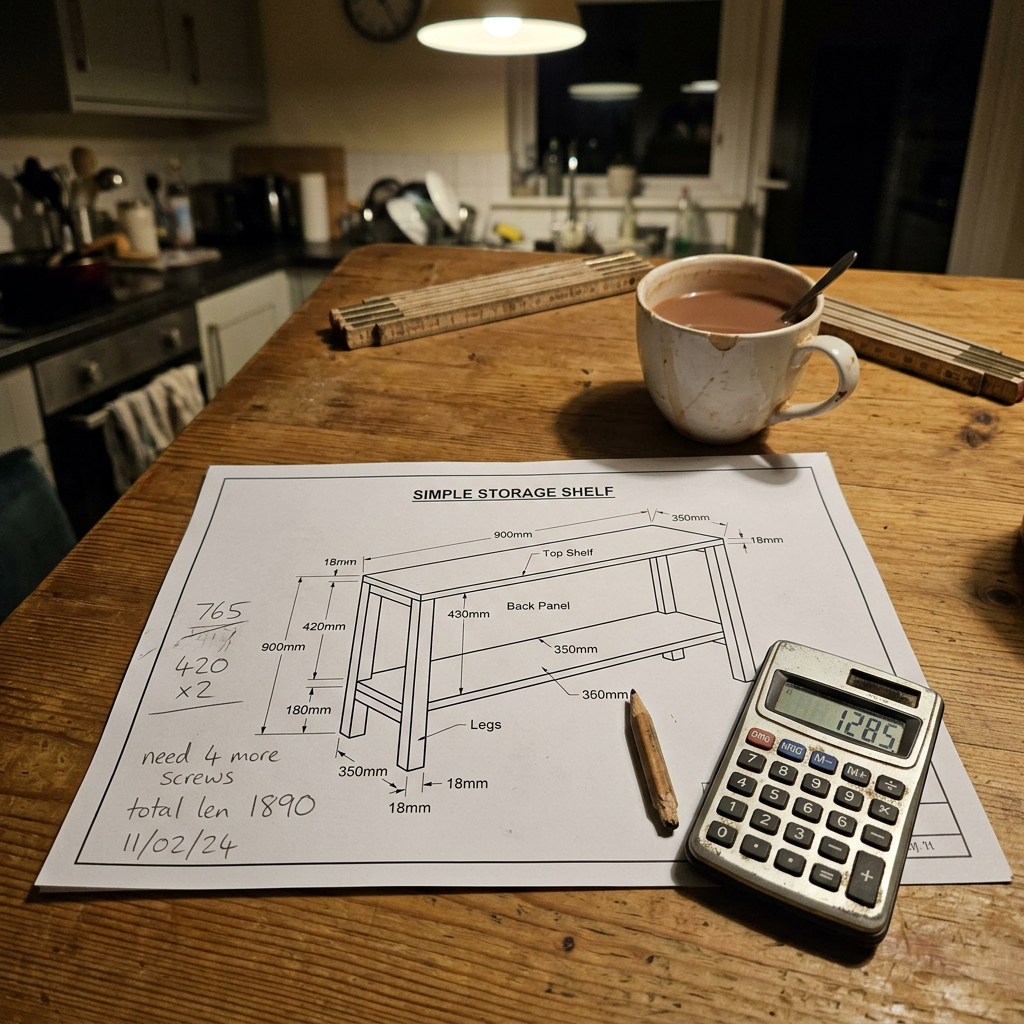
Ran for 3 days, from July 26 to July 28, 2026, the last day Crush saw it.
Run by Tom Ashby on Facebook. Crush is not the advertiser and does not verify its claims. See this ad in Meta's Ad Library(opens in a new tab)
Want an ad like this for your product?
Crush makes new ad images for your product from this ad: your logo, your product photo, your offer.
Trials from $19.95 USD, then $79.95 USD a month. Cancel anytime.
About this ad
- Meta Ad Library ID
- 1520397159240592
- Platforms
- Facebook, Instagram, Audience Network, Messenger and Threads
- Relaunches
- 0
- EU reach
- 122
Ad text
To anyone who has opened a set of plans and found only inches on every line. You were not being fussy. A 2x4 is not a 50x100, and that gap costs wood. I sell woodworking plans. What follows is not good for my business, and I thought about whether to write it at all. For about two years I sold the same files to someone in Ohio and someone in Lyon and I never once thought about the difference between them. The orders came in. The files went out. As far as I could see it was working. Then I started reading my own inbox properly. They were not angry emails. That is the part that stayed with me. A man in Belgium wrote three lines saying he had downloaded everything and could not find a single measurement in centimetres or millimetres anywhere, only American ones, and that surely this could not be the intention. Another man, in England, asked me a question before he bought anything at all. He wanted to know whether the plans accounted for the timber sizes he could actually walk in and buy. He asked first. Somebody had let him down often enough that he had learned to ask in advance. If you build anywhere in Europe you already know how that evening goes. You buy the plans. You open the one project you actually want to make. Everything is in inches, half of it in fractions of inches, and the timber is called things like 2x4 and 1x6 and 4x4. So you get the calculator out. You are not annoyed yet. You multiply by 25.4 and write the numbers in the margin, and by the fourth part you have started rounding because the decimals are ridiculous, and by the tenth part you have lost track of which rounded number belongs to which piece. Then you take your list to the yard. And the sections you have written down are not sections anybody actually sells. So you take the nearest thing. It is four millimetres off. You tell yourself four millimetres will not matter. It matters at the joint. It always matters at the joint. So you cut it again, out of the same board, and now the board is short, and the piece you cut for the shelf was the piece you needed for the side. That is the second trip to the yard. And the second trip is the one where you start quietly working out what this project has cost you. I have had customers describe exactly that to me and then apologise for the length of the email. Now, you already know the plans were drawn in America. That much is obvious and I am not going to pretend I am telling you something clever. Here is the part almost nobody explains, and it is the reason careful conversion still fails. A 2x4 is not two inches by four inches. It never was. It is a name, not a measurement. The board goes through the mill rough at roughly that size, then it is dried and planed, and what comes out the other end is about 38 by 89 millimetres. The name stayed. The wood shrank. So when you sit down with the calculator and turn 2x4 into 50 by 100, you are not making a small rounding error. You are converting a word as if it had been a measurement all along. You end up eleven millimetres out on one face and twelve on the other, on every single piece, and your arithmetic was perfect. That is why this keeps happening to people who are genuinely good at this. It is not carelessness and it is not a language problem. The number on the page was never the number of the wood. And no conversion chart will save you, because a chart converts inches. It has no idea the inches were nominal. Most plans in this category are drawn once, in one system, for one lumber standard. Everything between that page and your timber yard is left with you, and it is left with you silently. I went and opened my own files after those emails. Not the samples. The actual project sheets, the way a customer receives them. Every drawing was in inches. Every cut list was in inches. The timber was named the American way from front to back, and there was nothing anywhere that told a man in Poznan or Lyon what to ask for at the counter. I had been handing people an evening of work and calling it a product. Redrawing them took longer than I want to admit. Every sheet meant checking every dimension against the actual planed size, one at a time, and I found things in my own imperial numbers that had been wrong for two years. What I noticed when the first finished sheet came back was not excitement. It was the absence of something. I opened it and did not reach for anything. No calculator, no phone, no scrap of paper down the side of the page. The number was simply there. I had not understood how much of that reflex I had been building into other people's Saturdays. What the plans are now is this. Every dimension carries both numbers on the same line, so nothing has to be calculated and nothing has to be trusted. The cut lists give actual planed sizes rather than nominal names, which means what you write down is what the yard hands you. Where a piece has no direct equivalent in European stock, it says so, and gives the nearest section that is genuinely sold. It is the Master Crafts DIY woodworking set, furniture and garden structures and workshop fixtures. A few people have asked where to find it, so I will say it plainly and then leave it alone. It is not on any of the big platforms. I sell it myself, from my own site, which is the only reason I was able to go back and redraw the whole thing in the first place. The reason I am posting this at all is not really the plans. It is that man in England who asked whether they would work where he lives before he would spend a penny. Somebody taught him to ask that. If you have learned the same habit, I would rather you had a set that does not need the question. The link is below. Type MM below if you have ever stood in a timber yard holding a plan written in inches. If you have been at this a while, you worked out several paragraphs ago that I am selling something. And you have almost certainly read a version of this before, from someone who was not telling the truth. So do not take my word for it. Open whatever plans you already own, the ones you have already paid for. Find one dimension on one drawing. See whether it gives you a number you could say out loud at a timber counter without doing anything to it first. If it does, you do not need me, and I mean that. If it does not, at least now you know why. And you know it was never you.
Where the ad sends people
mastercraftsdiy.com
Both numbers on every dimension
Master Crafts DIY
Learn more: mastercraftsdiy.com(opens in a new tab)