BJF Trading Group
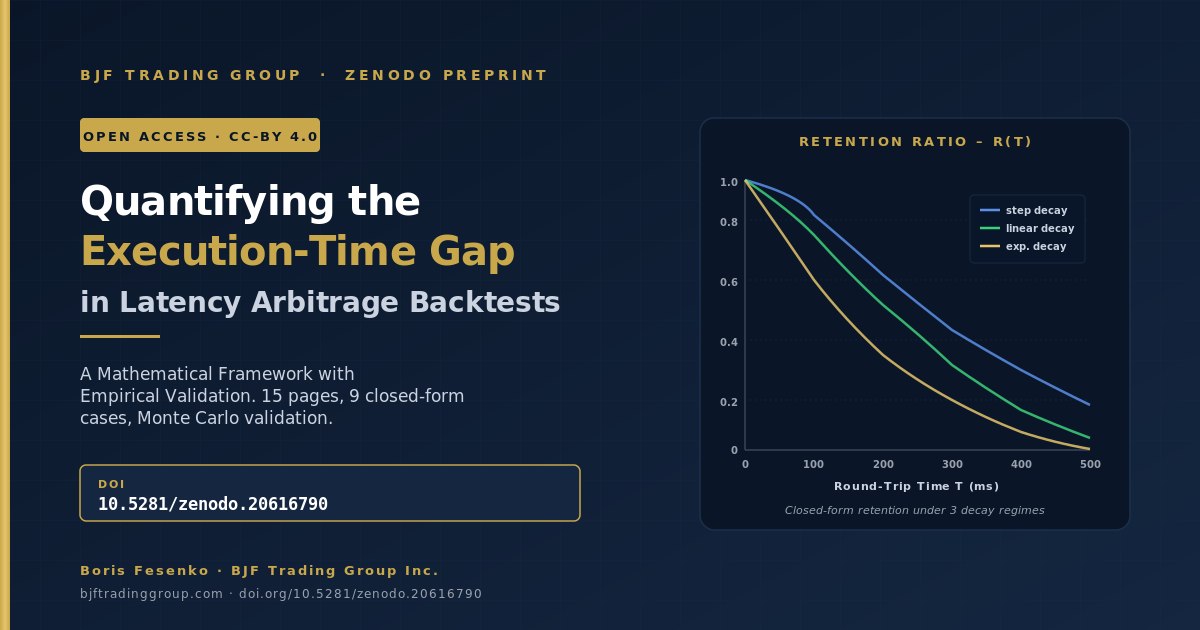
BJF Trading Group Facebook ad: “Quantifying the Execution-Time Gap in Latency Arbitrage…”
Ran for 9 days, from June 12 to June 20, 2026, the last day Crush saw it.
Run by BJF Trading Group on Facebook. Crush is not the advertiser and does not verify its claims. See this ad in Meta's Ad Library(opens in a new tab)
Want an ad like this for your product?
Crush makes new ad images for your product from this ad: your logo, your product photo, your offer.
Trials from $19.95 USD, then $79.95 USD a month. Cancel anytime.
About this ad
- Meta Ad Library ID
- 1530913658443010
- Platforms
- Facebook, Instagram, Audience Network, Messenger and WhatsApp
- Relaunches
- 0
- EU reach
- 3,947
- Niche
- Finance & Trading
Ad text
📄 New open-access academic paper on Zenodo A new academic paper has just been published in open-access form on Zenodo, the CERN-operated research repository. Title: Quantifying the Execution-Time Gap in Latency Arbitrage Backtests: A Mathematical Framework with Empirical Validation Author: Boris Fesenko, BJF Trading Group Inc. DOI: https://doi.org/10.5281/zenodo.20616790 The paper formalizes a question that every algorithmic strategy designer eventually asks, but few backtests address explicitly: how much of the simulated edge survives once production execution latency is taken into account. Three within-window decay regimes (step, linear, exponential) and three opportunity-duration distributions (exponential, uniform, log-normal) are combined into nine analytical cases. For each, a closed-form expression for the retention ratio is derived. The framework is empirically validated against a Monte Carlo simulation calibrated to a published broker-execution dataset, with closed-form predictions matching simulated outcomes to within Monte Carlo statistical error bounds. A worked numerical example from the paper: a backtest edge of 0.7 pips per opportunity, a log-normal window with a median of 94 milliseconds, and a round-trip time of 200 milliseconds under linear decay together yield a production edge of 0.091 pips. Roughly 87 percent of the backtest edge is gone before the trader can capture it. The framework makes this calculation reproducible from measurable broker-level inputs. The paper runs to 15 pages with full proofs in the appendix and an open-access reproducibility supplement (LaTeX source and bibliography file) included on the Zenodo record. Licensed CC-BY 4.0. Read the paper: https://doi.org/10.5281/zenodo.20616790 Companion site page covering the practical broker-execution angle: https://bjftradinggroup.com/latency-arbitrage-backtest-execution-time-gap/
Where the ad sends people
zenodo.org
Quantifying the Execution-Time Gap in Latency Arbitrage Backtests: A Mathematical Framework with Empirical Validation
Latency arbitrage backtests for retail foreign exchange and cryptocurrency markets routinely assume zero-latency order fills, so the simulated edge per opportunity matches the price differential observed at the moment of signal. Production execution introduces a deterministic round-trip time T betwe...
Learn more: doi.org(opens in a new tab)![BJF Trading Group Facebook ad: [:en]Get in Touch with BJF Trading Group[:de]Kontaktiere…](https://ads-analytics.nyc3.digitaloceanspaces.com/ads/images/805143e36a63d990865bc4b83435d486-1786416711858.jpg)