
Inactive· since Jul 5, 2026
- 35
- days it ran
- 1
- relaunches
- 19
- EU reach
Ad copy
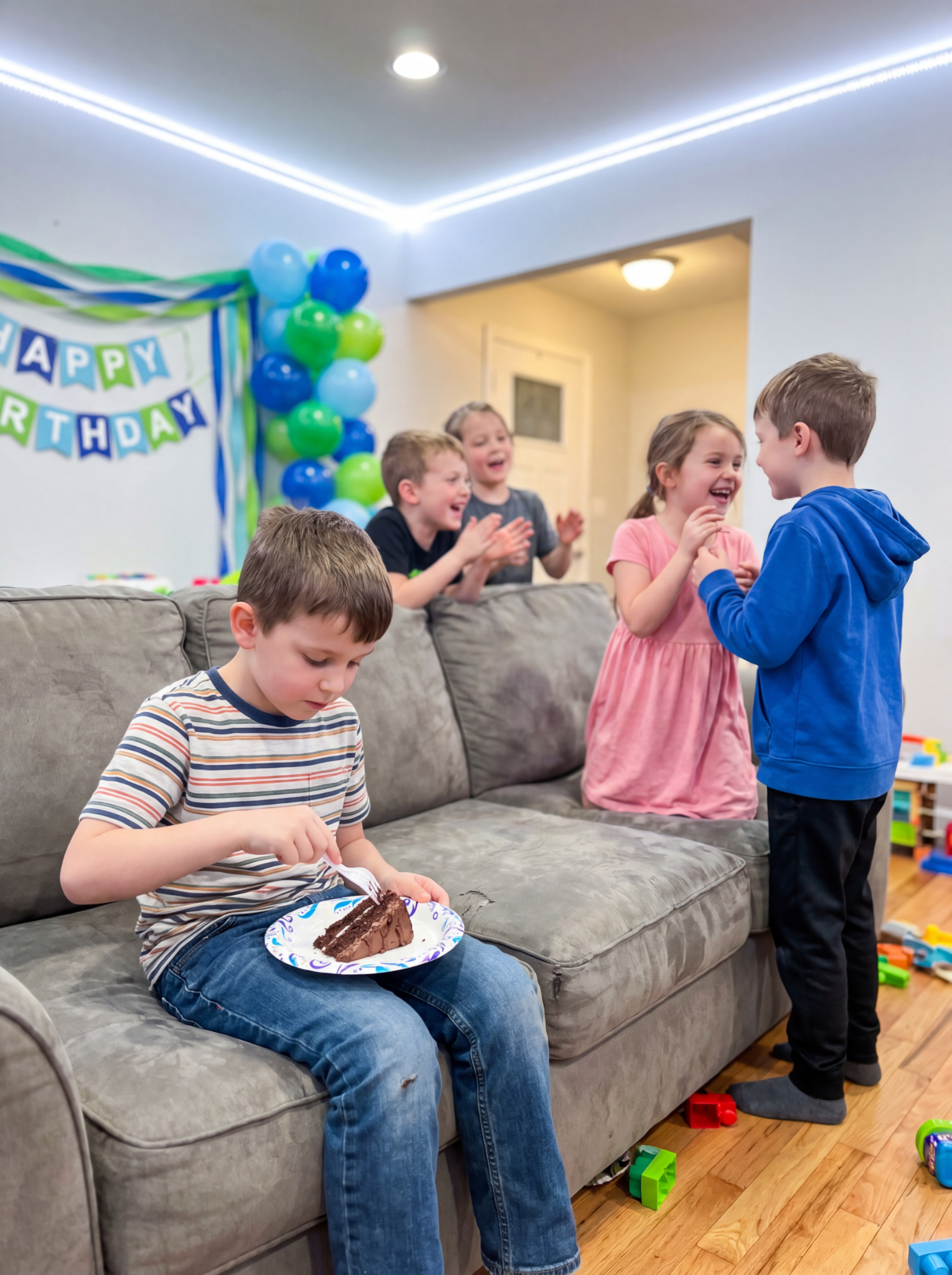
I overheard a mom call my son the bad kid at his own birthday party on Saturday. She was standing by my kitchen sink with two other moms. She did not know I was on the other side of the wall. She said I'm just saying, we have to keep an eye on him. He is the bad kid. He is seven. I stood in my own hallway holding a stack of paper plates and did not move for a long time. His birthday party was happening fifteen feet away in our living room. He was eating his cake on the couch with his cousins. He had been laughing the whole afternoon. He had not done a single thing wrong that I had seen. But he had done one thing earlier in the day. He had hugged her daughter too long when she had arrived. The kind of too long that a seven-year-old does because he is excited a friend showed up. She had pulled her daughter away. Apparently that had been enough. The bad kid. That was the phrase she used. He has ADHD. He has been on Adderall since he was five and a half. He has been in occupational therapy for two years. He has been in social skills group for a year. He has been working with a child psychologist for ten months. He is also funny. He is generous. He gives his sister his last bite of dessert every single night without me asking. He saves the wings off the bug fairies in his class because he thinks butterflies need their friends in the recycling bin. But none of that is what other moms see. What they see is the kid who hugs too hard. The kid who blurts. The kid who cannot stop moving. The kid who corrects them when they explain a game wrong. The kid whose mom is always apologizing on the sidelines. The bad kid. I had been hearing some version of that phrase about my son for four years. I had heard it from his preschool teacher who told me he was a handful. I had heard it from his kindergarten teacher who told me he was struggling with appropriate behavior. I had heard it from the camp counselor who pulled me aside in the carpool line to tell me he had been a lot that day. But I had never heard another mother say it to other mothers about my seven-year-old. I stood in that hallway and almost dropped the paper plates. I have read every book. I have tried every reward chart, every consequence ladder, every visual schedule, every brain break, every gentle parenting script, every authoritative parenting script. I have done the Conscious Discipline class. I have done the Big Little Feelings course. I have done a six-week intensive parenting program with a clinical psychologist that cost me three thousand dollars I did not have. We have his meds dialed in. His pediatrician adjusted them in October and he is on the right dose now. His grades are fine. His teacher actually likes him this year, which is the first year since he started school that I can say that out loud. But none of it has touched the part of him that other moms see. The part where he is too much. The part where he hugs too hard, talks too loud, gets too excited, takes up too much space in a room of seven-year-olds who do not know what to do with him. The medication makes him able to sit at his desk. It does not make him a kid that other moms want their kids to play with. And I had started to make peace with the idea that maybe he was always going to be the bad kid in the room. That maybe the work I was doing was just to make sure he survived being him. Until I got home from his party that night and called my friend Brooke. Brooke has a son the same age as mine. Same ADHD. Same Adderall. Same too-much for years. We had not talked in maybe two months. She had been working on something. She had told me she would call when she figured it out. She called me back at 10pm after I texted her about the kitchen hallway. I told her what the other mom had said. I told her I had stayed up after the party loading the dishwasher trying to figure out if she was right. Brooke was quiet for a second. "I want to tell you something that took me a year to figure out," she said. "My son's brain runs out of serotonin halfway through the day. That is what makes him too much in the afternoon. That is what makes him hug too hard. That is what makes him talk too loud. It is not a personality. It is a chemical that empties before 3pm." I sat down on my kitchen floor. Brooke told me she had spent eight months looking for what was happening to her son before her pediatrician had referred her to a developmental specialist who works specifically with ADHD. The specialist had handed her a printout from a 2019 clinical trial and a folded sheet of paper with three terms on it. Serotonin depletion. Methylated B6 cofactor. Saffron extract. Brooke said she had put the sheet of paper on her fridge and read it every morning for a month before she had ordered anything. Brooke told me an ADHD kid's brain spends every morning burning through serotonin. To sit still in his desk. To wait his turn. To not blurt out the answer. To handle the noise of the cafeteria. To keep his hands to himself in line. To not hug his friend too hard when he sees her. Serotonin is the chemical that keeps a kid emotionally regulated. It is what slows him down before he hugs too hard. It is what holds him together when he wants to interrupt. It is what gives him a half-second pause before he does the thing the other moms notice. His brain burns through it before lunch. By the time he gets to a friend's house at 2pm for a birthday party, the tank is empty. There is no half-second pause. The hug happens too hard. The voice gets too loud. The body takes up too much space. The other moms see it. Their kids feel it. He is not being a bad kid. He is running on fumes by the time anyone is looking at him. I had my hand over my mouth. I asked Brooke what about the medication. "That's the thing," she said. "ADHD medication only adds dopamine. Dopamine is for focus. It does not touch serotonin at all. That is why our kids do better at desks but still get called too much on playgrounds. The medication is doing exactly what the medication was built to do. It just was not built for the part of his brain that runs out before recess." That was why all the work we had done had not changed how other moms saw him. The medication, the OT, the social skills group, the psychologist. They were all working on parts of his brain that the other moms were not watching. The other moms were watching the part of his brain that ran out of serotonin by 11am. Brooke said her specialist had told her what to do about it. "She said the fix was not more therapy. Not more medication. It was giving his brain what it needed to make its own serotonin again." There is one natural ingredient clinically proven to help an ADHD child's brain make more serotonin. Nothing else even comes close. Saffron extract. The specialist had been recommending it in her practice for three years. It was the only supplement she had ever recommended. Because it does one thing and it does it well. It tells the brain to make more serotonin. Brooke said the specialist had walked her through the 2019 trial. They had put one group of kids with ADHD on Ritalin and one on saffron extract for six weeks. Both groups got the same gains in focus and behavior. The saffron group also did better on hyperactivity, which the specialist had called the social piece. The too-loud, the too-hard, the too-much. The part of an ADHD kid the other moms see. The saffron kids had no side effects. No personality loss. They came home themselves. I asked Brooke if she had tried it. "I bought saffron from Amazon a year and a half ago. Two months. Nothing happened. I threw the bottle in the cabinet." She told me the specialist had explained why it had not worked. Saffron only does half the job. It tells the brain to make more serotonin. But the brain cannot actually build serotonin without one specific vitamin that supplies the raw material. The bottle Brooke had tried did not have it. The signal was being sent. The brain still had nothing to build with. I asked which vitamin. "B6. It has to be the methylated form," she said. "Most kids' supplements use a cheaper version the brain cannot absorb. The methylated form is the one the brain actually uses to make serotonin from scratch." The specialist had pointed her to a formula that had both. Clinical-dose saffron and B6 in the methylated form, plus magnesium glycinate, lion's mane, L-theanine, and B12 in the same methylated form. Each ingredient had a job in one simple picture. Saffron sends the signal. B6 builds the serotonin. The others keep the system steady through the day so the tank does not empty at 11am. It was a gummy. Her son took it every morning. The bottle was on her kitchen counter next to the coffee maker. I asked her how long it had taken. "First week he slept through the night for the first time I could remember. By week three he had stopped grabbing his friends. By month two his teacher emailed me to tell me he had been a different kid all month. He still has ADHD. He is just not the kid anyone is whispering about anymore." Brooke sent me the link before we hung up. I sat at my kitchen counter with the link open for a long time. I had been here before. Bottles in the cabinet that I had thrown away. Things I had hoped would help. Things that had not. I had not heard anything that night that I had not already wanted to believe at some point in the last four years. Then I thought about the kitchen hallway. I ordered it. He chewed the first one on a Sunday morning before church. He said it tasted like a real gummy bear. Week one he slept through the night for the first time in months. He did not wake up at 5:30. He did not crawl into our bed. I told myself this was magnesium again. The same thing magnesium had done a year ago before it stopped working. Week two he came home from school and went straight to the kitchen and started his homework at the counter before I even put my keys down. He asked me to help him with one problem. He did not yell about any of the others. Week three I took him to a birthday party. The party was for a kid in his class he had been wanting to invite over for two months. I dropped him off and sat in my car in the parking lot for ten minutes deciding if I was going to stay. When I came back to pick him up, the host mom told me at the door that my son had been so sweet with her daughter. That he had been a really lovely guest. I drove home and cried. Week six his teacher emailed me. She said my son had been chosen as a buddy reader for the kindergartners. She said the kindergarten teacher had specifically requested him because he is so patient with the little ones. I had been waiting four years for an email that said anything close to that sentence. It has been four months. His pediatrician is talking with us about lowering his Adderall dose. We are doing it slowly. We are not stopping anything. We have added one thing. He gets invited to birthday parties now. He had three in the last six weeks. The mom who called him the bad kid in my hallway has not had her daughter over to our house and probably never will. That is okay. He has three other friends now whose moms text me to ask if he can come over on the weekends. He still has hard moments. He is still seven. He is still ADHD. But the moments do not happen in front of other moms anymore. They happen at home, with me, where he is allowed to be tired. If you are reading this and you have an ADHD kid that other moms call too much, I want you to know what nobody told me for four years. It is not a personality. It is not a phase. It is not a discipline problem. It is not anything you did or did not do. His brain runs out of serotonin halfway through the day. The medication does not touch it. The therapy does not reach it. The social skills group does not refill it. You just have to keep the tank full. One gummy. Every morning. Ten seconds. That is what gave his brain enough serotonin to get through a birthday party without anybody pulling their kid away. That is what changed everything for him. P.S. It is called Mood Balance. Clinical-dose saffron, plus B6 in the methylated form, magnesium glycinate, lion's mane, L-theanine, and B12. https://uselumexa.com/pages/saffron-2 P.P.S. He stays on his Adderall. The two work together. His pediatrician was the one who told us we could start tapering once the saffron was doing what the medication used to do alone. P.P.P.S. He chews it every morning with his breakfast. He has not missed a day. He asks for it when I forget. P.P.P.P.S. The mom who called him the bad kid is not invited to his next birthday party. The host mom from his classmate's party is bringing her daughter for a sleepover next month.
"My son is finally calm, focused, and happy. I wish I found this sooner." — Kathy N.
Lumexa
SEE DETAILSLike this ad? Make it yours.
Crush rebuilds this exact creative around your product — your brand, your colors, your offer — in about a minute.