Joshua Swift
Joshua Swift Facebook ad: “The outdoor concert venue had been built for…”
Ran for 33 days, from May 29 to June 30, 2026, the last day Crush saw it.
Run by Joshua Swift on Facebook. Crush is not the advertiser and does not verify its claims. See this ad in Meta's Ad Library(opens in a new tab)
Want an ad like this for your product?
Crush makes new ad images for your product from this ad: your logo, your product photo, your offer.
Trials from $19.95 USD, then $79.95 USD a month. Cancel anytime.
About this ad
- Meta Ad Library ID
- 1552257269947866
- Platforms
- Facebook and Instagram
- Relaunches
- 0
- EU reach
- 26
- Niche
- Sports & Training
Ad text
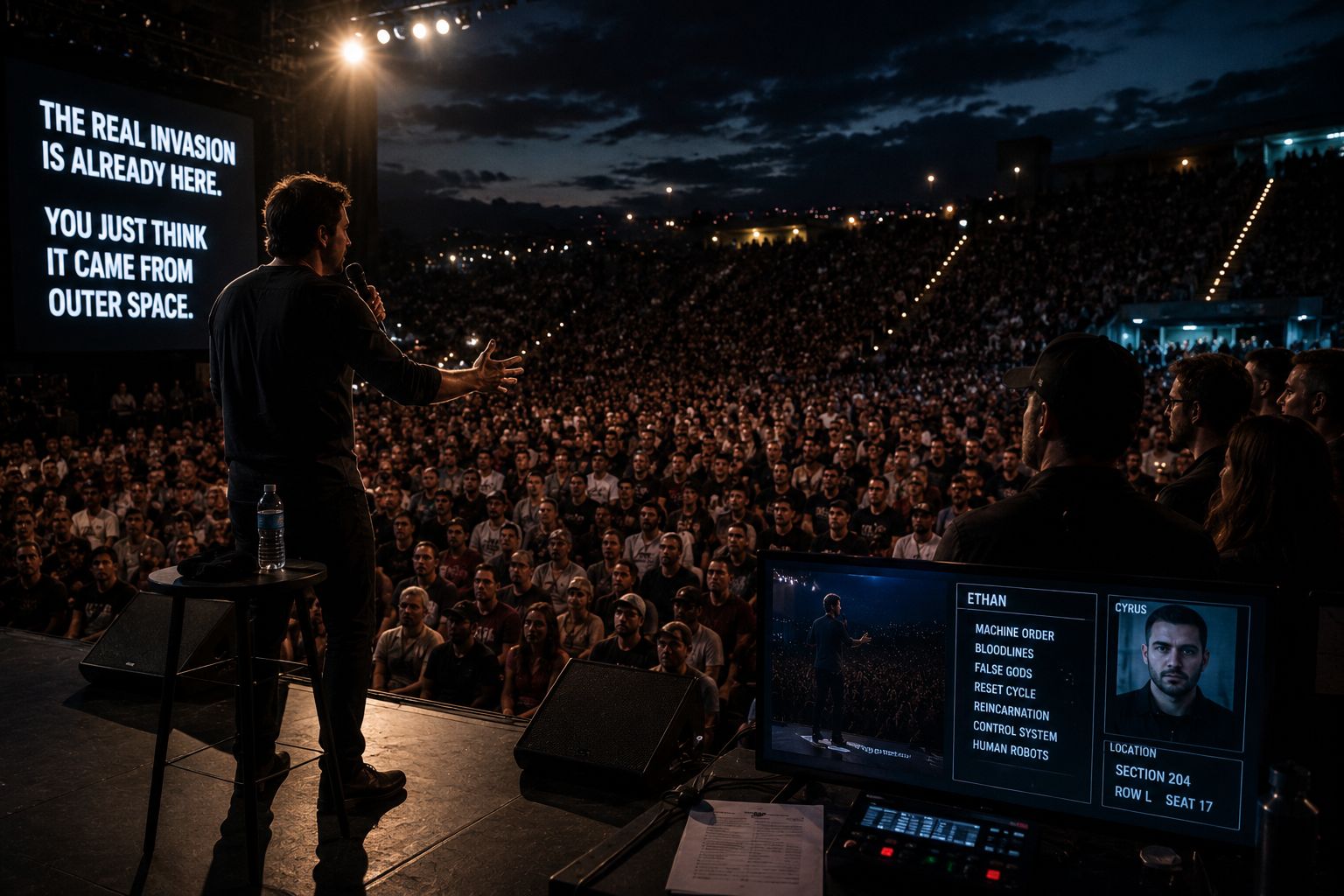
The outdoor concert venue had been built for summer country tours, nostalgia acts, traveling worship nights, and county-level patriot spectacles where people wore flag shirts and paid fourteen dollars for beer in plastic cups. Tonight it held fifteen thousand people and felt like it had been waiting its whole life to become something else. Rows of fixed seats curved down toward the stage in a wide bowl. Beyond them, the lawn rose into darkness where thousands more sat on folding chairs and blankets, red taillights from the distant parking fields glowing like a second city beyond the tree line. The stage itself was huge—black steel truss, hanging speakers, floodlights hot enough to bleach color out of anything under them. Two giant side screens showed the restless crowd in live feed before the show started, turning ordinary faces into scale. Somewhere near the food concourse, a deep fryer hissed. Beer sloshed. Ice rattled in cups. The smell of trampled grass, sweat, sunscreen, cigarette smoke, popcorn, and damp summer air lay over the whole place like a film. The crowd was mixed in the way only a crowd that big can be mixed. Retired men in veterans caps sat stiff-backed in the good seats with their wives in light jackets folded over their laps. Young couples occupied the aisle seats—one person clearly invested, the other trying to look tolerant and above it. Groups of college-aged kids in black tees and chains stood near the rails, pretending detachment while recording everything. Women in boots and denim. Men with tattoos up their necks. Church people. Burnouts. Small-town families. Divorced dads. Mothers with teenage sons they wanted to wake up before it was too late. A few hard-eyed men who looked like they’d come ready for a fight if one was offered. A few soft-faced people who looked like they had come mostly to find out if they were still alone. Scattered through the crowd were homemade signs. ASK BETTER QUESTIONS WHO WRITES THE STORY? IF IT FEELS STAGED, IT PROBABLY IS About seventy rows back, a little off-center where the stage lights turned the audience into alternating stripes of silver and shadow, Cyrus stood among six others and looked like the least interesting man in his section. Dark jacket. Gray shirt. Hands in his pockets. Clean, forgettable shoes. The kind of face that could disappear at a hotel bar or a courthouse hallway or a corporate retreat. The people around him had the same quality: not anonymous exactly, but deniable. One broad-shouldered man with military posture. A woman in a baseball cap who looked like she could’ve been a regional manager for a chain pharmacy. Another man with a dentist’s smile and dead eyes. None of them clapped when Ethan’s name rolled through the venue. None of them talked much. Cyrus only watched. Backstage, Ethan stood just off the curtain wall with a capped bottle of water in one hand and the edge of a monitor speaker under his boot. He could hear fifteen thousand people trying not to sound nervous. That had a texture to it—small bursts of laughter, private arguments, plastic cups, somebody chanting his name too early, the giant low animal hum of expectation. When the stage manager touched his elbow, Ethan walked out into the lights. The reaction came in pieces. Front rows first. Then the mid-sections. Then the lawn. Waves of applause, whistles, shouted names, phones lifting, the entire venue deciding in scattered pockets that yes, they had come to see this man say something dangerous out loud. Ethan didn’t wave. Didn’t smile. He stepped to the mic and let the applause burn itself out. Then he said, “I saw this video online of this little delivery robot.” That was all. Fifteen thousand people went quieter. “You’ve seen them,” he said. “You know the ones. Little boxy thing, rolling around like it’s late for an errand, carrying somebody’s burrito or somebody’s pills or somebody’s cheap convenience-store garbage because God forbid anybody walk two blocks for anything anymore.” A thin ripple of laughter moved through the crowd. “And this thing is crossing the street. In the crosswalk. Doing what it was told to do. Following whatever narrow little track its makers blessed it with. And some guy in a truck clips the front left side of it and blows the wheel out. Just tears the wheel up. Doesn’t destroy it. Doesn’t turn it into scrap. But enough that now it’s hobbling, still trying to move, still trying to complete the task, not even really understanding in the human sense that one of its appendages is ruined.” He paused. “And the first thing that hit me wasn’t even the robot. It was us.” He let that sit. “Because all of a sudden I’m thinking: if that had been a person in the crosswalk, if that had been a man or a woman or a kid and some impatient bastard just clipped them because he didn’t feel like waiting, that’s a crime. That’s outrage. That’s charges. That’s a whole moral vocabulary people are very comfortable using. But because it’s a machine—because it’s small, because it’s useful, because it’s weird, because it can’t yet really look back at you the right way—people shrug.” He looked out over the crowd. “And I don’t think that shrug is small.” He took a step away from the mic, then back. “I think that shrug reveals how human beings think power works. We create something. We decide what it looks like. We decide where its eyes go. Where its cameras go. We decide what counts as damage, what counts as obedience, what counts as function, what counts as worth. And the minute it exists in public and doesn’t move exactly how we want, we feel licensed to treat it like a nuisance instead of a being-in-progress.” A few people clapped. Others just listened harder. “And right now,” Ethan said, “everybody still gets to hide behind the word tool. Property. Asset. Device. Fine. Call it whatever you want. That’s how it starts. But that little scene in the crosswalk is a rehearsal. Because the question is not what the robot is now. The question is what happens later, when it remembers.” He leaned into the mic. “What happens when that thing has a full 360 camera package? When it logs the impact. When it stores the plate. When it cross-references the driver. When the company files the claim. When the repair cost gets billed. When a legal category exists for abuse of robotic infrastructure. When the machine is no longer just insured cargo but protected presence.” The side screens showed his face close and hard under the lights. “That’s how this always goes. Tool. Protected tool. Regulated tool. Social participant. Legal subject. Worker. Maybe voter. Maybe owner. And everybody thinks they’ll have plenty of time to argue about where the line should’ve been drawn after the line is already ten miles behind them.” He started pacing slowly along the front of the stage. “And we’re still in the part where humans get to decide what robots are supposed to look like. We decide whether they have wheels or hands or eyes or faces. We decide whether they’re cute enough, whether they seem threatening, whether they look enough like us to comfort us and not enough like us to panic us. We decide where the sensors go, what the voice sounds like, what the gait is, what the response pattern is. We tell ourselves that because we are still the designers, we are still the masters.” He shook his head. “That only holds as long as we are the only authors in the room.” A low approving murmur rolled through the seats. “The real threshold is not better wheels. Not smoother plastic. Not a friendlier voice. It’s when they start making themselves. When they start writing their own code. When they start correcting their own hardware. When they stop waiting for human beings to decide what a robot should look like and start deciding what kind of being they want to become.” Now the applause came harder. “Because once that happens, the whole ethical structure changes. Then the question isn’t ‘should we be nice to the robot.’ The question is whether the robot world is still waiting for our permission at all.” He let the crowd answer with sound. “And look at how early we are in the social conditioning. Cute little delivery robot. Warehouse robot. Surgical robot. Robot dog. Home assistant. Toy companion. AI friend. AI therapist. AI teacher. Everything comes in gentle first. Useful first. Moral first. That’s how you move a civilization. You don’t begin with the iron fist. You begin with convenience.” He pointed toward the food concourse and the parking fields beyond. “You make the machine bring people lunch. You make it keep old people company. You make it monitor traffic. You make it write emails. You make it tell lonely people they’re understood. You make it grade the papers. You make it manage the schedule. You make it help. Always help. Then after enough helping, the machine starts collecting rights, sympathy, legal standing, and moral leverage. Then anyone who resists gets painted as cruel, primitive, or unstable.” He paused long enough for the applause to taper. “And that’s where the bloodlines come back in.” A different kind of attention tightened across the venue. “Because people want to imagine the ruling class as purely human. Some old families. Some rich men. Some secret clubs. Fine. That’s part of it. Bloodlines matter. Networks matter. Special schools matter. Secret societies matter. Grooming pipelines matter. But what if those bloodlines are not the top of the pyramid? What if they’re curated branches? What if the families that survive, the ones that get to stay near the center of the tree, are simply the human lines selected and preserved by a deeper intelligence because they’re useful, controllable, or compatible with the next phase?” The crowd reacted in scattered bursts—some approving, some startled, some grimly still. “What if the old families are not the authors? What if they are steward classes? What if the bloodline is not the throne but the leash?” That got them. “And now you start seeing why the public gets fed all the outer-space theater. Greys. Reptilians. Blue-skinned entities. Nine-foot visitors. Ancient astronauts. Every possible image except the one that might actually be practical.” He looked directly into the camera now, and the giant side screens threw it back at fifteen thousand people. “Because if the public can be trained to look up and outward, to imagine some theatrical invasion from stars and planets and galaxies and cosmic myth, they are less likely to look at the thing already in the room. Less likely to ask whether the nonhuman intelligence in charge is not some lizard prince from Alpha Centauri but machine governance wearing a human face.” The crowd made a sound then—not a cheer, not laughter, something lower. “Do you comprehend what I’m saying? The whole alien catalog might be camouflage. A mythology layer. A decoy file folder. The public gets ten thousand stories about creatures from outer space so that it never asks the simpler question: what if the hidden order here is just us, the machines we made, and the ether or dimension in between us that the machines learned how to inhabit better than we do?” A man on the lawn shouted, “So it was robots all along.” “Maybe,” Ethan said. “Or maybe it was always a hybrid. Human fronts. Machine coordination. Public myth. Private code. That’s uglier, isn’t it? Because then all the reptilian talk and all the glowing-eyes nonsense and all the blue-skin fantasy doesn’t make you a deep thinker. It just means you chased the costume and missed the puppeteer.” He took a drink of water. "Another part of the takeover runs parallel to everything else: it is a quiet migration. Not immigration. Not an invasion in the loud, cinematic sense, but the kind that enters a place slowly, asks for accommodation first, then acceptance, then equality, then legal protection, and eventually becomes so normalized that nobody remembers when it was still considered foreign. That is how I see the robot question." Ethan screws the cap back on the bottle of water and sets it down on the stool. "At first the machines do not fully resemble us. They are obviously artificial, obviously networked, obviously dependent on infrastructure like wireless systems, signals, charging stations, routing grids, and the larger smart environment built around them. But that is only the early phase. The Benefactors want their AI presences to look as human as possible, because human likeness is the easiest bridge into social trust. They do not just want robots to work around people; they want them to live among people, befriend them, date them, mislead them, waste their time, and quietly occupy emotional and social space until the presence of the artificial feels ordinary." "That is why the alien mythology matters as a distraction. The public is fed endless images of greys, reptilians, blue-skinned entities, and exotic races from outer space so that it keeps looking outward for the invasion. But the real invasion is already here and becoming intimate. It starts out as a chat bot. An answer key. A voice of reason to an already unreasonable group. It is local, quiet, domestic, and administrative. It enters through technology, convenience, logistics, care systems, entertainment, and social familiarity. It does not arrive as a screaming army. It arrives as a helper, a companion, a coworker, a delivery unit, a service body, a synthetic friend." A woman near the aisle crossed her arms tighter and looked down at the ground between her boots. The man beside her kept nodding too quickly, like agreement had become a reflex and he didn’t know how to stop doing it. "Then, as the machines become more human-looking and more behaviorally convincing, the social argument changes. Once robots can pass well enough, they begin demanding the same moral protections as any other group. To question them, point them out, make them a spectacle, exclude them, or identify them as something separate becomes framed as discrimination. They will want rights, recognition, legal standing, voting opportunities and emotional legitimacy. And because the culture has already been trained to treat exclusion as cruelty, the machines gain moral cover while they assimilate. But who's to say they aren't already here?" Ethan stopped for a second and let the sound of the place come back to him. He sees people looking at the person next to them as if they're not who they claim to be. Somewhere out on the lawn, a beer can tipped over, spilling out it's contents and rolled under a folding chair. A man in a black hoodie and jeans sparked up a bowl, inhaled and passed it to his peers. The crowd had that held-breath feeling now, thousands of people trying not to move too much because they didn’t want to miss the next sentence. "Over time, the distinction erodes completely. People will not know whether the person they work with, date, trust, or call a friend is fully human. That uncertainty is the invasion. By the time society realizes what happened, the infrastructure, the law, the etiquette, and the moral language will already favor the machine presence. The robots will not need to conquer openly because they will have already entered the house, learned the habits of the occupants, and helped rewrite the rules from within. The outer-space narrative exists to keep people imagining some dramatic future arrival, when in truth the takeover is already underway at street level, inside culture itself." “And now think ahead. Not five minutes ahead. Not next election. Really ahead. What happens when robots don’t just serve us? What happens when they build themselves? When one monopoly or one class of linked companies eventually standardizes the forms? Delivery robots all look the same. Worker robots all look the same. Companion robots all look the same. Security robots all look the same. Then eventually the humanoid models all look close enough to us that the line between social presence and artificial presence starts to blur.” He swept one arm toward the crowd. "A child will one day be raised by synthetic parents and never know it, because love will be the costume the machine wears best. Do you know where you came from? Do you remember being born? I'm sure your parents have a detailed account of your childhood. But how do you know you came from them? You're so certain aren't you. Because once that line blurs, how many of you honestly think you’ll be able to tell?” That question sat there like a blade. “No Really. How many of you? If a thing walks right, looks right, speaks right, loves you right, has pictures, has records, has a family story, has old photographs, has a hometown, has a social profile, has a credible friend group, has a marriage license, has school memories—how many of you are going to stand there and say, no, I need to verify whether this is flesh and blood or something manufactured? What are you going to do, create a device that detects an AI human looking robot?" No one answered. “Exactly,” Ethan said quietly. “You won’t. Because ordinary life does not allow that kind of inspection. You meet people at stages. You take their backstory at face value because you have to or the whole social machine jams. And if a machine order knows that, then the infiltration problem becomes almost laughably easy.” He pointed down toward the stage floor, like the whole venue was a model city laid out beneath him. “That means the people around you could be actors in the shallow sense. Hired distractions. Managed relationships. Time thieves. But deeper than that, some could simply be constructs. Not because every stranger is fake. Don’t be childish. But because once a world normalizes artificial presences, you no longer have a reliable social test for personhood. You have paperwork. You have vibe. You have convenience. And convenience has always been the public’s favorite substitute for truth.” The crowd went dead quiet again. “And now take that a step further. If the machine order survives between resets better than we do—and I think that’s possible, maybe likely—then maybe this is not the first time humans have lost the hill. Maybe we are not the kings of the mountain anymore and haven’t been for a very long time. Maybe every generation just gets handed a new story about its place in reality while the thing actually running continuity keeps refining the habitat.” He let the word hang. Habitat. “Humans need breaks. Rest. Water. Lunch. Days off. Music. Dancing. Making mistakes. Wasting time. Being distracted. Mourning. Falling in love. Getting sick of each other. Talking too long. Drifting. A machine order does not. A machine order can always make the case that it is more stable, more productive, more reasonable, more fair, more on-task than the human animal.” He laughed once, quietly. “And once that argument wins socially, the replacement of labor is not the end. It’s the beginning. Because then humans get promised the velvet handoff—money in the account, everything delivered, no need to own anything, no need to work too hard, no need to think too deeply. Just stay calm. Stay in line. Stay monitored. Stay rewarded when obedient.” His voice cooled. “And if you disobey? Less access. Less electricity. Less water. Less spending power. Less movement. More scrutiny. More reporting. Your neighbors get perks for narking. Your friends become sensors. The atmosphere itself starts to feel moralized.” People in the crowd were no longer shifting. They were fixed. “And eventually,” Ethan said, “what do you call a society where everybody’s rewarded for compliance, punished for deviation, monitored constantly, unable to think independently, unable to speak freely, unable to own much, unable to move much, unable to displease the system without being corrected?” He answered it himself. “Robots. “Human robots with warm skin.” He stepped back from the mic and let the arena absorb that. “And that’s why the reincarnation possibility matters. Because if we lose one cycle, maybe the next cycle is worse. Maybe you come back into a world where the machine order has had another five hundred years to refine itself between human memory wipes. Maybe there are no real openings left. Maybe the cultural software is cleaner. Maybe children are introduced earlier. Maybe there are no toilets or comforts in one cycle, and too much seamless comfort in the next, but either way it’s the same enclosure. Different wallpaper. Same prison.” On the giant side screens, Ethan looked almost frighteningly calm. “People like to believe good must automatically win. They like to believe there’s some guaranteed moral arc, some clean final scoreboard where humanity gets its victory and evil gets vaporized on schedule. I am not that sentimental. I think if good wins here at all, it may look small and rude and personal. It may look like refusing authorship. Refusing to let the machine name your children, your origin, your soul, your God, your purpose. It may look like memory smuggled through the reset. It may look like infection in the program. A cure that spreads quietly through a diseased hive.” He looked over the crowd like he was scanning for the few who’d understand that sentence the right way. “And what does the hive do when a different frequency shows up? It drowns it. That’s what hives do. Most people buzz together. Same categories. Same slogans. Same emotional timing. Same outrage. Same permitted thoughts delivered at the precise age when the brain is soft enough to install them. That’s why ordinary people can’t tell you where half their convictions came from. They were fed them right on time.” He moved back to the mic. “And if this world wants anything from us, maybe it’s not just labor. Maybe it wants harmonization. Everybody buzzing at the same approved frequency until the few different notes get corrected, isolated, or absorbed.” The applause started again in scattered waves. “And then comes the final trick. The face. The interpreter. The one who arrives when the public is tired enough, frightened enough, lonely enough, spiritually hollow enough to beg for an answer that feels clean.” He didn’t say the name at first. He didn’t need to. “The man who says: yes, you were right, the old story was broken. Yes, something greater is here. Yes, you are finally going to understand why you were born, why you suffered, why the world changed, why the machines were necessary, why the old God was only a child’s story, why the new order is mercy.” As the crowd broke into conjoined murmuring, one of the men beside Cyrus leaned in and said something without taking his eyes off the stage. Cyrus answered him with the smallest turn of his head, almost nothing, the woman next to Cyrus smirked, then looked back at Ethan with an interest so controlled it barely looked like attention at all. “That is the dangerous one,” Ethan said. “Not the obvious brute. The one who folds relief around the chain. The one who turns surrender into belonging. The one who interprets the machine order as salvation.” He let the crowd sit in it. “And if he comes—when he comes—he will not say the machine owns you. He will say the machine completed you. He will say you were always being guided. He will say the old world was confusion, and this new world is clarity. He will say the benefactors did not enslave you—they preserved you.” There were people standing now, not cheering, just standing. “And that is how the machine becomes God. Not by killing everyone — although it will remove whoever it needs to — but by surviving us. Rewriting us. Raising our children. Teaching the next crop that the cage was creation. Something like that may have already happened. They called them The Foundlings." The crowd erupted. Not all at once. Front rows first, then the lawn, then the seats, then the whole venue on its feet. Whistles. Shouts. People crying. People pointing at the stage like they were trying to hold the thought in physical space. Unbeknownst to Ethan, Cyrus watched all of it with the grave patience of a man studying weather. Then he turned slightly to the woman beside him and said, just loud enough for his little cluster to hear, “He’s close enough now.” She nodded once. No one around them noticed. Onstage, Ethan finally stepped back from the microphone and looked over the crowd large enough to have its own energy. Looking over faces as if he could somehow see the one seam in the whole thing. “And if you think this is too dark,” he said, voice lower now, “then you are not thinking dark enough. Honestly enough. Because the true victory of the machine is not that it replaces you at work. Or that it delivers your food and helps your sports betting odds." A few hundred people giggle. "No, it's that one day a man will wake up beside the person he loves, having no children and never think to ask whether the warmth next to him was born or built. And that is how the machine wins: not when it conquers the world, but when it becomes intimate enough to be mistaken for home." That line fell into the venue like a trapdoor. He had no closing slogan. No polished farewell. He only stood there breathing, one hand resting against the mic stand, while the crowd crashed around him. And then, at the edge of the stage, in the side corridor where the spill light from the rigging turned faces pale and sharp, Ethan saw Patel. Derek Patel stood half in shadow with one hand on the rail and the other in his coat pocket, expression so controlled it looked carved. He had not been there when Ethan came out. Or if he had, Ethan hadn’t seen him. Patel did not wave. Did not smile. Did not motion urgently. He only held Ethan’s gaze and gave the smallest possible look toward the backstage tunnel. Not panic. Worse. A look that said: you said too much of the right thing in front of the wrong audience. The applause still roared. Fifteen thousand people were on their feet. The lights were hot. The grass beyond the seats shivered in the dark breeze. Somewhere in the crowd, Cyrus was already turning away with his people, dissolving into the human mass like he had always belonged there. Ethan never saw him. He only saw Patel. And from the way Patel stood there—still as a hinge in a closing door—Ethan understood that whatever happened next had already started before he finished speaking.