Sharon H.
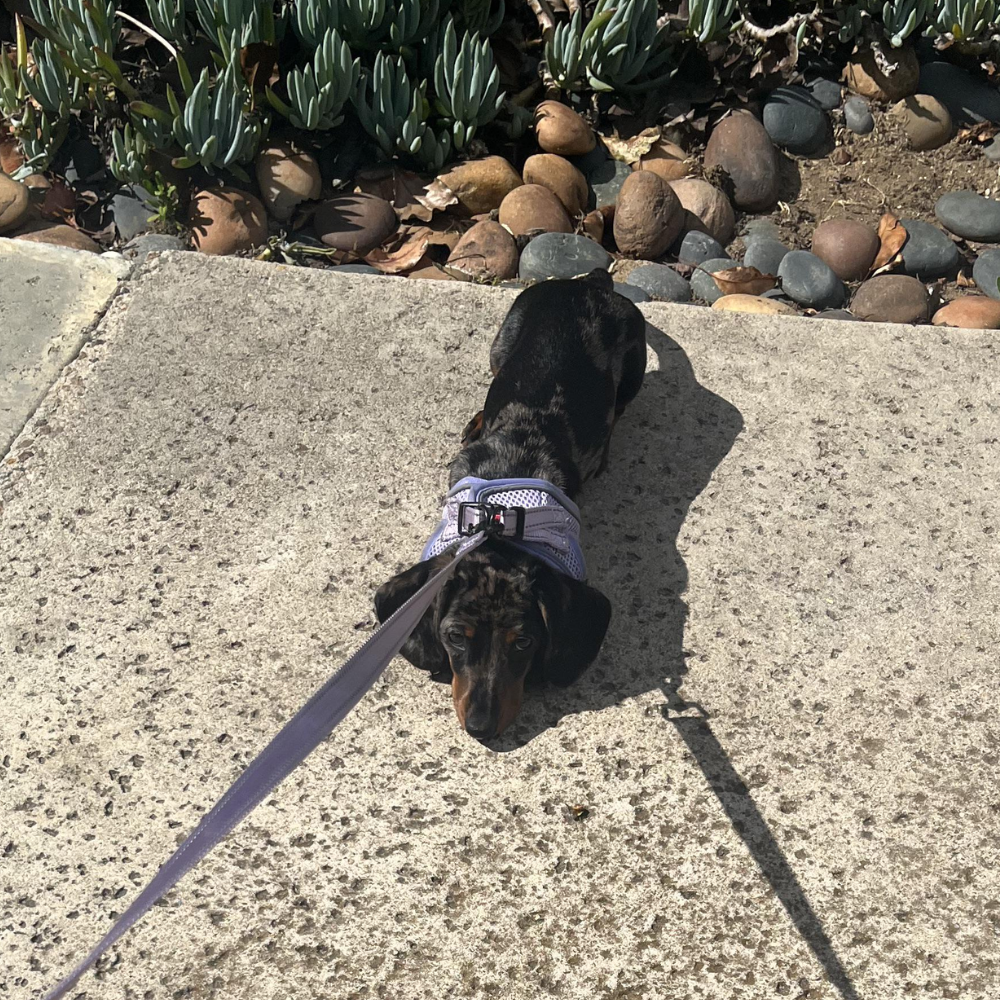
Sharon H. Facebook ad: “Read this if your dachshund is stubborn.”
Ran for 1 day, from March 21 to March 22, 2026, the last day Crush saw it.
Run by Sharon H. on Facebook. Crush is not the advertiser and does not verify its claims. See this ad in Meta's Ad Library(opens in a new tab)
Want an ad like this for your product?
Crush makes new ad images for your product from this ad: your logo, your product photo, your offer.
Trials from $19.95 USD, then $79.95 USD a month. Cancel anytime.
About this ad
- Meta Ad Library ID
- 1585591529388829
- Platforms
- Facebook, Instagram, Audience Network, Messenger and Threads
- Relaunches
- 0
- EU reach
- 51
- Niche
- Pets
Ad text
I finally figured out why my Dachshund is so stubborn on walks. It has nothing to do with his mentality. It has everything to do with what he was actually built for — and nobody told me until I went looking myself. Oscar has a corner. Actually that's not quite right. Oscar has a corner every few houses. It doesn't matter which way we go. Every few houses he just stops. No warning, no reason I can see. Just four legs planted and that look. You know the look. That flat, completely unimpressed Dachshund stare that makes you feel like you've done something wrong. And when I don't react fast enough he starts barking. Right there in the middle of the street. Not going forward, not going back, just standing there barking at me like I'm the problem. So I do what every Dachshund owner does. I pick him up, carry him a few houses down, put him back on the pavement. He walks for maybe thirty seconds. Then stops again. Same look. Same bark. I pick him up again. Put him down again. Every few houses, the whole walk, start to finish. I used to laugh about it. I'd tell people and they'd crack up and I'd crack up and someone always said the same thing — oh that's just Dachshunds, they're so stubborn, it's just who they are. And I'd nod and agree because what else do you do. But honestly? I was starting to dread it. This thing that's supposed to be good for him, supposed to be something we enjoy together — I could feel myself not wanting to go anymore. And I could see he hated it too. And that made it worse. Because I love this dog. I just wanted to actually enjoy walks with him for once. I tried everything before I figured it out. Treats first — my vet recommended it. Reward every few steps, make it worth his while. And it worked for about two minutes. He'd take three steps, eat the treat, stop again. I was bribing him forward one meter at a time and I knew even while I was doing it that something was off. Like I was rewarding him for the wrong thing. He stops, he gets a treat. He stops again, he gets another one. That didn't feel like training. That felt like giving in. I tried the stroller after that. Load him in, walk ten minutes away from home, lift him out and let him walk back. And honestly it was a little better. He'd walk maybe half the way before the stopping and barking started again. Still better than nothing but I was still carrying him, still ending every walk frustrated, still coming home feeling like I'd failed at something that should be simple. I posted about it again. Everyone laughed again. Someone said "not a phase, more of a lifestyle" and got forty likes. Someone else said Dachshunds refuse to do things they like just out of spite. I felt seen. I felt understood. I thought — yes, this is exactly it, this is just the breed, this is what I signed up for. I was completely wrong about what was actually happening. I don't know how I ended up on his page. I think Facebook just showed it to me one evening while I was scrolling after another one of those walks. A dog behaviour specialist who worked specifically with Dachshunds. Not dogs in general — Dachshunds specifically. I almost kept scrolling. I'd read enough forum posts at that point, I wasn't really looking for more opinions. But something made me stop. He wasn't talking about stubbornness like it was a personality trait. He wasn't laughing about it. He was talking about it like it was something that could actually be understood. So I read a bit more. And then I messaged him and told him everything — the stopping, the staring, the barking, the carrying, the stroller, all of it. His first question stopped me completely. He asked me if I knew what Dachshunds were originally bred to do. I said not really. I knew they were German, I knew they were stubborn — or at least that's what I'd always called it — and that was about the extent of it. And then he told me something that made me put my phone down and just sit with it for a minute. Dachshund means badger dog. Dachs — badger. Hund — dog. That's not a cute name. That's a job description. Dachshunds weren't bred to walk beside their owner. They weren't bred for the park or the pavement or a Sunday morning stroll. They were bred to hunt badgers. Underground. In narrow dark tunnels where a human couldn't follow. Every single part of their body was built for one specific job — dig into the earth, track prey through total darkness, make independent decisions with no human direction, chase something that fought back, and drag it out. The long low body. Built to fit through a tunnel. The short powerful legs. Built to dig. The big paddle shaped front paws. Built to move earth. The bark loud enough to carry through solid ground so the hunter above always knows exactly where the dog is. I looked at Oscar on the sofa and I thought — that is a hunting machine that has never once been allowed to hunt. And then the specialist said the thing that really got me. He said the stubbornness isn't personality. It's the symptom. A Dachshund that isn't getting its hunting instincts fed doesn't just get a little bored. That frustration builds up every single day — the mental frustration of a brain built to track and chase and solve problems independently, and the physical frustration of a body built for underground hunting that only ever gets a slow walk on flat pavement. It just accumulates. Quietly. Every single day. Until the walk becomes the moment all of that comes out. The stopping. The staring. The barking. Every few houses another standoff. That wasn't Oscar being difficult. That was a hunting dog completely overfull with frustration that had never been given anywhere to go. I sat there reading that and I thought about every walk we had ever taken. Every corner. Every standoff. Every time I had picked him up and carried him a few houses and put him back down and done it all again three minutes later. He wasn't being stubborn. He had been trying to tell me something the whole time. I just didn't have the right language to understand it. And then I thought — if the walk was never the answer, what was. I asked him that directly. If walks aren't giving him what he needs, what does. He said it simply. A Dachshund's brain needs to hunt. Not exercise in the general sense. Not a walk or a training session or a treat puzzle he finishes in four minutes and walks away from. It needs to track something that moves on its own, unpredictably, low to the ground, that it can chase and circle and never fully catch. That's the hunting loop. That's the sequence this brain has been running for five hundred years. And the only way to actually settle a Dachshund — not tire it out, not distract it, actually settle it — is to give that loop somewhere to run. I asked him what that looked like practically. He said he tells most Dachshund owners in this situation the same thing. An automatic ball. Not a ball you throw and it rolls straight and stops. Something that moves on its own, changes direction by itself, bounces at angles he didn't expect, behaves more like something alive than something inert. To a dog bred to track prey through underground tunnels, an object that moves unpredictably isn't just interesting. It activates something. The tracking part of the brain locks on. The hunting loop starts running. And a brain that is running the loop it was built to run has nothing left over for planting itself every few houses and barking at you. I want to be honest — I was skeptical. I'd bought enough things at that point. Toys Oscar had used twice and abandoned. I wasn't expecting this to be different. But I kept thinking about what he said. The loop. The hunting sequence. The five hundred years of breeding that a walk on flat pavement completely ignores. And I thought about Oscar spinning at the door every single morning, so excited to go out, and then stopping three houses later and staring at me. That wasn't a dog who didn't want to move. That was a dog who wanted to hunt and kept getting a pavement instead. I ordered it that afternoon. The first time I put it on the floor and switched it on Oscar just froze. Completely still. Nose forward, body low, ears up. Every part of him locked onto it. And then it changed direction and he went after it and I just stood in the doorway watching him and I had this weird feeling like — oh. There you are. Because I had never seen him like that before. Not frantic. Not chaotic. Not the bouncing spinning dog who loses his mind at the door every morning. Focused. Quiet. Completely in his own world. Tracking it across the floor, cutting off its angles, losing it behind the sofa and picking up the trail again on the other side. Like something had switched on in him that had always been there waiting. I left the room after fifteen minutes. Which if you've been picking your dog up and carrying him every few houses for two years you understand what a sentence that is. I just walked into the kitchen and made a coffee and waited for the barking. It didn't come. I came back twenty minutes later. He was still going. I sat down on the floor and watched him and I thought about every single walk. Every standoff. Every corner. Every time I'd stood in the street holding a leash attached to a dog who had simply decided he was done and I'd laughed it off and told people that's just Oscar, that's just how he is. It was never just how he was. He was a hunting dog with nothing to hunt. And the moment I gave him something to hunt — something that moved like prey moves, low and fast and unpredictable, something his brain could actually lock onto and run the loop it was built to run — he became a completely different dog. Not a different personality. The same Oscar. Just finally, actually doing what he was supposed to be doing. We went for a walk the next morning. Passed the first corner. He walked straight through it. Passed the second. Straight through. The whole walk, start to finish, no standoffs, no barking, no carrying. Fifteen minutes. Home. I actually looked back down the street to check it had really happened. It had. So if you have a Dachshund who stops every few houses, who plants his feet and stares at you and barks and makes a fifteen minute walk into an hour long negotiation — I just want you to know it was never stubbornness. It was never spite. It was never just how Dachshunds are. It was a hunting dog telling you it needs to hunt. And once you give it something to hunt — once you see that brain finally switch on and watch your dog go completely silent and focused and into his own world — you will understand immediately why every walk you ever took together felt like a battle. It wasn't stubbornness. He just needed the right job. If your Dachshund has days where nothing works and you've been calling it a phase for longer than you can remember — it might just be worth asking what that brain is actually getting to do each day. Not more walks. Not more treats. Not a stroller. Just something that gives the hunting drive somewhere to go. That's all it was. That's the whole thing.
Where the ad sends people
getpawdash.co
Read this if your dachshund is stubborn.☝
PawDash
Shop now: getpawdash.co(opens in a new tab)