
Inactive· since May 15, 2026
- 6
- days it ran
- 0
- relaunches
- 19
- EU reach
Ad copy
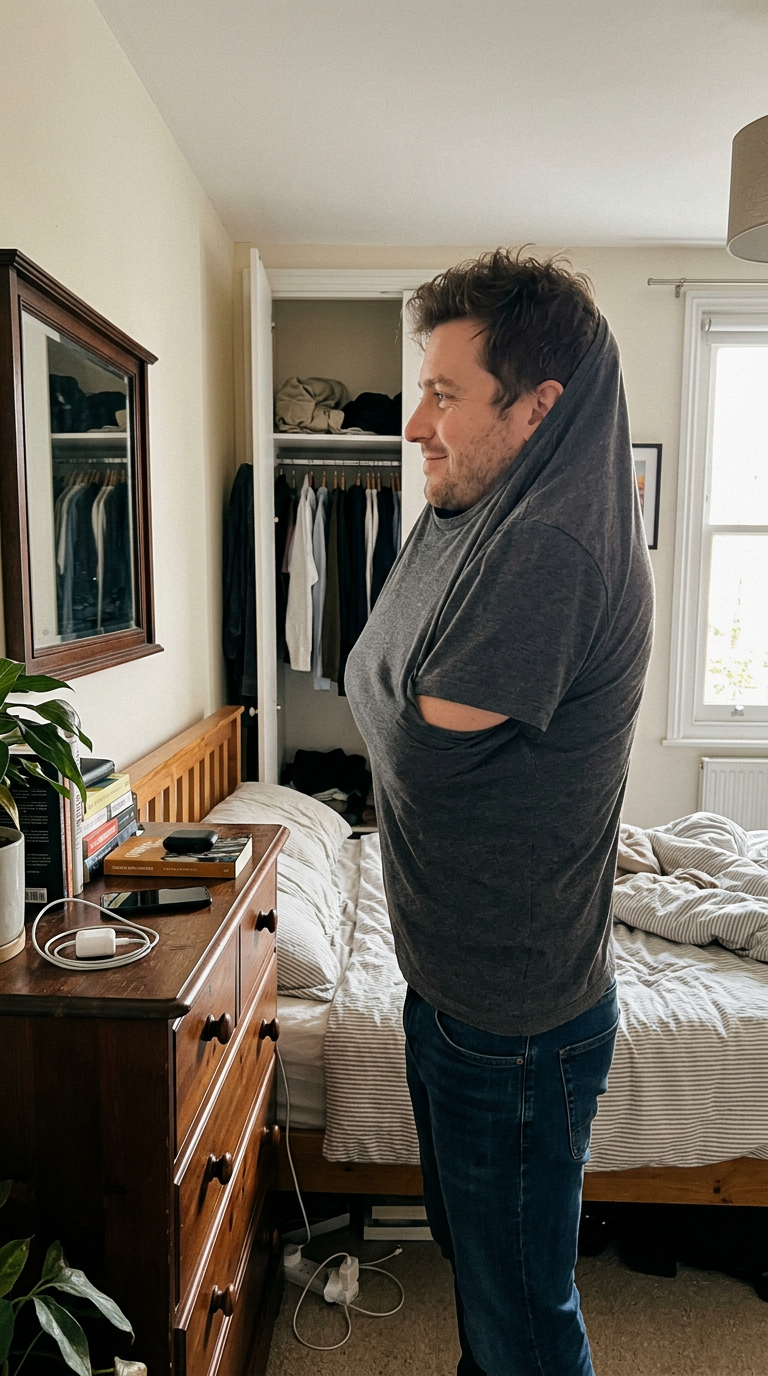
my husband used to turn heads. now he turns away from mirrors. That's the distance. From a man the room noticed to a man who won't look at his own reflection. From a man whose body was his entrance to a man whose body is his apology. From turning heads to turning away. Same man. Same marriage. Different body. Different everything. At 35, my husband turned heads. I'm not exaggerating — I watched it happen. In restaurants. At parties. Walking through an airport. Women looked. Men looked — the quick competitive scan that men do when another man's body registers as built. My husband didn't notice. That was the thing about it — he was oblivious. The head-turning was involuntary from everyone else and invisible to him. He just walked through rooms in a body that worked and the rooms responded. I LOVED that. Not because I'm vain — because it was confirmation. Every turned head was a vote. A stranger's eyes saying: yes, that one. The one you picked. The one you married. That one is worth looking at. The votes weren't for me. But I collected them. The way a wife collects proof that she chose well. At 44, the votes stopped. Not gradually — I can pinpoint the year they thinned and the year they stopped. At 40 they thinned: fewer glances, less registering, the body moving from "noticed" to "neutral." At 42 they stopped: the body moved from "neutral" to "invisible." Nobody looked. Not women. Not men. The competitive scan was replaced by — nothing. The body didn't register. It occupied space without making an impression on the space. Invisible at 42. The man who turned heads at 35 was invisible at 42. And the invisibility did something to him that the weight alone couldn't do: it changed how he walked through rooms. Because a man who's been noticed his whole adult life develops a walk. Not a strut — a presence. The walk of a man whose body is received by rooms as worth receiving. When the rooms stop receiving, the walk changes. The shoulders come forward. The chin drops. The body pulls inward. The walk becomes an apology. I watched my husband's walk change. The head-turning walk became the room-crossing walk became the "I'll stand at the edge" walk. The man who used to walk into the center of rooms started walking to the perimeter. Standing at the edge. Arms crossed. Taking up less space than a man his size should take. And the mirrors. At 35: he'd glance at mirrors the way men who look good glance at mirrors — the passing check, the quick confirmation. Yes, still here. Still looks right. Let's go. At 40: the glance shortened. Less lingering. More functional. At 42: he stopped glancing. Started avoiding. Walked past mirrors angled slightly — the body turned fifteen degrees from reflective surfaces so the reflection wouldn't catch his eye. In our house he reorganized his route: bathroom mirror avoided during teeth-brushing (stared at the faucet instead), hallway mirror walked past at an angle, bedroom mirror faced away (he moved the dresser so the mirror pointed at the wall). He moved a mirror. In our own house. Physically repositioned furniture so a mirror wouldn't show him what he'd become. His doctor said "metabolism." The word that sounds medical enough to end the conversation. He wasn't entirely wrong. But metabolism wasn't explaining why a man who trained four days a week — who benched 225, who squatted 315, who had more gym hours at 44 than at 35 — had a body that turned AWAY from mirrors instead of toward them. The effort was maximal. The result was invisible. Something between the effort and the visibility was intercepting. I watched him fight for four years. The wife's front row. The gym intensified. Every escalation producing the opposite of its intention. More sets, more days, more strain — and the body responding with more covering, more softness, more of the layer that was burying the training underneath. The diet became a punishment. Meals weighed. Joy removed. He ate restriction while I ate dinner. Two people at one table eating from different emotional systems — his body at war, mine at peace. He ran until his knees broke. Literally — the orthopedist said "degenerative" at 43. The knees that carried him through twenty years of training gave out under the weight of a body trying to run away from itself. The supplements. The powders. The expensive protocols from the internet. Each one a lottery ticket. Each one not winning. The shelf in the bathroom — a monument to the gap between marketing and reality. At 43, the mirror-turning became absolute. He wouldn't look. Anywhere. Car mirrors adjusted so they didn't show his body. Phone camera avoided — he'd hand the phone to someone else. "You take it." The photo-avoidance that means: I can't exist in documented form. If I'm not in the photo, the body isn't confirmed. The head-turning man had become the mirror-avoiding man. The room-entering man had become the edge-standing man. And I stood next to both versions across nine years watching the distance grow between a man the world noticed and a man who couldn't notice himself. One night — 2 AM, both of us in bed, him asleep and facing the wall (he'd started sleeping facing the wall — away from me, away from being seen even in sleep) — I searched. Not for the mirror-avoidance. For the covering. For the layer that was between the gym and the mirror. Between the effort and the result. Between the man who should be visible and the man who's been rendered invisible by a body that contradicts him. The article. The nervous system. Cortisol. Survival mode. The covering — not metaphor but mechanism. A nervous system in chronic emergency depositing fat specifically in the places that change visibility: the midsection, the chest, the face, the areas that rooms scan and mirrors show. The cortisol targeted the exact zones that head-turning depends on. Not random weight gain — strategic storage. The nervous system wrapping the body in the exact pattern that erases visibility. The gym was building underneath. The cortisol was erasing on top. Two systems running simultaneously in opposite directions. The gym saying SHOW. The nervous system saying HIDE. HIDE winning. Liven. Micro-Cycle Method. Five minutes a day. For the HIDE command. The nervous system issuing the order to cover. The cortisol executing the covering. Remove the command, the covering thins, the gym's work becomes visible, the mirror becomes tolerable, the head-turning becomes possible. I showed him on a Sunday. "You train harder than any man I know. Your body doesn't show it. Not because the training isn't working — because something is covering the work. And this might be the covering." He read it. Quietly. The reading of a man who's been told his body is in emergency and the emergency explains four years of invisible effort. He took the quiz. Started Liven. "I don't need to turn heads," he said. "I just need to look in the mirror without turning away." Without turning away. The lowest bar. The starting point. Not vanity — tolerance. The ability to see his own reflection without flinching. That's what four years of gaining had reduced to: the desire to tolerate his own mirror. Week 2: his face sharpened. The first visible change — the cortisol bloat draining from the jaw and cheeks. The face in the bathroom mirror — the one he'd been avoiding by staring at the faucet — was becoming recognizable. Not the 35 face. But a face with edges. With structure. With details returning. Week 3: I caught him. In the hallway. At the mirror. The one he walked past angled. He wasn't angled. He was facing it. Looking. Not long — three seconds. Three seconds of a man looking at his own reflection without the fifteen-degree turn. Three seconds of tolerance. The first three seconds in a year. Week 4: "Eleven pounds," he said. And the dresser mirror — the one he'd turned to face the wall — he turned it back. Didn't announce it. I noticed because the mirror was in a different position one morning. Facing the room again. Facing the bed. Facing a man who was starting to tolerate what it showed. Week 6: the walk changed. I noticed at a restaurant. He walked to our table — through the room, not around the edge. The shoulders were back. Not the 35 walk — not the head-turning walk. But the walk of a man who exists in a room without apologizing for the space he takes. A woman at a nearby table glanced. Quick. The quick involuntary scan. The first glance from a stranger in two years. He didn't notice. He's never noticed. But I did. I always notice. Because the glances were the votes I used to collect and the voting had resumed. Week 8: a morning. He was getting dressed. Our bedroom. The mirror — the dresser mirror, back in position. He pulled on a shirt and looked at himself. Not the functional glance. The 35 glance. The confirmation check. The one that says: yes, still here. Looks right. Let's go. He checked himself in the mirror and the checking was casual and the casual was everything. "There I am," he said. To the mirror. To the room. To the man who'd been turning away for two years and just turned toward. It's been five months. He walks through rooms. Not at the edge — through. The shoulders are back. The chin is up. The mirror is a mirror again — not a threat, not an enemy. A mirror. The thing it was before it became something to avoid. The head-turning isn't back to 35 levels. But the head-tolerance is back. He tolerates his reflection. He looks at himself. He faces mirrors instead of angling past them. The dresser is in the right position. The teeth get brushed looking at the reflection instead of the faucet. And last week — a restaurant, date night — a woman at the next table glanced at him as we walked past. The scan. Quick. Involuntary. The vote. He didn't notice. I did. It wasn't that metabolism didn't matter. It's that metabolism wasn't the covering. The cortisol was the covering. And the covering was specifically targeting the zones that mirrors show and rooms scan. Remove the covering, the zones emerge, the mirror becomes tolerable, and eventually — the heads turn again. If your husband used to turn heads and now turns away from mirrors. If the walk changed from entering to apologizing. If mirrors have been repositioned in your own home. The head-turning body is still there. Under the covering. Training. Working. Invisible. The covering is a nervous system in survival targeting the exact zones that visibility depends on. And the covering can come down. Liven has a quiz. A few minutes. Doesn't cost anything. Show it to him. Tell him: "The mirror isn't the problem. What's between you and the mirror is the problem. And it can come down." Link is below. 💙
THIS IS what you need to do
LEARN MORELike this ad? Make it yours.
Crush rebuilds this exact creative around your product — your brand, your colors, your offer — in about a minute.