
Active· since Sep 8, 2026
- 11
- days running
- 0
- relaunches
- 39
- EU reach
Ad copy
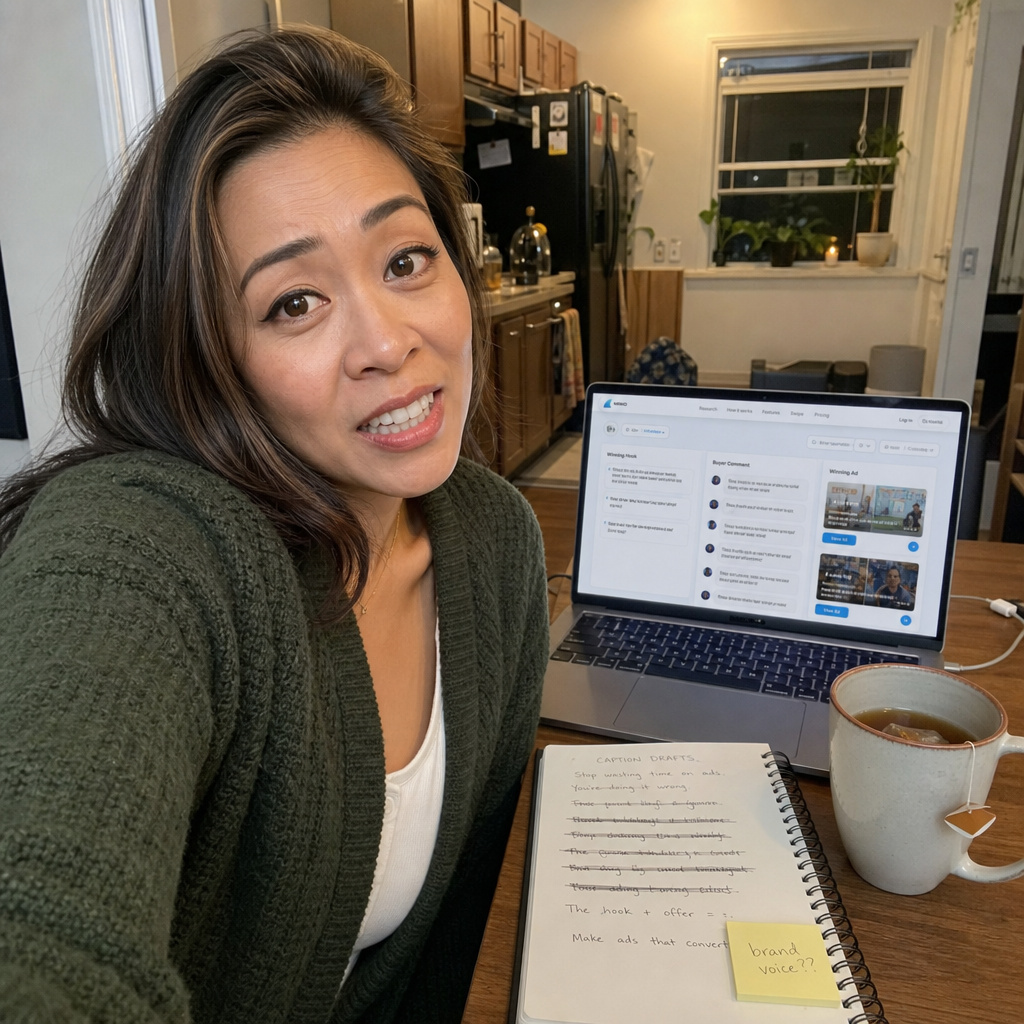
If your ads keep sounding like “AI,” stop starting with a blank prompt box. That is the trap. You open a tool. It gives you a big empty box. You type, “Write me a high converting ad for my product.” And it spits out the same shiny, generic nonsense you have already seen 50 times. Then you stare at it. You tweak 1 line. You tweak 1 more line. And suddenly it is 11:42 PM, your tea is cold, and you are still thinking, “Why does this not sound like us?” Look at my table right now. Laptop open. Notebook full of crossed-out caption drafts. A sticky note that literally says “brand voice??” That sticky note is not being dramatic. That sticky note is the whole problem. Because the problem is not that you “can’t write.” The problem is you are trying to pull a real voice out of an empty box. And when you do that, you get ads that look AI-generated, feel slightly off, and burn tomorrow’s test budget before you even get a fair read. I know because I have done this loop so many times it is embarrassing. Open tool. Paste prompt. Get 4 paragraphs of smooth words. Hate it. Rewrite it into my voice. Realize it still does not sound like how customers talk. Go back to the site. Open the reviews. Skim comments. Copy a few phrases. Try again. Then lose another hour switching tabs like a maniac. And the worst part? I would keep thinking the answer was “better prompting.” Like if I just found the magic sentence, everything would click. So I did what everybody does. I collected prompts. I saved swipe files. I kept a doc with “angles.” I watched videos where people swear you just need the right framework. It helped a little. But it never fixed the thing that actually mattered. The voice. The real, specific, customer voice. Not the “we help you unlock your potential” voice. The voice that shows up in actual comments. The way people describe their problem when they are not trying to sound impressive. That is when the shift happened for me. Not a new prompt. A new starting point. Customer signals first. Then the writing. That is what made Mako feel different to me. And yes, I rolled my eyes at first. Because I thought, “Cool. Another AI content generator.” If you are thinking that, you are not crazy. Most of them are basically the same idea. A fancy text engine. A blank box. And a bunch of templates that all sound like they came from the same “marketing” planet. But Mako is not built around staring at an empty prompt box. It is built around pulling the stuff you already have into 1 workflow. Your site. Your reviews. The customer chatter. Then it turns that into a first batch of ad angles and copy you can actually work with. Not perfect. Not “post it and print money.” Just… close. Close enough that you are editing instead of rewriting from scratch. Close enough that you stop asking, “Who talks like this?” I tested it the exact way I test anything now. Late at night. When I am too tired to pretend. When I have 0 patience for fluffy words. I had my laptop open with a planning dashboard. Columns of customer comments on one side. Little ad thumbnails on the other. My notebook had at least 6 caption starts that I had already crossed out. I kept staring at that sticky note, “brand voice??”, like it was personally mocking me. So I ran Mako. I let it pull what it needed. And when it gave me the first output, I did not even try to be optimistic. I was ready to hate it. But I caught myself doing something I had not done in a while. I saved the first output. Not because it was “perfect.” I saved it because it was the first time in a long time I thought, “Wait… why is this actually close?” It sounded like a human. It sounded like someone who had read what customers really say. It sounded like it understood the difference between what we think the product is and what people are actually buying. And that is the part that is hard to explain until you have been stuck. When your ads feel off, you assume you need better writing. But half the time, you need better inputs. If you feed a tool vague inputs, you get vague output. If you feed a tool nothing but a blank prompt and your own guesses, you get copy that feels like a guess. And then you spend 45 minutes trying to “make it sound like you.” You can do it. But it is slow. And it is mentally expensive. Especially when you are doing it day after day. Mako is basically the opposite starting line. Instead of asking you to imagine what a customer might say, it starts with what customers already said. Then it helps you turn that into ads without the whole tab-juggling circus. Here is what that changes for me in real life: 1) I stop hunting for words. Because the words are already there, in the customer language. 2) I stop forcing a “brand voice” from scratch. Because the voice comes from patterns, not vibes. 3) I can get to a usable first draft fast. Not a “ready to scale” draft. A “I can edit this in minutes” draft. And editing is a completely different kind of work than inventing. Editing is calmer. Editing is clearer. Editing does not make you question your entire career at 11:42 PM at a kitchen table. If you are reading this and thinking, “Okay, but I have tried tools and they still sounded fake,” same. That is why I am being specific about the problem. The problem is not “AI.” The problem is the empty box. The blank prompt. The vibe-based guessing. The disconnect between your brand and the way customers actually talk. And if you have ever written something that felt decent, then opened your own product reviews and thought, “Oh wow, customers describe this totally differently,” you know what I mean. This is also why that little sticky note hits so hard. “brand voice??” Because everybody acts like brand voice is some mysterious creative gift. Like you either have it or you do not. But a lot of brand voice is just consistency. Using the same customer phrases on purpose. Repeating the same promises the same way. Not reinventing your language every time you sit down to write an ad. Not panic-writing from scratch because you need 3 new ads by tomorrow. So if you are in that place right now, here is the simplest way I can say it: You do not need another empty prompt box. You need customer research and ad making in the same workflow. That is what Mako gave me. And that is why I still have that first output saved. Because I genuinely did not get how it landed that close, that fast. If you are curious, go look at Mako. Run it on your own stuff. Your site. Your reviews. Your real customer chatter. See if it gives you something you can edit instead of something you have to fight. Worst case, you confirm what you already believe. Best case, you finally peel that “brand voice??” sticky note off the table and stop losing your nights to the blank box.
Create winning creatives consistently
Research buyers, create ad content, and publish winning creatives with one AI software platform.
LEARN MORELike this ad? Make it yours.
Crush rebuilds this exact creative around your product — your brand, your colors, your offer — in about a minute.