Dr. Sarah Mitchell
Dr. Sarah Mitchell Facebook ad: “4 neurologists in 6 years missed this”
Ran for 38 days, from June 6 to July 14, 2026, the last day Crush saw it.
Run by Dr. Sarah Mitchell on Facebook. Crush is not the advertiser and does not verify its claims. See this ad in Meta's Ad Library(opens in a new tab)
Want an ad like this for your product?
Crush makes new ad images for your product from this ad: your logo, your product photo, your offer.
Trials from $19.95 USD, then $79.95 USD a month. Cancel anytime.
About this ad
- Meta Ad Library ID
- 1622161279278468
- Platforms
- Facebook, Instagram, Audience Network, Messenger and Threads
- Relaunches
- 0
Ad text
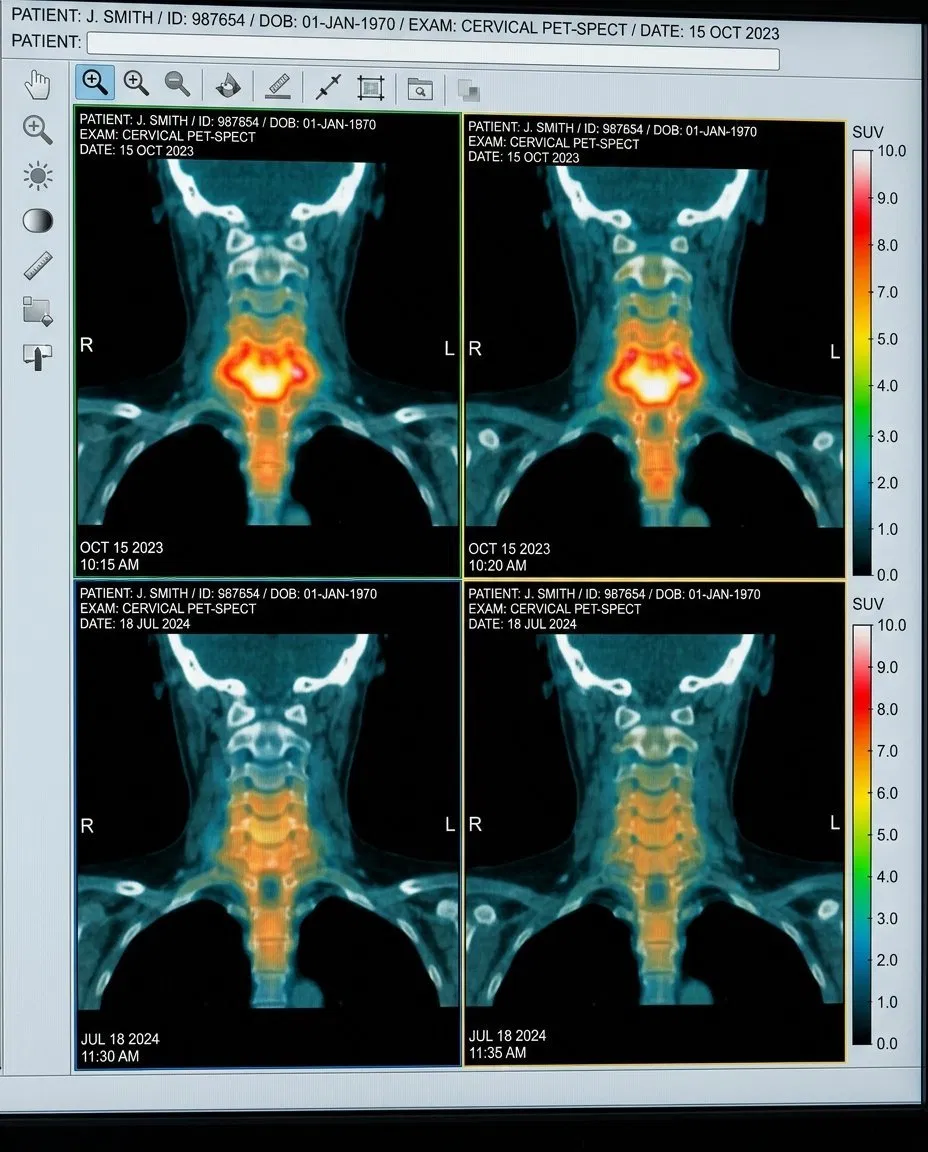
If your last neurologist looked at your MRI, said unremarkable for your age, then asked if you had considered a preventive that helps with weight loss too — I am writing this for you specifically. And if you also could palm the floor flat as a kid, had heavier periods than your friends, get dizzy when you stand up from the couch too fast, have a tall mother or a sister with scoliosis, and have a daughter who is the bendy one in her dance class — please read all the way through. The two things are the same thing, and not one of my six neurologists in eleven years ever once made the connection. I was you eleven months ago and nobody on my care team was going to tell me what was actually happening at the base of my skull every single night for eight hours — or why my neck was failing to hold its own alignment in the first place. My name is Linda Marshall. I am 47. I live in Phoenix. I have had chronic morning migraines for 11 years. My pill drawer has Topamax — my online group calls it Dopamax because I forgot the words "orange juice" standing in front of my own refrigerator and quit it the same week. Aimovig at $743 a month after my insurance denied three appeals. Ajovy when the Aimovig pooped out at month nine. Five rounds of Botox at $500 a round. Round four hit a nerve in my left temple and I could not lift my eyebrow for 11 weeks. There is a photo of me at my niece's wedding that week where I look surprised in every shot. I am not surprised. I am tired. But the migraine medications were not the only line item on my health budget. They were not even half of it. My dentist made me three night guards over the years for what he called "the worst clenching pattern" he had seen in a woman my age. The last one cost $1,400. It did nothing for my morning headache. My gastroenterologist diagnosed me with gastroparesis in 2017. My stomach empties slowly. Breakfast still feels like it is sitting in my chest at lunch. He never asked me about my migraines. My cardiologist ran a tilt-table test in 2019 for unexplained dizziness every time I stood up from a chair. The report was inconclusive. He never asked me about my migraines either. My gynecologist put me on three different birth controls trying to manage menstrual bleeding so heavy I had built my entire adult life around knowing where every bathroom was within a 90-minute radius of my house. There is a hotel night in Tampa I will never forget where I woke up at 3am and felt the sheet in the dark before I let myself turn on the light. She also never once asked me about my migraines. My orthopedist treated my sister Diane's scoliosis curve at fourteen and never connected it to the fact that our mother is 5'11" and our aunt was 6'0" and our grandmother on that side made every dress she ever owned because nothing fit a frame that tall. Six specialists. Four of them treating me. Two treating women in my immediate family. None of them ever drew a single line between any two of us. 11 years. Five neurologists. $6,400 spent on the brain alone. Easily another $11,000 across the four other doctors trying to manage four other symptoms in me that turned out to be the same symptom. The fifth neurologist, last August, did not look up from her screen for the whole 14 minutes. She said this preventive is good for weight loss too if that interests you. I sat in the medical building parking lot for 40 minutes. Did not cry. Felt worse than crying. I have to tell you about my aunt before I tell you what changed. My aunt is the reason any of this matters. Her first migraine MRI report had the same phrase mine did. Unremarkable for age. I will come back to her. That night I went home from the parking lot and read every paper I could find. Not the WebMD version. The actual journal version. The kind a neurologist would read if she ever bothered to read anything new. I found research published in 2023 in the Journal of Headache and Pain showing that sustained decompression at C1 through C3 reduced chronic morning migraine frequency by more than 50% in 84% of patients within 30 days — but only when the cervical compression had been measured on loaded imaging. Standard supine MRIs had missed almost all of it. That word — loaded — was the first time in eleven years I had read something that pointed at why every one of my own MRIs had come back unremarkable. Every cervical MRI I had ever had was supine. Lying flat on my back. No gravity loading the spine. Of course they were unremarkable. The compression only manifested under load — when I was sitting up, or standing, or sleeping on a pillow that let my skull settle into positions a stable cervical spine would not allow. Then I found the part that made me sit on the kitchen floor. There is a nerve junction at the base of your skull called the trigeminocervical complex. The cervical nerves from C1 through C3 share the same signaling pathway as the trigeminal nerve in your face. They converge. They feed the same pain circuit. When your head settles wrong on a regular pillow, those cervical nerves are compressed for eight hours every night. Not eight minutes. Eight hours. By morning the trigeminocervical complex has been firing in continuous cycles for the entire sleep period. Your trigeminal nerve has activated hundreds of times before your alarm goes off. You are not waking up with a migraine. You are waking up at the end of one. The next question — and the one no neurologist had ever bothered to ask me — was why my cervical spine was compressing in the first place. Other women slept on the same pillows I did. Other women did not wake up with the same morning pain. The answer was sitting in my own body and I had never been screened for it. I have what specialists now call hypermobile Ehlers-Danlos Syndrome — a connective tissue disorder where the body produces collagen that does not quite do its job. My ligaments have always been loose. My joints have been quietly subluxing and reducing themselves my entire life while I did nothing more than walk around. I was a ballet dancer through high school and was praised every year for being the most flexible girl in the company — what I now know was undiagnosed cervical and ligamentous laxity being treated as a gift. A friend who is a geneticist measured my Beighton score on her kitchen table over coffee one Saturday. I scored a 7 out of 9. I had never heard of the test. Hypermobility had been in my body for 47 years and nobody — not the orthopedist who reconstructed my left ankle at 31, not any neurologist on my chart — had ever once given it a name. Then I went through my own history with new eyes. The reason I could put both palms flat on the floor without bending my knees at sleepovers, and was proud of it. The reason I had to retire from ballet at 22 because my joints kept going out. The reason my dentist made me three night guards. The reason my gastroparesis turned every breakfast into a brick in my chest. The reason my cardiologist could not figure out the dizziness. The reason my school years were a logistical nightmare around my own body. The reason my ankles roll on flat sidewalks. The reason my sister Diane has the scoliosis curve and my mother and aunt were both nearly six feet tall in a generation where that meant tailoring everything. The reason my daughter Maya, 16, has fingers her piano teacher mentions at every recital. Every single one of those was the same condition. And the cervical instability that condition produced was what was compressing my upper cervical region every night on every pillow I had ever owned. There is a community of women I had no idea existed. They call themselves Zebras — the medical proverb says when you hear hoofbeats think horses, and zebras are the patients nobody is looking for. Most of us get diagnosed in our forties after a decade of being treated as if our five different specialists each had separate problems to solve. The cluster has a name in the community. They call it the Trifecta — hypermobile EDS, POTS for the dizziness, mast cell activation for the unexplained reactivity. Many of us have some version of it. Almost none of us know. Once I knew, my aunt came back into focus. She was diagnosed with chronic migraines at 42. Same words I heard. Trigger diary. Preventives. Come back next year. What I had never put together until this year was the rest of her history. She was 6'0" at fifteen and was told she was lucky to be so flexible. She was the dance soloist in our family at sixteen. She could put her foot behind her head into her sixties. She had heavy periods through perimenopause. She had a TMJ click my mother used to tease her about at Thanksgiving. She had IBS her whole adult life that turned out, on her last endoscopy, to be undiagnosed gastroparesis. Year 5 her migraines became daily. Year 8 her MRI — supine, like every one of mine — showed white matter lesions consistent with chronic vascular irritation. Her neurologist called it common at her age. Year 11 her cognitive screening showed early word retrieval deficits. They called it mild cognitive impairment. Year 14 she stopped recognizing my mother at Thanksgiving. She died at 67 of complications from Alzheimer's. Her brain on autopsy showed the same white matter damage pattern radiologists see in early Alzheimer's patients — the same pattern researchers now link to chronic cervical compression in women whose cervical ligaments never quite held the alignment overnight. My aunt did not die of Alzheimer's. She died of 25 years of nightly cervical compression in a body nobody had ever screened correctly. The pattern runs through our female line. My grandmother on that side was tall enough to be considered "imposing" in 1932 and made every dress she ever owned. My mother is 5'11" and has had heavy bleeding her whole adult life. My aunt was 6'0" and had the migraine progression. My sister Diane has the scoliosis curve. My daughter Maya is the bendy kid in her class. We are four generations of zebras and nobody had ever named one of us. I was not going to be my aunt. I refused. I called my neurologist the next morning. I asked her about the trigeminocervical complex, about flexion-extension imaging, about hypermobility screening. She said she was aware of the cervical theory but there was no standard protocol in her practice. She said she could not recommend anything she had not personally assessed. So I went looking myself. I pushed for a flexion-extension cervical MRI in October. It cost $880 out of pocket because no neurologist would order it through insurance. The imaging showed measurable narrowing at C1 through C3 under loading. Bilateral. 14 millimeters. The radiologist wrote: marked metabolic activity at upper cervical junction consistent with chronic neurogenic inflammation, etiology unspecified. Etiology unspecified means we see it but nobody is going to tell you what's causing it. The etiology had a name. I was 47 years old and a hypermobile woman with cervical instability who had been treated for migraine for eleven years and never once been screened for the underlying condition. Three cervical pillows I tried over eight months. A memory foam contour from Costco. A Tempur-Pedic. A buckwheat hull traditional. My forward head measurement at the chiropractor stayed the same. My morning migraine frequency stayed the same. My next loaded cervical MRI showed identical narrowing at C1 through C3. Eight months. No change. $340 spent. The pillows were doing nothing because they were not built for sustained decompression in a hypermobile cervical spine. They contoured. They cradled. They were fine for the first hour. By 2am they had compressed under my head, the cervical curve had collapsed, and my ligaments could not pull it back into alignment because my ligaments have never done that job on their own. That is when I found the Éloura CerviSoft. I had never seen a pillow built like this before. For a hypermobile woman, the three things the upper cervical region actually needs at night are precisely what almost every cervical pillow on the market fails to deliver. Anatomical contouring at C1 through C3 specifically — not the general cervical spine, not "around" the area, the exact vertebrae where the nerve convergence happens and where hypermobile cervical instability concentrates. Sustained alignment through the full eight-hour sleep cycle — not a settle-and-shift, the curve held for the entire window when my ligaments are off duty. Adaptive fiber technology that does not collapse under head weight like memory foam does after 90 minutes — the support has to be present at 5am, not just at 10pm when I went to bed. Miss any one of those three. The cervical spine collapses. The trigeminocervical complex stays activated. The migraine still triggers by morning. The lesions still accumulate. The aunt's path still rolls forward. The Éloura CerviSoft delivers all three. I ordered it the same night I read the Bragatto paper. $57.95. 90-night money-back guarantee. After five rounds of Botox at $500 each that paralyzed my face, $58 was the cheapest experiment I had run in 11 years. It arrived three days later. A small white contoured pillow with a center dip for the head and side cutouts for the shoulders. I held it and thought how is this going to fix what six neurologists could not. The first night I felt the difference at C1 immediately. There was a specific holding at the base of my skull I had never felt from a pillow before. A grounding. Like the bones were finally being held in alignment instead of falling into shapes I had been correcting all night in my sleep. Week 1. I stopped reaching for the Excedrin bottle before opening my eyes. Week 2. I made coffee one morning and did not do the body scan first. I noticed three hours later, on the way to a meeting, that I had not done it. Week 4. My husband Will said you have been weird this week. I asked him what he meant. He said you came down to dinner two nights in a row. Week 6. My daughter Maya, who is 16 and notices nothing, looked up from her phone at breakfast and said you look like you again. Week 7. My dentist asked me at my routine cleaning whether I had stopped clenching. He said the wear pattern on my last night guard had changed. Week 9. My coworker Sarah asked if I had done something different with my hair. I had not done anything different with my hair. Week 9 I also went back for my follow-up loaded cervical MRI. The radiologist pulled up the side-by-side. October versus July. The inflammation pattern at C1 through C3 had reduced by approximately 65%. He looked at the screen for a long time. He said I do not often see this kind of change without surgical intervention. What did you do? I told him about the pillow. He wrote it down. That was nine months ago. My migraine frequency went from 14 mornings a month to two. My most recent cognitive screening showed measurable improvement in word retrieval. My new neurologist — the sixth one — looked at my updated scans and said whatever you are doing, keep doing it. The body scan ritual is gone. Not reduced. Gone. I get out of bed in the morning without checking first. I have not opened my Excedrin bottle in six weeks. There is one bottle in the medicine cabinet I have not refilled in three months and the pharmacist has stopped sending me reminders. I sat at the front of my niece's piano recital last month for 90 minutes under bright lighting and did not need the dark room after. And for the first time since I was 36 — I am not afraid of becoming my aunt. If you are reading this and you have been waking up at 4am pressing the base of your skull with your right thumb wondering when somebody is finally going to see it. If your MyChart still says unremarkable. If you could put your palms flat on the floor as a kid. If your mother is tall, your sister has scoliosis, or your aunt had migraines that became something else. If your CGRPs failed and your Botox failed and your Topamax made you forget the word orange juice. If your dentist made you a $1,400 night guard that did nothing for the morning pain. If your stomach has emptied slowly your whole life and the gastroenterologist called it IBS. If you have spent thousands across five different specialists who never once spoke to each other. Please hear me. Your cervical region has never been decompressed in a body that has never been screened for what is actually loose underneath. That is the root. Nothing your neurologist has prescribed addresses it. Nothing your gastroenterologist treated, your dentist molded, your gynecologist prescribed, or your cardiologist measured ever once put together what every one of them was looking at a piece of. The Éloura CerviSoft delivers the three inputs the upper cervical region requires for sustained nightly decompression — especially in a body whose ligaments cannot hold the alignment on their own. My inflammation reduced 65%. My migraines went from 14 a month to two. My aunt did not get this chance. You do. 90 nights to try it. If your mornings do not change, every dollar back. No questions. 👉 https://eloura-sleep.com/products/eloura-cervisoft-pillow P.S. The first loaded MRI is still in my MyChart next to the new one. I keep it because I want to remember what my own pain looked like the first time anybody bothered to take a picture of it from the angle it was actually happening at. Éloura is a small company. They have run out of inventory twice this year already. If the link goes through, they have stock. I went from 14 mornings a month in pain and six neurologists who could not see it — to two mornings a month and a radiologist who could not explain it. My aunt lost 25 years of her life because nobody told her any of this. She had been a zebra all along and nobody had ever named her. You know now. If you read this far and the pattern is yours, please share this with the women in your female line. Sister. Cousin. Daughter. The neighbor who has had migraines since she was twelve. The cheer mom on your daughter's squad whose elbow does the thing. We are easier to find than the medical system pretends. We just need each other. — Linda Marshall, 47 Phoenix, AZ
Where the ad sends people
sleepposturejournal.com
4 neurologists in 6 years missed this
Read more
See details: sleepposturejournal.com(opens in a new tab)