The Wellness Centre
The Wellness Centre Facebook ad: “Natural Relief in Weeks”
Ran for 32 days, from May 3 to June 4, 2026, the last day Crush saw it.
Run by The Wellness Centre on Facebook. Crush is not the advertiser and does not verify its claims. See this ad in Meta's Ad Library(opens in a new tab)
Want an ad like this for your product?
Crush makes new ad images for your product from this ad: your logo, your product photo, your offer.
Trials from $19.95 USD, then $79.95 USD a month. Cancel anytime.
About this ad
- Meta Ad Library ID
- 1641432786901023
- Platforms
- Facebook, Instagram, Audience Network, Messenger and Threads
- Relaunches
- 0
Ad text
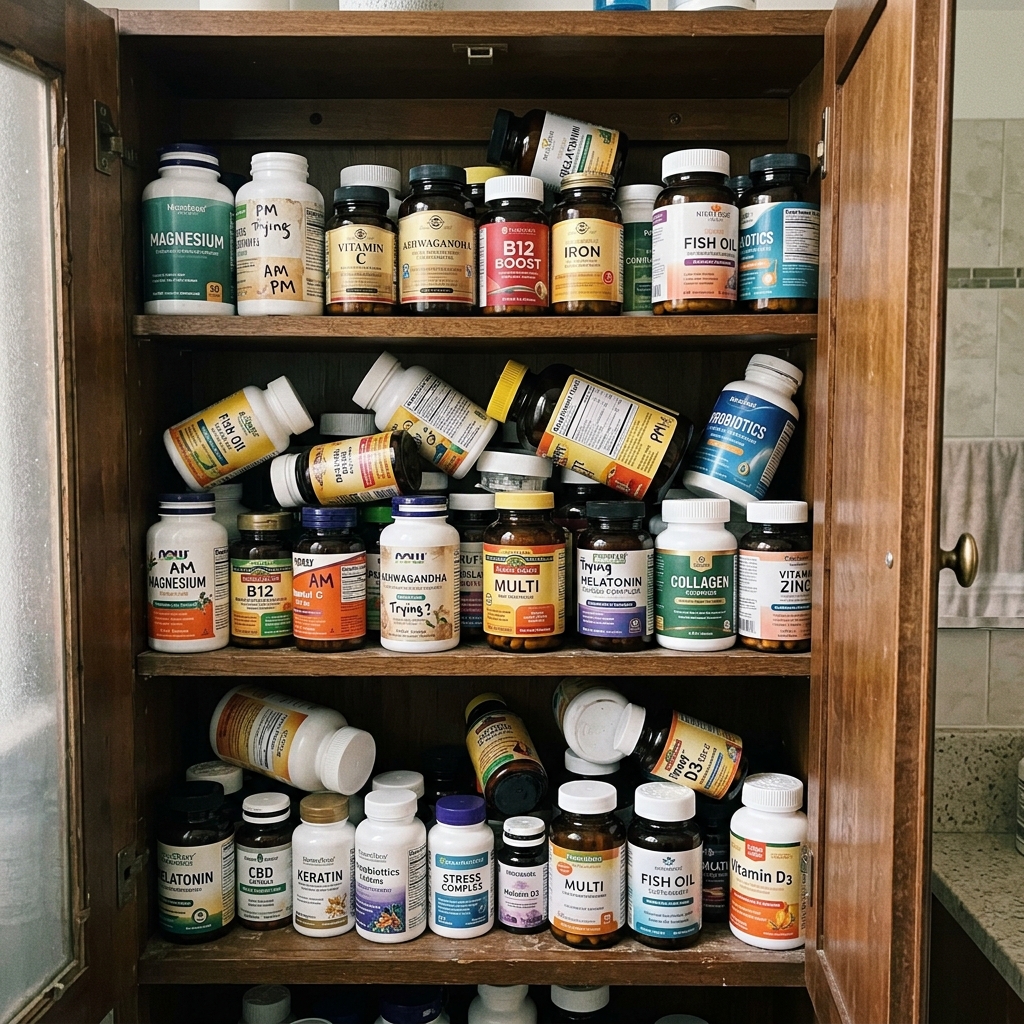
I'm going to say something that might land badly in certain parts of the wellness community and I want to say it anyway because I think it matters. I think magnesium has become a crutch. Not because magnesium is bad. I still take it. The research behind magnesium glycinate for sleep and nervous system regulation is legitimate and I'm not dismissing it. But I spent three years reaching for it and the things recommended alongside it every time something felt off. Ashwagandha when the anxiety was worse. An adaptogen blend a naturopath recommended. A B complex because energy. I was consistent and I was careful and I genuinely believed I was addressing the problem. What I was actually doing was managing symptoms with tools that had no ability to reach the cause. The thing that eventually shifted my thinking was going upstream. Not what helps with anxiety but what is producing it. And the further upstream I went in the research the more clearly one driver kept appearing that almost nothing in the mainstream wellness conversation addresses. Neurological inflammation. Oxidative stress accumulating in brain tissue. Not a disease state, not something with a diagnosis, just a gradual shift in the neurological environment that builds over time and produces effects that are ambient rather than acute. Let me describe what it actually feels like to be living inside this, because I think the description matters more than the science for most people deciding whether this is relevant to them. It's not anxiety in the way anxiety is usually depicted. There's no panic, no obvious trigger, no spiralling. It's lower frequency than that. An edginess underneath things that doesn't have a cause. A flatness to days that are objectively fine. An emotional muting where good things register at maybe half the intensity they should. A version of yourself that is functional and present and getting through everything but feels like yourself with something turned down. Most people who experience this attribute it to external things because the external things are always there and the explanation is always plausible. A hard year. A lot of demands. Getting older. The invisible load. And because the explanation is plausible they don't look further. They take their magnesium and their ashwagandha and they manage around the feeling and they quietly accept that this is probably just what life feels like now. I did this for three years. I was doing genuinely good things for my health throughout that entire period and the underlying thing was completely unchanged by any of it. Here is why, once I understood it properly. Your brain is living tissue under oxidative stress every day. Free radical damage accumulates. Through your late 30s and into your 40s your body's natural antioxidant production declines and the balance shifts. Damage builds in brain tissue faster than it is being repaired. The regions most affected are the most metabolically demanding ones, the areas governing mood and emotional regulation and stress response. When inflammation builds there the output is not a clinical finding. It is a feeling. Persistent, ambient, resistant to everything being thrown at it. And the reason everything being thrown at it doesn't work is the blood-brain barrier. Most supplements, including most antioxidants, do not cross the blood-brain barrier in meaningful concentrations. Magnesium has partial permeability but not at the level needed to address neurological inflammation. Ashwagandha modulates the stress response at the adrenal and HPA level. Adaptogens work systemically. B vitamins support cellular energy metabolism. All doing real things. None of them reaching the neural tissue where the inflammation is actually living. I had built an excellent supplement routine for the wrong problem. The problem was upstream of everything I was taking and nothing I was taking could get there. What I found when I started looking specifically for antioxidants with demonstrated blood-brain barrier access was astaxanthin. I'd come across it before, hadn't paid it much attention, went back and actually read the research properly this time. Marine antioxidant from microalgae. Extraordinary potency as an antioxidant. Genuine demonstrated ability to cross the blood-brain barrier and reach neural tissue directly. The clinical research at 12 milligrams on mood outcomes and neurological inflammation markers is consistent across multiple studies and the findings are meaningful, not marginal. Not through sedation or chemical alteration of brain chemistry. Through reducing the oxidative environment that was producing the dysregulation in the first place. I want to be specific about the dose because I got this wrong the first time and I suspect a lot of people reading this have too. I took a 4mg product for about eight weeks. Noticed nothing. Wrote it off and went back to my magnesium. Did more research later and found that 4mg is not remotely close to the clinically studied dose. The research is run at 12 milligrams. Most consumer products are at 4mg because properly produced astaxanthin at the right dose costs significantly more to make and most brands aren't absorbing that cost. Eight weeks of nothing wasn't evidence the compound doesn't work. It was evidence I was taking less than a third of the effective dose. When I got to 12mg the experience was different in every way. The first two to three weeks I wasn't sure I was noticing anything real. By week four something had shifted. The mornings were quieter. The edginess that had been my first experience of every day was less constant. By week six the flatness in the evenings was noticeably different. I was landing in things rather than watching them from a slight distance. By two months in I felt like myself again. Not a new version. The version from a few years earlier before whatever this was had gradually settled in. I hadn't changed anything else. Same routine. Same diet. Same supplements alongside it. Same life. The only variable was getting to the right compound at the right dose for the actual problem rather than continuing to manage symptoms downstream of it. Three years of magnesium and ashwagandha and adaptogens had helped around the edges. Six weeks at the right dose of the right compound changed the fundamental thing. That distinction is worth sitting with. The one I use is Peakcora. 12 milligrams, Australian owned, every single batch independently third-party tested. I care about the testing because I want to know what is actually in what I'm taking rather than relying on a label claim. You can find them at peakcora.com. Small batch production so they do sell out and it's worth getting when stock is available. This is not medical advice. I'm not a health professional. I'm someone who spent three years taking the right supplements for the wrong problem and found what was actually missing. If the ambient edginess and flatness I've described sounds like your normal, and if the things you've tried have helped a little without changing the fundamental thing, this is the conversation that was missing from your routine. Save this post. And drop a comment if this resonated because I think more people are in this situation than talk about it openly, and the more we do talk about it the sooner people find what actually works.
Where the ad sends people
peakcora.com
Natural Relief in Weeks
Peakcora Astaxanthin 12mg with coconut oil for 95%+ absorption. Supports skin firmness, UV resilience, eye comfort and faster recovery—no meal timing needed.
Learn more: peakcora.com(opens in a new tab)