
Inactive· since May 6, 2026
- 6
- days it ran
- 1
- relaunches
- 3
- EU reach
Ad copy
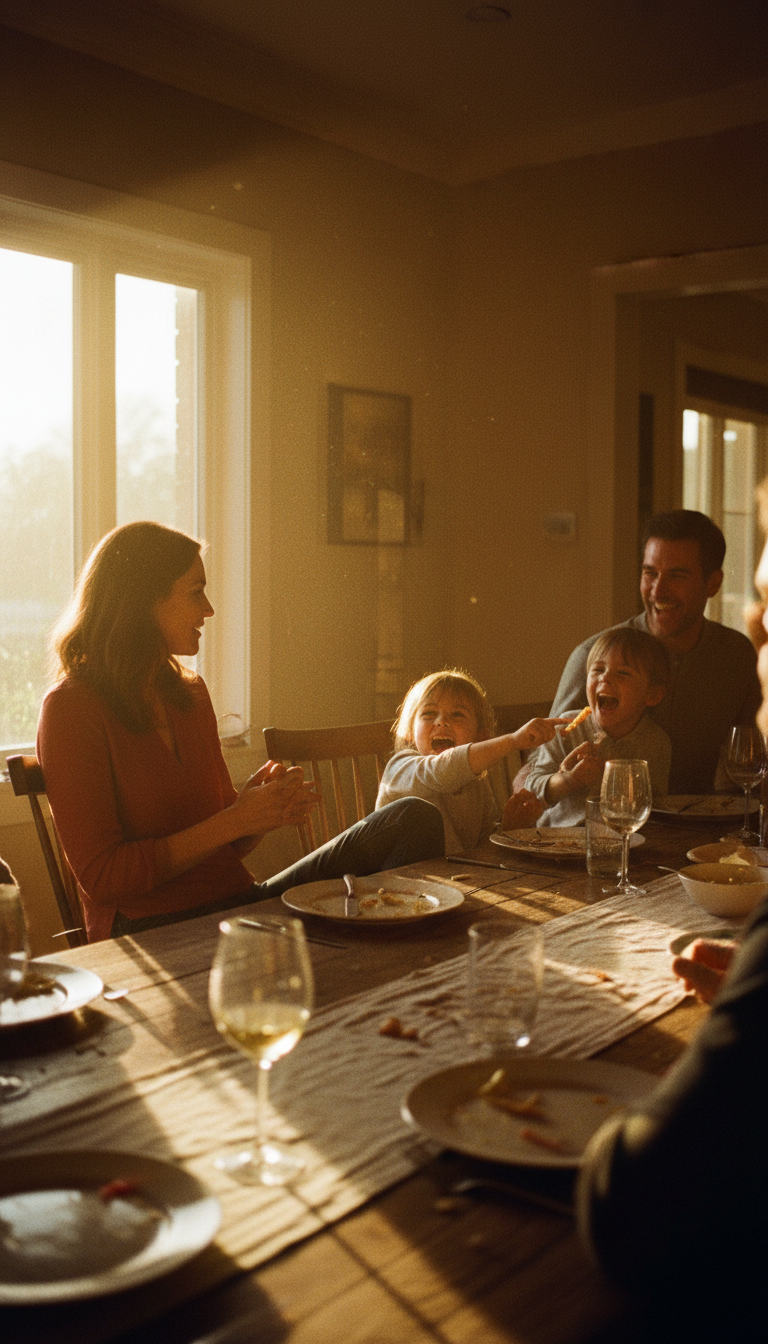
I've told my kids "Dad's just tired" so many times I've started to believe it myself. He's not an alcoholic. He just gets loud. He just gets mean. He just doesn't remember saying that. I've been translating him to the world for eleven years. Last Saturday he knocked a glass off the counter and yelled at our youngest for flinching. I watched her go still — that particular stillness — and I felt nothing. Not shock. Not anger. Just the familiar quiet that comes over me when I start doing math. How bad is it tonight. How long until he passes out. Whether I should take her to my mother's or just wait it out. That's the math I do now. At dinner. At school pickup. During sex, when it happens. The math of managing him. He's not an alcoholic. That word is for men who lose jobs and sleep under bridges. He goes to work. He coaches the travel soccer team on Saturdays — the good Saturdays. He's charming at parties, generous when he's happy, and my friends think I'm lucky. One of them told me last year, "I wish my husband loosened up the way Matt does." I smiled. I was thinking about the night before. I've explained him to my kids so many times it's become a kind of fluency. "Dad's stressed." "Dad had a long week." "Dad didn't mean it that way." I do it smoothly. Automatically. The way you drive a route you've driven a thousand times — no thinking, just arriving at the destination. The destination being: everyone stays calm, no one cries, we get through tonight. My friends don't see it. My mother — my mother asked me once if everything was okay and I heard myself say "we're great, just busy" before she finished the sentence. I don't know when I learned to do that. I think I've always known. Here's what I've never said out loud: I'm not sure what I'm protecting anymore. Him, maybe. The image of us. My kids' belief that their father is basically a good man. My own belief. Because if I stopped explaining him — if I let the sentence just end at "he got drunk and screamed at our daughter" — I don't know what would come after it. And not knowing what comes after it has kept me very, very busy making sure we never get there. I started reading something at 2 in the morning a few weeks ago. Not looking for anything. Just couldn't sleep and didn't want to lie there listening to him breathe. It was an article — not even a good one — about hypervigilance. How some people learn to track someone else's emotional state so closely, for so long, that it becomes their baseline. Their nervous system calibrates itself around another person's chaos. They become experts at reading the room because, at some point in their lives, reading the room was survival. I thought about my father immediately. Not Matt. My father. I thought about the math I did as a kid — same math, different kitchen. How loud was dinner tonight. Which version of him came home. Whether I should stay quiet or say something funny. I was nine years old and I was already fluent in this language. What I thought was loyalty — covering for Matt, smoothing it over, finding the explanation that made it make sense — wasn't loyalty. It was the only thing I knew how to do. My nervous system learned very early that chaos was coming and my job was to manage it quietly. It never got the update that I'm forty-one now and I don't have to do that anymore. That's not a therapeutic insight. That's just what happened. I learned something, and I kept doing it, and I called it love. I took a quiz that was linked in the article. Didn't expect much. Three minutes, questions about patterns — not feelings, patterns. The thing you do when tension rises, how your body responds, what happens to you in the silence after a hard moment. It felt strangely like being accurately described. Like someone had been in my kitchen. What came back wasn't a diagnosis. It was more like a map. Here's what your nervous system learned to do. Here's why it still does it. Here's where the behavior is actually coming from — and it's not weakness, and it's not codependence, and it is not love. I haven't had a single dramatic moment since then. But I've stopped doing the math as automatically. I caught myself starting a sentence with "he was just tired" last week and I paused. I didn't finish it. My daughter looked at me for a second, waiting. I said "I don't know, actually." She nodded. We moved on. That pause is the whole thing. For right now, that pause is enough. If you've been explaining someone for years and you've started to lose track of why — If you know, somewhere quiet and specific, that you learned this in a house before his — If you're exhausted by how good you've gotten at this — This isn't about him. It was never about him. Liven has a quiz. Three minutes. It shows you what your nervous system actually learned to do and why it keeps doing it — even when you're not ten years old anymore, even when there's no reason to, even when the cost is you. I spent years making myself smaller so nobody had to feel the size of the problem. You don't have to keep doing that math. Link is below. 💙
He's not an alcoholic. He just gets mean.
LEARN MORELike this ad? Make it yours.
Crush rebuilds this exact creative around your product — your brand, your colors, your offer — in about a minute.