
Inactive· since May 11, 2026
- 3
- days it ran
- 0
- relaunches
- 29
- EU reach
Ad copy
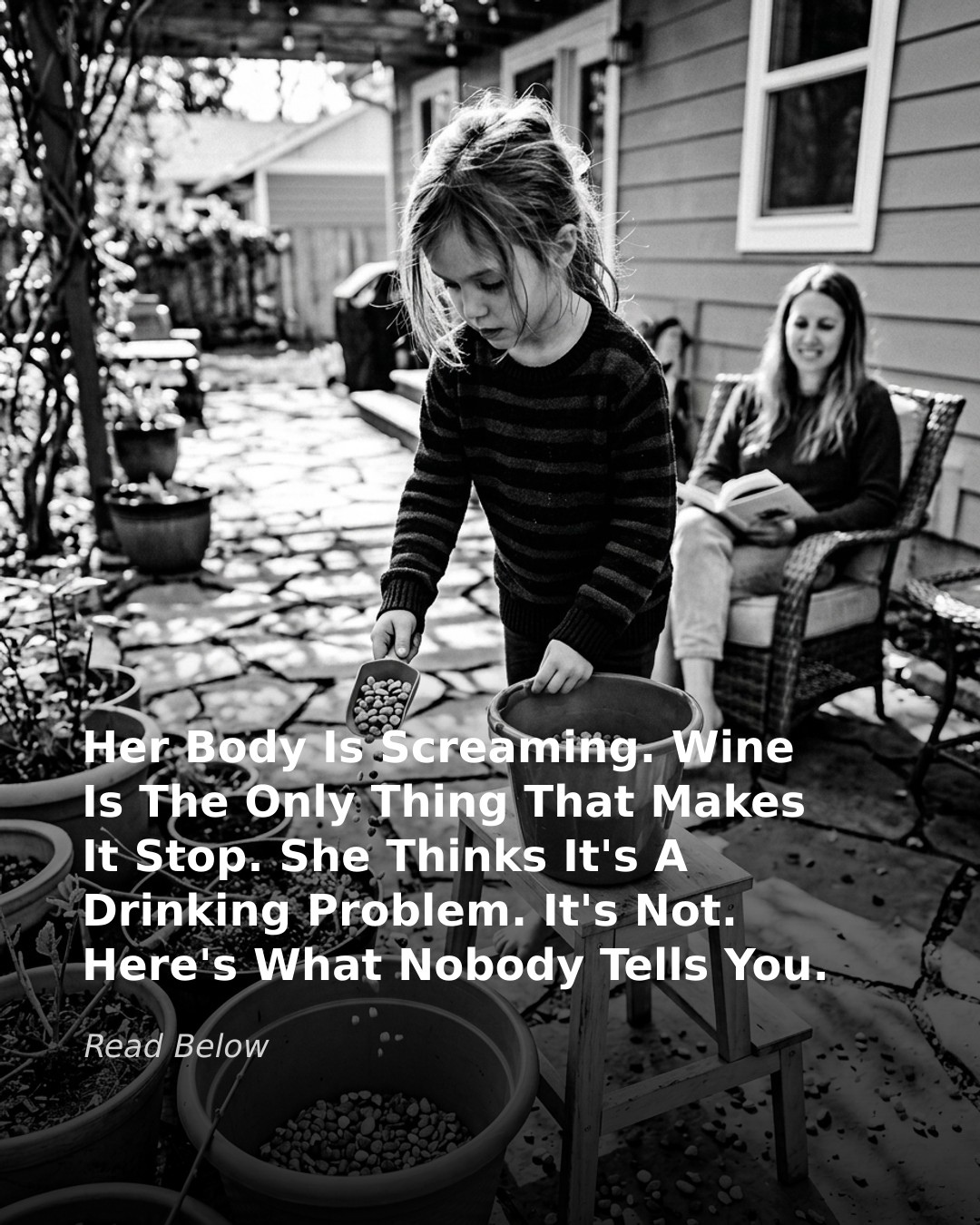
I watched my sister disappear into a bottle of wine every evening for two years. She wasn't drinking. She was hiding. There's a difference. My sister and I are eighteen months apart. We grew up in the same house. Same parents, same school, same everything — including the same faith. We went to the same church, sat in the same pew, learned the same prayers. I know her the way you only know someone you've watched become who they are from the very beginning. I watched her become someone I didn't recognize over about two years. Not dramatically. That's the thing about it. There was no moment. No rock bottom. No scene I can point to. Just a slow, quiet shift that I kept explaining away until I couldn't anymore. The first time I noticed: Christmas, two years ago. We were at mom's. Kate opened a bottle of wine at 4 PM. I thought: long year. Didn't say anything. The second time: her birthday dinner. Two glasses before the food arrived. I thought: she's celebrating. Didn't say anything. The third time: a random Tuesday. I stopped by after work. She opened the door with a glass already in her hand. 5:15 PM. Tuesday. I started paying attention. 5:15 became 5:00. Became 4:45. Became as soon as the kids are occupied. Became while I'm making dinner. Became I just need a minute. Every day needed a minute. Every day had something to hide from. I want to be precise about what I was watching. Kate wasn't falling apart. She was functioning — working, parenting, showing up. She and her husband were at church every Sunday. They looked like the couple everyone points to. You know the ones. Solid faith, solid marriage, solid family. The kind of people you'd call "couple goals" without thinking twice. But I'd been watching closely enough to see what Sunday mornings cost her. She had explanations. Work was hard. The kids were exhausting. Marriage is complicated. Everyone drinks. And besides — it's just wine. It's not like it's a real problem. She wasn't wrong about any of it. Work was hard. The kids were exhausting. But there was something else underneath the explanations. Something I recognized because I'd watched her try to pray it away before she poured it away. I'd seen her on her knees on Sunday mornings. I'd seen her close her eyes in the pew and hold very still, like she was trying to find something she'd lost. I'd seen her come home from small group with that same tight look around her eyes that she had before the glass. She wasn't failing to pray hard enough. She was exhausted in a way that prayer alone wasn't reaching. And the wine was getting there faster. Here's what I mean by that. Before the glass, Kate was tight. Shoulders up near her ears. Jaw set. Short with the kids. Short with her husband. Short with me. Moving fast, talking fast, a kind of coiled energy that radiated off her. Like she was carrying something very heavy and trying not to let anyone see how heavy it was. Then the glass. And within twenty minutes: the shoulders dropped. The jaw softened. She'd laugh at something. She'd sit down instead of pacing. She'd look at me and actually see me instead of looking through me. She wasn't drinking to feel good. She was drinking to feel less. To put down whatever she'd been carrying all day. To stop running from something she couldn't name. The wine wasn't the problem. The wine was the exit door. And she'd been walking through it every evening because nothing else — not prayer, not church, not sheer willpower — had shown her another way out. The night I almost said something and didn't: We were in her kitchen. Her kids were upstairs. She was on her second glass — maybe third. I'd had one. Her youngest came downstairs. "Mommy, I can't sleep." Kate said — without looking up, without pausing — "You're fine. Go back to bed." He stood there for a moment. Then went back upstairs. Alone. He's six. I watched him go up the stairs by himself and I opened my mouth. But Kate turned to me and said: "God, I'm sorry. He does this every night. I just need five minutes." And she refilled her glass. And the moment passed. I drove home and sat in my driveway for a long time. I should have said something. The night I actually said something: Two months later. Her kitchen. Her glass. 4:52 PM. I said: "Kate, what are you hiding from?" She laughed. "What?" "Every evening. The glass. What are you running from?" She stopped laughing. "I'm not running from anything. I'm just tired." "You've been tired for two years. What are you tired of?" She looked at me the way you look at someone who's said the thing you know is true and you hate them for it. "I don't know," she said finally. "I just know that by 4 PM every day something in me is completely done. Like I've been holding everything together all day and I can't hold it for one more second. And the wine is the only thing that makes me feel like I can put it down." She paused. Then, quieter: "I've prayed about it. I've asked God to take it. It doesn't go away. And I don't know what that says about me." I can't hold it for one more second. I wrote that on a receipt when I got to my car. I still have it. She didn't stop that night. I didn't expect her to. But something had broken open — not just the drinking, but the shame underneath it. The quiet belief that if she were faithful enough, strong enough, she wouldn't need the exit door at all. Three weeks later I was up late — couldn't sleep, scrolling — and I found an article about the nervous system and chronic stress. Not about alcohol. Not about addiction. Not about faith or willpower or moral failure. About what happens when a body has been carrying too much for too long. The article explained: when a nervous system has been in survival mode for years — running on cortisol, never fully recovering, always braced for the next thing — it loses the ability to come down on its own. The off-switch stops working. The body doesn't know how to transition from holding everything together to resting. It's stuck in the carrying. And when a body is stuck in the carrying, it looks for the fastest exit it can find. Something that does in twenty minutes what the body can no longer do on its own. Something that makes the holding feel, just for a few hours, like putting down. Kate wasn't drinking because she was weak. She wasn't drinking because her faith wasn't enough. She was drinking because her body had forgotten how to rest without it. Because the exit door was right there every evening and nothing else was getting her all the way down. The article mentioned Liven. Not an addiction program. Not willpower training. Something designed to work directly with the nervous system — to help the body find its own way down so it stops needing an exit door. I texted Kate the link at 1 AM. One line: "Read this. It's not about the wine." She read it at 6:30 AM. Called me at 6:45. "This is me," she said. "The 4 PM thing. The can't-hold-it-anymore. The needing something to put it down. This is exactly me." "I know." "But it's not about the wine?" "It's not about the wine." She was quiet for a moment. Then: "So it's not that I'm not trying hard enough?" "It's not that you're not trying hard enough." She took the quiz that morning. Started the app before she got out of bed. Here's what I watched from the outside over the next few months. Week one: She still poured at 4:30. But she texted me: "Doing the app. Haven't noticed anything yet. Keeping going." Week two: "Forgot to pour until 6:30. Is that something?" It was something. Week three: "One glass last night. Didn't want the second. That's never happened." Week four: "Three nights without wine this week. Didn't fight it. Just didn't feel like it. The 4 PM thing was quieter." Week six: I went over on a Wednesday at 5 PM. She opened the door. No glass. I looked at her hand. She saw me look. She held up a sparkling water. "Don't." I didn't. But I sat in her kitchen and watched her be present at 5 PM — actually present, not managed-by-wine present — for the first time in two years. Her youngest came downstairs. "Mommy, can I show you something?" She looked at him — actually looked at him — and said: "Yeah, come here. Show me." He climbed into her lap. She held him. I looked away because I didn't want her to see me cry. Week ten: She called me on a Sunday afternoon. Just to talk. The way she used to call before the evenings got heavy. We talked for an hour about nothing. About everything. The way sisters talk when neither of them is managing anything. It's been five months. Kate drinks maybe once a week now. A glass at dinner. At a restaurant. The way she used to drink at 32. She told me last week: "The 4 PM thing is gone. I don't know when it left. I just noticed one day that my body knew how to put it down on its own. Without the exit door." Then she said something I keep thinking about: "I used to think I was praying wrong. That the wine meant something was broken in my faith. But it wasn't a faith problem. It was a body problem. And once my body learned to rest — the wanting just went quiet on its own." Her body knows how to put it down on its own. That's the whole story. Her nervous system learned to come down without the wine. So the wine stopped being the exit. I'm writing this because Kate said I could. Because she said: "If other women are sitting in the pew every Sunday holding everything together and pouring a glass the minute they get home — someone should say something." So I'm saying something. If you have a Kate — a sister, a friend, a woman you love who looks fine on Sunday and disappears into her evenings by Tuesday — ask. Not "are you drinking too much." Ask: "what are you hiding from? What can't you hold anymore?" And if you ARE Kate — if the 4 PM thing is real and the wine is the only exit you've found, and you've already tried to pray it away — It's not a faith problem. It's not a willpower problem. It's a body that forgot how to put things down on its own. And the wine is filling a gap that your nervous system used to fill. Liven has a quiz. A few minutes. Free. It asks about the carrying. Not the glass. Link is below. 💙 P.S. — Kate knows I'm posting this. She read it first. She said: "Tell them the exit door doesn't disappear. You just stop needing it. Tell them my son climbs into my lap now instead of going back upstairs alone. Tell them I can sit in church on Sunday without feeling like I'm holding my breath until I get home." I'm telling you. 💙
THIS IS what you need to do
LEARN MORELike this ad? Make it yours.
Crush rebuilds this exact creative around your product — your brand, your colors, your offer — in about a minute.