Mark Delaney
Mark Delaney Facebook ad: “Eleven of twelve copper water bottles I tested at my…”
Ran for 3 days, from June 12 to June 15, 2026, the last day Crush saw it.
Run by Mark Delaney on Facebook. Crush is not the advertiser and does not verify its claims. See this ad in Meta's Ad Library(opens in a new tab)
Want an ad like this for your product?
Crush makes new ad images for your product from this ad: your logo, your product photo, your offer.
Trials from $19.95 USD, then $79.95 USD a month. Cancel anytime.
About this ad
- Meta Ad Library ID
- 1701151507887612
- Platforms
- Facebook, Instagram, Audience Network, Messenger and Threads
- Relaunches
- 14
Ad text
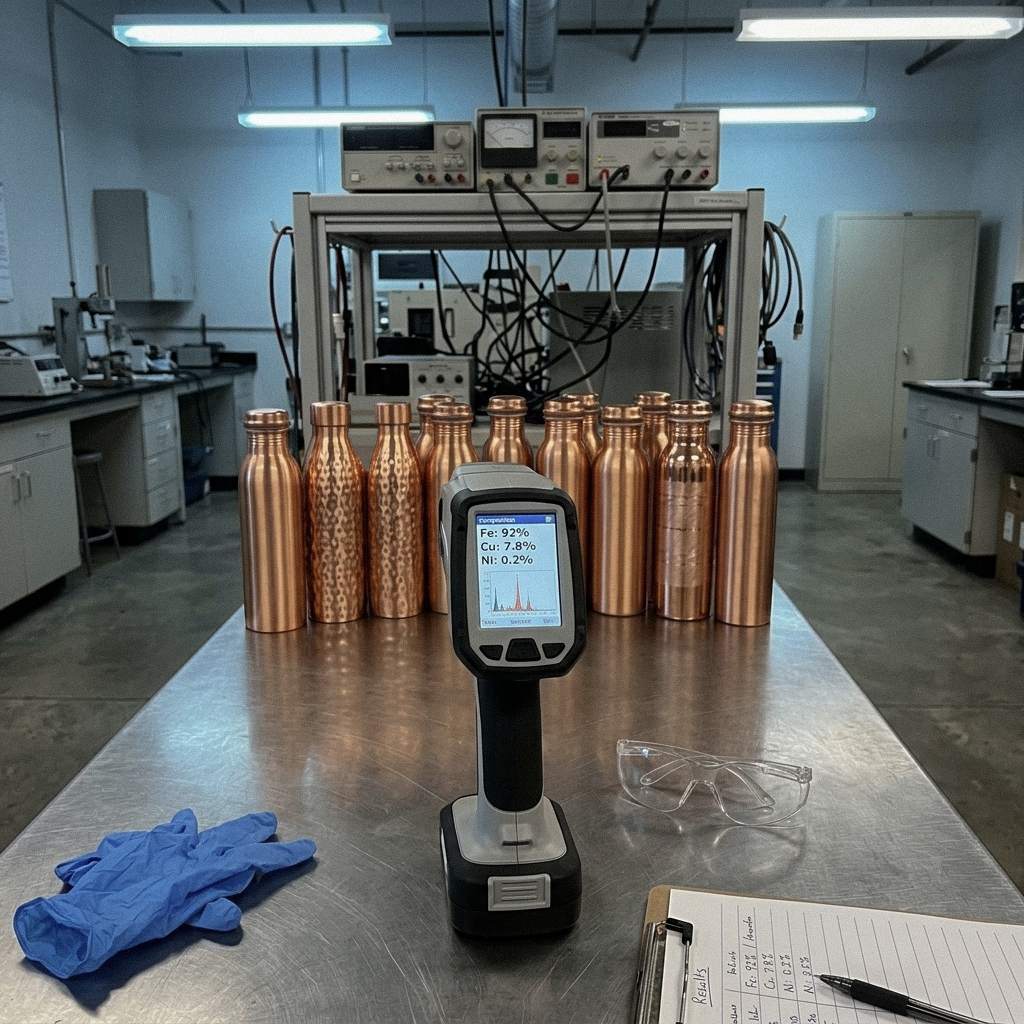
Eleven of twelve "copper" water bottles I tested at my materials lab last spring stuck to a magnet. The twelfth read at eight percent copper, plated brass. None of them were what their packaging said. They came from a wellness shop my college roommate was about to stock for the season. Sara called me on a Sunday in March. I had just sat down to eat lunch. She said, "I think I just sold a steel water bottle to a woman with arthritis. I need you to test the rest." Sara is my college roommate from Bowling Green. She runs a small wellness shop in Akron. We talk maybe four times a year. She told me a customer named Patty had brought a bottle back the day before, complaining the water tasted "metallic in the wrong way." Patty had bought it for her morning hot lemon water, which is what brought up the metallic question — copper plus acid plus heat is a real reaction Sara knew enough to be worried about. Sara hung up Patty's bottle on a peg behind her counter and looked at the wall of "copper" bottles she had been planning to stock for spring. Twelve different brands. About four hundred dollars she had spent on samples. She did not want to put any of them out until she knew. I'm a materials engineer at a testing lab in Akron. I run X-ray fluorescence analysis on metals. Mostly for industrial clients who need a third-party report before a supplier ships them ten thousand units of something. It is not exciting work. Sara mailed the twelve bottles to me on Monday. I told her I would run them Saturday morning when the lab was empty. I want to describe what I did because the test itself is something you can do at home. I started with a magnet. A fridge magnet. I held it to the bottom of each bottle. Eleven of twelve sticked. Hard. The twelfth gave a weak attraction, not nothing. I lined the eleven on one side of the bench and the twelfth on the other. Then I ran XRF. The eleven all read as ninety-plus percent iron at the substrate, with a thin copper coating on the outside. The twelfth was a copper-zinc-nickel alloy at about eight percent copper. None of them were the "ninety-nine point nine percent pure copper" their packaging said. I sat at my desk for a minute. I have a kid in middle school. My wife Karen teaches kindergarten and has had stiff knees since she was thirty-four from sitting on classroom floors. She had been drinking from a "copper bottle" I bought her three years ago. I had never tested it. It had never occurred to me to test it. I work in materials. I drove home and pulled Karen's bottle off the kitchen counter. Magnet stuck. I did not say anything that night. I lay awake thinking about Patty in Sara's shop. Monday morning I emailed all twelve brands. I attached the XRF reports. I asked, politely, to explain the discrepancy. I offered to retest a different production batch. Three months later not one of them has written back. Not one. Sara took her copper-bottle shelf down. She replaced it with a small handwritten card that said, "We are working on finding a real one." I started looking. Not for Sara. For Karen. I bought four more "copper" bottles from different brands on Amazon over six weeks. I ran XRF on all of them. Three failed completely. One was marginal — about fourteen percent copper, the rest brass alloy with trace nickel. Brass is not copper. The one I finally found is called House of Ayurveda. Sara had heard about them from her aunt in Cleveland who had been ordering from them directly for nine years. The aunt is seventy-one and does not have stiff hands. Sara had not connected it before. The brand hand-hammers their bottles in Moradabad, in northern India. They publish an SGS lab certificate openly on their site. SGS is a name I know — they certify industrial materials for European clients I have worked with for years. I checked the certificate against the SGS database directly. It was real. I bought one bottle. I ran XRF on it before I drank from it. The reading came back at 99.86% copper. That is within rounding of their published number. I ran the magnet. Clean drop. I ran it again. Clean drop. I bought one for Karen. Then I bought one for Sara for her shop. Then I bought one for Sara's aunt as a thank-you, even though she already had one. Sara laughed at me when I told her. I tested Karen's new bottle before I gave it to her. She thinks I am thorough. She said, "I know what you're going to say, Mark, just give me the bottle." Week one she said the water tasted "different. Like the well water at my grandmother's farm. Cleaner." I did not have a chemistry explanation for that. Week three she stopped wearing her wrist brace at night. I noticed because the brace had been on her nightstand for two years and one morning it was in the bathroom drawer. Week six the school nurse asked her what she had been doing differently. Karen said she didn't know, she had been drinking water. The nurse asked her if it was the lemon water thing she had read about. Karen said it was actually a copper bottle. Then Karen had to explain the magnet test to a school nurse and a fifth-grade gym teacher in the staff room. I want to be careful here. Karen also stopped grading papers in bed last fall. Karen also started doing the yoga her sister bought her a video for. Karen also drinks more water than she did before because the bottle is on her counter where she sees it. I am not telling you a water bottle fixed my wife's knees. I am telling you she switched one thing at a time, kept the new bottle, and is measurably better. What I can also tell you, as someone who works in materials, is that real copper has documented antimicrobial properties. American hospitals install it on high-touch surfaces in their ICUs for the same reason. India has been drinking from it for five thousand years and the practice has a name there: Tamra Jal. Peer-reviewed research on copper's antimicrobial action goes back to 1893. The fake bottles in my XRF reports could not do any of that work. The one Karen has now can. If you have a copper bottle at home, take a magnet from your fridge and hold it to the bottom of the bottle. If it sticks, the bottle is steel. Whatever you have been hoping that bottle is doing for you, it has not been doing. This is the brand I bought for Karen, for Sara, and for Sara's aunt in Cleveland: https://houseofayurveda.co/products/himalayan-ayurvedic-pure-copper-bottle-hammered
Where the ad sends people
houseofayurveda.co
Eleven of twelve "copper" water bottles I tested at my materials lab last spring stuck to a magnet.
250,000+ Happy Customers
Learn more: houseofayurveda.co(opens in a new tab)