Linsay - Menopause Matters
Linsay - Menopause Matters Facebook ad: “Over $800 worth of failed products in the trash”
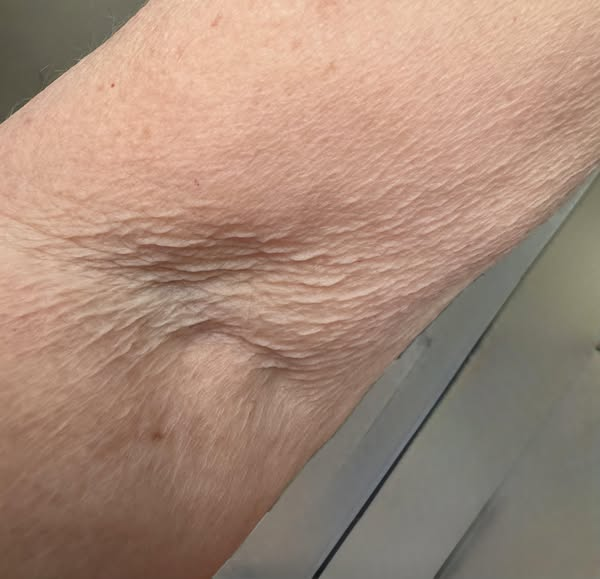
Ran for 2 days, from July 26 to July 28, 2026, the last day Crush saw it.
Run by Linsay - Menopause Matters on Facebook. Crush is not the advertiser and does not verify its claims. See this ad in Meta's Ad Library(opens in a new tab)
Want an ad like this for your product?
Crush makes new ad images for your product from this ad: your logo, your product photo, your offer.
Trials from $19.95 USD, then $79.95 USD a month. Cancel anytime.
About this ad
- Meta Ad Library ID
- 1705689603980735
- Platforms
- Facebook, Instagram, Audience Network, Messenger and Threads
- Relaunches
- 4
- Niche
- Skincare & Beauty
Ad text
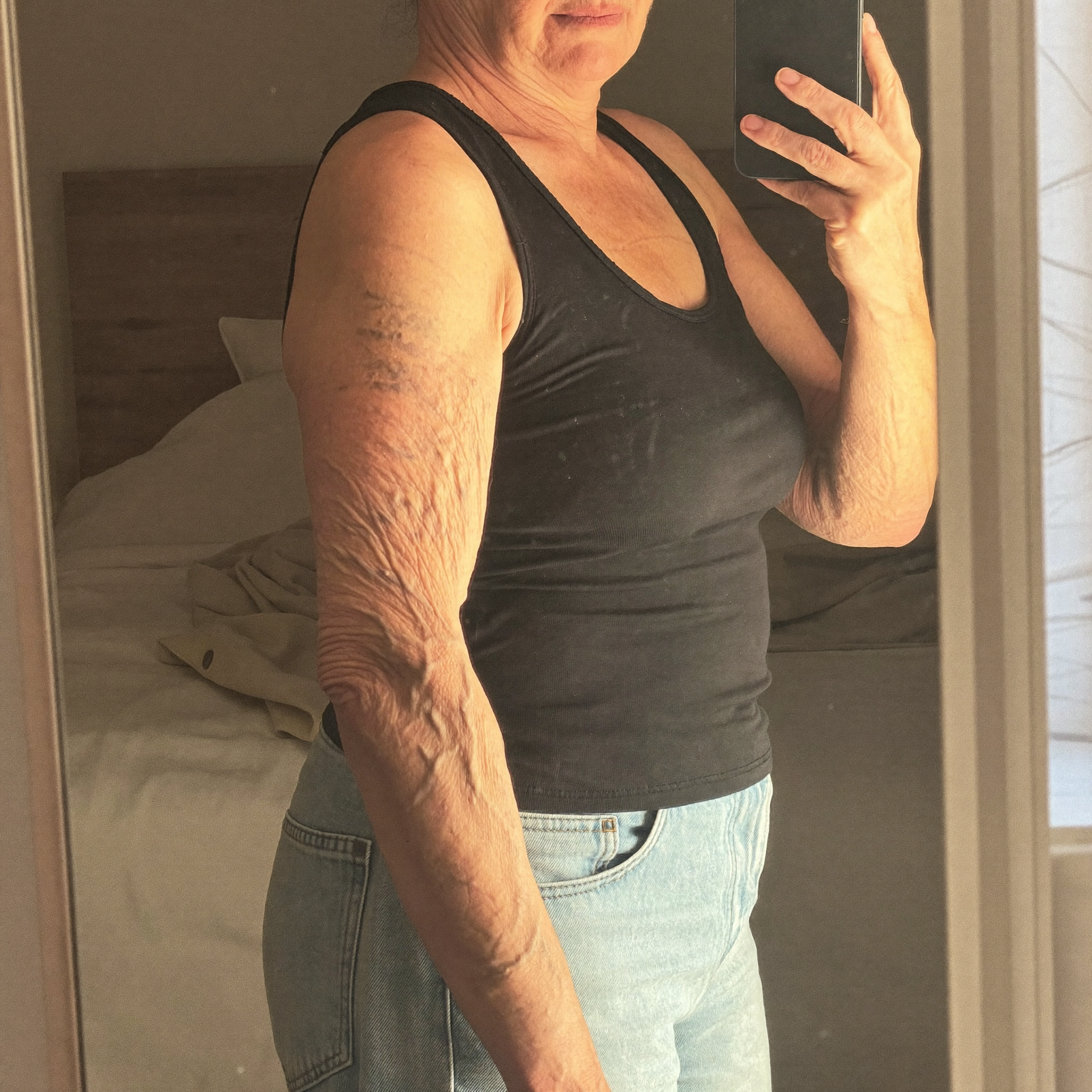
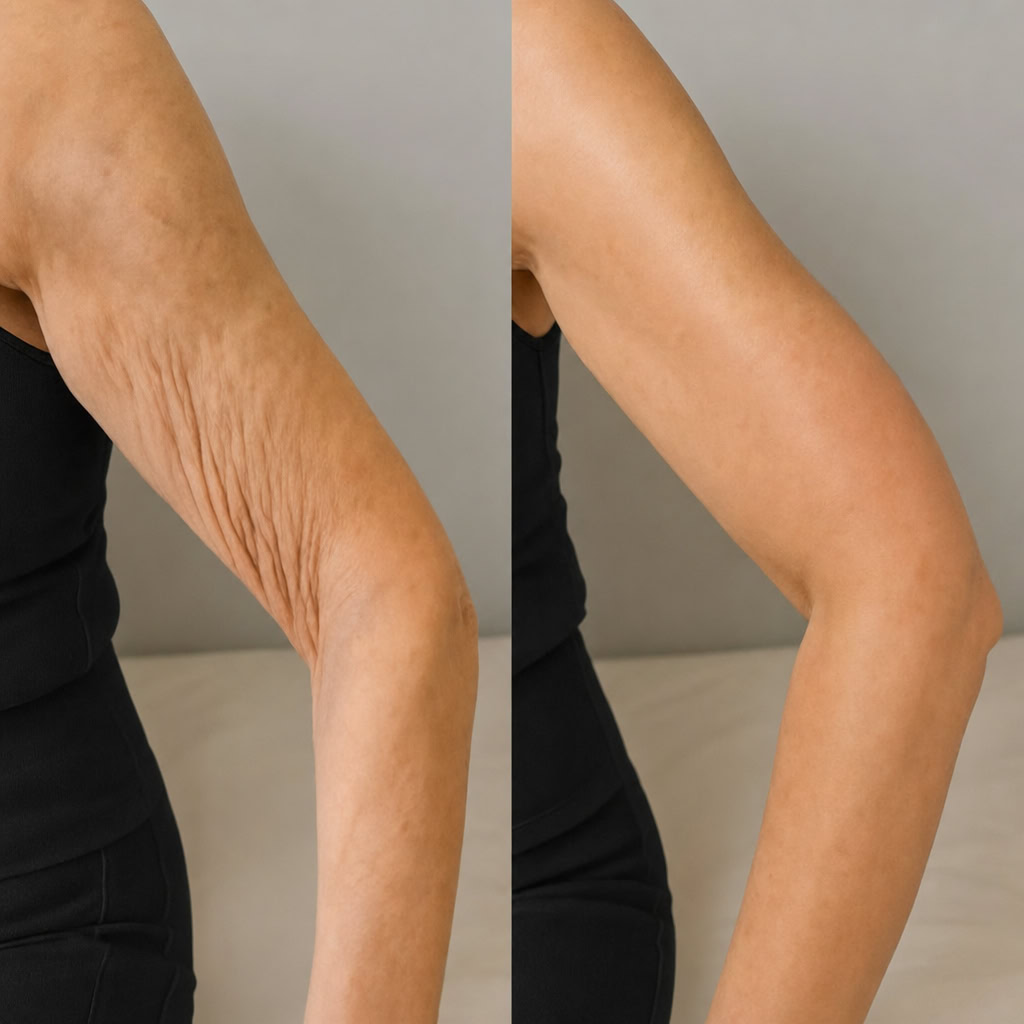
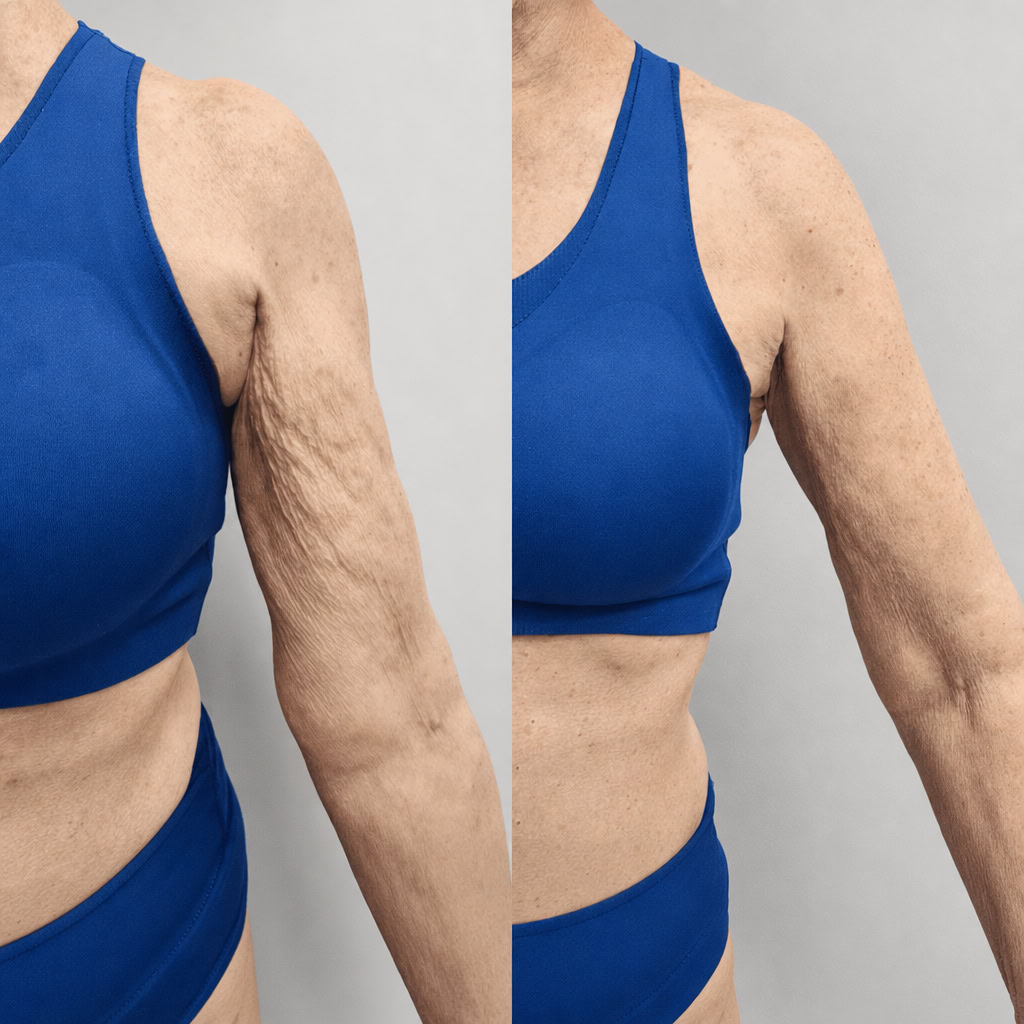
I'm 53, I've been training for three years, and I've always had thin arms. Then I lost 17 pounds and the skin on my upper arms went crepe in three months. The muscle underneath answers to everything I ask of it. The skin right above it answers to nothing. At first I thought it was the sun. It was the only explanation that held up, you understand. I spent every summer of my life near the water. So I told myself, there it is, you got too much sun, now you're paying for it. A late punishment, but a logical one. Except the sun doesn't work in three months. ═══════ I have to describe my arms to you the way they were, or you won't understand the shock. I was always the girl with thin arms. Not muscular — thin. Even in school. My mother used to say I had dancer's wrists. They were the one thing on my body I never had to watch. My stomach yes, my thighs sometimes, but my arms, never. They were mine, they were fine, end of story. I started working out at 50. Three years of regular classes, cardio, some weights, an instructor who calls me by my first name. I'm stronger now than I was at 40 — that part is true. When I make a fist and flex, the muscle is there, defined, it answers. And sitting right on top of that muscle is skin I don't recognize. Crepey. Fine horizontal lines running along the inside of my arm, like crepe paper. A texture that moves on its own when I reach up for something on a high shelf. I've never had this. At any weight. At any age. ═══════ I lost the 17 pounds last fall. Slowly, cleanly, the way you're always told to. I was proud of it. Three months later, pulling on a sleeveless blouse in front of the bedroom mirror, I watched the top of my arm crease as I raised it. I froze. I did it again, slowly. The skin wrinkled, half-uncreased, wrinkled again. I didn't think I'm getting older. I'd been perfectly fine three months earlier. You don't age ten years in a quarter. I thought: the sun. It has to be the sun. And I covered up. Blouses with sleeves. A thin linen cardigan I kept over my shoulders even on a patio in June. I became an expert at extending my arm without really raising it — reaching for the salt at the table, waving to someone across the street. You learn those movements fast. You stop noticing you're making them. My daughter took a picture of me at a birthday party this winter. I had a sweater on, everything was fine. But when she sent me the photo, the first thing I did — before I even looked at my own face — was check that you couldn't see my arms. That's when I understood something was wrong. Not with my arms. In my head. I was managing an angle. All the time. ═══════ I brought it up with my dermatologist at an appointment for a mole. I showed her. I said, "It's the sun, right?" She looked. She was kind. She said: "It's age, and yes, a little sun. Skin loses elasticity after menopause, it's normal. There are creams that moisturize, they help with comfort. But for the texture itself, honestly, there isn't much." Normal. That word got stuck. Because it wasn't normal. Something that takes three months is not "normal." The sun takes twenty years. Menopause settles in gradually. This landed on me between September and December, like a switch someone flipped off. I believed her anyway. You believe your dermatologist. And I went home with the idea that I needed to grieve my arms. ═══════ What I bought after that, in order, because if you're reading this you've probably lived it: A firming cream from the drugstore, $44. Eight weeks. Nothing. An "elasticity" serum the saleswoman swore was a miracle, $68. Ten weeks. Nothing. A retinol body cream I found online, $39. It irritated my skin and changed nothing else. Nothing. Collagen capsules, two boxes, three months, about $89. My nails grew faster. My arms, nothing. An at-home radiofrequency device I saw in an ad, $132. Ten minutes per arm, three nights a week, for two months. Nothing. Total: $372 over six months. Five different things. Not one of them changed the texture in any way I could measure. And the worst part isn't the money. The worst part is that during those six months the clock was running, and I didn't know it yet. ═══════ It was a friend, Helen, who told me about Anne. Helen had the same problem after a big weight loss, and she said, "Call her, she's in the city this month, she doesn't work like the others." Anne is a French esthetician, in her seventies, nearly forty years in practice working on women's skin after menopause and after weight loss. Exactly what I had. I didn't really believe in it. I'd already paid $372 to be told there was nothing to be done. But Helen kept pushing, so I went. Anne pressed her thumb into the skin at the top of my arm. One second. She let go. The dent stayed. It took almost five seconds to come back. She wasn't looking at my arm. She was looking at me. "Have you lost weight recently?" Seventeen pounds. Last fall. She nodded, slowly. "It isn't the sun. And it isn't simply age. Your dermatologist isn't lying to you — she has the wrong category." ═══════ She sat me down and took out a sheet of paper. Normal aging, she explained, is about one percent of collagen lost per year. Slowly. Steadily. That's what your dermatologist is trained to recognize, and for that she's right — there isn't much to be done, it happens over twenty years. "But you didn't lose one percent a year. You lost two or three years of structure in a few months. Because two things happened at the same time: the hormonal upheaval of this period, and the support cushion under the skin emptying out when the weight came off." She drew a cross-section. The surface. Then, four to five millimeters down, the layer where that cushion lives. "That's where the collapse is. Not on the surface. Which is why nothing you put on top ever touched it — not the cream, not the serum, not the radiofrequency. They stay up here. The problem is down there." That explained everything. Five products. $372. Every one of them working on a floor where the problem wasn't. Then she said the thing that made my hands go cold. "From the moment it starts, you have roughly eighteen to twenty-four months during which the cells that build the structure — the fibroblasts — are dormant, not dead. Wakeable. After that, they settle into the sleep. Permanently. Count backward from your weight loss." Last fall. I was already nine months in. I had, at best, nine months to a year left. ═══════ She didn't name a brand. She wrote three requirements on the paper and said, "Find a product that does these three things. I don't care which one." One — it has to be an oil, not a cream. A plant oil light enough to cross the skin barrier and reach the layer four or five millimeters down. Creams stay on the surface; that's their nature. "You will never fix the basement by repainting the walls." Two — it has to contain something that wakes the dormant fibroblasts. She named bakuchiol: the effect of retinol, without the irritation or the sun sensitivity. Precisely what had made my retinol cream fail. Three — it has to put back the lipids menopause removed, so the structure can rebuild. She talked about a camellia oil the skin recognizes as its own. "All three. Twice a day. Otherwise it's pointless." She handed me the sheet. "Check it yourself. Read about cushion collapse. Then decide." ═══════ I searched for two evenings. It's a real subject. Real research, clinics in Paris, in Milan. Then I went into the Facebook group I'd landed in after my weight loss, and I typed arms. The same name kept coming up. Eraé Queen Oil. I read that thread twice. The same things kept surfacing. The thumb test going from five seconds to under two in ten weeks. A sleeveless dress at a wedding, the first since 2019. A woman who'd been hiding under cardigans in summer, at her granddaughter's birthday in a tank top, and her daughter's face when she walked in. Women whose dermatologists had told them there was nothing to be done, writing back at week twelve to say the texture hadn't improved — it had changed. I looked at the formulation. Bakuchiol. Camellia. Exactly Anne's sheet of paper. I ordered it that night. The little linen cardigan was still hanging on the back of my chair while I clicked. ═══════ I'm going to be honest, because I've been lied to enough times. The first week, nothing spectacular. The oil absorbs in thirty seconds, no greasy film, but I thought, here we go, another one. Day 12 — out of the shower, I looked at the inside of my arm. The fine lines seemed less hollow. Not smoothed over on top. Like something was filling in underneath. I told myself I was imagining it. Week 4 — I did the thumb test again. The dent came back in a little over three seconds. It had been taking five. Week 6 — I raised my arm in front of the mirror to reach for a sweater on a high shelf. The movement I'd been avoiding for a year. The skin moved less. I did it three more times to make sure I wasn't inventing it. Week 8 — I caught myself waving to a neighbor across the street with my arm up, fully, without thinking. I froze mid-gesture. Not because something was wrong. Because something was right, and I hadn't calculated anything. That's what I wanted to tell you. It isn't the skin. It's having stopped managing an angle every waking minute. Being someone in the room again, instead of a woman keeping an eye on her arm. ═══════ If you lost the weight and instead of the reward you were promised, you inherited arms you hide — If your doctor told you it was "normal," that it was age, that it was the sun — She has the wrong category. It isn't the sun. The sun doesn't work in three months. It isn't simply age. It's a recent collapse, triggered, and repairable — but not forever. From the beginning, the window is eighteen to twenty-four months. Most of us are already at twelve or fifteen by the time we understand what's happening. Most of us have less time than we think. Eraé Queen Oil does the three things on Anne's sheet of paper: ✓ An oil, not a cream — light enough to cross the surface and reach the cushion layer, where every cream you've tried stayed sitting on top. ✓ It wakes the dormant fibroblasts — bakuchiol, the effect of retinol without the irritation or the sun sensitivity. ✓ It rebuilds — Camellia Japonica, which the skin recognizes as its own, restoring the lipid barrier menopause removed. Sea Buckthorn and Evening Primrose replace the structural lipids it stopped making. Four plant-and-sea-derived heroes. All three jobs, at once, twice a day. 60-day money-back guarantee. Full refund. No forms, nothing to ship back, no questions. A bottle you can send back. The months you have left, you can't. ═══════ I'm not giving you any stock urgency, any countdown. This isn't a promotion. It's a clock. The cells don't switch back on by themselves. No cream turns back time. There's a window, and at this minute you're inside it, or you're not. I'll put the link just below. P.S. Three months now. Second bottle. The math is almost insulting next to the $372 from the six months before — the cream, the serum, the collagen, the radiofrequency device, all of it physically unable to reach where the problem was. The little linen cardigan, I don't know where it is anymore. It's not on the back of my chair. That much I know. P.P.S. My dermatologist isn't a liar. She told me what she was taught: slow, gradual, age, sun. For the woman losing one percent a year, she's right. For the woman it landed on in three months, it's the wrong floor. If it happened fast to you, count your months backward. Then decide while you still can.
Where the ad sends people
erae-paris.com
Over $800 worth of failed products in the trash
French Wisdom
Learn more: erae-paris.com(opens in a new tab)