
Active· since May 20, 2026
- 114
- days running
- 0
- relaunches
- 2
- EU reach
Ad copy
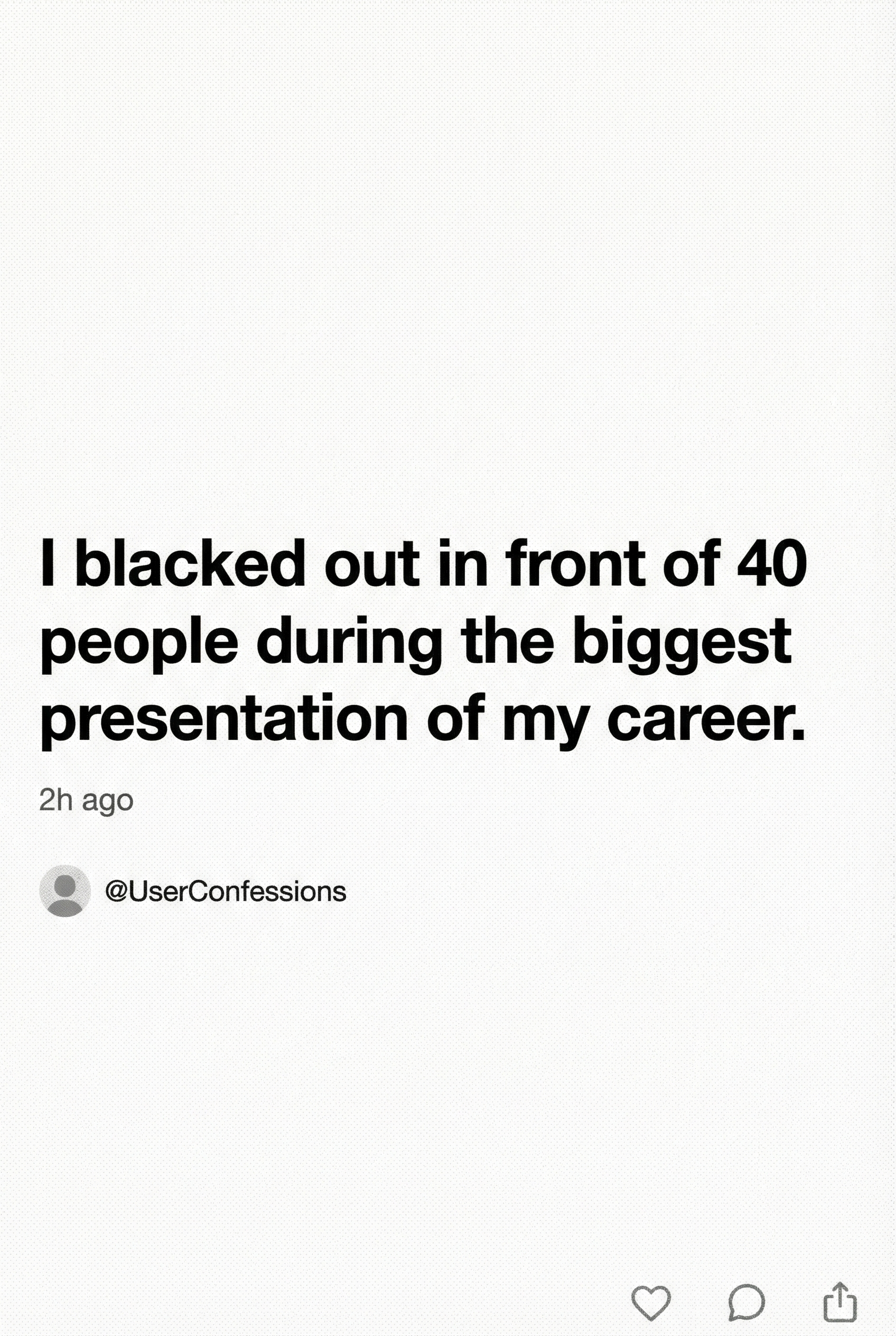
I blacked out in front of 40 people during the biggest presentation of my career. But that wasn't the worst part. The worst part was what I found on my husband's phone the night before. My name is Sandra. I'm 43 years old, a mother of two, and up until recently, I was a Marketing Director at a company I'd given seven years of my life to. And right here in this post, I'm going to tell you about the night I almost destroyed my marriage, the morning my body shut down in front of every executive at my company, and the one thing a doctor told me that changed everything. Let me start from the beginning. For the last three years, I'd been running on fumes. Not the kind of tired where you yawn a lot. The kind where you wake up feeling like you never slept. Where your brain is wrapped in cotton wool before you've even opened your eyes. Where the only thing standing between you and complete collapse is your next cup of coffee. And I mean that literally. Four cups a day. Sometimes five. A large one the second I woke up, another by 10am, one after lunch to fight the crash, and sometimes a fourth just to make it through the afternoon school pickup without losing my mind at the kids. I thought that was normal. I thought every working mother ran on coffee and willpower and whatever was left in the tank after everyone else got their share. On top of that, my body had been falling apart in ways I kept brushing off. My stomach was a disaster. Bloating after every meal. Cramps that came out of nowhere. I couldn't remember the last time my digestion actually felt normal. My skin looked grey. Dull. I'd aged five years in the last two. My hair was thinning around the temples — something I'd never dealt with before. I was stiff in the mornings. My joints ached. Not badly enough to see a doctor, but enough to notice. Enough to wince when I picked up my four-year-old. I mentioned it to my GP once. He told me it was probably stress. Told me to get more sleep. Wrote me a prescription for ibuprofen and sent me on my way. So I took the ibuprofen. I bought turmeric capsules because my coworker Sarah swore they changed her life. I tried magnesium gummies. I tried melatonin for the sleep. Nothing made a real difference. But I figured — this is just what 43 looks like when you're running a department, raising two kids, and trying to hold a marriage together. Speaking of my marriage. That's the part I haven't told you yet. For the last several months, something had shifted between me and my husband, David. He was distant. Not in a dramatic, movie-style way. Just... not there. He'd come home later than usual. He'd be on his phone more. When I'd ask him what he was looking at, he'd lock the screen and say "just work stuff." He stopped reaching for me in bed. Stopped asking about my day. We used to laugh together. Now we just... coexisted. I told myself it was nothing. We were both busy. We were both tired. Every marriage goes through phases. But there was this feeling in my gut. This constant, gnawing anxiety that something was wrong. Something he wasn't telling me. I started watching him. Not obviously. But I'd notice things. The way he'd angle his phone away from me. The way he'd step outside to take certain calls. The way he'd shower the second he got home from work, which he never used to do. My mind started filling in the blanks. And the story it was writing was devastating. But I pushed it down. I had to. Because I had the biggest week of my career coming up. Our company was pitching a new brand strategy to the CEO and the entire senior leadership team. Forty people in the room. And I was presenting. If this went well, I was getting the promotion I'd been working toward for two years. VP of Marketing. A seat at the table. Everything I'd sacrificed for. So I buried the anxiety about David, poured another coffee, and kept going. Then came the night before the presentation. It was a Tuesday. Just past midnight. I was lying in bed, staring at the ceiling, running through my slides in my head for the hundredth time. David was asleep next to me. Or at least I thought he was. His phone buzzed on the nightstand. I told myself not to look. I told myself it was nothing. But my hand was already reaching for it. The screen lit up. One new message. From a name I didn't recognize. A woman's name. I felt my chest tighten. I opened it. There were messages going back weeks. Heart emojis. Laughing emojis. The kind of easy, flirty energy that I hadn't felt from him in months. And the last message, the one that just came in, said: "Can't wait to see you Thursday ❤️" My entire body went cold. I put the phone back on the nightstand with shaking hands. I rolled over. My heart was pounding so hard I could hear it in my ears. I didn't sleep. Not one minute. I just lay there in the dark, next to the man I'd built my entire life with, replaying every sign I'd ignored. The late nights. The phone. The distance. The showers. It was all right there. By 6am, my alarm went off. I hadn't slept. My eyes were swollen. My head was pounding. I dragged myself out of bed, looked at myself in the mirror, and barely recognized the woman looking back at me. But I had to present. Forty people. The CEO. My promotion. So I did what I always did. I made coffee. A large one. Then another. Then a third before I even left the house. I popped two ibuprofen for the migraine that was building behind my eyes. I put on makeup to hide the fact that I looked like I'd been crying for six hours. Because I had been. Silently. In the dark. Next to a man I thought I knew. I drove to the office on autopilot. Walked into the building. Smiled at reception. Took the elevator to the fourth floor. Walked into the boardroom. Forty people. Already seated. Laptops open. The CEO in the front row, coffee in hand, looking at me expectantly. I plugged in my laptop. My slides appeared on the screen behind me. I took a breath. "Good morning, everyone. Thank you for being here. I'm going to walk you through our proposed brand strategy for Q3 and beyond." Slide one. Fine. Slide two. Fine. My voice was steady. Professional. Nobody could tell I was running on zero sleep, three coffees, and a broken heart. Slide three. "And our Q3 projections show—" That's when it happened. My heart started racing. Not like nerves. Like something was wrong. I felt a wave of heat rise from my chest to my face. My vision narrowed. The edges of the room went dark, like someone was slowly closing curtains around me. The words on my slides blurred. I gripped the edge of the podium. I tried to keep talking. Tried to push through. "Our Q3 projections show that we can expect—" But my voice sounded far away. Like it was coming from someone else. The last thing I remember is my hands slipping off the podium. Then black. I woke up on the boardroom floor. Someone had put a jacket under my head. A cold cloth on my forehead. My boss was kneeling next to me, gripping my hand, saying my name. "Sandra. Sandra, can you hear me? The ambulance is coming." I could hear people whispering. I could see the blurred outlines of my colleagues standing around me in a half-circle, some of them on their phones. And all I could think was: this is it. My career is over. The paramedics arrived within minutes. They put me on a stretcher, wheeled me out past every single person I worked with, and loaded me into the ambulance. I stared at the ceiling of that ambulance and cried. Not because of the collapse. Not because of the presentation. Because in that moment, lying on that stretcher, I felt like I was losing everything at the same time. My marriage. My career. My health. My mind. All of it. Slipping away. At the hospital, they ran bloodwork, an EKG, checked my vitals, asked me a hundred questions. I kept telling them — I'm healthy. I'm only 43. I don't smoke. I barely drink. This doesn't make sense. About two hours later, a woman in a white coat walked in and introduced herself as Dr. Priya Anand, an endocrinologist and stress physiology specialist. She sat down next to my bed, looked at my chart, then looked at me. "Sandra, your cortisol levels are critically elevated. Your adrenal system is in crisis." I stared at her. She asked how long I'd been dealing with chronic fatigue, sleep problems, digestive issues, brain fog, and anxiety. I said years. She nodded slowly, like she'd heard that answer a thousand times. Then she said: "Can I be honest with you about what's happening inside your body right now? Because what I'm about to tell you, most doctors won't." I nodded. She said: "Sandra, you didn't collapse because of one bad night. You collapsed because your body has been running in survival mode for years. And it finally hit its limit." She explained it to me step by step. And everything she said made my blood run cold. She said that cortisol — the stress hormone — is supposed to be temporary. When you face a threat, cortisol spikes. It sharpens your focus, increases your heart rate, and floods your muscles with energy so you can fight or run. Once the threat passes, cortisol drops back down, and your body recovers. But when stress is constant — when it's work deadlines and financial pressure and marital anxiety and sleep deprivation and four cups of coffee a day all stacked on top of each other for years — cortisol never drops. It stays elevated. Day and night. For months. For years. And when cortisol stays elevated for that long, it doesn't just make you feel stressed. It physically destroys your body from the inside. She told me there are five systems that chronic cortisol wrecks, and she went through each one. The first is your brain. She said this was the one that scared her the most. Chronic cortisol literally shrinks your prefrontal cortex — the part of your brain responsible for rational thinking, decision-making, and emotional regulation. At the same time, it enlarges your amygdala — the part of your brain responsible for fear, threat detection, and paranoia. She looked at me and said: "When your prefrontal cortex shrinks and your amygdala grows, you lose the ability to think clearly and gain an amplified ability to perceive threats. Even threats that don't exist." My stomach dropped. She asked: "Have you been feeling more anxious than usual? More paranoid? Like something bad is always about to happen?" I thought about David's phone. The texts. The woman's name. The way I'd been spiraling for months, convinced he was cheating. I whispered: "Yes." She said: "That's not a character flaw. That's cortisol physically reshaping your brain. Your brain has been rewired to see danger everywhere. Including in your own marriage." I felt tears running down my face. The second system is your gut. She explained that 70% of your immune system lives in your gut. And cortisol is its worst enemy. Chronic cortisol suppresses the repair of your gut lining. Over time, the lining becomes permeable — what they call "leaky gut." Toxins, undigested food particles, and bacteria leak through the gut wall into your bloodstream. Your immune system detects these invaders and launches an inflammatory response. But because the gut lining never repairs while cortisol is elevated, the leak never stops. So the inflammation never stops. That's why your stomach is a mess, she said. That's why you're bloating after every meal. Your gut lining has been under assault for years. The third is your sleep. Cortisol directly blocks melatonin production. Melatonin is the hormone that signals your brain it's time to sleep. When cortisol is elevated at night — which it is when you're chronically stressed — your brain can't produce enough melatonin to initiate proper sleep. You might fall asleep from exhaustion. But you're not getting deep, restorative sleep. Your body isn't repairing. Your brain isn't clearing out inflammatory waste. You wake up feeling like you never slept because, physiologically, you barely did. And then you drink coffee to compensate. Which spikes cortisol again. Which blocks melatonin again the following night. She said: "You've been caught in a cycle. Stress raises cortisol. Cortisol wrecks your sleep. Bad sleep makes you drink more coffee. Coffee raises cortisol further. And the cycle tightens every single day." The fourth is your appearance. Cortisol breaks down collagen. Collagen is the structural protein that keeps your skin firm, your hair thick, and your joints cushioned. When cortisol is chronically elevated, it accelerates collagen degradation throughout your body. That's why your skin looks dull and aged beyond your years. That's why your hair is thinning. That's why your joints ache in the morning. Cortisol has been silently breaking down the structural integrity of your body for years. She said: "You told the nurse you thought you'd aged five years in the last two. You weren't imagining it. Cortisol makes that happen." The fifth is your cardiovascular system. And this, she said, is what put me in the hospital today. Chronic cortisol keeps your blood pressure elevated. It constricts blood vessels. It increases heart rate. Day after day, month after month, your heart is working harder than it should just to push blood through narrowed vessels. She said: "Think of it like revving a car engine in neutral for three years straight. Eventually, something breaks." And for me, that breaking point was a boardroom on a Tuesday morning after a sleepless night, three coffees, and the worst emotional shock of my life. My nervous system was already at 95%. The presentation pushed it to 100%. And my body simply shut down. I sat there, in that hospital bed, and everything suddenly made sense. The brain fog. The paranoia. The gut issues. The aging. The fatigue. The collapse. It wasn't five different problems. It was one problem. One root cause. Chronic cortisol. And everything I'd been doing — the coffee, the ibuprofen, the turmeric, the melatonin — was either making it worse or putting a band-aid on a bullet wound. I asked Dr. Anand what I needed to do. She pulled her chair closer and said: "Sandra, there are two things that need to happen at the same time. If you only do one, it won't work." She held up one finger. "First, you need to break the cortisol cycle. Your adrenal system has been stuck in overdrive for years. You need something that directly regulates cortisol production and tells your nervous system it's safe to stand down. Without this, everything else — the gut damage, the brain changes, the sleep disruption, the collagen loss — will continue. You can't heal while the alarm is still ringing." She held up a second finger. "Second, you need to repair the damage that's already been done. Your gut lining is compromised. Your cognitive function has declined. Your collagen has been depleted. Your energy pathways are exhausted. You need compounds that actively rebuild these systems. Not mask the symptoms. Rebuild." Then she said the part that changed everything. "You need BOTH. One without the other doesn't work." I asked her what she meant. She said: "If you calm the cortisol but don't repair the damage — you'll feel less anxious, but you'll still be exhausted, foggy, bloated, and aging rapidly. The fire stops spreading, but everything that already burned is still destroyed. If you try to repair the damage but don't calm the cortisol — you're rebuilding a house that's still on fire. Cortisol will tear down everything you're trying to rebuild. You'll take supplements and eat clean and exercise and wonder why nothing is getting better. It's because the cortisol is undoing it all in real time." She said: "Sandra, you need to put out the fire AND rebuild at the same time." Then I asked the obvious question. What about just cutting the coffee? Wouldn't that solve the cortisol problem? She said yes, reducing coffee would lower the caffeine-driven cortisol spikes. But it would also leave me with zero energy, zero focus, and zero ability to function. And the damage that had already been done — the gut, the brain, the collagen, the sleep cycle — wouldn't reverse on its own just because I stopped drinking coffee. I'd be less stressed but still broken. What about decaf? She said decaf removes the cortisol spike but gives you nothing in return. No cognitive support. No gut repair. No adaptogenic benefit. Just brown water. What about just taking ashwagandha supplements? She said ashwagandha — specifically KSM-66, the clinically studied form — is excellent for cortisol regulation. It's one of the most effective natural adaptogens in existence. But alone, it doesn't fuel cognition, repair the gut, restore collagen, or provide the clean energy you need to function. It calms the fire but doesn't rebuild anything. What about turmeric? She said turmeric has anti-inflammatory properties, which is good for the gut inflammation. But it doesn't touch cortisol. Doesn't support cognition. Doesn't restore collagen. And most turmeric supplements have such poor bioavailability that very little of the active compound actually reaches your bloodstream. What about those mushroom coffees I've seen all over social media? She paused at this one. She said: "This is where it gets interesting. The concept is right — using functional mushrooms like Lion's Mane and Cordyceps to support brain function and energy is scientifically sound. But most of the mushroom coffees on the market right now have two problems." "First, the doses are too low. They sprinkle in just enough mushroom extract to put it on the label, but not enough to create a meaningful physiological effect. It's marketing, not medicine." "Second, they're missing the cortisol piece entirely. They don't contain ashwagandha. They don't contain collagen. They might give you a slightly gentler caffeine experience, but they're not breaking the cortisol cycle and they're not repairing the damage. You're still stuck on one side of the equation." She said she'd actually looked into a few of the popular ones after patients asked about them. She said one in particular — she didn't name it but described it as the one with all the social media ads — had review after review of people complaining about the taste. Saying it was gritty, tasted like dirt, didn't dissolve properly. "If you can't drink it consistently, it doesn't matter what's in it," she said. So I asked her: what DOES work? What gives you both sides? She said there's one product she's found that addresses the full picture. It contains KSM-66 Ashwagandha — the gold standard, clinically proven form — to directly regulate cortisol production and break the stress cycle. Lion's Mane mushroom — to stimulate nerve growth factor and rebuild the cognitive function that cortisol damaged. This is how you get your focus, clarity, and memory back. Cordyceps mushroom — to improve oxygen efficiency and deliver clean, sustained energy without spiking adrenaline or cortisol. This replaces the caffeine crutch. Turkey Tail mushroom — a natural prebiotic rich in beta-glucans that repairs the gut lining and restores the microbiome that cortisol destroyed. Collagen — to rebuild the structural protein that cortisol broke down in your skin, hair, and joints. And actual coffee — so it fits seamlessly into your existing morning routine. Same ritual. Same warmth. Same comfort. But instead of spiking cortisol, it calms it. Instead of borrowing energy, it creates it. She said she takes it herself. Every morning. Has for the past year. She wrote the name on a piece of paper and handed it to me. It said: Erth Superfood Brew. She told me to replace my regular coffee with it. One cup every morning. Same routine, completely different result. She said it wasn't something I'd find at Walmart or Target. I'd need to order it from their website. But she said it was the single most impactful change I could make right now. She said she could prescribe me beta-blockers for the blood pressure and an SSRI for the anxiety — and she would if I wanted them — but unless I addressed the root cause, the cortisol cycle, I'd be managing symptoms for the rest of my life instead of fixing the problem. The next day, David came to pick me up from the hospital. He looked exhausted. He'd been there the entire time. The car ride home was quiet. Heavy. I didn't bring up the texts. I didn't have the energy. All I could think about was what Dr. Anand had told me, and the fact that my body had been silently falling apart for years while I was too busy surviving to notice. That evening, I ordered Erth from my phone while lying on the couch. It arrived three days later in this cute little box. Inside was the bag of Superfood Brew, an electric frother, a scoop, a recipe book, and stickers. It felt like someone actually cared about the experience — not just selling me a product. I made my first cup the next morning. And honestly? It tasted like actual coffee. Not dirt. Not mushrooms. Not that weird earthy thing I was expecting. Just smooth, rich coffee with a slightly deeper flavor. I thought: okay. I can do this. Here's what happened over the next four weeks. Week 1: The first thing I noticed was sleep. By day three or four, I was falling asleep faster and not waking up at 2am with my mind racing. I was still tired during the day, but it felt different — like my body was finally resting instead of just shutting down from exhaustion. The bloating after meals was slightly better. Not gone, but better. I didn't reach for ibuprofen once. Week 2: The brain fog started to lift. That thick, heavy feeling behind my forehead — like trying to think through wet concrete — was clearing. I was able to focus in meetings without that constant background static. I wasn't snapping at the kids after school. I actually sat down and helped my daughter with her homework without feeling like I was going to scream. And the paranoia... it was quieter. Not gone, but quieter. Like someone turned the volume down on that constant anxious noise in my head. Week 3: This was the week everything shifted. I woke up on a Monday morning and felt... good. Not just "not terrible." Actually good. I had energy. Real energy. Not the jittery, borrowed energy from caffeine, but this calm, steady clarity that lasted all day. My gut was settling. The bloating was mostly gone. My skin looked different — not transformed, but there was color in my face again. My colleague Sarah looked at me during lunch and said: "I don't know what you're doing, but keep doing it." And that was the week I finally talked to David. It was a Thursday evening. Kids were in bed. We were sitting on the couch, and for the first time in months, I felt calm enough to actually have a conversation instead of an interrogation. I told him I needed to ask him something. And I needed him to be honest. He looked scared. He said okay. I asked him about the texts. The woman's name. The heart emojis. "Can't wait to see you Thursday." He stared at me. Then his face changed. Not guilt. Confusion. Then he started laughing. Not at me. He could see I was serious. He caught himself and reached for my hands. He told me her name was Anna. His cousin. She'd just moved back to the city from Vancouver after her divorce. He'd been helping her find an apartment and get settled. The "Can't wait to see you Thursday" was a family dinner that his mother had organized. A dinner I was invited to. The heart emojis? He said: "Babe, that's just how my family texts. My mom sends me heart emojis when she asks me to pick up milk." I sat there staring at him. And then I broke. Not from relief. Not from embarrassment. From the realization of what I had almost done. I had almost destroyed my marriage. Accused the father of my children of cheating. Built an entire narrative of betrayal out of a cousin's text messages and some heart emojis. And it wasn't because I was crazy or irrational. It was because my brain — my actual, physical brain — had been rewired by years of chronic cortisol to see threats everywhere. My prefrontal cortex had shrunk. My amygdala had grown. I was biologically incapable of seeing the situation clearly. David held me while I cried. And when I finally caught my breath, he said something that broke me all over again. He said: "I thought I was losing you, Rach. Not to someone else. Just... losing you. You were disappearing. You were always angry or exhausted or somewhere else in your head. I didn't know what to do." That was the moment I understood what chronic cortisol had really cost me. Not just my health. Not just my career. My presence. My connection. My ability to be in my own life instead of just surviving it. Week 4: I went back to my GP for a follow-up. He ran bloodwork. My cortisol levels had dropped significantly. My inflammatory markers were down. My blood pressure had stabilized. He looked at the results, then looked at me, and said: "Whatever you changed, it's working." I wanted to say: "No thanks to you." But I didn't. I just smiled and said: "I changed what was in my cup." It's been three months now. I sleep through the night. I wake up without that dread in my chest. My gut works like it's supposed to. My skin has life in it again. My hair stopped thinning. I'm sharper at work. Calmer at home. Present with my kids in a way I haven't been in years. And David and I... we're good. Really good. Better than we've been in a long time. Not because some magic drink fixed my marriage. But because it gave me back the brain, the body, and the emotional bandwidth to actually show up for the people I love. I'm not writing this to sell you something. I'm writing this because I spent years running on coffee, ibuprofen, and anxiety, convinced that this was just what life looked like in your 40s. And it nearly killed me. If you're a woman over 35 reading this, and any of what I described sounds familiar — the fatigue, the brain fog, the gut issues, the anxiety, the sleep problems, the feeling like you're losing yourself — listen to me. You're not lazy. You're not dramatic. You're not "just getting older." Your cortisol may be destroying you from the inside. Quietly. Systematically. While every doctor tells you to sleep more and take an Advil. According to Dr. Anand, the most effective way to break the cycle is to calm cortisol AND repair the damage simultaneously. And the most effective way she's found to do that is with a superfood coffee that combines KSM-66 Ashwagandha, Lion's Mane, Cordyceps, Turkey Tail, and Collagen in a single daily cup. That's Erth Superfood Brew. One cup. Every morning. Same routine you already have. Here's what I'll tell you practically. If you were to buy KSM-66 Ashwagandha, Lion's Mane extract, Cordyceps, Turkey Tail, and a quality collagen supplement separately — and somehow figure out the right dosages — you'd be spending $150+ a month and swallowing a handful of pills every day. Erth puts it all in one cup. For a fraction of that cost. And right now, they're running a spring sale — up to 60% off. Plus every order comes with a free starter kit. That cute little box I mentioned — electric frother, scoop, recipe book, stickers. The whole experience. They also offer a 90-day money-back guarantee. Three full months to try it. If you don't feel a difference in your energy, your sleep, your gut, your clarity, your mood — they'll refund every penny. No questions. Zero risk. I wish someone had told me this three years ago. Before the collapse. Before the hospital. Before I almost accused my husband of something he never did. But I can tell you now. So don't wait for your body to shut down in a boardroom, or a grocery store, or your own living room. Don't wait until you're in a hospital bed, finding out that years of chronic stress silently rewired your brain and destroyed your body while everyone told you it was "just stress." Change what's in your cup. Click the link below to check if Erth still has the Superfood Brew in stock. If they're still available, grab a supply. You'll be glad you did. I almost lost everything — my health, my career, my marriage — because I didn't know what was happening inside my own body. Don't let what happened to me happen to you.
Like this ad? Make it yours.
Crush rebuilds this exact creative around your product — your brand, your colors, your offer — in about a minute.