
Inactive· since May 29, 2026
- 4
- days it ran
- 0
- relaunches
Ad copy
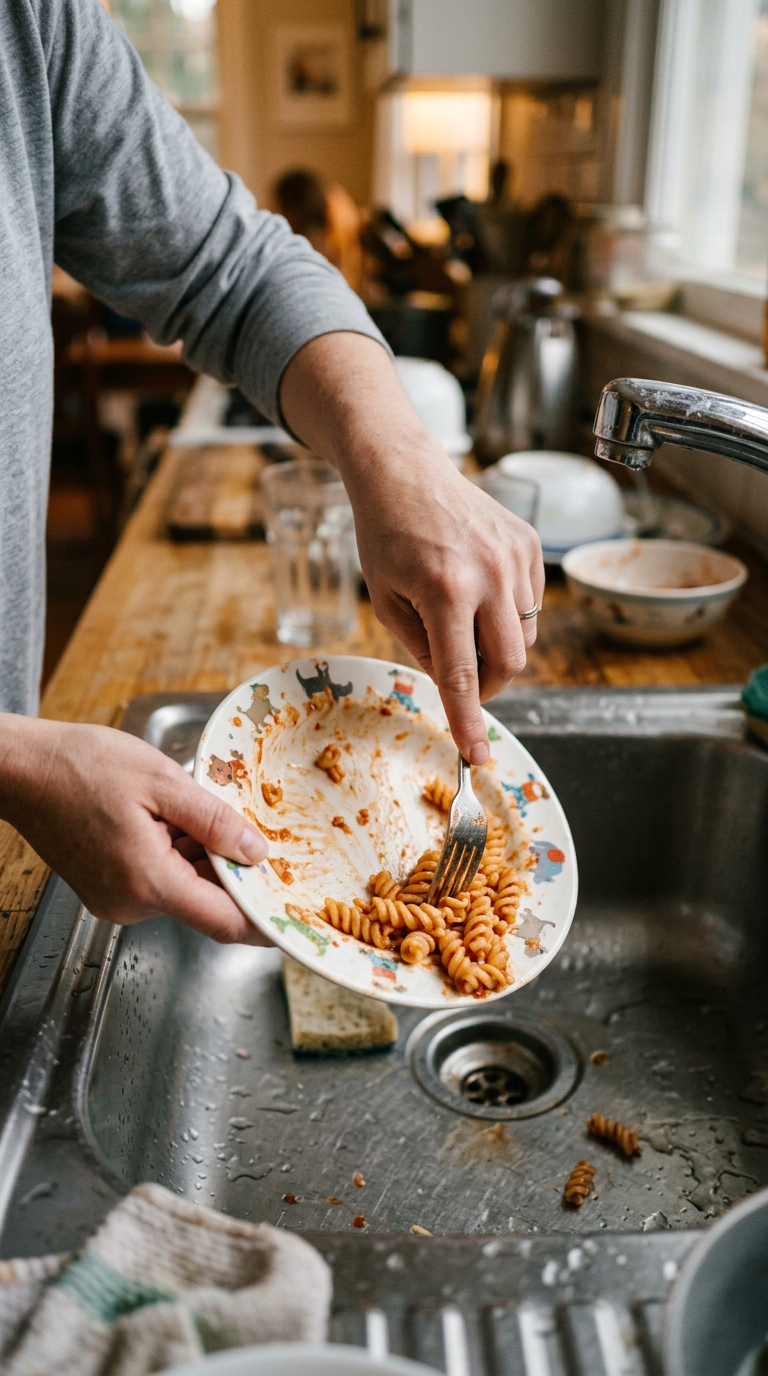
The reason you cannot stop is not in your willpower. It is 11:14 p.m. You are standing in front of the open refrigerator. The light is on your face. You are not hungry, exactly. You ate dinner. You also ate the children’s leftover pasta over the sink before you washed the bowl. You drank a glass of wine. You are not hungry. You are standing here anyway. You will eat something, in about ninety seconds, that you have not decided to eat. You will eat it standing up, with the overhead light off, in a way that you will tell yourself, tomorrow, does not count. You have been doing this, in some form, since you were eleven, or fifteen, or twenty-two. You have tried many things. None of them worked, because none of them were about the thing that is actually happening. Here is what is actually happening. — Before we get into the mechanism, one note. This is not an article about disordered eating in the clinical sense. It is not about restriction, or purging, or any of the things that show up in diagnostic manuals. It is about something more ordinary, and, in many ways, more pervasive: the slow, decades-long use of food as a regulator for a nervous system that was never taught any other way to come down. If you have spent years convinced that the problem is your appetite, or your discipline, or your relationship to sugar, the rest of this article is for you. The problem, almost certainly, is not in any of those places. It is in a much older room, with much earlier furniture. — What a nervous system is actually for Your nervous system is not, primarily, in charge of thoughts. It is in charge of states. Specifically, it is in charge of moving you between two broad conditions: a state of activation, in which your body is mobilized to deal with something, and a state of rest, in which your body is allowed to digest, repair, and feel. In a person whose early years were calm, predictable, and reliably soothing, the nervous system learns, between roughly birth and age seven, that activation is followed, every time, by someone helping the body come down. A parent picks up the crying baby. A child falls, is held, is calmed. A teenager has a hard day, comes home, is met by an adult who notices. The body learns: when I go up, something brings me down. That something is, eventually, internalized. The person grows up able to come down on her own, because she has, thousands of times, been brought down by another person’s presence. In a person whose early years were not calm, predictable, or reliably soothing — because a parent was depressed, or sick, or working three jobs, or angry, or simply not paying attention — the nervous system learns something different. It learns that activation comes, and stays. It learns that the way back down has to be invented. Children are very, very good at inventing. — Why a child invents food Of all the things a small child has access to, food — specifically, dense, sweet, fatty food — is one of the few that reliably produces a felt sense of safety inside her own body. It is not a metaphor. The act of eating something rich activates a specific cascade in the body: the vagus nerve calms, the heart rate slows, the brain releases a brief flood of soothing chemistry. This is not weakness or hedonism. It is the same mechanism by which an infant calms at the breast. A child who comes home from school activated and finds an empty kitchen, or a distracted parent, or a loud one, will, given enough Tuesdays in a row, do the math. The bowl of cereal in front of the television works. The handful of crackers in her room works. The thing she sneaks at 9 p.m. when no one is looking works — not because it tastes good, but because, for approximately fourteen minutes after she eats it, her body comes down in a way nothing else in the house is bringing it down. She is, in those moments, doing for herself what a regulated adult would otherwise be doing for her. She is performing co-regulation, alone, with a bowl of cereal in a dark kitchen. This is not a metaphor either. This is, neurologically, what is happening. — Why this does not, later, stop on its own Here is where it gets harder to undo. The body does not file this away as a strategy. The body files this away as a route. By the time the child is fifteen, the route from activation to calm runs through the kitchen. By the time she is twenty-five, the route is so well-worn that her body takes it before her mind has registered that she is activated at all. By thirty-five, the activation itself has become invisible. She does not feel anxious before she opens the fridge. She just finds herself, suddenly, in front of an open fridge, with no memory of having decided to walk there. This is the part that makes people feel insane. It looks, from the outside and from the inside, like a failure of will. It is not. It is a thirty-year-old reflex moving faster than conscious thought. By the time the thought arrives — I shouldn’t be doing this — the hand is already in the jar. Diets do not interrupt this reflex. They cannot. They are addressed to the conscious mind, which is showing up at the kitchen ninety seconds late, every time, to read its own behavior in surprise. — What the body is actually asking for It is not food. This is the single most important sentence in the article, and it deserves to be on its own line. What the body is asking for, at 11:14 p.m. in front of the open refrigerator, is the felt experience of having been brought down. It is asking for the thing the mother did not do, or could not do, or was not present enough to do, in 1997. It is asking for a regulator. Food, because it is the only regulator the child found that worked, is the version her body knows how to use. If you give the body the food, it gets a short, partial version of the regulation — about fourteen minutes ’ worth, before the chemistry wears off and the activation, still un-met, comes back, now with shame on top of it. The body, dissatisfied, tries again the next night. Then again. Then again, for thirty years. If you give the body something else — not a substitute, but a different way of meeting the actual request — the route through the kitchen begins, very slowly, to weaken. Not because you have outlawed the kitchen. Because the body, for the first time in decades, has been offered the regulation it was actually asking for. You cannot quit a coping mechanism. You can only outgrow it, by giving the underneath thing what it needs. — What “giving the body what it needs” actually means It is, frankly, less mystical than wellness culture has made it sound. It is also less effortful than diet culture has made it sound. It begins, almost always, with naming. Not naming what you ate — you have been doing that for years. Naming what was happening in your body in the ninety seconds before you walked to the kitchen. Most women who have done this for decades cannot, at first, name it. They have spent so many years overriding the signal that the signal has gone silent. The first task is not to stop eating. The first task is to make the signal audible again. Once the signal is audible, the body can begin to learn that activation does not have to be answered with food. It can be answered with breath, or with presence, or with a hand on one’s own chest, or with another person’s voice, or with a long exhale in a parked car. None of these things are as fast as sugar. All of them, with practice, last longer. There is a phrase, in something I was reading on Liven about why some adults cannot sit alone in their own kitchens after dark, that I have not stopped thinking about. It described the difference between hunger and the need for a small, private way to step out of being a person for a few minutes. I had been confusing those two for most of my adult life. Once the two were separated, I could not, exactly, put them back together. The route through the kitchen began to weaken. Not because I had defeated it. Because it had been mis-categorized for thirty-one years. — What changes, and what does not Articles like this usually end with a transformation. I am not going to give you one, because the honest version is more useful. What changes, when the nervous system begins to be addressed instead of the food, is not the desire. The desire to walk to the kitchen at 11 p.m. does not vanish. What changes is the gap between the desire and the action. At first the gap is a second. Then it is ten seconds. Then it is, on some nights, long enough that you sit down at the kitchen table instead. Some nights you still get up and open the fridge. The difference is that you can, increasingly, feel yourself doing it, which means that, increasingly, the doing stops being automatic. The route through the kitchen stops being the only road on the map. Over months, this changes the body’s baseline. Not because you have become disciplined. Because you have stopped asking your body to invent a regulator alone, in the dark, every night, the way it had to when it was eleven. You are not weak. You were a small child who solved a problem no one else solved for you. The solution is now the problem. Both things are true. — There is a quiz at the link below. It does not ask what you ate. It asks what was happening in the rest of your life when the eating started, which is the question almost no one has ever asked you, including yourself. Take it tonight, when the house is quiet, before you reach for the fridge handle. It will not be about the food. It was never about the food.
Why you eat at 11pm without thinking
LEARN MORELike this ad? Make it yours.
Crush rebuilds this exact creative around your product — your brand, your colors, your offer — in about a minute.