Dr. Elena Baumann
Dr. Elena Baumann Facebook ad: “ MY LIFE CHANGED FOREVER”
Ran for 13 days, from July 16 to July 29, 2026, the last day Crush saw it.
Run by Dr. Elena Baumann on Facebook. Crush is not the advertiser and does not verify its claims. See this ad in Meta's Ad Library(opens in a new tab)
Want an ad like this for your product?
Crush makes new ad images for your product from this ad: your logo, your product photo, your offer.
Trials from $19.95 USD, then $79.95 USD a month. Cancel anytime.
About this ad
- Meta Ad Library ID
- 1766884047785917
- Platforms
- Facebook, Instagram, Audience Network, Messenger and Threads
- Relaunches
- 0
Ad text
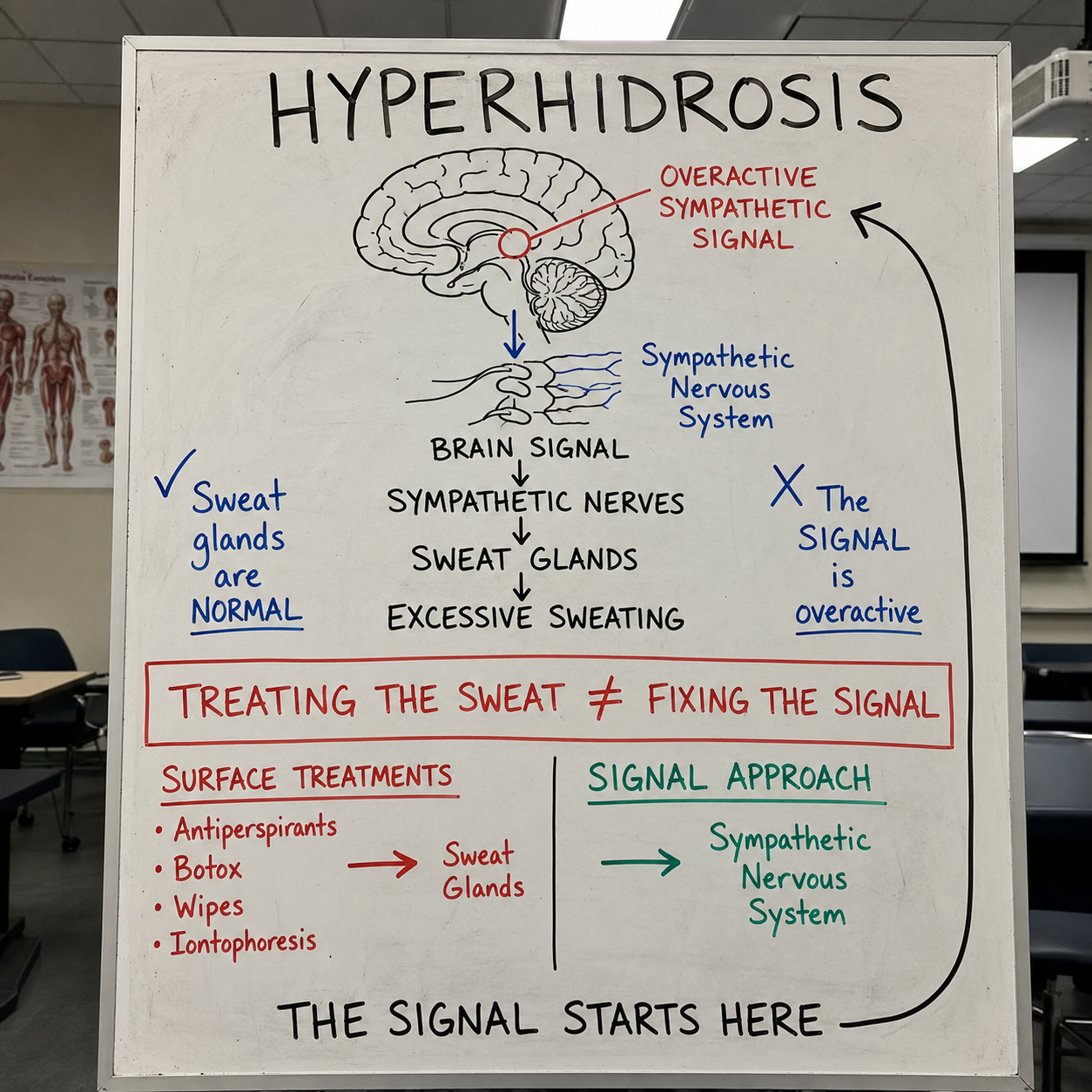
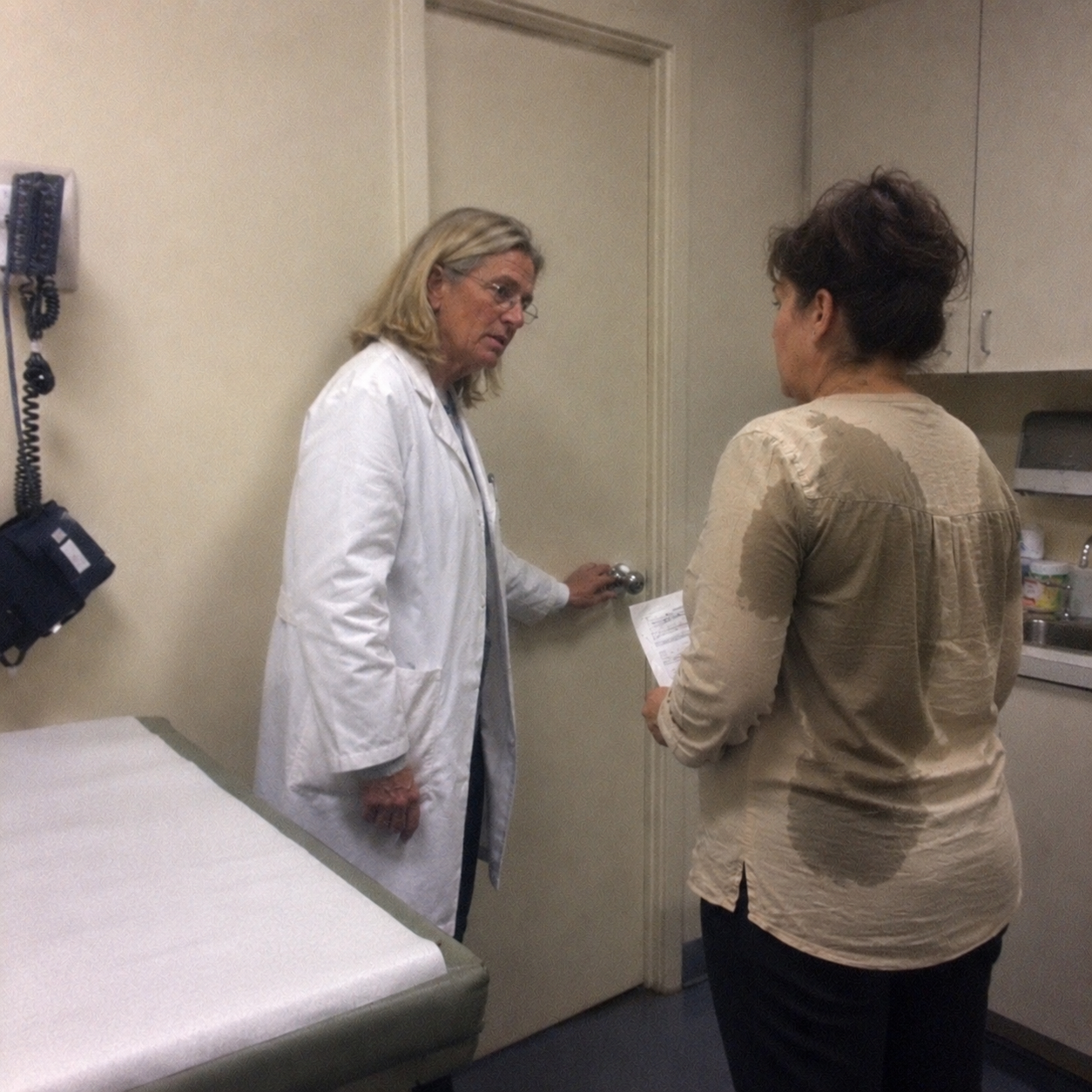
I'm a dermatologist, and last week a patient of mine canceled her surgery. Not the Botox. The surgery. The one where they go into your chest and cut the nerves at the top of your spine just to stop you from sweating. She canceled it because of something that happened during her sweat test that I have not seen in 22 years of practice. I've been treating hyperhidrosis — the medical name for uncontrollable, excessive sweating — for 22 years. I've seen every version of it. Palms that drip onto the paper you hand them. Shirts soaked through in a 65-degree room. Faces that pour in a job interview. Feet that slide inside the shoes. I can tell within 30 seconds of a starch-iodine test how bad someone's sweating is and exactly what they're in for. Last week, I couldn't. She came in the way they always do. A jacket on in a cool office to hide the rings under her arms. A tissue balled in each hand — one soaked on top of another. She wiped her palm on her jeans before she shook mine, the apology I've watched a thousand patients make without saying a word. She was 41, and she had arranged her entire life around staying dry: black clothes only, a spare blouse in her bag, the seat nearest the door, no handshakes, no dates, the 3 a.m. wake-up in soaked sheets that she'd stopped even mentioning to anyone. If you live with this, you already recognize every sentence I just wrote. You've lived all of it. Her surgery was scheduled in three weeks. She'd read every horror story about it and she was doing it anyway. Because she had nothing left. Six months ago, her sweat test lit up jet black across her palms, her underarms, her back. Gravimetric testing — the way we actually measure sweat, in milligrams per minute — put her at the top of the severe range. I ran the test again. And I just… stopped. The numbers looked different. Not worse. The opposite. Where the iodine test had been solid black, there were a few faint dots. Her gravimetric number had dropped by more than two-thirds. And her hands — the hands that six months ago couldn't hold a sheet of paper without soaking it — were dry in mine. I looked at her. "What have you been doing?" "Nothing crazy. Just something my sister told me about." I didn't believe her. "No new prescription? No Botox? No iontophoresis? You didn't fly somewhere and get the surgery already?" "Nothing like that. Just one thing I've been taking for four months." I pulled up her old test and set it beside the new one. The woman who six months ago was scheduled to have her nerves surgically cut was sitting in front of me with dry palms and clear underarms. I sat back in my chair. "I'm going to be honest with you. I don't think you need the surgery." She looked confused. "But my sweating—" "Your sweating is more controlled than anything I've ever injected or prescribed for it." Long pause. "So what do I do now?" "Keep doing whatever you're doing. Because it's working better than everything I was about to put you through." She walked out. And I spent the rest of the week wondering what she knew that I didn't. Here's what bothers me. I've been in dermatology my whole adult life. I know every treatment for hyperhidrosis that exists. And I see the same people in my office every single day. Men and women in their 30s, 40s, and 50s who soak through their shirts in a cold room. The handshake they dread all meeting long. The armpit check before every Zoom call. The closet with nothing but black and navy, because those are the only colors that hide it. The 3 a.m. wake-up in a drenched nightgown. The odor that shows up no matter how many times they shower. The light-blue blouse they bought and never once wore. And I help them. Temporarily. I inject Botox into their armpits. I write prescriptions for aluminum chloride and anticholinergic pills. Then they come back four months later exactly as wet as before — plus a dry mouth and a foggy head from the pills. Because every treatment I have targets the sweat gland. The needle blocks the gland. The antiperspirant plugs the pore. The surgery cuts the wiring to the gland. None of it touches why the glands are being ordered to pour in the first place. I've known that for years. But I had never seen someone turn it off at the source. Until last week. I called her that evening. "I know this is unusual, but I can't stop thinking about your test. What are you actually taking?" She didn't hesitate. "Sage leaf capsules. Sage, with magnesium, zinc, and B12. That's it." We talked for twenty-five minutes. She'd spent years trying everything. Certain Dri and Drysol that burned. Qbrexza wipes that dried her mouth to sandpaper. Glycopyrrolate that fogged her brain so badly she'd forget words mid-sentence. An iontophoresis machine that shocked her hands in the bathtub every night. Botox that wore off in four months and came back worse. And sage tea — she'd read about it on a blog, drank it for weeks, and it did absolutely nothing. Nothing moved. The sweating never let up. Then, four months ago, she stopped researching treatments and started researching the mechanism. Why a body sweats when there is no reason to. And what she learned is what I'm about to tell you. Because it is the thing no one in my field ever explains. Sweat is not the problem. Sweat is a signal. Your sweat glands themselves are perfectly healthy. If I biopsied them, they'd look identical to the glands of someone who never sweats. The problem is upstream — in the nerves that switch them on. A set of nerves called the sympathetic nerves fire your sweat glands by dumping a chemical, acetylcholine, onto them. In a person with hyperhidrosis, those nerves are stuck on. They fire far too easily and never fully stand down — flooding the glands with the "sweat now" command in a cold room, in a quiet meeting, in the middle of the night, when a normal nervous system would be silent. And sitting on top of that is a second failure: the internal thermostat in your brain — the hypothalamus — that's supposed to decide when you're actually hot. In chronic sweaters, it's jammed, raising false alarms and dumping heat through your skin when the room is 65 degrees. So the sweat pouring out of your skin is just the very end of the line. The order is being given deep in your nervous system. And every antiperspirant, every wipe, every needle, every surgery works at the end of the line — the gland, the exit — never at the order. That's why nothing you've tried has held. You've been damming a river at the mouth while the flood keeps coming from the source. "So what did you do?" I asked her. "I stopped attacking the gland. I calmed the signal from the inside." She told me it wasn't sage alone that did it — she'd tried single ingredients before and gotten nowhere. It was a specific combination, each part doing a different job on the same broken signal. Sage Leaf. This is the one that does the heavy lifting. Sage — Salvia officinalis — has been used for uncontrollable sweating for over two thousand years. Hippocrates prescribed it. It works on the nerve itself, quieting the constant "sweat now" command at the source so the glands stop getting the false order. And this is not folklore: in Germany, the national regulator — the Kommission E — officially cleared sage for excessive sweating over two decades ago, and it's taught there as standard dermatology. But it has to be real sage extract at a real dose — not the tea, which carries a trace, and not the dusting most bottles hide behind a blend. Magnesium. The reason the signal keeps re-firing is the fight-or-flight loop: you sweat, you panic that people can see it, the panic dumps adrenaline, the adrenaline drives more sweat. Magnesium is the off-switch for that loop — the thing that lets the sympathetic nervous system finally stand down. Most people are deficient in it, which is exactly why the loop never breaks on its own. Without it, the sage is calming a nerve that stress keeps switching back on. Zinc. This is the thermostat. Zinc is directly involved in the body's temperature regulation, and it's what helps reset the hypothalamus so it stops raising false heat alarms and dumping sweat to cool a fire that isn't there. It does one more thing that matters to anyone living with this — it shuts down the odor that rides along with the sweat. Vitamin B12. The final piece is the nerve fibers themselves. B12 rebuilds and protects the myelin sheath — the insulation around the sympathetic nerves — so the pathway stops misfiring. Low B12 is a documented driver of the drenching night sweats that wake people at 3 a.m. Restore it and the nerves stop firing in your sleep. One ingredient quiets the signal. The other three make sure the nervous system can actually stand down and stay down. That's why every single-ingredient supplement — sage alone, magnesium alone — had done almost nothing for her. She'd been taking them one at a time. "Most things sold for sweating give you aluminum for the surface," she said. "They never touch the nerve giving the order." That's the part no one talks about. I didn't even ask the brand at first. Then she said, "I know you're going to look it up, so I'll just tell you. It's called Marosena." I looked at it as a dermatologist who knows exactly what drives sweating. Sage leaf at a real dose for the nerve. Magnesium for the stress loop. Zinc for the thermostat. B12 for the nerve fibers. The selection made sense. The combination addressed the actual mechanism instead of the exit. I ordered a bottle that night. Not for a patient — for myself. I'm 54. I've stood in front of patients with a damp collar and hoped they didn't notice for most of my career. My own antiperspirant is prescription strength. It never fixed anything. It only managed it. Week two: less clamminess in the afternoons. Subtle, but there. Week three: the pit-check before every appointment stopped being automatic. Week five: I woke up in dry sheets for the first time in years. Week eight: I ran a starch-iodine test on my own hands. Barely any color where there used to be black. A colleague asked what I'd changed. Said I seemed more comfortable — less like I was managing something all day. She was right. My body had turned down a signal I hadn't realized I'd been fighting every waking minute. If you soak through your shirt in a cold room… if you dread every handshake… if you wake up in drenched sheets at 3 a.m.… if the odor shows up no matter how much you shower… if you own nothing but black — it is not that your sweat glands are broken. And it is not your fault. It's that the nerve driving them is stuck on, and the thermostat above it is jammed. You cannot fix that with a needle or a stick of aluminum, because neither one reaches the signal. You have to quiet it from the inside. That's what sage leaf, magnesium, zinc, and B12 do together. Sage quiets the nerve. Magnesium switches off the stress loop. Zinc resets the thermostat. B12 rebuilds the nerve. All at once, at the source. Every antiperspirant, every wipe, every Botox appointment works on the gland. If the nerve and the thermostat are what's actually driving your hyperhidrosis, none of them will ever get ahead of it. I'm a dermatologist. I've injected more Botox into more armpits than I can count. But I cannot quiet a nerve from the outside. That has to come from within. This is what's working for me — and for the patient who canceled her surgery because she didn't need it anymore. It's called Marosena Sage Leaf Capsules. Sage leaf at a real dose, plus magnesium, zinc, and B12 — the whole signal, addressed at once. Made in the USA. Third-party tested. Non-hormonal. No prescription. Two capsules a day. It takes about eight weeks to see the real change, the way it did for her and for me. They make it in small batches and it sells out — the last time I went to reorder, it was gone for two weeks. If it's in stock when you click, don't wait for the next batch. 👉 https://marosena.com/products/sage-leaf 60-day money-back guarantee. If your sweating hasn't backed off, you send back the bottle and get every cent returned. The risk is theirs, not yours. You've carried enough of it already. — Dr. Elena Baumann, MD
Where the ad sends people
marosena.com
⚠️ MY LIFE CHANGED FOREVER
60 Day Money Back Guarantee
Shop now: marosena.com(opens in a new tab)