SciFi Adventures
SciFi Adventures Facebook ad: “Crazy Old Man Was Right”
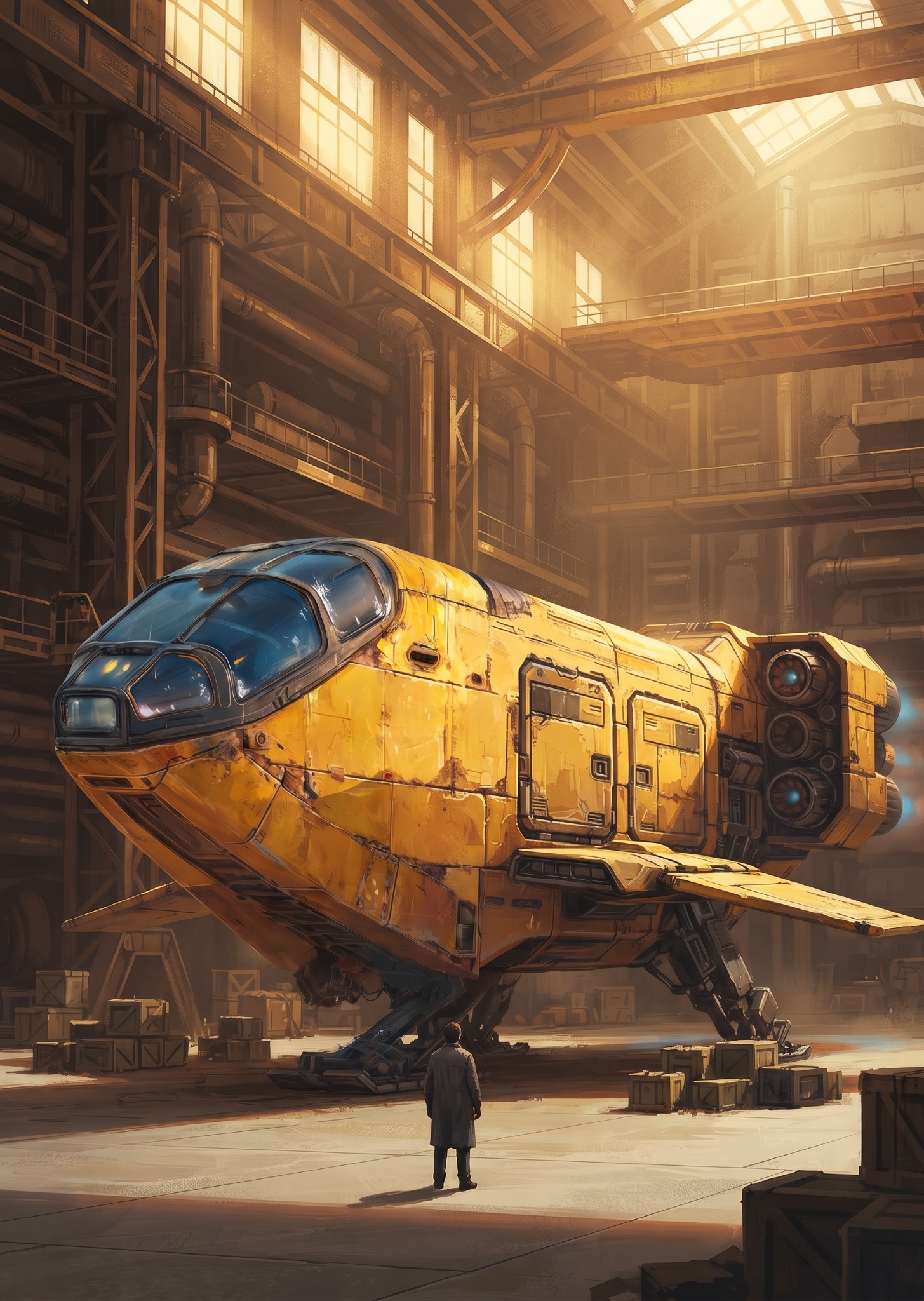
Ran for 7 days, from September 4 to September 11, 2026, the last day Crush saw it.
Run by SciFi Adventures on Facebook. Crush is not the advertiser and does not verify its claims. See this ad in Meta's Ad Library(opens in a new tab)
Want an ad like this for your product?
Crush makes new ad images for your product from this ad: your logo, your product photo, your offer.
Trials from $19.95 USD, then $79.95 USD a month. Cancel anytime.
About this ad
- Meta Ad Library ID
- 1770577960800134
- Platforms
- Facebook, Instagram, Audience Network, Messenger and Threads
- Relaunches
- 0
Ad text
Three days passed before I opened the box again. It sat on my kitchen table the whole time, right there between the salt shaker and a stack of unopened mail that I kept meaning to sort through and never did. On my way to the coffeemaker each morning, I walked past it. I walked past it every evening on my way to the fridge. I ate dinner next to it twice, once with a microwave burrito and once with leftover Chinese that was pushing the limits of what a reasonable person would still consider edible. Both times I looked at the box instead of the television, and both times I looked away and told myself it was nothing. The thing is, I knew it wasn't nothing. I was almost sure of that. But knowing something and doing something about it are two strange activities, and I'd gotten very good at the first one over the years while avoiding the second. I felt like looking into that box would essentially end whatever secrets Tuckey still had over me, and revealing them would, in a way, end that special bond between us. If you've ever read an incredibly gripping book and wanted that sense of anticipation to continue forever, you'll understand what I'm talking about. On the second day, I almost threw it out. I actually picked it up, walked it to the kitchen trash can, held it over the opening, and stood there like an idiot for thirty seconds before setting it back down on the table. I'm fairly certain the fear of losing that same connection once and for all is what stopped me. On the second attempt, later that same evening, I made it as far as the apartment door with the box in one hand and my keys in the other, fully intending to walk it out to the dumpster in the parking lot. I got the door open, stepped into the hallway, and then turned around and brought it back inside. I just couldn't do it. Something in my gut kept pulling the plug on the entire operation every time I got close, the same something that had stopped me from tossing it in the trash bag back in Room 14. The third night was a Thursday, and it was a bad one. Bad nights weren't unusual for me. I'd been having them long before Tuckey died, long before I started working at Sunningdale. Long before any of this, in fact. They were the nights where you lie in bed at two in the morning and take an inventory of your life, and every shelf comes back empty. Twenty-six years old, no degree, no prospects, no relationship, no plan. Just a non-existent orderly in a psychiatric facility, which is a kind of polite way of saying that I changed bed sheets and redirected confused old people away from fire exits for a living. My apartment had one bedroom, one bathroom, a kitchen that could generously be described as functional, and a living room that doubled as everything else. My car had a hundred and forty thousand miles on it and a check engine light that had been on so long I'd stopped seeing it. Aside from Chris and Dale, my social life was confined to what was on TV after nine. Talk about dull. Here's the thing, though. I wasn't depressed. My feelings weren't ones such as sadness or anger, which might have warranted a room on the other side of Sunningdale's front desk. I was just…invisible. Not to other people, although that was also true most of the time, but to myself. I'd stopped expecting anything from my life somewhere around the age of twenty-two, and the four years since had done nothing to prove me wrong. On some basic level, I simply existed. I showed up. I did what I had to, and I went home. That was the entire show, with a non-existent audience to match. It was in that frame of mind, staring at the ceiling of my bedroom at something past two in the morning, that I got up, walked into the kitchen, sat down at the table, and pulled the rubber band off the shoebox. I hadn't done so since I had first found it at the bottom of Tuckey's bedroom, so you can imagine my hesitation now that I had made the conscious decision to revisit the old man for what I expected to be one last time. The pages looked the same as they had in Room 14. A chaos of handwriting on mismatched paper, some of it crisp and legible, some of it barely qualifying as English. I spread them out on the table, pushing the salt shaker and the mail aside to make room, and tried to organize them into something that resembled order. It was like trying to sort a deck of cards that three different people in three different languages had printed, half of them blindfolded, none of it able to be classified into any order. I started with the pages I could actually read, the clear English passages. There were maybe a dozen of them scattered through the pile, and I pulled them out one by one and laid them in a row across the table. Most were short, a paragraph or two, and all of them were written in the same direct, conversational tone that sounded so much like Tuckey talking that I could hear his voice in my head as I read them. If you're reading this and you're not the boy, put it down and walk away. It won't make sense to you, and it's not meant to, was written on one. The games matter. If you played them with me, you already have half of what you need. The other half is in these pages, but it won't look like anything until you use what the games taught you. Start with the sequences. You'll know which ones on another. And on another still, I wrote this on a good day, so pay attention. The bad days are in here too, and they're harder to follow. That's not your fault. That's my head doing what it does now. If a section doesn't track, skip it and come back. The pieces that matter are the ones that repeat. That last one got to me. The pieces that matter are the ones that repeat. Tuckey had said something almost identical during one of our game sessions, back when I thought we were just killing time between stories. He'd laid out a set of word-number pairs and asked me to repeat them back, and when I stumbled on a few of the later ones, he'd waved it off. "Don't worry about the ones you miss," he'd told me. "The ones that stick are the ones your brain knows you'll need." I'd thought it was a kind thing to say to someone failing a memory exercise. Now I wasn't so sure that was what he meant. I turned to the coded pages, the bulk of what the box contained. These were dense blocks of symbols, letters, and numbers arranged in patterns that looked deliberate but meant nothing to me. Some pages had small diagrams in the margins: circles connected by lines, arrows pointing to coordinates or measurements, or some other thing I still couldn't identify. Others had what looked like lists, columns of entries with annotations beside them in handwriting so compressed I'd need a magnifying glass to read it. And on almost every coded page, tucked into a corner or written along an edge, was a single word in plain English, usually underlined. I didn't notice these words at first. They blended in with the margins, easy to mistake for labels or afterthoughts. But once I saw one, I started seeing all of them, and something cold ran through me I couldn't explain. Something like a tap on the shoulder, asking me to pay closer attention. Corridor. The word was underlined at the top of a page covered in dense symbol blocks. And the moment I saw it, I heard Tuckey's voice in my head, clear as the day he'd said it. "Corridor, seven." That was one of his pairs. One of the word-number combinations he'd had me repeat back to him during the memory games. Corridor, seven. I could hear the cadence, the way he'd tap the rubber ball once against his palm after saying each pair, like a metronome keeping time. Corridor, seven. Bulkhead, thirteen. Transit, four. He'd drilled dozens of these into me over the months, always framing them as memory exercises, always mixing them in with the stories so they felt like a natural part of the conversation rather than a separate activity. I looked at the page again. The first symbol block sat directly below the underlined word. I counted to the seventh character in the block. It was a letter. An R. My hands were still as the apartment remained silent behind me. The refrigerator hummed in the background, and somewhere outside a car drove past with its radio on, a few seconds of bass and then nothing. I stared at the R and tried to decide whether I was losing my mind or finding something relevant. I flipped to another page. The margin word was Transit. Transit, four. I counted to the fourth character in the first symbol block. E. Another page. Bulkhead, thirteen. Thirteenth character. A. I went faster, my curiosity driving me onward, my finger moving before my brain caught up, flipping pages, finding the margin words, matching them to the pairs I could hear Tuckey reciting in my head like a recording that had been playing on a loop for months and I'd only just hit the volume button. Docking, nine. Starboard, two. Manifest, eleven. The numbers pulled letters out of the symbol blocks one at a time, and the letters started forming words, and the words started forming sentences, and the sentences were…well, they were Tuckey. Not Tuckey the storyteller. Not Tuckey the entertainer who painted distant worlds from a chair in Room 14. This was someone else. Someone precise, someone urgent, someone who wrote the way a man writes when he knows his time is running out and every word has to count. This was a man I didn't recognize and yet understood, thanks to the hours of interaction we had shared. If this part is making sense to you, then you're the right person, and I'm sorry for what comes next. The stories I told you were true. All of them. I know you didn't believe me, and I don't blame you for that. I wouldn't have believed me either, sitting where you were sitting. But you need to believe me now, because what I'm about to ask you to do doesn't work if you think I was just a crazy old fool with a good imagination. I set the page down, my whole body buzzing with a kind of electric charge running through me as I stared at the words, the message he had left me. I picked it back up and read it again just to be sure. The stories were true. That's what the decoded passage said. Not "based on actual events" or "inspired by something that happened to me a long time ago." True. The Perathic Tangle, the three suns, the Lashburn, the Stilljaws, the Drennach Corridor, the deliveries, the ship. All of it. True. I should have laughed. I should have thrown it all back into the box, shaken my head in dismay at conjuring up some fantastic 3-AM hocus pocus, and disposed of it once and for all. A reasonable person sitting alone at a kitchen table in the middle of the night, believing they had decoded a dead psychiatric patient's secret writings, would have done so. They would have thrown the papers back inside, closed the box, and gone back to bed. But I didn't laugh, and the reason I didn't laugh is hard to explain without sounding like someone who belonged on the fourth floor of Sunningdale. The reason was the code itself. Tuckey had taught me this. Not in one afternoon, and certainly not in a single conversation, but across the better part of a year of what I thought were just casual games. He'd built a decryption key inside my head, one pair at a time, and hidden the training inside something so ordinary that I never once questioned it. It's a memory exercise. A logic puzzle. A pattern match. Each game was a lesson, and each lesson was a piece of a system designed to unlock these exact pages. Think about what it would take to build that kind of precision, the patience of it, the sheer amount of planning required to pull it off while your own mind is falling apart around you. Does that sound like the work of a crazy person? It's not crazy people who build ciphers. Crazy people don't spend months teaching someone a key without telling them it's a key. Crazy people don't leave instruction manuals addressed to a specific reader, written in a code only that reader can crack. Whatever Nelson Tuckey was, he wasn't crazy. And whatever these pages contained, they certainly weren't fiction. I kept going. The pattern-match games came into play next, and I almost missed their purpose entirely. Some of the coded pages didn't respond to the word-number pairs. I'd find the margin word, apply the number, and get gibberish. Letters that didn't form words, combinations that went nowhere. I hit three in a row and felt the momentum stall; the excitement turning into frustration as I again questioned myself. Maybe it was random. Maybe I'd gotten lucky with the first few pages and the rest was just the scattered output of a deteriorating brain. Or maybe I had imagined the whole thing and… And then I remembered the colors. Tuckey had played a matching game with me one afternoon, maybe two months before he died. He'd described a list of colors and asked me to pair them with directions. Red meant forward. Blue meant reverse. Green meant skip one. I'd thought it was abstract nonsense, the arbitrary rule set that brain exercise books are full of. But looking at the pages that weren't decoding properly, I noticed something. The margin words on those pages were written in different colored ink. Most of the box was blue or black ballpoint, but these margin words were in red, or what had once been green before the ink faded. Red meant forward. Blue meant reverse. Feeling something tighten inside me, I took a red-margin page and applied the word-number pair in the normal direction. Gibberish. Then I reversed it, counting from the end of the symbol block instead of the beginning. A letter. A clean, unmistakable letter that belonged to a word that belonged to a sentence. I leaned back in the chair and stared at the pages spread across my table, and for the first time since I'd opened the box, the scale of what Tuckey had done hit me. Like a sledgehammer. It wasn't a scribbled note left behind by a confused old man. This was architecture. This was calculated. These word-number pairs were what it was built upon. The sequence of games was navigation. The color-pattern matches were the switching mechanism that kept the whole thing from collapsing into noise when his handwriting changed, or his mind drifted between encoding systems. Three separate layers, taught across three separate types of games, and all over the course of nearly a year, to a person who did not know he was being trained. Me. The man had built a multilayered cipher and distributed the keys across dozens of casual conversations spread over the better part of a year, and the whole thing was stored in my memory in pieces that only assembled when I sat in front of the document they unlocked. I thought about his bad days, the afternoons when the fog was thick, and his stories wandered around in circles. On those days, the games got shorter and simpler. He'd repeat pairs I already knew, drilling them again and again until I could say them in my sleep. I'd assumed he was regressing, losing ground, repeating himself the way patients do when the wiring frays. But sitting here now, looking at the results, I understood something different. His worst days as a patient were his most disciplined days as a teacher. He was reinforcing the foundation on the days he knew his mind was least reliable, making sure the core pairs were locked in deep enough to survive whatever came next. The man was losing himself, and yet, he continued to shore up my training before the tide went out completely. I decoded for two more hours. Not the whole box. Not even close. The process was slow; each page requiring me to find the margin word, remember the matching pair, check the ink color, apply the direction, and extract the letters one at a time. Some pairs came to me instantly, sharp and clear, and I could hear Tuckey's voice delivering them like he were sitting across from me. Others were buried deeper, pairs from early sessions that I had to dig for, closing my eyes and trying to reconstruct the afternoon when he'd first said them. A few I couldn't recover at all, and those pages stayed locked, their contents out of reach…for now. But what I decoded felt enough. Enough to understand that the pages were a manual. Not a memoir, not a journal, and certainly not the ramblings of a man losing his grip. A manual, written by a professional for his successor, containing instructions for systems and processes I had no frame of reference. Navigation. Docking procedures. Cargo handling. Atmospheric entry protocols. Hell, even communication frequencies. The language was technical but patient, the tone of someone who expected the reader to be starting from zero and will meet them there. And threaded through the technical passages, in the same direct voice as the clear English sections, were notes addressed to me. Not by name. Always "the boy" or "you." But unmistakably me. You're going to think this is impossible. That's fine. Think it's impossible all the way to the coordinates on page twelve, and then tell me what you see. Page twelve. I hadn't decoded page twelve yet. I dug through the pile, found it, and spent twenty minutes extracting the text character by character. When I finished, I had coordinates. Latitude and longitude, written in standard Earth notation, followed by a single sentence. She's buried, not gone. You'll need the sequence from the third game we played on the Tuesday after the rainstorm. If you remember it, she'll let you in. She. I read the line again. She. He was talking about the ship. The Lost Princess. The name he'd mentioned in our very first conversation, the one I'd assumed was a yacht. I put the coordinates into my phone. The map zoomed in on a patch of ground about forty minutes outside of town, a stretch of undeveloped land between a state forest and an abandoned industrial lot. Nothing there. According to the satellite view, nothing had been there for a long time. And yet, somehow, I felt something continue to grow inside me, an excitement with no boundaries, the outer edges pushing past my previous apprehensions. The third game on the Tuesday after the rainstorm. I sat back in my chair and closed my eyes. We'd had a rainstorm in October that knocked out power to half the facility. I remembered it because the backup generators kicked in late and three of the patients on my floor had needed calming down. The dark hadn't bothered Tuckey. He'd actually seemed amused by it, like a power outage was a charmingly primitive thing to worry about. The following Tuesday, I saw him, and he'd started with a game before the story, which was unusual. A sequence game. He'd given me a string of words in a specific order and asked me to memorize them, then repeat them back while tapping a rhythm on my knee. I sat there at my kitchen table at nearly five in the morning and whispered the sequence out loud. It came back in pieces, fragmentary and uncertain, but it came back. Seven words in a specific order, spoken in a specific rhythm. I didn't know what they meant. I didn't know what they'd do. Whether any of this was real, or if I was just one poor decision away from ending up in Room 14 myself, I didn't know. But the coordinates? They were real. They pointed to a place. A place I could drive to in forty minutes and confirm what my subconscious already had. I looked at the mess of pages spread across my kitchen table, the decoded passages sitting alongside the ones still locked, the diagrams and the lists and the margin words in their different colored inks. I looked at the rubber ball sitting on the counter where I'd put it the night I brought it home, and I thought about the hand that used to squeeze it, the hand that had written every one of these pages between bouts of fog and clarity, on napkins and menu cards and prescription forms, in a room that smelled like disinfectant and institutional soap. He'd done all of this for me. He'd built a cipher, taught me the key, written a manual, and hidden it in a shoebox at the back of his closet, all of it aimed at a moment exactly like this one: a person sitting alone at a table in the middle of the night, deciding whether to believe something impossible. I didn't believe it. A portion of it. Not yet. Not fully. But I didn't need to believe it to get in my car and drive forty minutes. I stacked the pages back into the box, put the rubber band around it, grabbed my keys off the counter, and walked out the door. The sky outside was just lightening along the eastern edge, that familiar thin band of ever-changing color that shows up an hour before the sun does. I got in my car, set the box on the passenger seat, and typed the coordinates into my phone. Forty minutes. That's all it was. Forty minutes between the life I had and whatever was waiting in a patch of dirt between a state forest and an abandoned lot. Forty minutes that stood between me and a fate decided by a man most considered crazy. What I still didn't know was whether any of it was real, and only time would finally show me the truth. https://www.amazon.com/dp/B0HF8WCHQ2
Where the ad sends people
amazon.com
Crazy Old Man Was Right
See details: amazon.com(opens in a new tab)