American MAH JONGG
American MAH JONGG Facebook ad: “See How the Card Actually Works”
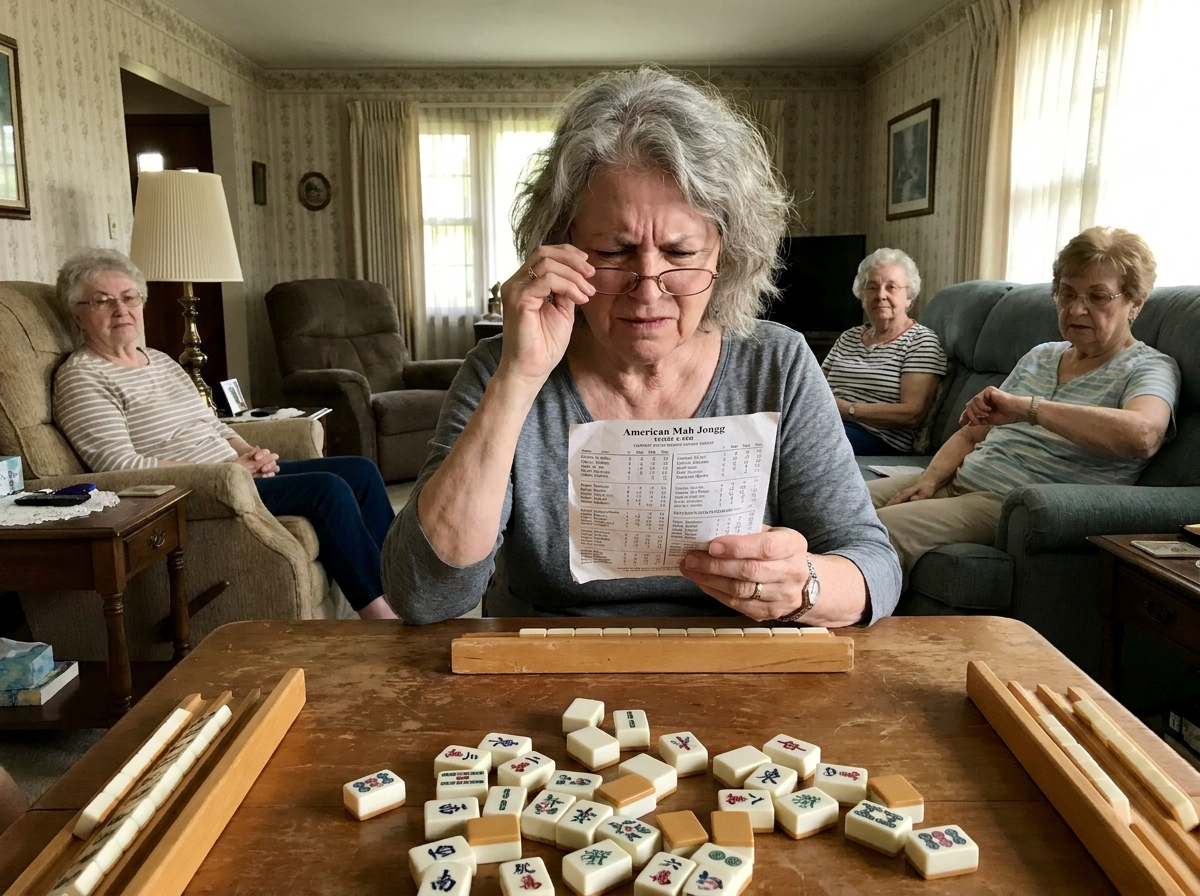
Ran for 43 days, from July 30 to September 11, 2026, the last day Crush saw it.
Run by American MAH JONGG on Facebook. Crush is not the advertiser and does not verify its claims. See this ad in Meta's Ad Library(opens in a new tab)
Want an ad like this for your product?
Crush makes new ad images for your product from this ad: your logo, your product photo, your offer.
Trials from $19.95 USD, then $79.95 USD a month. Cancel anytime.
About this ad
- Meta Ad Library ID
- 1822950642005100
- Platforms
- Facebook, Instagram, Audience Network, Messenger and Threads
- Relaunches
- 0
- Niche
- Parenting & Kids
Ad text
Arlene has played American Mah Jongg for 31 years. Last Tuesday she set down her rack, looked at me across the table, and said, "I have taught dozens of women this game. Nobody learns the card that fast. Nobody. What did you do?" I had just called Mahjong for the second time that afternoon. Eleven weeks after touching my first tile. Here's what you need to understand about me: I taught high school math for 34 years. I believe in systems. I believe that anything, absolutely anything, can be learned if someone breaks it down in the right order. But that card nearly beat me. If you play, you know exactly which card I mean. Fifty-some hands printed in type so small you need your good glasses and a prayer. Consecutive Runs. Like Numbers. 13579. A secret language disguised as a bookmark. For eight months, I was the slow one. Every group has one. The table would wait while I scanned line after line, trying to figure out if my tiles matched anything at all. Three minutes per turn. Sometimes four. I counted once: in a two hour session, I spent 74 minutes just staring at that card. 74 minutes of feeling stupid. Me. A woman who taught calculus. My friends were kind about it. "It takes years, honey." "I didn't feel comfortable until my third card." Everyone repeated the same folklore: you can't rush the card. You just have to absorb it, the way you absorb humidity. That answer bothered me. Really bothered me. Not the struggle itself, I never minded working hard. The idea that there was no method. That the only way in was years of confusion. I did what I did my whole career whenever a student was stuck. I asked the real question: is the student the problem, or is the teaching? So one night after my husband went to bed, I started researching. Not desperately. Systematically. YouTube first. Hours of videos. Half of them taught Chinese or Riichi mahjong, which is a different game entirely. Wrong card, wrong rules, wrong everything. The American ones were sweet ladies filming their kitchen tables, jumping around with no sequence, assuming you already knew the very things they were supposed to explain. Then the books. I ordered three. One was written in 1984. One spent forty pages on the history of tile carving. None of them taught the card the way you would actually teach a skill: one concept, then the next, each building on the last. It was like trying to learn algebra from a pile of loose worksheets. Then, at 12:52 AM, I found something different. A structured program called the American Mahjong Institute. Built by people who had clearly taught before, because the whole thing was organized like a real curriculum. Lesson one, lesson two, lesson three. Each skill isolated, practiced, then combined. But what stopped me was their core idea. As a math teacher, it hit me like a bell: You don't memorize the card. You learn to read its patterns. The card looks like 50 random hands. It isn't. It's a small number of underlying structures, repeated and disguised. Pairs, pungs, kongs, arranged in families. Once you can see the skeleton, the whole card collapses into something manageable. Like realizing 50 scary equations are really the same three formulas wearing different clothes. Nobody at my table had ever explained it that way. Because nobody had ever been taught that way. They all learned by osmosis, over years, and passed the confusion down along with the tiles. The whole program cost less than a single month of the private lessons I had priced at our community center. I signed up that night. The next morning I did lesson one with my coffee. Twenty minutes. That afternoon, lesson two. By the end of week one, I could look at a line on the card and actually see it. Not decode it. See it. By week four, something happened that still makes me smile. During our Tuesday game, I noticed Doris was collecting for a hand that could no longer work with the tiles already discarded. I saw it before she did. Me. The slow one. Week seven, I called my first Mahjong. A Consecutive Run, the hard version. The table went silent, then erupted. Sandra actually stood up. Week eleven was the Tuesday with Arlene. Two Mahjongs in one afternoon, and that question I will never forget. I told her the truth. It wasn't talent. It was sequence. Somebody had finally put the lessons in the right order. Here's my honest math, since numbers are my love language. Eight months of the old way: still lost, still slow, roughly 300 hours of table time with almost nothing to show for it. Eleven weeks of the structured way, about 20 minutes a day: reading the card fluently, winning regularly, and finally enjoying the strategy instead of drowning in the rules. Same brain. Same game. Different teaching. My granddaughter asked me why I seemed so happy lately. I told her Grandma learned a new language at 64. Three women from our group have started the program since. Our group chat is a delight now. Carol called her first Mahjong last Thursday and sent fourteen exclamation points. Doris, who swore she was "too old for online courses," finished the pattern lessons in a weekend. Here's what I want you to hear, from a teacher of 34 years: we are not slower learners because we're older. Most of us were simply never taught. There is a difference between being exposed to a game for years and being taught it for weeks. If you've been telling yourself you're just not a card person, I would gently suggest that you were never the problem. The card has a system. Someone finally wrote it down in the right order. It's called the American Mahjong Institute, and it's the best thing I've done for my Tuesdays in years. Arlene asked me what I did. Now you know. The only question is how many more months you'll spend staring at that card, waiting for it to explain itself. It won't. But someone else will.
Where the ad sends people
americanmahjonginstitute.com
See How the Card Actually Works
Go From Confused to Confident in 7 Days — Guaranteed If you've ever felt personally attacked by the annual NMJL card, confused by the Charleston, or terrified of picking the wrong hand… welcome. You're in the right place.
Learn more: americanmahjonginstitute.com(opens in a new tab)