Clement Ibe
 Facebook ad: “THE MAN BEHIND THE WORDS”
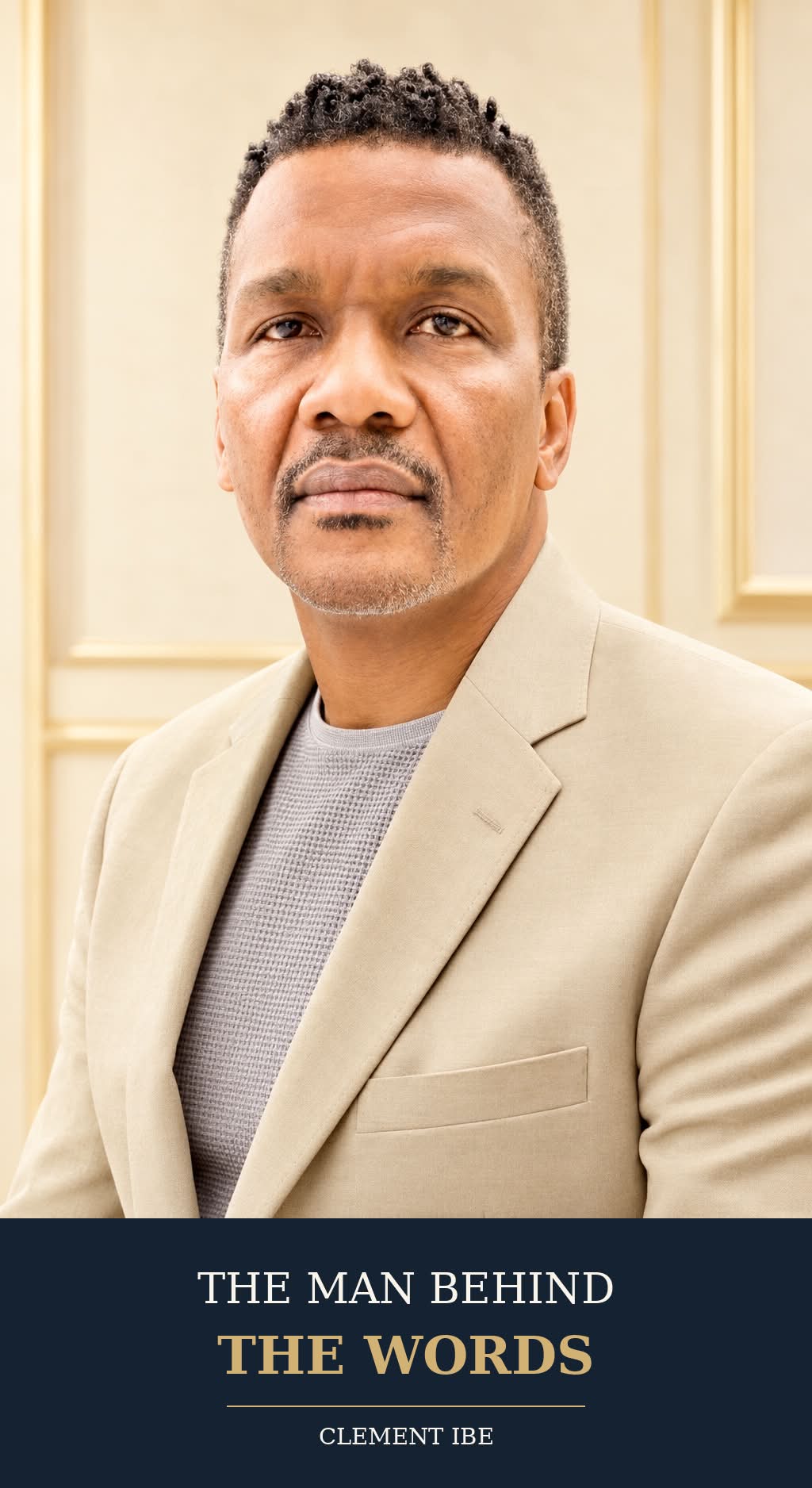
Ran for 4 days, from October 20 to October 24, 2026, the last day Crush saw it.
Run by Clement Ibe on Facebook. Crush is not the advertiser and does not verify its claims. See this ad in Meta's Ad Library(opens in a new tab)
Make your own version of this ad
Crush makes it, launches it in your own Meta ad account, scales the winners and pauses the losers.
About this ad
- Meta Ad Library ID
- 1844216560257515
- Platforms
- Facebook and Instagram
- Relaunches
- 0
Ad text
THE MAN BEHIND THE WORDS MY CALLING IS NOT SUBJECT TO HUMAN VALIDATION. To those who presume they have figured me out, confined me within the boundaries of their preconceived notions, and reduced my identity to the limitations of their own understanding, let me be unequivocally clear about the man you think you know. In my 25 years of pastoring Bethesda Christian Centre, I have never once sought recognition, applause, endorsement, or validation from any individual, institution, or organization. Neither have I considered the sacred responsibility of ministry an opportunity for self-promotion, personal ambition, or self-aggrandizement. I have never understood ministry to be a contest for visibility, a competition for prominence, or a desperate pursuit of public acceptance. I KNOW WHO I AM. I KNOW WHO CALLED ME. AND I KNOW WHAT HAS BEEN ENTRUSTED TO ME. I do not require the approval of men to be secure in an assignment I did not receive from men. Neither do I need the recognition of an institution to authenticate a responsibility whose origin and purpose I have long understood. There is a difference between being conscious of one’s calling and being consumed by the desire to be recognized for it. Unfortunately, that distinction has become increasingly blurred in a generation where visibility is frequently mistaken for significance, popularity for spiritual authority, and public applause for divine approval. For me, ministry has never been a do-or-die struggle for relevance, a contest to prove superiority, or an endless pursuit of recognition. THE PULPIT IS NOT A STAGE FOR THE EXHIBITION OF PERSONAL IMPORTANCE. It is not a platform upon which men are called to parade their accomplishments, advertise their possessions, celebrate their titles, or manufacture an image of greatness before an impressionable audience. The sacred responsibility of ministry is far greater than the personality of the person entrusted with it. In all my years of preaching and teaching, I have never once deliberately turned my pulpit into an advertisement for myself, my achievements, or my material accomplishments. Not because I have no great achievements to speak of, but because I have always understood that these external trappings are not the substance of ministry. What a man possesses is not necessarily a reflection of what he carries within. After all, even individuals of questionable character and dubious means may accumulate considerable wealth, yet their material abundance does not make them people of genuine substance, integrity, or wisdom. What a man has accumulated does not necessarily reveal the depth of his understanding, the quality of his character, or the measure of his contribution to humanity. Neither does the attention he commands, the influence he wields, or the applause he receives authenticate the truth he claims to represent. For the true measure of a man is not what he has acquired for himself, but the substance of what he carries within and the enduring value of what he contributes to the lives of others. And …. THE TRUE WEIGHT OF A MINISTRY IS NOT MEASURED BY THE MAGNITUDE OF ITS PUBLIC IMAGE, BUT BY THE SUBSTANCE OF ITS MESSAGE AND THE QUALITY OF THE LIVES IT HELPS TRANSFORM. I have never regarded ministry as a vehicle for advancing personal ambitions, promoting hidden agendas, or pursuing interests beyond the sacred responsibility entrusted to me. Rather, I have always understood it as a solemn calling to impart truth, enrich lives, transform perceptions, and make a meaningful and enduring contribution to the lives of others. And that conviction has not diminished with the passage of time. On the contrary, it has become clearer, deeper, and more compelling. I understand the measure of my assignment, the capacity entrusted to me, and the knowledge I am called to contribute to the Body of Christ. I also understand that not everyone will immediately recognize the significance of what another person has been entrusted to communicate. Some things can only be appreciated when the necessary understanding has been developed. And this brings me to something I have said repeatedly, which I want to state again with deliberate emphasis: I AM ONLY JUST GETTING STARTED. Those words are neither an expression of personal ambition nor a declaration of superiority. They are the expression of a man who understands that the passage of years does not necessarily mean the exhaustion of purpose. Twenty-five years of pastoring have not emptied the reservoir of what I have been entrusted to communicate. If anything, those years have deepened my understanding of human nature, the transformative power of truth, the consequences of distorted perception, and the enormous responsibility of helping people see beyond the limitations of what they have been conditioned to believe. There are dimensions of understanding that experience alone cannot produce, just as there are insights that cannot be appreciated merely because they have been articulated. TIME DOES NOT AUTOMATICALLY PRODUCE MATURITY. EXPERIENCE DOES NOT NECESSARILY PRODUCE UNDERSTANDING. AND EXPOSURE TO TRUTH DOES NOT GUARANTEE THAT TRUTH HAS BEEN PERCEIVED. That is why I remain persuaded that some of my most consequential contributions are still ahead of me. In due course, the substance of my work will speak more comprehensively than any attempt I could make to explain myself. And many who have misunderstood those words may eventually understand precisely what I meant when I said I was only just getting started. I HAVE NOTHING TO PROVE, NO ONE TO COMPETE WITH, AND NO REPUTATION TO MANUFACTURE. My confidence is not rooted in public opinion, numerical strength, institutional recognition, material possessions, or the applause of men. It is anchored in a settled understanding of responsibility and purpose. But there is something else I must address. To those who mistake my willingness to engage publicly for an open invitation to make reckless assertions, issue uninformed judgments, or question matters they have made little effort to understand, let me offer this solemn caution: THIS PLATFORM IS NOT A FREE-FOR-ALL FOR THOSE WHO DARKEN COUNSEL WITH WORDS WITHOUT KNOWLEDGE. — Job 38:2 Regrettably, this has become one of the most troubling characteristics of contemporary Christianity, where virtually anyone can establish a church, assume a title, ascend a pulpit, and presume to speak authoritatively on matters they have neither adequately studied nor properly understood. The sacred responsibility of teaching has, in too many instances, been reduced to an unregulated platform for personal opinions, reckless assertions, and interpretations devoid of sound knowledge, intellectual discipline, or scriptural integrity. And what is even more disturbing is the apparent absence of accountability, where individuals can make the most outrageous pronouncements, misrepresent Scripture, mislead entire congregations, and continue without correction or consequence. LET US CALL IT WHAT IT IS: THIS IS NOT SPIRITUAL LIBERTY. IT IS LAWLESSNESS MASQUERADING AS MINISTRY. The freedom to preach has never been a license to propagate ignorance, and the possession of a pulpit does not automatically confer the authority, competence, or understanding required to teach others. When God confronted Job, He asked: “Who is this who darkens counsel by words without knowledge?” — Job 38:2 What a profound indictment of the human tendency to speak confidently about matters we have not sufficiently understood! One of the great tragedies of our time is not merely the absence of knowledge, but the arrogance that frequently accompanies its absence. People who have scarcely examined a subject sometimes speak with greater certainty than those who have devoted decades to understanding it. They mistake familiarity with a person’s name for knowledge of that person’s character. They confuse fragments of information with comprehensive understanding. They interpret what they do not understand through the limitations of what they already believe. And having reached conclusions without adequate examination, they proceed to pronounce judgment as though their assumptions were established facts. IGNORANCE BECOMES PARTICULARLY DANGEROUS WHEN IT MISTAKES ITSELF FOR DISCERNMENT. Let me be equally clear: I am not opposed to questions, criticism, or principled disagreement. No individual, including myself, is beyond examination or accountability. I welcome thoughtful engagement. I welcome honest inquiry. I welcome reasoned disagreement supported by knowledge, context, and evidence. But there is an enormous difference between examining a matter to understand it and approaching it with a predetermined conclusion. There is a difference between asking questions in pursuit of truth and asking questions merely to validate suspicion. And there is a difference between spiritual discernment and the reckless habit of assigning motives to people whose lives, experiences, and convictions one has never seriously examined. Scripture admonishes us: “Let every man be swift to hear, slow to speak, slow to wrath.” — James 1:19 Yet we live in an age where many have reversed that order. They are swift to speak, swift to condemn, swift to circulate accusations, and painfully slow to listen. They have opinions about everything but have examined very little. DO NOT CONFUSE THE CONFIDENCE OF A MAN WHO UNDERSTANDS HIS ASSIGNMENT WITH ARROGANCE. Do not mistake his refusal to solicit your approval for an unwillingness to be accountable. Do not interpret his silence as ignorance, his restraint as weakness, or his unwillingness to engage in every controversy as an inability to defend his convictions. There is a time to speak and a time to remain silent. There is a time to answer a question and a time to recognize that the questioner is not yet prepared to examine the answer. Even Jesus, when confronted by those whose questions were not always motivated by a sincere desire for truth, demonstrated that wisdom does not require a response to every provocation. THE FACT THAT SOMEONE DEMANDS AN EXPLANATION DOES NOT AUTOMATICALLY ENTITLE THEM TO CONTROL THE TERMS OF THE CONVERSATION. I have spent decades teaching, studying, examining Scripture, engaging with people, confronting difficult questions, and seeking to understand the relationship between truth, perception, and human transformation. Those years have taught me something that I consider profoundly important: The greatest obstacle to understanding is not always the absence of information. Sometimes it is the unwillingness to reconsider the assumptions through which information is interpreted. A person can hear the truth and still reject it, not because the truth lacks clarity, but because accepting it would require the reconstruction of a deeply entrenched perception. And this is why I have consistently maintained that the transformation of the human mind is indispensable to genuine spiritual formation. YOU CANNOT CONSISTENTLY INTERPRET WHAT YOU HAVE NEVER LEARNED TO PERCEIVE. So, before rushing to question my motives, challenge my convictions, or dismiss my writings, I encourage you to examine the substance of what I communicate. Read carefully. Listen attentively. Consider the context. Test the reasoning. Examine the scriptural foundations. And where you disagree, let your disagreement be informed rather than impulsive. After 25 years of labor, sacrifice, teaching, and service, I will not reduce my calling to a competition for the approval of those who have neither taken the time to understand my message nor made the effort to examine the substance of my work. I have never claimed to know everything. I remain a student of truth, conscious that understanding must continually deepen. But humility does not require a man to deny what he knows, diminish what he has learned, or pretend to be uncertain about convictions he has carefully examined. THERE IS NOTHING HUMBLE ABOUT PRETENDING TO BE IGNORANT OF WHAT YOU HAVE COME TO UNDERSTAND. And there is nothing arrogant about standing firmly upon convictions that have been subjected to years of reflection, study, and examination. The Apostle Paul understood this distinction when he wrote: “But by the grace of God I am what I am, and His grace toward me was not in vain.” — 1 Corinthians 15:10 Notice that Paul did not deny who he was. Neither did he attribute his capacity to personal greatness. He acknowledged both the reality of his calling and the source of the grace that enabled him to fulfill it. That is the distinction I wish to emphasize. TO KNOW WHO YOU ARE IS NOT NECESSARILY PRIDE. TO FORGET THE SOURCE OF WHAT YOU HAVE BEEN ENTRUSTED WITH IS. I know who I am, but I am equally conscious that whatever understanding, capacity, or opportunity I possess carries a responsibility greater than myself. That responsibility is not to impress people, but to serve them with the truth as faithfully as I understand it. And so, to those who have followed my writings, listened to my teachings, and engaged sincerely with the ideas I have sought to communicate, I say: the journey is far from over. There is still much to examine, much to question, much to unlearn, and much to rediscover. The work of restoring perception, challenging inherited misconceptions, and awakening people to the transforming power of truth is not a task that can be exhausted by a few sermons, public broadcasts, or written reflections. It is a lifelong responsibility. AND I AM ONLY JUST GETTING STARTED. Let those who have ears to hear, hear. For calling is not conferred by popularity. Truth is not established by majority opinion. Wisdom is not measured by public applause. And a divine assignment does not cease merely because men refuse to acknowledge it. History has repeatedly demonstrated that what one generation dismisses, another may eventually recognize as significant. But I will not spend my life waiting for recognition before doing what I believe I have been called to do. I KNOW WHO I AM. I KNOW WHAT I HAVE BEEN ENTRUSTED TO CARRY. I KNOW THE RESPONSIBILITY THAT RESTS UPON ME. AND I WILL NOT APOLOGIZE FOR WALKING IN THAT CONVICTION. Clement Ibe
Where the ad sends people
fb.me